Showing posts with label animals. Show all posts

Monday, April 15, 2013

Dead sea lions washing on shore in California appear to have died from radiation poisoning

 California

An unusual surge of stranded dying and dead sea lions (seals) have littered Southern California beaches from Santa Barbara to San Diego since earlier this year. Most of the area newspapers and media outlets have been alarmingly reporting this unusual phenomenon.

It's unusual because this is the season when sea lion pups flourish. Instead they're struggling ashore in starved, emaciated conditions, if they've managed to stay alive. Scientists say almost half the sea lions born this past winter have died.

When they get too thin, they're forced to go ashore for sun because they can't stay warm in cool waters. All the concerned marine biology scientists are scratching their heads. Some have commented on how this sort of mortality rate is usually predictable according to atmospheric or oceanic conditions.

But there are none of the obvious tell-tale signs that could have predicted this high occurrence of seal pup mortality.

"They're clearly not getting enough food," said Victoria Harris, Interim Executive Director with the California Wildlife Center. Yet another scientist claims there are sufficient squid and sardine populations for them off the coast of California.

Scientists seem to be determined to get to the bottom of this marine life tragedy. "Marine mammals are sentinels of the eco system," stated Victoria Harris, of the National Oceanic and Atmospheric Agency (NOAA).

The NOAA publicly announced that they considered radiation unlikely as the cause, but it wasn't ruled out.

How radiation could be the primary causal event

Japanese marine scientists have announced extremely high radiation reading in sea water collected off Japan.

The New York Times article, "Fukushima's Contamination Produces Some Surprises at Sea" published September 28, 2011 contained information from scientists about extremely high amounts of radioactive cesium 137.

The extremely high readings recorded at different times indicated that cesium 137 was rising, and at that time in 2011, more radioactive material was continuing to leak into the ocean.

That article registered concern over the high amounts of radioactive material, but claimed at that time the ocean was diluting the radiation levels low enough to prevent humans from being harmed directly.

Of course, California sea lions are a long way off from the Japan coast, but different currents and eddies could spread a continuing accumulation of radioactive contamination farther out into the ocean from Japan.

Even tuna caught off the California coast have been found with higher than normal traces of cesium 137 from the Fukushima disaster in May of 2012.

An unpublicized cause of death for seal pups is domoic acid, produced by toxic algae bloom. It causes seizure and death in California sea lions. Domoic acid is a neurotoxin produced by a few specific types of harmful algae blooms among the phytoplankton on the ocean's surface.

Often this results in what's been termed "Red Tide" that kills off lots of marine life.

Here's where I'm going with this. Phytoplankton is easily corrupted. Although it's involved with providing well over half the earth's oxygen through the process of photosynthesis, excessive UV rays coming through ozone layer openings do damage them.

So now we have a 2011 report from researchers at the Tokyo University of Marine Science and Technology which stated that Fukushima's radioactive cessium 137 has contaminated ocean plankton. Plankton is the first food within the marine life food chain.

Professor Takashi Ishimaru, said the plankton were heavily contaminated because sea currents continuously carried contaminated water southward from the nuclear plant. There you have it. Radioactively contaminated plankton.

If it doesn't produce a form of domoic acid from that damage, it goes up the food chain to larger fish and sea mammals. Remember that quote from earlier in this article: "Marine mammals are sentinels of the eco system."

If not directly from radioactive contamination, which has not been ruled out since some Fukushima radioactive debris has washed ashore on the west coast, then the indirect consequences of radioactive plankton could be at the bottom of this seal pup tragedy.

Tuesday, January 22, 2013

Buying Iodine In Oregon? Bring Your Papers!

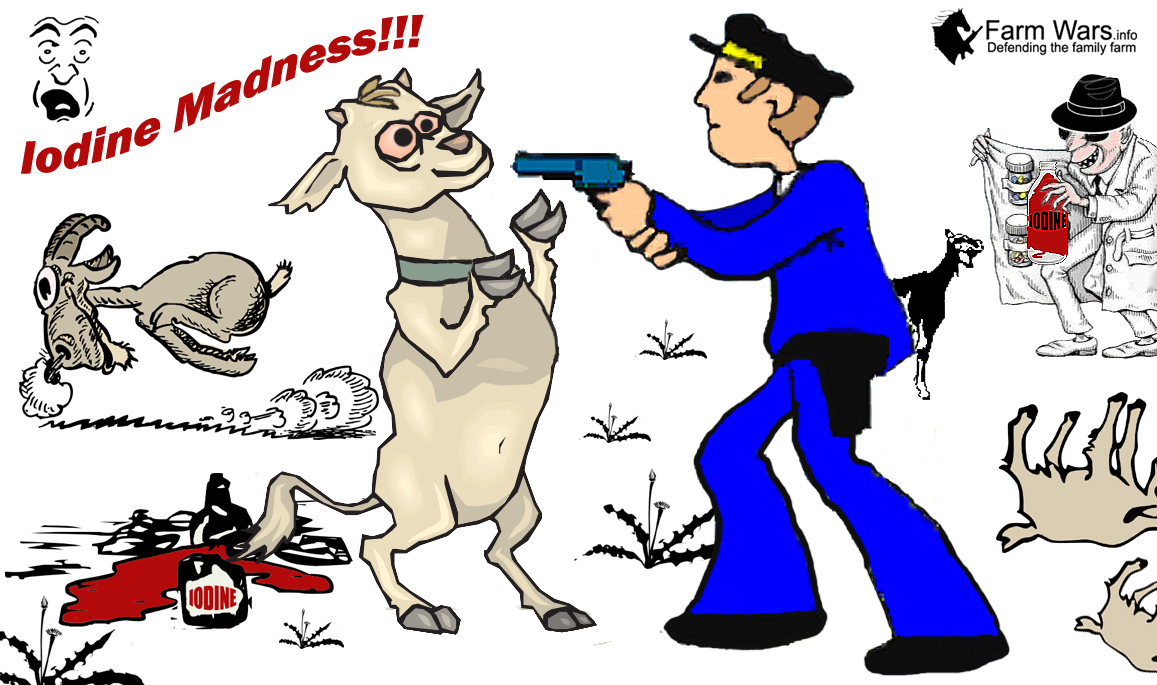
Iodine Madness
Barbara H. Peterson
Farm Wars

If you want to buy Iodine in a feed store in Oregon for your animals, you had better run right over to your local car dealership and buy yourself a vehicle first. Yes, that’s right. If you don’t own a vehicle registered with the DMV, then you either have to have someone else present his/her vehicle registration papers to the proper authorities, or your iodine buying days are over.
I went to town with my neighbor and she drove.

Since my goats are getting ready to kid, I thought it would be a good idea to get some sort of iodine solution to treat the umbilical cords. No biggie, just a routine stop at the local Big R feed store. I looked around and decided on Triodine-7. According to the website, this is “for topical application on the skin to disinfect superficial wounds, cuts, abrasions, insect bites and minor bruises.” And it dries up the umbilical stump quickly. So, I put a bottle in my cart along with my goat minerals. Then I approached the cash register. And so it began…

The gal behind the register looked at me, and I looked at her and smiled. Then she pulled out a form and asked for my vehicle registration. PAPERS PLEASE!!! Huh? Why do you want my vehicle registration?

 She said – it’s for the iodine. You cannot buy this without providing a picture I.D. and your vehicle registration. I said I didn’t drive to town, and therefore, cannot provide my registration papers.

Then I got it….. the stink-eye. You know, that look that says I know you’re probably a felon since you won’t show me your papers… I stared right back, prepared to take this to the matt and most likely end up behind bars. Then my neighbor stepped in and provided her registration papers so that we could end the day without someone having to post bail.

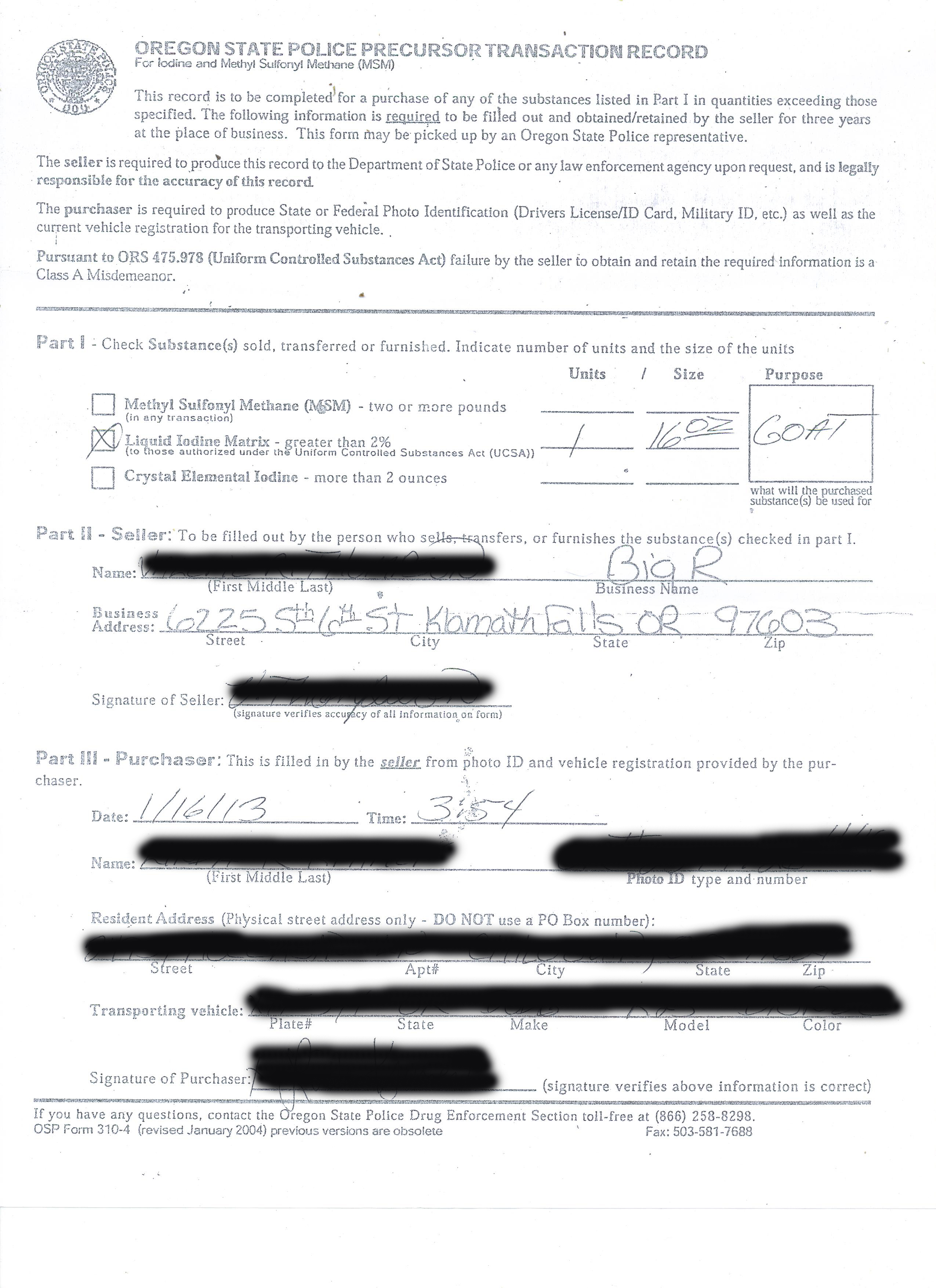
Here is a copy of the form provided by the Oregon State Police that she had to fill out just so I could buy one lousy little 16 oz bottle of Triodine-7:
001
Notice the part that specifically demands a picture I.D. and vehicle registration papers for the transporting vehicle. No car, no iodine.
When I got home, I looked up the law. Read it and weep. It is not only unlawful to buy or sell, but even unlawful to possess unless you fit the description in section 2 of the following:
§ 475.976¹
Unlawful possession of iodine matrix
  •  recording transfers
  •  unlawful distribution of iodine matrix
(1) Except as otherwise provided in subsection (2) of this section, a person commits the crime of unlawful possession of an iodine matrix if the person knowingly possesses an iodine matrix.
(2) Subsection (1) of this section does not apply to:
(a) A person who possesses an iodine matrix as a prescription drug, pursuant to a prescription issued by a licensed veterinarian or physician;
(b) A person who is actively engaged in the practice of animal husbandry of livestock as defined in ORS 609.125 (Definition of livestock);
(c) A person who possesses an iodine matrix in conjunction with experiments conducted in a chemistry or chemistry related laboratory maintained by a:
(A) Regularly established public or private secondary school;
(B) Public or private institution of higher education that is accredited by a regional or national accrediting agency recognized by the United States Department of Education; or
(C) Manufacturing, government agency or research facility in the course of lawful business activities;
(d) A veterinarian, physician, pharmacist, retail distributor, wholesaler, manufacturer, warehouseman or common carrier or an agent of any of these persons who possesses an iodine matrix in the regular course of lawful business activities; or
(e) A person working in a general hospital who possesses an iodine matrix in the regular course of employment at the hospital.
(3) Except as otherwise provided in subsection (4) of this section, a person who sells or otherwise transfers an iodine matrix to another person shall make a record of each sale or transfer. The record must be made on a form provided by the Department of State Police, completed pursuant to instructions provided by the department and retained by the person for at least three years or sent to the department if directed to do so by the department. Failure to make and retain or send a record required under this subsection is a Class A misdemeanor.
(4) A licensed veterinarian is not required to make a record of a sale or transfer of an iodine matrix under subsection (3) of this section if the veterinarian makes a record of the sale or transfer under other applicable laws or rules regarding the prescribing and dispensing of regulated or controlled substances by veterinarians.
(5) A person commits the crime of unlawful distribution of an iodine matrix if the person knowingly sells or otherwise transfers an iodine matrix to a person not listed in subsection (2) of this section.
(6) Unlawful possession of an iodine matrix is a Class A misdemeanor.
(7) Unlawful distribution of an iodine matrix is a Class A misdemeanor. [2001 c.615 §8; 2005 c.706 §15]
http://www.oregonlaws.org/ors/475.976
Iodine is one of many substances defined by Oregon law as a “precurser” substance. In other words, someone, sometime, might make methamphetamine out of it. Maybe we should ban water or spoons too, since they can be used in the process of making drugs. Where does it end? This is pre-crime law. Even the bottle of Triodine-7 label states clearly:

 ”Complies with DEA Iodine Regulation 21 C.F.R. 310.2. No DEA registration required.” Yet, if anyone in Oregon is caught with a bottle of iodine and doesn’t fit into the proper mold as defined in Oregon pre-crime law, guess what? That person is a criminal.
Here is the definition of a “precursor substance:”
Chapter 448 Oregon Laws 2003 
AN ACT 
HB 2034 
Relating to precursor substances; creating new provisions; and amending ORS 475.940, 475.950, 475.973 and 475.978. 
Be It Enacted by the People of the State of Oregon: 
 475.940. As used in ORS 475.940 to 475.999:
(1) “Iodine matrix” means iodine at a concentration greater than [1.5] two percent by weight in  a matrix or solution.
(2) “Matrix” means something, as a substance, in which something else originates, develops, or is contained.
(3) “Precursor substance” means:
(a) Phenyl-2-propanone.
(b) Methylamine.
(c) D-lysergic acid.
(d) Ergotamine.
(e) Diethyl Malonate.
(f) Malonic acid.
(g) Ethyl Malonate.
(h) Barbituric acid.
(i) Piperidine.
(j) N-acetylanthranilic acid.
(k) Ethylamine.
(L) Pyrolidine.
(m) Phenylacetic acid.
(n) Anthranilic acid.
(o) Morpholine.
(p) Ephedrine.
(q) Pseudoephedrine.
(r) Norpseudoephedrine.
(s) Phenylpropanolamine.
(t) Benzyl cyanide.
(u) Ergonovine.
(v) 3,4-Methylenedioxyphenyl-2-propanone.
(w) Propionic anhydride.
(x) Insosafrole (Isosafrole).
(y) Safrole.
(z) Piperonal.
(aa) N-methylephedrine.
(bb) N-ethylephedrine.
(cc) N-methylpseudoephedrine.
(dd) N-ethylpseudoephedrine.
(ee) Hydriotic acid.
(gg) 1,4-butanediol.
(hh) Any salt, isomer or salt of an isomer of the chemicals listed in paragraphs (a) to (gg) of this subsection.
(ii) Iodine in its elemental form.
(jj) Iodine matrix.
(kk) Red phosphorus, white phosphorus, yellow phosphorus or hypophosphorus acid and its salts.
(LL) Anhydrous ammonia.
[(mm) Methyl sulfonyl methane (MSM).]
[(nn)] (mm) Any substance established as a precursor substance by rule under authority granted in ORS 475.945.
http://www.leg.state.or.us/03orlaws/sess0400.dir/0448ses.htm
So, whatever you do, don’t buy antihistamines, MSM and iodine on the same day or you just might end up in cuffs even if you do present your papers. And make sure to keep on checking in because it seems that just about anything can be declared a “precursor substance” and voila! It is illegal to possess.

Feeling safer now? I know I sure am…. In a pig’s eye! No vehicle? No iodine, or any other thing they want to declare a precurser substance for a possible crime to be committed sometime in the future. Or, how about forcing you to purchase a house? Can’t afford one? Too bad – no iodine for you!

Friday, January 11, 2013

PORK Is The Government's Meat

NOTE:  Industrial, CAFO meat found in supermarkets is vile.  It doesn't have to be that way, 

grass fed meats, taste entirely different and offer excellent beneficial properties that your body craves.  Experience the difference

 http://www.grasslandbeef.com/StoreFront.bok?affId=13491

Years ago I began to cease eating pork because I came to despise it, but at the time, I didn't really know why that was the case. 

I was turned off by the dry, white, crumbly texture and the inability to cook most pork cuts – with the exception of some ribs or roasts – in such a manner that I could retain the moisture and integrity of taste. The boneless, center-cut pork chops, that were considered to be prime cuts, had become unpalatable. 

Most of us have grown up with the old adage, “You have to cook your pork well done or it will make you sick.” Accordingly, growing up eating inherently dry, overcooked, rubberized, white pork brought me much agony as a child. It wasn’t until I was well into my adult years that I discovered that pork was really red, and not white. It was then that I began to understand the depth of the political ploys that had turned traditional pork on its ear in favor of factory-farmed white meat. This “white” meat had become representative of Big Agriculture farming interests and the federalized dietary guidelines that are the result of the politicization of food and nutrition.

Pork, PACs, and Politics

The story of pork’s decline involves the usual suspects: mounting government intervention, political mandates, special interest lobbying arms, redistribution of income, and the federal government’s 30+ years of war on dietary fat. 

The pork arm of the government, the National Pork Board, was established in 1985 under the terms of the Pork Act, with the fluff name being the Pork Promotion, Research and Consumer Information Act of 1985. The activities of this organization are funded by a mandatory “checkoff” program that forces pork farmers to pay into a fund each time an animal is sold. 

The USDA maintains oversight for this program, as well as similar programs in other industries. And while the U.S. congressional body has permitted these forcibly applied taxes to fund mega-marketing budgets in the various food industries, there have been numerous legal challenges to mandatory checkoffs over the years, including within the mushroom, beef, grape, and pork industries. 

The beef industry has witnessed varied legal rulings concerning the government tax levied on beef producers to pay for the epic “Beef: It’s What’s For Dinner” campaign that began in 1992. In 2003, the United States Court of Appeals for the Eighth Circuit upheld a South Dakota District Court decision that ruled that the mandatory beef checkoff program, like a similar program in the mushroom industry, was “compelled speech” and thus the program was declared unconstitutional. In 2005, this decision was overturned by the Supreme Court with Justice Antonin Scalia, writing for the majority, claiming that “government speech” was at issue in this case, and thus was not subject to challenge under the First Amendment. 

Though nonconformist cattle ranchers wanted an opt-out for the tax, the Court ruled, with a 6-3 majority, that producers being forced to pay for the funding of government speech do not raise First Amendment concerns. According to the First Amendment Center, Scalia defended the forced levies by writing:
Citizens may challenge compelled support of private speech, but have no First Amendment right not to fund government speech. That is no less true when the funding is achieved through targeted assessments devoted exclusively to the program to which the assessed citizens object.[1]
Likewise, prior to the Supreme Court ruling on the beef checkoff, the pork checkoff had been declared unconstitutional in a federal district court with the decision being affirmed by the Sixth Circuit Court of Appeals. 

The propaganda supporting the levies puts on a spin to give the appearance of benefits for those who are fleeced in order to fund campaigns they don’t want to support. In the fall 2012 issue of Pork Checkoff Report, an article reviewing an econometrics-based self-evaluation of the pork checkoff program claimed that producers “get back $17.40 of value for every $1 they invest in the pork checkoff.” While these taxes on the pork producers produce in excess of $50 million in booty per year, the subsequent expenditures benefit the largest and most industrialized factory farm machinations, including the giants Smithfield and Tyson. 

Back in 2000, the Agriculture Department held a referendum where pork producers voted to terminate the mandatory checkoff program, and this was in spite of millions being poured into the campaign by the National Pork Producers Council (NPPC) to maintain the status quo. In mid-January 2001, Dan Glickman, who was the Secretary of Agriculture, released the voting results and he prepared the USDA to move forward with termination of the checkoff program. Immediately, the NPPC and large-industrial pork producers from Michigan successfully applied for a temporary restraining order to halt the USDA elimination of the plunder program. 

Then came Ann Veneman, a Bush appointee from Big Agra with her feet firmly planted in the biotech corporatocracy, who took over as Secretary of Agriculture on January 20th 2001. Immediately, she overturned the results of the referendum, citing a voting technicality. And this is in spite of the fact that both the General Accounting Office and Office of Inspector General had already concluded that Dan Glickman had acted within his statutory authority for holding the referendum, and that the proper voting controls were in place for the referendum. 

Most recently, Veneman trots the globe fighting the war on obesity for global organizations and big government while maintaining posts as a Nestle board member and a Director at Alexion Pharmaceuticals.
Additionally, the National Pork Board is supported by its underling and foremost political arm, the National Pork Producers Council.

 The NPPC has a very powerful political lobby, PorkPAC, that, according to its website, “educates and supports candidates at the state and federal levels who support the U.S. pork industry.” In other words, the NPPC uses its monetary influence to drive legislation, regulation, and other political initiatives through its system of buying the favors of politicians to empower and enrich its industry benefactors.

The CAFO Calamity

The CAFO (Concentrated Animal Feeding Organization) concept is an industrial concept. During the 1970s and 1980s, cattle and pigs began to come predominantly from the CAFO system. That time period saw the shift from the family farm to large industrial factory farming. 

The confinement model aims at economies of scale – that is, the highest output at the lowest cost. In the meat industry, this model sacrifices food quality and raises ethical concerns in order to maintain desired profit margins. Those who decline to explore the facts of food politics still believe that the mega-industrial food machine is the epitome of the free market. Nothing could be further from the truth. In the United States as well as Europe, there are billions of dollars spent per year in government subsidies to support this model of animal agriculture. 

First, the government subsidies artificially lower the cost of feed that saves the industry billions per year. This allows for a large reduction in operating costs. The competitors of these industrial-factory farms are those farmers who choose to farm their animals in diversified, pasture-based systems where they produce their own forage, and without government subsidies. 

Additionally, farm bills come with massive incentives to influence investment in the industrial-factory farming system, and this spurs artificial growth. The Environmental Quality Incentives Program (EQIP), a mandatory spending program, doles out financial and technical assistance for agriculture conservation. It’s actually a welfare program for CAFOs because these large-scale operations leave behind a massive trail of environmental and biological destruction: soil erosion and sedimentation, polluted watersheds, and manure and wastewater issues. 

This impacts the air, water, and land quality. There are also public health consequences from the routine administration of antibiotics that is necessary to keep animals alive within an intensely confined area.
The government contributes to the cost of conservation practices to clean up the mess to sustain profit margins in the industry and keep the industrial farms operable. An EQIP contract can pay up to 90 percent of the costs for planning, design, capital, labor, maintenance, and training for conservation projects. This program was funded to the tune of $1.75 billion for fiscal year 2012. The subsidies are just one reason why this industrial agricultural model has been called unsustainable. 

Government policy has created CAFOs, and many years of supplementary government policies serves to maintain their existence. If the industrial-factory model farmers were left to clean up their own mess to sustain operations and pay their own costs, the industry model would be unprofitable. Instead, these streams of subsidies enable low-cost industrial food and healthy profit margins, and this is what the pasture-based farmers are up against.

Why White?

While the CAFO system was up and running in high gear, the aggressive marketing campaign titled “Pork. The Other White Meat” made its debut in 1987. This campaign focused on presenting pork as an alternative “lean protein” to help eradicate the public perception of pork as a high-fat meat. Dietary fat had become synonymous with “unhealthy” as varied pop studies were trotted out by the medical establishment linking dietary fat to cardiovascular disease.

 According to a page from the National Pork Board website, this campaign was aggressively aimed at consumers with the goal being “to increase consumer demand for pork and to dispel pork’s reputation as a fatty protein.” Accordingly, industrial pork became the politically correct alternative to chicken and turkey, neither of which were demonized by the government’s intensifying war on fat. 

However, the government’s food pyramid was not founded on science, but rather, it was based in politics and serving special interests. The food pyramid is a purely political animal developed by politicians to serve political ends. It was Senator George McGovern and his Select Senate Committee on Nutrition and Human Needs that gave us these politicized and destructive federal dietary guidelines. 

The food politics of the Committee were set in motion as McGovern’s Dietary Goals for the United States were hammered out at the hands of federal politicians and a journalist who wrote the final draft. The guidelines were heavily influenced by lobbying from the food industry foot soldiers who vilified animal fat and won, in spite of the numerous, highly qualified scientists who debunked their political agenda with the power of science. 

The Dietary Goals for the United States (The McGovern Report) were issued in 1977, leading to the 1980 publication of Nutrition and Your Health: Dietary Guidelines for Americans, first edition.
Since that time, the government has had a non-scientific lock on dietary-nutritional central planning. The nutrition central planning model has held steadfast on the notion that dietary fat is the enemy, and thus planted the seeds for the low-fat revolution. 

As a response to the low-fat craze, the pork industry began utilizing new feeding and breeding techniques. Essentially, the animals have been genetically altered to produce a white, lean, dry meat product to adapt to the political-nutritional health models that were sweeping the mainstream media and consumer consciousness. The pork industry’s website admits to claims that:
Today's pork has 16% less fat and 27% less saturated fat as compared to 1991. Many cuts of pork are now as lean as skinless chicken.
Additionally, the same website page notes that this new pork meets the government’s “guidelines” to earn a declaration of “lean.” The new “lean” meat is produced not only through the production of a leaner animal with reduced fat, but also a reduction of intramuscle fat that cannot be trimmed. 

Consequently, modern pork is artificially pale and unexciting, hence the “white” designation. The use of the term “white meat” is a misnomer, however, because the traditional definition of red meat is a meat product that is derived from a mammal, whereas white meat has been defined as being derived from a fowl. A pig is a mammal. Generally, pig meat does produce less saturated fat than that from ruminants such as cows, which have four-compartment stomachs as opposed to the one stomach of a pig. 

Still, real pork – that which hasn’t been modified by scientific modifications conforming to political dictates – is red, not white. When these animals are raised within the boundaries of natural farming practices that include rotational grazing, grass-based animal husbandry, and humane handling, the meat takes on a sharp, appealing, red color. The following is a snippet from the website of Melo Farms of Yale, Michigan, where the proprietors raise Berkshire heritage pigs in a natural environment as an alternative to the industrial CAFO system.
Our pigs are life-lived animals that enjoy pastured land every day. This gives our herd the luxury of playful socialization with each other rather than the isolation of the single-stall pen system favored by the pork industry. Our pigs roam our pasture, run and romp in the field, nestle with each other when sleeping, and move like an army of mini-hippos to play in favorite dig holes.

They have a shaded nest in the pasture, free-running clean water, and protection from predators. Their bodies bear no signs of crowding stress such as ear or tail bites. What we don’t have are wire floors, single occupancy stations, or a manure lagoon. Our Berkshire hogs are calm and playful and, of course, full of personality!
Amazingly, it wasn’t until 2011 that the USDA revised its cooking guidelines for pork, bringing the guidelines more in line with beef and lamb. Prior to the guideline revisions, food scaremongering techniques had put medium or medium-rare pork in the “unsafe” category, even though it was never disclosed that the hazards of the industrial feedlot system were behind the impetus to keep higher standards for cooking pork.

 However, chefs and knowledgeable layman who have been cooking and eating pasture-based pork have long been preparing safe pork dishes with the meat in a medium rare state. Meat produced from the pasture-based model is lacking many or all of the risks posed by the industrial model that is rife with safety concerns and is therefore heavily regulated. 

Yet the USDA claims that the revision was due to improved methodology in animal feeding and housing, in spite of the fact that the industrial CAFO model is under more scrutiny than ever for its use of intense confinement, pesticides, steroids, hormones, antibiotics, and other unnatural agents. 

In early 2011, the National Pork Board announced that it was replacing the “Other White Meat” slogan with a new mantra to fit with the times: “Pork: Be Inspired.” The pork central planners believe that after twenty-five years of white meat spin they have completed their mission of constructing the “new chicken” for the health conscious, and thus they will take the pork propaganda in a new direction in an attempt to increase consumer consumption of its product. In fact, it’s the same old parched, industrial, white meat with a newfangled promotional spin.

Thursday, November 8, 2012

Scientists study risks of contracting fatal brain diseases from eating farmed fish fed rendered cows

How do you know whether the farmed fish you buy has been fed soy bean pellets or rendered cows? Where do consumers go for objective, validated evidence and the latest information when research is ongoing on whether to eat farmed or wild-caught fish?

Do they go to their doctors? Farmed fish start out by having the rous sarcoma virus implanted into a specialized gene early in their embryonic development in order to amplify the fish’s growth hormone. The virus acts as a carrier. It’s called a vector (meaning a carrier virus). The farmed fish are made to grow faster and larger.

This specific rous sarcoma virus has been known since 1911 to cause cancer in chickens. See the article titled, "The Rous Sarcoma Virus (RSV)."  For more information, also see The Cholersterol Hoax, by Sherry A. Rogers, M.D., page 193. In the book, The Cholesterol Hoax, the section on page 193 specifically mentions that farmed fish are implanted with the rous sarcoma virus. On page193, the reader also is referred to the doctor's newsletter, Total Wellness, 2001.

On top of this retrovirus type of implant, farmed fish also may be getting a diet of byproducts rendered from cows. See the article, "Bovine Spongiform Encephalopathy and Aquaculture," published in the June 2009 issue of  the Journal of Alzheimer's Disease. Reference to the study also appears in the June 26, 2009 Reuters article, "Risk of Mad Cow Disease From Farmed Fish?"

A brief Journal of Alzheimer's Disease abstract of pages 277-279 reports that, "Dietary consumption of fish is widely recommended because of the beneficial effects of omega-3 polyunsaturated fatty acids on the risks of cardiovascular and Alzheimer’s diseases.

The American Heart Association currently recommends eating at least two servings of fish per week. We are concerned that consumption of farmed fish may provide a means of transmission of infectious prions from cows with bovine spongiform encephalopathy to humans, causing variant Creutzfeldt Jakob disease."

And what about the implant of  the rous sarcoma virus into a specialized gene early in the fish's embryonic development? Experts are going to refute that based on FDA laws forbidding genetic alteration of farmed fish.

Yes, everyone knows the FDA doesn't allow farmed fish to be genetically altered, but what do you say to a doctor and the doctor's book and newsletter articles that insist the rous sarcoma virus is implanted into a farmed fish embryo not to genetically change the fish's DNA, but merely to enhance the ability of the fish to produce more of a hormone that makes it grow faster?

The faster the farmed fishes grow, the sooner they'll reproduce. And maybe they'll get a bit bigger, too, but growing faster means higher turnover and more generations of fish to be sold, hence more money to be made. Follow the money. If consumers ask too many questions, experts might give details or they might try to confuse consumers by pulling out the 'misinformation' card.

Then consumers are left to validate on their own which information is correct and which is flawed or so-called 'misinformation,' a word commonly used by public relations executives for industry to silence blue-flamers, that is reporters or consumers that ask too many questions of scientists or industry spokespersons. So where do you go next? To physicians?

Do you ask your doctor where the information came from? And when the doctor cites a medical journal article that's not that recent, where do you go to validate it if the article's authors are not easy to find?

You might ask a scientist is the DNA altered or not altered during the fish's fetal stage? You could ask when the fish is implanted with the rous sarcoma virus, does the carrier virus only strengthen and nourish the fish's growth hormone without genetically altering the genes of the fish?

The outcome is that the fish grows faster. Or is the DNA of the fish altered anyway, but with some loophole that consumers haven't been told about to get around the FDA laws of not genetically altering farmed fish?

Where can consumers go for answers? What happens when consumers question authority? Do public interest research groups help? Is there a way to bridge the communication gaps between scientists and physicians sharing information?

Consumers won't know the answer unless they talk to scientists. But would scientists have the time to talk to consumers asking questions? Then there's the problem of farmed fish being fed rendered cows.

The consumer is questioning whether or not this practice is safe. These are not scare tactics. It's realistically and objectively being concerned, and wanting to know how farmed fish are treated, fed, and cared for medically.

How healthy are farmed fish? What's injected or implanted into fish? What's the difference between farmed and wild caught fish? Are fish treated with insecticide-type chemicals? Why? But consumers aren't going to learn about all the diseases of fish if there's no one to interview.

So who do you turn to?

The most approachable with a phone call would be the public relations department of a fish farm business. You could ask your doctor, but your doctor may or may not have the time to discuss fish choices with you. If doctors and scientists had a choice of what to feed their children, would they choose wild caught or farmed fish and why? 

It has been said that you are what you ate. Do you realize how much the food industry has changed since 1959? My son and my son in law both are physicians dealing with neuroradiology specializations and internal medicine. My grandchildren are in medical school. Our family sits down together for a meal and discusses genetics. Our family's goal is to discuss answers based on evidence.

So which type of fish is safest for consumers? The problem is that although the fish may not be genetically altered, the embryonic fish are implanted with a carrier virus not to change their DNA. No, that would be genetically altering them. Instead, they're implanted with a carrier virus to stimulate their own body's growth hormone. It makes fish grow faster.

There's a difference between genetically altering a fish and giving the fish a boost of strength in its growth hormone. So is there a loophole to get around the FDA's rules?

Can you inject a fish or a cow with a chemical that makes the creature grow faster by stimulating its hormone levels without changing its genes or DNA? The question keeps me up at night, but the doctors around my dinner table shrug their shoulders and joke, "there's power in numbers." And that leaves me standing alone wondering whether the consumer has the right to have a voice of confidence and resilience as a party of one.

The rous sarcoma virus (RSV) is an oncogenic virus — that is, a virus capable of causing cancer. This virus originally came from tumors of sick chickens back in 1911. The tumors were sarcomas, tumors of connective tissue. The virus was named the rous sarcoma virus (RSV) during those first 1911 experiments. Back then, healthy chickens were vaccinated with the virus from sick chickens that had cancer.

The purpose of the 1911 experiment showed that healthy chickens could be made to get cancer from a specific virus. The rous sarcoma virus is a retrovirus. Cancer can be induced in healthy chickens by injecting them with a cell-free extract of the tumor of a sick chicken. There's another problem.

Aids also is a retrovirus.

So are a lot of other tumor viruses taken from one animal and put into another. Why genetically alter fish with retroviruses just to increase the growth hormone? There's a reason why farmed fish are implanted with the rous sarcoma virus in order to increase their growth hormones.

The faster and bigger farmed fish grow, the more money they make. Each business and each hired scientist has a reason for genetically engineering farmed fish. But there's more. Omega 6 fatty acids replace much of the omega 3 fatty acids in farmed fish.

You’ll find more omega 3 fatty acids in wild caught fish than you'll find in genetically engineered farmed fish. The elevated levels of omega 6 fatty acids in farmed fish keep rising year after year, replacing the omega 3 fatty acids. Part of the reason why is because farmed fish are fed increasingly more commercial soybean pellets that contain pesticides.

The soybean pellets also have been genetically engineered (unless you’re raising fish yourself and feeding them organic fish foods). The commercial soybean pellets fed to farmed fish are full of pesticides such as Roundup that originally had been sprayed on the commercial soybean pellets along with other commercial insecticides, sometimes even with herbicides (for getting rid of weeds around the soybeans) and various pesticides.

On top of the insecticides in the soybean fish food pellets, the levels of PCBs in farmed fish are higher, in fact, ten times higher (in numerous studies) than you find in wild-caught fish from cleaner waters. So now you’re also getting PCBs in the fish. The farmed fish is exposed to more pollutants than wild fish in the open ocean. Yes, there are still some pockets of ocean not as polluted as some fish farms.


There are some cleaner spots in the ocean. Some of those oceanic areas include parts of the Arctic and Alaska. Wild-caught fish may not be irradiated, but farmed fish are irradiated so they won’t spoil while in transit to local supermarkets.

Wild-caught fish are more expensive than farmed fish.

When there's an overrun of wild fish, the overrun is canned and costs less per pound than fresh fish. The overrun is still the safe wild-caught fish in the can for three or four dollars that you'd buy in the supermarket for $17.00 per lb.

The irradiation of farmed fish not only destroys the bad bacteria. It also neutralizes some of the vitamins. So now you have fewer vitamins in farmed fish than in wild fish. When you get the cheaper farmed fish home, perhaps the fish are microwaved.

Now the fish coming out of the microwave oven has had all the antioxidants destroyed. Microwaved food destroys almost all of the nutrients, about 95% of them, according to the study, “Microwaved cooking zaps nutrients,” J. Randerson, New Scientist, Oct 25, 2003, page 14. Also, see the book titled, Optimal Nutrition for Optimal Health, by T.E. Levy. Keats Publishing, a division of McGraw-Hill, NY, 2001.

According to the article,  Microwaved cooking zaps nutrients, “Steaming left antioxidants almost untouched, while microwaving virtually eliminated them, the team found” (Journal of the Science of Food and Agriculture, vol 83, p 1511). Also see the article, "Looking at the Science on Raw vs. Cooked foods," by Jean Louis-Tu.

If you're interested in reading about what antibiotics are given to farmed fish for human consumption, see the book, Improving Farmed Fish Quality and Safety, edited by Torger Borresen. There's also a problem of how to improve disease immunity in order to reduce antibiotic use in farmed fish. How will the antibiotics given to farmed fish effect your resistance to antibiotics when you need them?

The solution to this problem is to eat wild-caught canned salmon packed in water with the “no salt added” label. It’s less costly than buying wild salmon for $16-17 per lb. Wild salmon usually is Alaskan king salmon caught from the overrun and canned.

It’s the same type of wild Alaskan salmon that you pay a lot more money for in the supermarket fish and meat department. A can of wild salmon usually costs three or four dollars. And there are two servings in the can.

One excellent brand is Crown Prince Wild Caught Natural Alaskan Pink Salmon. The low in sodium variety that comes with only 50 mgs sodium. The can notes that it contains 1.5 grams of omega 3 oils per serving. There are about 3.5 servings per can.

A serving size is ¼ cup of salmon. It also comes in a variety containing more salt. To stretch a serving further, you can mix it with chopped vegetables and a teaspoon of extra virgin olive oil. That way you get a balance of the omega 3 and omega 6 oils from the fish and olive oil.

Another possibility is to add a tablespoon of grape-seed oil mayonnaise to canned fish such as sardines or salmon. Sardines also are good if they are wild caught and canned in water without added salt. An excellent brand is Brunswick sardines canned in spring water, no salt added.
There are already 200 mg of sodium per serving in the sardines, even with no salt added. A serving size of the sardines is one can drained, which contains one gram of omega-3 fatty acids per serving and also is a good source of calcium.

Risks and benefits of eating fish are hot topics. Then again, you can always buy a bottle of contaminant-free Carlson's cod liver oil or take two Nordic Naturals (no mercury) brand of fish oil capsules. The controversy surrounding farmed versus wild-caught fish is all about what the research tells you. Consumers often follow the money.

Look for the $4 cans labeled "wild caught" when you buy Alaskan pink salmon. They contain the overrun of the same king salmon that is sold as fresh wild-caught fish in supermarkets and marked up to $17 per lb. You'll find a variety of those cans in local grocery and produce markets that offer organic foods.

Are Farmed Fish Fed Rendered Cows? 

What type of animal feed is safe from any risks of passing prions into both the human and animal food chain?

 Farmed fish are being fed too high on the food chain. Instead of fish eating fish and seaweed, farmed fish commonly are being fed rendered cows and bone meal from animals that never lived in the oceans.

See the article, "You Are What They Eat" on animal feed at the Consumer Reports.org site. Also see the June 2009 article on farmed fish and what types of food that farmed fish are fed in the Journal of Alzheimer’s Disease by Robert P. Friedland, M.D.

There are a lot more details to know regarding animal feed. Some cows may be born with a gene variation that gives them a higher risk of later developing mad cow disease or of being carriers, passing that gene to other animals, or the prions to humans, without being infected with outward symptoms.

The quick solution to this dilemma is for government regulators to ban the feeding of cow meat byproducts or bone meal to farmed fish (and to other animals) until the safety or danger of this common practice can be ascertained. The basic problem is that farmed fish are not being fed what they normally would eat.

When restaurants buy farmed fish, or when you buy farmed fish from supermarkets, are there prions in the farmed fish that could cause mad cow disease in humans? According to a Science News article, published June 17, 2009, "Farmed Fish May Pose Risk For Mad Cow Disease," University of Louisville neurologist Robert P. Friedland, M.D., questions the safety of eating farmed fish in Journal of Alzheimer’s Disease, adding a new worry to concerns about the nation’s food supply.

For those people anywhere in the world that have been diagnosed with fatal mad cow disease, did they get it from previous farmed fish meals or from beef? Are other prion-caused diseases of the brain, including Creutzfeldt Jakob disease caused by eating meat from infected animals?

Most consumers know it's not safe to eat fish that ate bonemeal. How long will it take to prove it? And is Alzheimer's also linked to what people eat? Who's studying prions in the brain related possibly to diet?

A press release on neurologist Robert P. Friedland's  research results, titled, "Farmed Fish May Pose Risk for Mad Cow Disease," appeared in the Journal of Alzheimer's Disease  on June 16, 2009. Based on his research, he and his team question the safety of eating farmed fish that are fed byproducts rendered from cows.

Recently, Dr. Friedland also has been working on the patterns of disease occurrence, including risk and protective factors, with studies of the Kikuku in Kenya, Jews and Arabs in Israel, and Caucasian and African-American subjects in Cleveland.  Friedland and his co-authors suggest farmed fish could transmit Creutzfeldt Jakob disease--commonly known as mad cow disease--if the farmed fish are fed byproducts rendered from cows.

The scientists researching the question of whether there are prions in farmed fish urge government regulators to ban feeding cow meat or bone meal to fish until the safety of this common practice can be confirmed.

“We have not proven that it’s possible for fish to transmit the disease to humans. Still, we believe that out of reasonable caution for public health, the practice of feeding rendered cows to fish should be prohibited,” Friedland said. “Fish do very well in the seas without eating cows,” he added.

Creutzfeldt Jakob disease (CJD) is an untreatable, universally-fatal disease that can be contracted by eating parts of an animal infected with bovine spongiform encephalopathy (BSE or mad cow disease). An outbreak in England attributed to infected beef prompted most countries to outlaw feeding rendered cow material to other cattle because the disease is so easily spread within the same species.

The risk of transmission of BSE to humans who eat farmed fish would appear to be low because of perceived barriers between species. But, according to the authors, it is possible for a disease to be spread by eating a carrier that is not infected itself. It’s also possible that eating diseased cow parts could cause fish to experience a pathological change that allows the infection to be passed between the two species.

“The fact that no cases of Creutzfeldt Jakob (CJD) disease have been linked to eating farmed fish does not assure that feeding rendered cow parts to fish is safe. The incubation period of these diseases may last for decades, which makes the association between feeding practices and infection difficult. Enhanced safeguards need to be put in place to protect the public,” Friedland said.

What if any prions remain in the fish's digestive tract? All you need is one molecule, and the prion will replicate itself. Fish or any animal infected with prions also might be a carrier without getting symptoms. That's one way prions might possibly get into the human food chain.
There are three major categories of CJD: sporadic CJD, hereditary CJD, and acquired CJD. There have been 163 deaths from Creutzfeldt Jakob disease (CJD) in the United Kingdom attributed to eating infected beef. Bovine spongiform encephalopathy has been identified in nine Canadian and three U.S. cattle.

There's a food safety problem with feeding animal by-products that contain mad cow disease prions in meat and bone meal. Yet rendered cow meat and bone meal is routinely fed to farmed fish. A few years ago people even fertilized vegetable gardens and fruit trees with bovine bone meal.

There is no single diagnostic test for CJD yet. The only way to confirm a diagnosis of CJD is by brain biopsy or autopsy. Whereas CJD can be transmitted to other people, the risk of this happening is extremely small. There is no treatment that can cure or control CJD.

 Patients are made comfortable and given opiates to relieve pain. Other drugs relieve the muscle jerks.

You'll still see calcium or mineral supplements containing bone meal from animals. How do you know the animals didn't carry a gene for mad cow disease or had been infected with it or some other disease fatal to humans? You've seen flu jump species from bird and pig to human, why not mad cow disease prions from cows to humans? Of course the mad cow prions jumped species from cow to human.

Can they jump from cow to fish to human?

 Prions for mad cow disease can't be killed by cooking. Research will eventually confirm or deny whether fish can pass along mad cow disease based on whether the fish ate rendered meat or bone meal from cows infected with mad cow disease. Meanwhile, the nation's food supply is at risk as evidence mounts.

How do farmed fish get the prions in their flesh that are then eaten by humans so that the fish and the human comes down with mad cow disease? It's a genetic mutation within a gene called the Prion Protein Gene that causes mad cow disease.

Prion proteins are proteins expressed abundantly in the brain and immune cells of mammals. The questions researchers are trying to answer is whether prions are found in farmed fish after the fish consume meat or bone meal containing prions from cows that are carriers but not infected themselves.

Another issue being researched is whether the meals that the fish are fed contain prions that the fish pass on to human consumers. And is it possible or not that humans can get mad cow disease from consuming farmed fish?

 If mad cow disease actually is a genetic  mutation in the cow, can a cow that doesn't become infected with mad cow disease act as a carrrier, and still pass on the prions to humans to cause mad cow disease in people or other animals--from farmed fish to chickens?

It's not only the ongoing research on whether farmed fish are transmitting diseases to humans--diseases that range from mad cow disease to possibly Alzheimer's or other brain diseases theoretically caused by prions. Think of commercial pet food also made up largely of meat by-products.

It's easy for pet food to get into the human food chain by handling pet food and touching one's mouth, nose, or eyes, or handling human food in the same room, dishes, or dishwasher, or transfering fluids or dust from canned or dry pet foods to human foods.

For now, the question is whether farmed fish contain mad cow disease prions. That's what Dr. Friedland and his co-authors want consumers to know about as the research continues. The goal is to see whether it's safe or not to feed farmed fish rendered cows. The research team so far thinks it's not safe but will continue researching to confirm or not confirm safety beyond a doubt.

Dr. Friedland wants consumers to know that scientists have not proven that it’s possible for fish to transmit the disease to humans. But researchers want consumers to be cautious. The warning is out of reasonable caution for public health. Friedland believes rendered cows should not be fed to fish. Friedland explained, "feeding rendered cows to fish should be prohibited.”

His group also is using animal models to better define the pathophysiology of Alzheimer’s disease and develop new treatments. Dr. Friedland has documented a series of important determinants of the disease, including physical and mental inactivity, smoking and diet. This work has focused on interactions of genetic and environmental lifestyle elements.

Who's studying the health of the rendered cows that are currently fed to farmed fish? Creutzfeldt Jakob disease is an untreatable, universally-fatal disease that can be contracted by eating parts of an animal infected with bovine spongiform encephalopathy (BSE or mad cow disease).

According to "Farmed Fish May Pose Risk For Mad Cow Disease," the mosts recent outbreak in England attributed to infected beef prompted most countries to outlaw feeding rendered cow material to other cattle because the disease is so easily spread within the same species.

Now people eating farmed fish have to worry not only about the hormones and antibiotics given to the farmed fish to make them grow faster, or the pollutants and insecticides in the farmed fish. Now consumers have to worry about the rendered cows, those meat byproducts fed to the fish that might be full of mad cow disease prions.

The barriers between species could be breaking down. But scientists will have to study how a disease jumps from one species to another. Rather than rely on a prion mutating, a person could get infected from a fish even if barriers between species are perceived as low.

Maybe the infection barrier between species is no longer low if the fish eats the sick mammal or infected cow as ground meal byproducts, and then the human eats the sick farmed fish? If a disease infects a fish that once infected a cow, could that disease also infect a human?

 It's easy for a disease to jump between a cow and a human. Mad cow disease spread to humans through infected cows that might even have a gene variant that makes them susceptable to mad cow disease.

The risk of transmission of mad cow disease, also known as BSE to humans who eat farmed fish could be higher than most people thought. According to the authors of the research, "it is possible for a disease to be spread by eating a carrier that is not infected itself. It’s also possible that eating diseased cow parts could cause fish to experience a pathological change that allows the infection to be passed between the two species."

According to the press release, Friedland notes, "The fact that no cases of Creutzfeldt Jakob disease have been linked to eating farmed fish does not assure that feeding rendered cow parts to fish is safe."

Scientists know it takes decades, sometimes up to 30 years, for certain brain diseases similar to mad cow disease infections to incubate in a human. Most people don't make the association between what meat they ate and what that animal or fish ate before it was cooked or sold in the market. When you go out to a restaurant for a fish sandwich, do you think that the farmed fish in the sandwich contains mad cow disease prions or similar infections?

 Dr. Friedland and the authors of the research studies would like consumers to know that "enhanced safeguards need to be put in place to protect the public.” People in Europe that came down with mad cow disease after eating infected beef never had to wait very long. Certainly not for decades.

Those people that caught mad cow disease in Europe didn't have to wait 30 years between the time they ate the beef and the time they came down with Creutzfeld Jakob, the human form of Bovine spongiform encephalopathy (mad cow disease).

 In recent years, mad cow disease, always fatal in humans and cows, also has been identified in nine Canadian and three U.S. cattle.

The moral compass of this finding is that farmed fish need to be fed safer foods, and in the meantime, eat wild-caught fish from some ocean areas that are relatively cleaner than others.
Even wild-caught fish can be bought in cans, without added salt, because they are canned from the overrun of wild-caught fish.

 Worse yet, some commercial chicken ranches feed their chickens rendered cow meat and bone meal. When you buy organic chicken, do you know what they were fed? All you know is that they weren't given hormones or anti-biotics if the label says so.

What are turkeys fed? You are told that they're not getting hormones. But what else is in the food animals eat if you're eating the animals?

 Think about whether cows were fed grass or grain. They should have been grazing on grass. Cows shouldn't be feeding on bone meal and rendered other cows. And dogs/cats shouldn't be eating meat byproducts that have been genetically altered and then injected with all types of chemicals, hormones, or antibiotics.

Be aware of what the animal ate and what hormones, antibiotics, and insecticides that animal absorbed before you ate it. If you're a vegetarian, ask what herbicides, genetic alterations, or insecticides went into the plants you eat. At least you'll know what's going into your body. And the research continues on whether farmed fish present a mad cow disease problem.

If a loved one has come down with CJD, you might wish to contact a disability attorney of your choice in order to find out related information. Also some of the associations listed below may be able to direct you to the information you'll need.

Here's a thought and helpful links to consider--posed by viewer, Terry Singeltary: "Even if fish could not contract a transmissible spongiform encephalopathy (TSE), disease, it would still be possible for the TSE agent to survive the digestinal tract. And then if that fish was added as an ingredient for feed, the agent could further spread to infect other species."

Tuesday, October 30, 2012

Monsanto & Chemical Supprters Push For Round Up & Slaughter Of Wild Horses & Burros

When representatives of Conservation Districts with ties to Monsanto attended the last Bureau of Land Management’s National Wild Horse and Burro Advisory Board meeting, they not only pushed for the roundup of wild horses & burros, they pushed to have the wild horses & burros sold for slaughter.

Wait a minute, these organizations have the word “conservation” in their titles, don’t they? So what’s going on?

Right before the last Wild Horse & Burro Advisory Board meeting in Reno, the National Association of Conservation Districts (NACD) had their big annual meeting in Las Vegas. The NACD meeting was sponsored by Monsanto, Bayer Crop Science, DuPont, Sygenta and Pioneer, the biggest producers of the genetically engineered crops on the planet.

At NACD’s meeting, Monsanto sponsored a radio broadcast on Agritalk and NACD President Gene Schmidt and First Vice President Earl Garber were interviewed. (So was Rick Cole, Director of Weed Resistance for Monsanto.)

For NACD’s live auction, Monsanto donated four 30-gallon containers of Roundup Power Max.

At the NACD meeting, Callie Hendrickson, appointed by Secretary of the Interior Ken Salazar to represent the general public (is Monsanto the general public?) on the National Wild Horse & Burro Advisory Board, gave a presentation. She made unsubstantiated claims regarding wild horses & burros, including the statement that wild horses “degraded resources for all.”

If Callie is so worried about conservation, why didn’t she bust a gut talking about the “degraded resources for all” caused by Monsanto and the other sponsors of the NACD annual meeting?

Monsanto

In 1995, Monsanto ranked fifth among U.S. corporations in EPA’s Toxic Release Inventory, having discharged 37 million pounds of toxic chemicals into the air, land, water and underground.

In Anniston, Alabama, “for nearly 40 years, while producing the now-banned industrial coolants known a PCBs at a local factory, Monsanto Co. routinely discharged toxic waste into a west Anniston creek and dumped millions of pounds of PCBs into oozing open-pit landfills.”

In Sauget (originally named Monsanto), Illinois, near the Mississippi River, the Monsanto plant was the nation’s largest producer of PCBs. Production of PCBs was banned in 1977, but they remained part of a “noxious chemical stew” at an EPA Superfund site in Sauget.

In a Post-Gazette story, Richard Karl, director of the EPA’s Superfund Division, Region 5 stated: “It’s basically a soup of different chemicals,” including PCBs, benzene, toluene, and dioxin and organic solvents. Heavy-metal pollutants include cadmium, silver, selenium and zinc. So far, the agency has spent tens of millions of dollars to clean up the area.”

Times Beach, Missouri was found in 1982 to be so thoroughly contaminated with dioxin, a by-product of PCB manufacturing, that the government ordered it evacuated. Dioxins are endocrine and immune system disruptors, cause congenital birth defects, reproductive and developmental problems, and increase the incidence of cancer, heart disease and diabetes in laboratory animals.

It seems the National Association of Conservation Districts apparently aligns itself proudly with, and has no problems taking donations from, this corporation.

What about NACD’s other sponsors?

Dupont

Was No. 4 on a Mother Jones list of the Top 20 polluters of 2010 for dumping over 5,000,000 pounds of toxic chemicals into New Jersey and Delaware waterways.

Pioneer

Is a DuPont company, and a lawsuit was filed against this company in Hawaii this year by Waimea residents. The suit claims that Pioneer has failed to control dust, and is “transporting toxic chemicals used on a daily basis and that Pioneer Hi-Bred is conducting open-air testing of genetically modified crops at its Waimea Research Center.” It claims “

fugitive airborne dust exposure from restricted-use pesticides presents unreasonable environmental risks including human health, the Waimea River, the coastline and coral reef.”

Sygenta

Was at the center of a recent class-action lawsuit because hundreds of community water systems across the United States were contaminated by the company’s atrazine weed killer. For decades, communities in at least 45 states had their water supply contaminated by atrazine and had to spend millions of dollars to filter out the poison.

Bayer Crop Science

Responsible for the contamination of the U.S. long grain rice supply in 2006 with their experimental and unapproved genetically modified Liberty Link variety that had not received approval for human consumption.

And since we’re on the subject of environmental contamination,

“has Callie written any letters protesting the 2, 4-D that the BLM is spraying, including planned spraying for the Desatoya Mountains Habitat Resiliency, Health & Restoration Project? ”

Yet, Callie and these Conservation Districts focus blame on wild horses & burros for “degrading the resources.” More inaccuracies about wild horses & burros were published in NACD’s newletter, The Resource.

Conservation Districts

There are about 3,000 conservation districts in the U.S., and since they’re established under state law, they vary in what they’re called and how they’re funded. There are elected and appointed positions on governing boards. Their partners include the Department of Interior (BLM, Bureau of Reclamation, Fish & Wildlife Service) and USDA (Forest Service, Farm Service Agency).

Considering this, keep an eye on the ball for appointed officials on various Boards of Directors, with overlapping duties, like Callie Hendrickson.

Callie is the Executive Director for the White River Conservation District in Colorado. She has also served as the Vice President of the National Association of Conservation Districts, and was a registered lobbyist in Colorado for the Colorado Association of Conservation Districts.

Callie has been, and is, pushing to have the wild horses and burros run off their federally protected areas and slaughtered.

After the big NACD annual meeting in Las Vegas, Callie went up to Reno and took her seat for the first time on the Wild Horse & Burro Advisory Board. Gary Moyer and Neil Brennan, who are on the Board of Supervisors for the White River Conservation District and work with Callie, came to this meeting. (Gary Moyer is also on the Board of Directors for the National Association of Conservation Districts and the Colorado Association of Conservation Districts). Chris Freeman was there to represent the NACD.

They all pushed for the roundup and slaughter of wild horses & burros.

The Wild Horse & Burro Advisory Board, but the BLM, can claim they are listening to the public. But, there is more than just an appearance of undue influence. There IS undue influence. These people are on the Boards of Directors of Associations partnering with the BLM. They have Memorandums of Understanding to SUPPORT each other’s interests. Appointed advisory boards are gaining more and more influence over land use decisions. Meanwhile, the BLM continues to turn a deaf ear to public outcry by American taxpayers and acts with impunity.

Things get a little more interesting

The White River and Douglas Creek Conservation Districts own and operate the Upper Colorado Environmental Plant Center in Meeker, Colorado.

Gary Moyer and Neil Brennan are on the Board of Directors.

The USDA states about this plant center “National interest in significant deposits of oil-bearing shales, the economical recovery of that oil, and the successful revegetation of the disturbed sites related to oil extraction were the primary factors leading to the establishment of the Center. The Center is located adjacent to the world’s largest known deposit of these oil bearing shales.”

So, looking at vast areas of land being drilled, there will be a big need for “revegetation” and for the reclamation of these areas in the future. The White River Conservation District buys trees to resell to producers (would this be the oil companies?) in that area. I wonder if the Conservation District will buy any trees from White River Trees in Meeker, CO, owned by Gary Moyer.

This area is also near Herd Management Areas where the BLM has been pushing, for years, to completely remove wild horses. While the BLM continues a shell game driving the extinction of wild horses & burros in the very near future, we see wolves in sheep’s clothing hiding behind the words conservation and environment.

Tuesday, October 23, 2012

Move The Deer Crossing Signs!

NOTE: This brought tears to me eyes...laughing & crying.

Monday, September 24, 2012

The Bouncing Bulldog

<iframe width="440" height="260" src="http://www.youtube.com/embed/0ug8o-fWWUs?feature=player_detailpage" frameborder="0" allowfullscreen></iframe>

Monday, September 17, 2012

Thousands Of Sheep Buried Alive In Record Snows

<iframe width="440" height="260" src="http://www.youtube.com/embed/mVEXreQirrk?feature=player_embedded" frameborder="0" allowfullscreen></iframe>

“Unprecedented” cold and snow in Iceland.
Thousands of sheep (13,000) buried alive in snowdrifts is nothing short of disastrous.
Here’s a video showing the rescue of a sheep buried by snow.

Snow in North Iceland in early September is not unheard of but snowfall of two to three meters overnight at this time of year—when the sheep are still in highland pastures—is highly unusual.
Two to three meters (7-11 feet) of snow overnight! That’s a small taste of what the mammoths experienced.

Armed with long sticks as used to look for people buried in avalanches, farmers in North Iceland have succeeded in finding hundreds of sheep. The search continues but hope grows fainter by the minute.

Although not all have survived, most of these amazingly hardy creatures were alive after days in icy graves.  To make it even more difficult, foxes are attacking the trapped sheep, often leaving them brutally injured.

The association of breeders speaks of unprecedented disaster. Farmers say they have never experienced anything like this in their lifetime and hope they never will again.

Coupled with blackouts across the region, from Blönduós in the west to Þórshöfn in the east, due to icing of power lines and we’re looking at an unprecedented situation, with real blizzards and extended blackouts throughout the region and motorists stranded in their cars.

Record snowfall
According to the Iceland Review Online, “it is believed to be a new record for snowfall at this time of the year”.

Thursday, September 13, 2012

Cesar Tells Of Pongo Fund, A Food Bank For Pets


When Larry Chusid discovered in 2009 that no resource existed to provide dog and cat food to Portland, Oregon area pet owners in need, he made it his mission to become that resource.
The Pongo Fund, named after Chusid’s late four-legged best friend who thrived on homemade food, exists to distribute healthy, high-quality diets to anyone with hungry pets. To date, the nonprofit organization has provided more than 3,731,013 healthy meals to dogs and cats in need.

“A healthy pet leads to a healthy family,” says Chusid, The Pongo Fund’s executive director. “Our belief is that if the family cannot afford pet food, they’re facing a lot of struggles, and giving them low-quality food is only going to exacerbate the situation. Let’s make sure that we take care of the soul of the family: the animal.”

Caring for a Community

Though traditional food-bank networks throughout the Pacific Northwest provide food to people in need, they only focused on the two-legged family members, Chusid says. “I wanted to make sure hungry animals had access to great food, but I was shocked to learn there was no resource. I just thought, this can’t continue.”

So he used his own resources to purchase high-quality pet food and began giving it out twice a day, every day, to families with pets living under bridges or on the streets. He was making a difference, but he felt it wasn’t enough. He wanted to reach everyone in need – including those behind four walls.

“The people who are living outdoors with pets were the easiest people to access because they were out there,” he said. “But what about all the people who are living behind four walls? Suffering in silence?”

Three years ago, Chusid began to formulate a plan — a plan that came to fruition thanks to a chance encounter with Canidae Pet Food CEO Scott Whipple. When Chusid shared his vision, Whipple wanted to help.

“I told him that I wanted to open a pet food bank that would exceed the expectations that anyone ever had when it came to opening any food bank,” Chusid recalls. “I wanted to reach out and care for a community that was in such dire need, that could not afford to feed their pets. But I wanted to do it in a way that was filled with courtesy and dignity, something beyond what anyone even imagined possible.

When Chusid said he needed $125,000 worth of food, Whipple didn’t even blink.
“[Whipple] said, ‘You can count on that donation. When do you want it?’ I couldn’t believe it,” Chusid says. “Canidae has allowed The Pongo Fund to develop an organization with a mission statement of providing quality pet food for the family pets of anyone in honest need.”

In 2010, after just one year in operation, The Pongo Fund had served more than 1 million meals — all made possible by Canidae, pet food maker Dogswell, and the countless volunteers who distribute the food every month.

“When we opened our doors on November 8, 2009, we had forty people that came that day and received literally life-saving respite in terms of the food for who they consider to be the most valuable members of their family: their pets,” Chusid said. “One year later, November 14, 2010, we celebrated our one-year anniversary. On that day, we gave out our one millionth meal. Instead of forty people in line, there were now almost two hundred.”

Since then, The Pongo Fund has provided nearly four million meals to hungry pets. “And we have also facilitated some thousand spay/neuter surgeries, a strategic formula working in unison to reduce overcrowded shelter populations,” Chusid says.

Reaching Beyond Portland

The Pongo Fund not only gives out free Canidae and Dogswell meals twice a month via its distribution center, but it also disperses food throughout Oregon and southwest Washington via allied nonprofits.

“We built this mission into a fully operational endeavor that does not only open the door and give food to the public,” Chusid said. “We have developed, integrated and managed a pet food distribution network that now supplies pet food to more than fifty different nonprofit organizations throughout Oregon and southwest Washington. That is, as far as I can tell, the largest pet food distribution network in America.”

During the month of September, The Pongo Fund will be closing its doors for the first time — but only for six weeks. Plagued with roof leaks in its existing facility, the organization has been forced to relocate to a new space in Southeast Portland.  In anticipation of the move, the group made sure its distribution network was fully stocked, Chusid says.

“The Pongo Fund has donated an extra 50,000 pounds of kibble to many of our community partners, including Snowcap Charities, Salvation Army, Neighborhood House, Potluck in the Park and Clackamas Service Center,” he says. “We also donated food to establish pet food pantries at West Columbia Gorge Humane Society and Multnomah County Animal Services. These extra food supplies will provide struggling families with increased options during this brief service interruption.”

Unfortunately, this also means The Pongo Fund’s depleted pantry will need to be restocked. Chusid says he welcomes donations from concerned supporters. “Because The Pongo Fund purchases pet food at huge discounts, monetary donations go the farthest to help feed hungry animals around the state,” he says.

“If we can continue building on what we’ve done, I remain optimistic that we can make a bigger difference than we already have,” Chusid says.

Love Animals? HELP Homeless People Continue To Feed Their Animals

Pongo is an incredible organization. They donate superior grade dog & cat food to the homeless street people of Portland. Folks who, in spite of adversity, have not neglected or surrendered their animals.

Pongo has also contributed many thousand pounds of dog food & treats to many other rescues including Happy Tails Rotts......our pooches have benefited enormously! We don't know how we could manage without his generosity. Recently, we received 7,000 lbs of premium quality treats and foods, we are thankful for his efforts.

PLEASE vote Pongo! If you can get your family & friends on board it could make a tremendous difference in whether Pongo is able to continue their most worthy efforts, many mouths depend on your support....

Thanks, so greatly appreciated. The Pongo Fund is about loving animals and generosity!

Toni

NOTE FROM PONGO FUND FOUNDER BELOW....

Toni,


I need your help now.


The Pongo Fund is part of the Chase Community Giving campaign. And I need you to please VOTE PONGO. And to please send an email out to your email list also. This is serious.


This isn’t for us, it’s for Oregon. The dollars are going to get donated somewhere and we’ve got a real good chance at getting some of them here. But we need your help. The voting ends on 9/19 and we can’t do this alone.

To keep that food coming requires help along the way. And that help is needed today.


Please VOTE now for The Pongo Fund in the Chase Community Giving contest. This is the quick link


Thank you…Larry


Tuesday, September 4, 2012

75 Year Old Grandmother Held At Gunpoint While Slaughtering Her Dog

On August 15, 2012 Wayne County Sheriff's deputies, along with Macedon, NY Police broke into 75 year old Phyllis Loquasto's Plank Road home in the town of Walworth, NY, forced her at gunpoint to lay on her bathroom floor, screamed at her to close her eyes and stay down, then executed her dog "Duke."

Minutes earlier, Loquasto, who has had three strokes and a knee replacement, was on her computer when she heard loud smashing sounds, then saw what she described as several men dressed in black with masks on.

As she was laying on her bathroom floor Loquasto could hear the men talking in loud voices.

"The dog hadn't even barked, yet I heard one of them say, he's aggressive, shoot him! I'll never forget the sound of that gunshot and the blood flying everywhere. They did all this while forcing me to lay on the bathroom floor, screaming at me to stay down, and holding me at gunpoint. I couldn't get up if I wanted to. I'm 75 years old, had three strokes and knee replacement, and can hardly walk. There was nothing I could do to help my pet."

Unfortunately, Duke died a slow death.

"They shot him with a shotgun in such a manner that he ran around in pain and bled all over the house and suffered a slow, cruel death. There was no reason for this kind of treatment, they killed my dog for no reason. This was the sweetest and most gentle animal anyone could want, I would trust him with a baby."


Trail of blood on Phyllis Loquasto's stairs after her beloved dog "Duke" was shot by WayneNET Task Force officers.

As you can see in the photo, Duke did indeed suffer, bleeding out throughout the house, leaving a trail of blood in the hallways, stairs, walls and bedrooms, including on the bed where he used to sleep in.

Afterwards, Phyllis Loquasto was taken outside and placed inside a police car for over an hour in the heat.

 It was then when officers showed her a search warrant, and it was then that Loquasto realized who these masked men who had just broke into her home, held her at gunpoint, screamed at her and executed her dog were -- police officers.

The 75 year old Loquasto was so afraid, she urinated on herself.

As a filmmaker, writer and activist exposing police misconduct and corruption, hearing stories of police officers abusing and violating innocent citizens' rights is nothing new.

In fact I receive an average of 20-25 calls weekly from people who either themselves, or a loved one, has been abused, harassed, or assaulted by law enforcement.

But I must admit, to hear of a 75 year old lady having been terrorized in her own home by a bunch of rogue, thugs in uniforms and masks, in a "home invasion-like" style, before executing her dog, left me speechless.

I Called Macedon, NY police and asked to speak to a public information officer. The woman who answered the phone asked me "What's that?" I explained to her it's usually a department official who is in charge of communicating with the press.

She replied "We don't have that."

I then proceeded to tell her about the incident with Duke, and before I could finish, she angrily cut me off and said "I'm sure if a grandmother would have been held down at gunpoint, I would have heard about that."

She then abruptly transferred me to the Chief, with whom I left a message on his voicemail.

About an hour later, I received a call from Macedon, NY Police Chief John P. Colella.

After I thanked him for getting back to me, Chief Colella laughed and said "The media campaign continues."

I asked Chief Colella what he meant by that comment, but he completely ignored my question.

I then asked the Chief exactly what law enforcement agencies were present at the Plank Road residence.

Chief Colella said that a search warrant was executed by the Wayne County Narcotics Enforcement Team (WayneNET) on the residence.

He also said that he is the Task Force Commander.

Chief Colella told me that his task force seized several marijuana plants from the location, which he said belonged to Phyllis Loquasto's grandson.

He explained that the WayneNET team consists of the Wayne County, NY Sheriff's office, Macedon, NY Police, Clyde, NY Police, Lyons, NY Police, Newark, NY, Palmyra, NY Police, Sodus Point, NY Police, Wolcott, NY Police and the Wayne County, NY District Attorney's office.

Chief Colella confirmed that the only person inside the location was 75 year old Phyllis Loquasto.

Having sensed an obvious sense of sarcasm on the Chief's part, with his earlier comment, about the "media campaign continues", as well as what I would describe as the non-chalant, hesitant, and "careful" tone of his voice, not giving many details, I decided to get down to brass tax with the Chief.

I asked him about police officers holding down a 75 year old grandmother at gunpoint on her bathroom floor, and it was clear that Chief Colella wasn't comfortable answering my question.

But perhaps more interesting, he never denied officers doing this to Loquasto.

Instead, Chief Colella made sure to choose his words very carefully, stating that all he would say is that she (the grandmother) was "held in place" by officers.

Again, when I asked Chief Colella if in fact officers with his WayneNET task force held a 75 year old grandmother at gunpoint on her bathroom floor, Chief Colella replied "I don't care if she is 2 years old or 75 years old."

I think Chief Colella must have realized that his statement would not look good, so he decided to do some 'damage control' by quickly adding "We needed to secure the location and since there was a dangerous animal, we were holding her down for her own safety."

Are you kidding me?

"Dangerous animal?"

"Holding her down for her own safety?"

Duke was her pet!

After a few more minutes of talking with Chief Colella, it became more and more clear that as is common with law enforcement officials, especially in cases of misconduct and abuse, the "cover-up" had already begun, and Chief Colella, along with his WayneNET task force, clearly have their story which they have every intention of sticking to.

Contact Macedon, NY Police Chief John P. Colella and let him know how you feel.

Macedon, NY Police Chief
and WayneNET Commander
John P. Colella
315-986-7103, -7262, -5932
E-mail: jpcolella@rochester.rr.com

WayneNET Sgt.
Roger LaClair
(315) 947-9711

WayneNET
Chief Deputy
Bob Hetzke
(315) 946-9711
__
Davy V. is a Cuban-American Filmmaker, Video Producer, Photographer and Freelance Writer, best known for using the power of video and film to expose Police Brutality, Corruption and Misconduct. Davy V.'s work has been featured in publications such as THE SOURCE Hip Hop Magazine, URBAN AMERICA Magazine, The Ave. Magazine, Insider Magazine, La Voz Newspaper, Minority Reporter Newspaper, CNY LATINO Newspaper, DOWN Magazine, as well as on television news stations, and programs such as CNN and Inside Edition. In addition to his freelance writing, Davy V. also writes a monthly Op/Ed Column for LA VOZ Magazine and Minority Reporter Newspaper.