On
March 7 one of Uruguay’s strongest myths was broken: trust in state
enterprises. That day those who turned on their faucets were met with a
foul smell and those who were drinking coffee or maté found a strange
taste. The company in charge of the water supply, the State Sanitary
Works (OSE), had to confess that there was “an episode” of algae
contamination in the Santa Lucia River Basin, which supplies six out of
ten Uruguayans.
Despite
this, the state company said that the water was potable.
A statement
released days later said: “In relation to the event of the taste and
odor perceived several days ago by the population of the metropolitan
area, OSE informs that it was entirely due to a substance released by a
type of microscopic algae in the Santa Lucia River. This substance,
called Geosmin, has no bearing on the health of the population “[1].
The
authorities closed ranks and denied emphatically the contamination of
water sources, which had always been of high quality. However, much of
the population did not believe the State’s arguments, buying bottled
water and depleting stocks.
This
event wouldn’t have had much significance if it were not for a
movement that has grown in recent years against the installation of an
Indian owned, open pit, iron mine called Aratirí. The movement has also
been protesting the extensive use of pesticides and fertilizers that
have polluted the soy crop and recently re-forested areas. In fact,
environmental consciousness has grown widely due to a debate following
the installation of a massive pulp mill on the Uruguay River.
At
that time (approximately 2003 – 2008), amid the euphoria of to the
rise to power of the Fente Amplio (2004) and an atmosphere of
nationalism exacerbated by disputes between environmentalists and the
Argentine government, the majority of the population supported the
Uruguayan government. Now things have changed. The rural population
(only 5% of the total) began to feel the harmful effects of agricultural
development and small-scale traditional farmers (including livestock
herders) began to mobilize.
A Contaminated Country
It’s
difficult to accept that Uruguay’s rivers are polluted. The country
was always a natural paradise, with few cars and light industry, with
extensive ranches and grain farming. But in the last decade, with
agricultural and mineral speculation, things have changed drastically.
The
main changes that have been occurring over the last ten years have
been concentrated in rural production.
The price of land has increased
six fold ($500 to $3,000 per hectare on average). Thirty-eight percent
of agricultural land has been sold, and 41% has been leased [2].
Between 2000 and 2008 Uruguayan owners lost 1.8 million hectares that
went to corporations that acquired a similar surface quantity.
There
is a strong concentration of land owned by multinational corporations
with one million hectares belonging to just 14 groups. Montes del Plata
(Chilean-Swedish-Finnish) has 234,000 hectares followed by Forestal
Oriental (Finnish) with 200,000 hectares. The U.S. company, Weyerheuser
has 140,000 hectares and the Argentine owned El Tejar and Agronegocios
de Plata (ADP) have 140,000 and 100,000 hectares respectively,
completing the list of the largest foreign investments.
In
the 2001-2002 season there were only 29,000 hectares of soybeans
planted. In 2012 it exceeded 1 million hectares. Another million
hectares of land was forested. This represents an exponential increase
in the use of pesticides and fertilizers that have been washed by rain
into rivers. This has initiated a drama that the people are beginning to
feel.
A
study of the Santa Lucia River (which provides 60% of the drinking
water) conducted by the National Direction of the Environment (DINAMA)
resulted in scandal. Internationally accepted phosphorus levels in water
are 25 micrograms per liter, but the count detected in the river
ranged between 70 and 12,900 micrograms per liter. [3] Scientists and
environmentalists have been ringing alarm bells about the pollution, but
the state has done little.
Biologist
Luis Aubriot of the Sciences Department told reporters that “if there
is no reduction of nitrogen and phosphorus” then the water problems
will not be solved [4]. Another biologist, Mario Calcagno, recalled
that in addition to the pesticides and fertilizers used for soybeans,
the Santa Lucia River is polluted by refrigerator effluents, food
industries and urban centers, and that native forest on its banks have
been disappearing. “It’s a disaster,” he said [5].
Diego
Martino, who represented Uruguay at the United Nations Program for the
Environment, presented one of the strongest arguments: “In 2010,
levels of atrazine were detected in the water. It is one of the
components of glyphosate. There is no nationwide study that says what
the consequences of very low levels of atrazine could be when consumed
over ten years “[6].
In
his opinion the main problem is the inability of the State to make and
regulate decisions. He gave an example: How long did it take for the
DINAMA to change the distance of 50 meters to 500 meters for spraying
[pesticides] around a rural school? Years”. It’s not known how many
children were made ill by this delay.
One
of the main problems are [agricultural] reservoirs, which are used
mostly for irrigation and rice cultivation. In a small country like
Uruguay there are over a thousand dams that with the summer heat become
incubators for algae growth because of the concentration of
agrochemicals. Rain the water in the reservoirs overflows into rivers.
All the rivers of Uruguay, including the extremely wide Río de la Plata,
are green with pollution.
Livestock
is also being affected. A rancher from the central part of the
country, whose sheep drink in the large Rincón del Bonete dam, suffered
the loss of 56 sheep in one year, all intoxicated [7]. The Director of
Renewable Resources of the Ministry of Livestock, Agriculture and
Fisheries acknowledged, “Uruguay does not have a diagnosis of the state
of its water”. The same official affirms that soy is grown only four
meters from lakes, rivers and streams, even though there is legislation
that establishes a distance of [at least] eight meters, which is also
insufficient. [8]
The
director of the Institute of Ecology and Environmental Sciences at the
Sciences department, Daniel Panario, received in 2012 the National
Award for Citizen Excellence. He is the country’s most distinguished
and combative scientist that has been denouncing pollution for over 20
years. In his opinion, the best example [of pollution] linked to water
is lead.
“In
the 1940s in England it was concluded that the poor performance of
children in schools was due to lead and immediately all the water pipes
were changed. In Uruguay this conclusion was made in the 1970s. We are
now in 2013 and they have still yet to finish changing out the lead
pipes in Montevideo. They say they have other priorities and that it’s
expensive”[9].
In
addition to the State, the university is an obstacle in allowing the
population in knowing the truth. “One does not have complete freedom to
investigate issues of national interest. When one goes to talk they
risk having to deal with the authorities. A few days ago the
[university] president said that I did not speak representing the
university and that I was damaging the [image] of the department”[10].
Here
appear two problems: academics prioritize research that can be
published in journals, usually in English, to which ordinary people do
not have access. On the other hand, universities depend on conventions
and funds from various international organizations and private companies
that have no interest in making public criticisms of the products they
sell.
Universities
themselves often boycott researchers like Panario, despite their
national and international recognition. He applied twice for the
national research fund and was rejected both times. He had to appeal to
higher authorities for admission. He now seems happy with the growth
of the movement against open-pit mining.
A Different Movement
Iron
ore prices were stable for twenty years. In 1985 a dry metric ton was
worth $26. In 2004 it had reached $38 and climbed to $140 in 2008. In
2009 the price dropped to $101 per ton, but now it’s rising once again.
Iron ore is not just any other metal, as it represents 95 percent of
all metals used in the industry.
Aratirí
Mining belongs to Zamin Ferrous, an Indian company based in London. It
has seven projects in South America, five in Brazil, one in Peru and
one in Uruguay, and expects to produce about 50 million tons of iron
ore across the continent in 2013. But the company’s potential in the
region amounts to 10 billion tons.
In Uruguay they were licensed to
mine about 110 thousand hectares in areas devoted to cattle ranching
and forestry, where exploratory drilling had been performed to detect
areas of greater density of iron ore. The mining project has three
parts: the area where the mining will be conducted, about 220
kilometers of pipeline to the Rocha coast and finally a freight
terminal. The total investment is estimated to be $2 billion.
In
late 2010, when Parliament passed the Mining Code, small-scale rural
producers of Valentines and Cerro Chato (180 and 3,000 inhabitants
each), the areas where Aratirí installed [it’s project], began to
mobilize. In January 2011 neighborhood commissions from the coast, where
a port will be installed to export the iron, started a petition
against the project.
From
there [opposition] activity intensified. First they attended a session
of parliament to explain the reasons for opposing the project.
Small-scale livestock ranchers would see disruptions in their production
because they will either face land expropriations and thus be forced
to emigrate or they will be forced to migrate because of air and water
pollution. The coastal villagers would suffer a loss to their fisheries
and tourism will become scarce.
Later
they held dozens of informational events in different places, such as
small towns of 50 to 100 people. Finally in May 2011 they convened the
first national march in Montevideo with the slogan “No to mining, yes
to natural resources”.
The [mining] company held its own march in Cerro
Chato mobilizing merchants and workers. The next day the [small-scale,
opposition] producers doubled the number of people mobilized,
challenging the multinational [company] that had also began conducting
its own informational events that were boycotted by those opposed to
mining.
In
July 2011 the Confederation of Coastal villages was created with
representatives from seven communities of the Rocha Department: La
Paloma (pop. 3,500), Aguas Dulces (400), Punta del Diablo (800), Valizas
(330), La Pedrera (200), La Esmeralda (57) and Cabo Polonio. These
communities oppose the construction of a port in La Paloma designated
for the export of wood to be sent to paper factories, and another port
designated to export iron.
On
October 12 the second national march was held with a confluence of
collectives from the north, central region, south and coastal zone,
made up of small-scale producers and rural workers. Several celebrities
participated in a video against mega-mine projects. Since then each
region now focuses on local activities and the Permanent National
Assembly in Defense of the Land and Natural Assets was created with
about 36 grassroots collectives [11].
In mid-2012 the government
confirmed the construction of a deepwater port for the export of iron,
wood and other products near La Paloma. In August the movement against
mining held its first national assembly in Tacuarembó (North) attended
by 300 people from 35 collectives.
In
attendance were three unions, indigenous groups, community radios,
small-scale producers and rural workers. Members of the coastal towns
opted for direct action to prevent the construction of the port near La
Paloma. On October 12 the third national march was held in Montevideo
with 10 thousand people participating, dozens of gauchos on horseback, tractors, flags of indigenous peoples, environmentalists and unions.
The
movement against mining in Uruguay has three unprecedented features.
The first is that it was born in the rural central region, in villages
of about 50 to 3,000 people, and then it appeared in the departmental
capitals and later in Montevideo, where the first groups are still
being organized. This is a reversal of what has happened throughout the
country’s history of social struggles, where almost all have been born
in the capital.
Secondly,
it’s a grassroots, assembly based, horizontal movement, linked to land
and territory. It finds its inspiration from rural populist identities
rather than unions and labor of the traditional left. Although these
sectors are integrated and participate they do not assume a hegemonic
role. The speech and language invoke the independence struggle of 200
years ago led by Jose Artigas, also emphasizing that everything relates
to the land.
The
third is that the movement has thus far rejected being
institutionalized. NGOs have their hands bound. Political parties are
kept silent. But was is most interesting is that the movement hasn’t
chosen the path of a national referendum, the modality that has been
adopted by all the great Uruguayan movements since the restoration of
democracy, beginning with human rights.
There
are local collectives that gather signatures for departmental
referendums, and after extensive discussions the choice to move to a
national referendum has been avoided. The experience of over 20 years
indicates that this path leads to the dismantling of the movement since
it infringes upon the popular will.
This
is the first social movement that was born under a progressive
government. It directly questions the extractive model and the pollution
of water only supports the movement’s arguments especially for gaining
public support. As Panario said reflecting on the aftermath of
Hurricane Sandy in New York and the overall climate change debate: “You
must have a catastrophe for the people to become aware.”
Showing posts with label Soy. Show all posts
Showing posts with label Soy. Show all posts
Wednesday, May 15, 2013


Tuesday, February 12, 2013
FDA Finally Admits Chicken Meat Contains Carcinogens

Even worse, the FDA says its own research shows that the arsenic added to the chicken feed ends up in the chicken meat where
it is consumed by humans. So for the last sixty years, American
consumers who eat conventional chicken have been swallowing arsenic, a
known cancer-causing chemical.
But now the evidence is so undeniable that the manufacturer of the chicken feed product known as Roxarsone has decided to pull the product off the shelves (http://www.grist.org/food-safety/20...).
And what's the name of this manufacturer that has been putting arsenic
in the chicken feed for all these years? Pfizer, of course -- the very
same company that makes vaccines containing chemical adjuvants that are
injected into children.
Technically, the company making the Roxarsone chicken feed is a subsidiary of Pfizer, called Alpharma LLC.
Even though Alpharma now has agreed to pull this toxic feed chemical
off the shelves in the United States, it says it won't necessarily
remove it from feed products in other countries unless it is forced by
regulators to do so.
Arsenic? Eat more!
But even as its arsenic-containing
product is pulled off the shelves, the FDA continues its campaign of
denial, claiming arsenic in chickens is at such a low level that it's
still safe to eat. This is even as the FDA says arsenic is a carcinogen,
meaning it increases the risk of cancer.
TheNational Chicken Councilagrees
with the FDA.
In a statement issued in response to the news that
Roxarsone would be pulled from feed store shelves, it stated, "Chicken
is safe to eat" even while admitting arsenic was used in many flocks
grown and sold as chicken meat in the United States.
What's astonishing about all this is that the FDA tells consumers it's safe to eat cancer-causing arsenic but it's dangerous to
drink elderberry juice! The FDA recently conducted an armed raid in
an elderberry juice manufacturer, accusing it of the "crime" of selling
"unapproved drugs."
Which drugs would those be? The elderberry juice, explains the FDA.
You see, the elderberry juice magically becomes a "drugs" if you tell
people how it can help support good health.
The FDA has also gone after dozens of
other companies for selling natural herbal products or nutritional
products that enhance and support health. Plus, it's waging a war on raw milk which it says is dangerous. So now in America, we have a food and drug regulatory agency that says it's okay to eat arsenic, but dangerous to drink elderberry juice or raw milk.
Eat more poison, in other words, but
don't consume any healing foods. That's the FDA, killing off Americans
one meal at a time while protecting the profits of the very companies
that are poisoning us with their deadly ingredients.
Thursday, December 6, 2012
Friday, November 2, 2012
Soy's Cycle Of Destruction In The Amazon
By Dr. Mercola
One of the best strategies for reducing or eliminating GE foods is to force food manufacturers to list them on the label. You have a right to know if the foods you're eating contain GE ingredients. As it stands now, there is no labeling law.
This November, we have a great opportunity to change that with California Ballot Initiative Prop 37, which would require labeling of all genetically engineered foods and food ingredients, and ban the routine industry practice of labeling and marketing such foods as "natural." Voting day is fast approaching — if you're going to act, the time is now!
They need funds and volunteers. Remember, since California is the 8th largest economy in the world, a win for Prop 37 would be a huge step forward, likely affecting ingredients and labeling nationwide. As the campaign says,
"As goes California, so goes the nation."
I urge you to support this bill in any way you can. Here are a few suggestions as to how you can help pass this important initiative:
Soybeans are touted by the food industry as the answer to world hunger. But very few pieces of propaganda could be more misleading. Not only does soy consumption lead to a number of health problems, but its production is leaving a trail of ecological devastation beyond belief.
While most people know the Amazon is under threat, few know that one of the principal perpetrators is soy.
One of the regions hardest hit by soy monoculture is Brazil, home of the largest expanse of precious Amazon rainforest. For several years, Greenpeace has been involved in an intense investigation of Amazon soy production using satellite images, aerial surveillance, previously unreleased government documents and on-the-ground monitoring, to expose the links in the soy chain.
Many of their findings are presented in the documentary "Soy: In the Name of Progress," which you can watch in its entirety in the link above. For more information, you can also read their final report, Eating up the Amazon1.
Agricultural multinational bullies are rushing into Brazil to flatten forests into massive soy farms, expelling native peoples from their land by any means possible, legal or otherwise.
Peaceful community protests are met with violent beatings from large soy producers and their hired thugs, and individuals speaking out the loudest have been assassinated. The Brazilian government is sadly absent, uninvolved, and ineffective on this issue.
Not only is the soy takeover harming the Brazilian people and their native culture, but it's having a devastating ecological impact that could potentially affect the rest of the world.
Soy Monoculture Could Alter Global Climate Patterns
The Amazon is the largest expanse of tropical rainforest on the planet, but deforestation is occurring at an alarming rate. An area the size of France has been destroyed thus far. Not only does the Amazon contain some of the richest biodiversity in the world, but it's being destroyed before it can even be studied — so we don't even know what treasures have been lost.
The rainforest is tied into climatic patterns worldwide and provides a major source of the water vapor that ends up falling on your garden as rain. Some estimate that, if trends continue, the entire Amazon rainforest could be gone in 30 to 40 years. Consequences would be far reaching to the world's climate, including the U.S. and Europe — a climate that is already undergoing significant stress.
Soy's Cycle of Destruction in the Amazon
Between 2007 and 2008, almost three million acres of Brazilian rainforest were lost to illegal logging, soy plantations, and cattle ranching2. Soy traders encourage farmers to cut down forest vegetation and plant massive soy monocultures. The traders then take the soy and ship it to Europe where it's fed to animals like chickens and pigs. The animals are then turned into fast food products.
Before soy can be planted, soy farmers have to remove the most valuable timber from areas they illegally occupy. According to Greenpeace2 :
"As one of the first steps in the cycle of destruction, land grabbers build logging roads into pristine rainforest. Once accessible, these roads open the door to further devastation of the forest ecosystem through clearing for agricultural operations, fuel wood gathering, and mining."The illegal timber trade supports the cheap sale of once-valuable tree timber. Then deforested lands are set on fire to clear any remaining debris. So not only is the rainforest destroyed, but tons of greenhouse gases are released into the atmosphere by these burnings. Profits from this illegal logging are then used to seed soy plantations and line the pockets of a few select multinationals.
Three major companies account for 60 percent of the total financing of soy production in Brazil: ADM, Bunge and Cargill3. These enormous corporations build soy silos and terminals at the rainforest edge and buy soy from illegally cleared and operated farms, including those implementing slave labor.
As if this cycle of destruction is not bad enough, most of the soy crops are genetically engineered, which introduces an entire new set of dangers to you and the food chain. Genetically engineered crops come with serious risks, including resistant super weeds and super pests, uncontrollable cross contamination and serious health hazards, including allergies, infertility, birth defects, bizarre mutations and cancer, just to name a few.
Brazil Sees Fastest Climb in GE Soybean Share
The United States is the world's top soybean producer (33 percent), with Brazil running a close second (27 percent), followed by Argentina (21 percent)4. As of 2007, more than half of the world's soybean crops (58.6 percent) were genetically engineered (GE).
GE soybeans contain a gene that confers herbicide resistance, engineered by Monsanto. "Roundup ready soy" is being cultivated on a massive scale across the globe, having devastating effects in many countries, such as Argentina, where people are being sickened daily by massive herbicide spraying. According to GMO Compass5, at one time, GE soybeans were not permitted in Brazil, but that isn't the case today. GE seed was smuggled in from neighboring countries and planted illegally.
Unfortunately, the GE soybean share has risen faster in Brazil over the past decade than in any other major soy-producing country, as you can see in the following graphic illustrating GE soybean share trends over time.
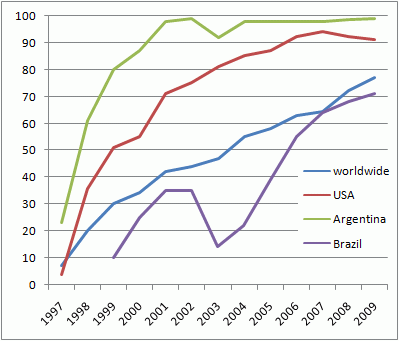
GE Soybean Share: From GMO-Compass
Strategies for Avoiding GE Foods
There are some measures you can take to make sure the foods you select are not genetically engineered. Soy is one of only nine common GE food crops, but their derivatives are in over 70 percent of supermarket foods, particularly processed foods. So, the more fresh, organic and local foods you eat, the less likely you'll be consuming GE ingredients. Also, look for the USDA Certified 100% Organic seal: This green or black seal assures the product is certified organic by the USDA, which means it contains at least 95 percent organic ingredients that are free of genetically engineered ingredients.
URGENT ACTION NEEDED: Support California's Ballot Initiative to Label GMO's!
One of the best strategies for reducing or eliminating GE foods is to force food manufacturers to list them on the label. You have a right to know if the foods you're eating contain GE ingredients. As it stands now, there is no labeling law.
This November, we have a great opportunity to change that with California Ballot Initiative Prop 37, which would require labeling of all genetically engineered foods and food ingredients, and ban the routine industry practice of labeling and marketing such foods as "natural." Voting day is fast approaching — if you're going to act, the time is now!
They need funds and volunteers. Remember, since California is the 8th largest economy in the world, a win for Prop 37 would be a huge step forward, likely affecting ingredients and labeling nationwide. As the campaign says,
"As goes California, so goes the nation."
I urge you to support this bill in any way you can. Here are a few suggestions as to how you can help pass this important initiative:
- Whether you live in California or not, please donate money to this historic effort, through the Organic Consumers Fund. If you live outside of the United States, you can still donate! For International Donations, please call (218) 353-7651!
- If you live in California and want to get involved, please contact CARightToKnow.org. They will go through all volunteer requests to put you into a position that is suitable for you, based on your stated interests and location.
- No matter where you live, please help spread the word in your personal networks, on Facebook, and Twitter. For help with the messaging, please see CARightToKnow.org.
- Talk to organic producers and stores and ask them to actively support the California Ballot. It may be the only chance we have to label genetically engineered foods.
Saturday, August 11, 2012
Friday, August 10, 2012
Soy ~ Destruction In The Name Of Progress
<iframe width="440" height="260" src="http://www.youtube.com/embed/8y3pPt3dlTQ?feature=player_embedded" frameborder="0" allowfullscreen></iframe>
Tuesday, June 5, 2012
Oh Possibly Happy Day! Ca Initiative Would Require GMO Labeling All Foods & Force Rest Of States To Follow
In November, California voters will decide on a ballot initiative that would require labeling of all foods containing ingredients from genetically modified crops. The initiative made it to the ballot after almost 1 million Californians signed a petition in favor of it—nearly double the 504,760 signatures needed under the state's proposition rules. The campaign that organized the push to get the measure on the ballot focused on possible health effects of GMO foods.
This news will not likely be applauded by my friends over at Croplife America, the main trade group of the GM seed/agrichemical industry. The big GMO crops—corn, soy, sugar beets, and cotton—are processed into sweeteners, fats, and additives used widely by the food industry. Everything from high fructose corn syrup-sweetened Coke to soybean oil-containing Hellman's mayo would have to bear a label reading something like "Contains GMO ingredients."
That would send a shockwave through the food industry—one that could ultimately be felt on the industrial-scale US farms that have been devoting their land to GMO crops for years, and the companies that profit from selling them patented seeds and matching herbicides. The reason isn't just that California represents an imposing chunk of the US food market. It's also that a food-labeling law that starts in California is unlikely to stay in California.
Advertise on MotherJones.com
To see why, look at the case of another practice beloved of US agribusiness: that of stuffing egg-laying hens into cages so tight that they can't turn around.
Back in 2008, California voters mulled a ballot initiative to ban that production method by 2015. The egg industry fought the proposal bitterly—but Proposition Two (as it was known) won anyway, by a margin of nearly two-to-one. Two years later, the California legislature passed a law applying the new rules to all eggs sold in the state—foiling the industry's threat to close shop in California and send in eggs from hens caged in other states.
But the initiative was never really just about California. Its main champion, the Humane Society of the United States, was clear about that from the start. As HSUS's Paul Shapiro told Grist weeks before the 2008 vote, "Nobody can ignore the fact that California is the largest agricultural state in the country and it's often a trend-setting state. We envision national reforms coming from passage of Prop. 2.”
Shapiro's words proved prescient. In July 2011, less than three years after the California initiative's passage, executives from the egg industry's main trade group joined forces with their peers from HSUS to propose national legislation that would essentially make the California rules the law of the land. The legislation hasn't gone anywhere yet, but with the industry vowing to support and not crush it in Congress, the days of stuffing hens in tiny cages seem numbered.
Why did the egg industry crack? Did these hard-boiled execs experience a sudden pang of conscience over the plight of the millions of hens confined in their egg factories? More likely, they were acting in deference to a basic law of capitalism: differentiation costs money. Nearly 38 million people live in California—12 percent of the entire US population, and 17 percent of the US egg market, according to the USDA. It's costly and cumbersome to apply one set of production rules to eggs for California's vast horde of consumers, and another to everyone else.
So the egg industry wants a set of standards that applies nationwide.
Similarly, if massive food processors like Kraft and Unilever are forced to label essentially all of their products just for the California market, it likely won't be long before they're pushing for national labeling—or simply just labeling everything for the national market.
It's hard to say how consumers would react to national GMO labeling, but there's evidence that a substantial portion of them might reject GMOs and demand alternatives. A recent national poll by the Mellman Group found that 91 percent of respondents favored GMO labeling, a result that was roughly consistent among Democrats, Republicans, and independents. The fact that they want that information suggests that they may be willing to act on it.
If they do, they'll initially find that the only way to avoid GMOs is to buy certified-organic products, which by USDA code can't contain GMOs. As of last year, genetically modified seeds accounted for 94 percent of US soy and three-quarters of corn and cotton (which makes it into the food supply in the form of cottonseed oil, a popular fat for the food industry).
A move to labeling would likely create a robust market in non-GMO, conventional versions of those crops, giving large-scale farmers incentive to transition away from GMOs and cutting into the profits of giants like Monsanto, Syngenta, and DuPont. If a substantial percentage of them did, that would be a hard blow to the profit plans of the big agrichemical companies, whose business models are based on constant growth, not shrinkage.
As I've written before, herbicide-tolerant GMO technologies have pushed US farmers to apply ever greater doses of ever-more toxic herbicides. New-generation GM seeds from Monsanto and Dow promise to accelerate that trend. So far, regulatory agencies like USDA and EPA have proven utterly unable to check this slow-motion, GMO-generated gusher of agrichemicals onto our prime farmland and ultimately into the water of millions of people.
Where regulators have failed, California's voters might ultimately make a difference.
This news will not likely be applauded by my friends over at Croplife America, the main trade group of the GM seed/agrichemical industry. The big GMO crops—corn, soy, sugar beets, and cotton—are processed into sweeteners, fats, and additives used widely by the food industry. Everything from high fructose corn syrup-sweetened Coke to soybean oil-containing Hellman's mayo would have to bear a label reading something like "Contains GMO ingredients."
That would send a shockwave through the food industry—one that could ultimately be felt on the industrial-scale US farms that have been devoting their land to GMO crops for years, and the companies that profit from selling them patented seeds and matching herbicides. The reason isn't just that California represents an imposing chunk of the US food market. It's also that a food-labeling law that starts in California is unlikely to stay in California.
Advertise on MotherJones.com
To see why, look at the case of another practice beloved of US agribusiness: that of stuffing egg-laying hens into cages so tight that they can't turn around.
Back in 2008, California voters mulled a ballot initiative to ban that production method by 2015. The egg industry fought the proposal bitterly—but Proposition Two (as it was known) won anyway, by a margin of nearly two-to-one. Two years later, the California legislature passed a law applying the new rules to all eggs sold in the state—foiling the industry's threat to close shop in California and send in eggs from hens caged in other states.
But the initiative was never really just about California. Its main champion, the Humane Society of the United States, was clear about that from the start. As HSUS's Paul Shapiro told Grist weeks before the 2008 vote, "Nobody can ignore the fact that California is the largest agricultural state in the country and it's often a trend-setting state. We envision national reforms coming from passage of Prop. 2.”
Shapiro's words proved prescient. In July 2011, less than three years after the California initiative's passage, executives from the egg industry's main trade group joined forces with their peers from HSUS to propose national legislation that would essentially make the California rules the law of the land. The legislation hasn't gone anywhere yet, but with the industry vowing to support and not crush it in Congress, the days of stuffing hens in tiny cages seem numbered.
Why did the egg industry crack? Did these hard-boiled execs experience a sudden pang of conscience over the plight of the millions of hens confined in their egg factories? More likely, they were acting in deference to a basic law of capitalism: differentiation costs money. Nearly 38 million people live in California—12 percent of the entire US population, and 17 percent of the US egg market, according to the USDA. It's costly and cumbersome to apply one set of production rules to eggs for California's vast horde of consumers, and another to everyone else.
So the egg industry wants a set of standards that applies nationwide.
Similarly, if massive food processors like Kraft and Unilever are forced to label essentially all of their products just for the California market, it likely won't be long before they're pushing for national labeling—or simply just labeling everything for the national market.
It's hard to say how consumers would react to national GMO labeling, but there's evidence that a substantial portion of them might reject GMOs and demand alternatives. A recent national poll by the Mellman Group found that 91 percent of respondents favored GMO labeling, a result that was roughly consistent among Democrats, Republicans, and independents. The fact that they want that information suggests that they may be willing to act on it.
If they do, they'll initially find that the only way to avoid GMOs is to buy certified-organic products, which by USDA code can't contain GMOs. As of last year, genetically modified seeds accounted for 94 percent of US soy and three-quarters of corn and cotton (which makes it into the food supply in the form of cottonseed oil, a popular fat for the food industry).
A move to labeling would likely create a robust market in non-GMO, conventional versions of those crops, giving large-scale farmers incentive to transition away from GMOs and cutting into the profits of giants like Monsanto, Syngenta, and DuPont. If a substantial percentage of them did, that would be a hard blow to the profit plans of the big agrichemical companies, whose business models are based on constant growth, not shrinkage.
As I've written before, herbicide-tolerant GMO technologies have pushed US farmers to apply ever greater doses of ever-more toxic herbicides. New-generation GM seeds from Monsanto and Dow promise to accelerate that trend. So far, regulatory agencies like USDA and EPA have proven utterly unable to check this slow-motion, GMO-generated gusher of agrichemicals onto our prime farmland and ultimately into the water of millions of people.
Where regulators have failed, California's voters might ultimately make a difference.
OH HAPPY DAY! Five Million Brazillian Farmers Sue Monsanto
Five million Brazilian farmers are locked in a lawsuit with US-based biotech giant Monsanto, suing for as much as 6.2 billion euros. They say that the genetic-engineering company has been collecting royalties on crops it unfairly claims as its own.
The farmers claim that Monsanto unfairly collects exorbitant profits every year worldwide on royalties from “renewal” seed harvests. “Renewal” crops are those that have been planted using seed from the previous year’s harvest. While the practice of renewal farming is an ancient one, Monsanto disagrees, demanding royalties from any crop generation produced from its genetically-engineered seed. Because the engineered seed is patented, Monsanto not only charges an initial royalty on the sale of the crop produced, but a continuing 2 per cent royalty on every subsequent crop, even if the farmer is using a later generation of seed.
"Monsanto gets paid when it sell the seeds. The law gives producers the right to multiply the seeds they buy and nowhere in the world is there a requirement to pay (again). Producers are in effect paying a private tax on production," Jane Berwanger, lawyer for the farmers told the Associated Press reports.
In the latest installment of the legal battle erupting in South America, the Brazilian court has ruled in favor of the Brazilian farmers, saying Monsanto owes them at least US$2 billion paid since 2004. Monsanto, however, has appealed the decision and the case is ongoing.
In essence, Monsanto argues that once a farmer buys their seed, they have to pay the global bio-tech giant a yearly fee in perpetuity – with no way out.
At stake is Brazil’s highly profitable and ever growing soybean production. Last year, Brazil was the world's second producer and exporter of soybean behind the United States, according to the AFP report. The crops can be used for anything from animal feed to bio fuel, and worldwide demand is growing.
Genetically engineered soy first appeared illegally in Brazil in the 1990’s, smuggled in from neighboring Argentina. The Brazilian farmers found the seed attractive despite the ban in place from the Brazilian authorities because Monsanto had specifically designed the seed to be resistant to its own immensely powerful and popular herbicide Roundup.
When used in tandem, the strong herbicide will kill the weeds while allowing the soy crops to grow unimpeded. After the ban was lifted, genetically modified seed flooded the Brazilian market, and now 85 per cent of the Brazilian soy crop is genetically-engineered. Soy has been extremely successful in Brazil, currently making up 26 per cent of the country’s farm exports last year and netting Brazil a total of $24.1 billion, according to AP. However, Brazil’s farmers were apparently unaware there would be a heavy price to pay.
To make a deal with Monsanto is to make a deal with a company that is one the most powerful and pervasive food giants in the world. It is the world’s number one seed developer, and its patented genes have been inserted into 95 per cent of all American soy, and 80 per cent of all American corn crops. Monsanto has repeatedly levied large damage suits against independent farmers that have unknowingly or unwittingly used their seed.
And Monsanto’s reach goes far beyond agriculture.
Monsanto is also the world’s largest manufacturer of synthetic bovine growth hormone, injected into cows in order to stimulate greater milk production. The widespread pressure by the company to use the chemical and the subsequent measures taken by Monsanto to suppress information regarding the potential health risks sparked uproar among American farmers.
When dairy producers that did not use Monsanto’s products began labeling their products as “Hormone Free” or “Organic”, Monsanto slapped them with a lawsuit as recently as 2008, claiming the labels amounted to negative advertising against hormone-produced milk.
Director of corporate communications for Monsanto, Phil Angell, summed up Monsanto’s take on the issue in a report by food author Michael Pollan for New York Times Magazine in 1998: "Monsanto should not have to vouch for the safety of biotech food. Our interest is in selling as much of it as possible. Assuring its safety is FDA's job."
The farmers claim that Monsanto unfairly collects exorbitant profits every year worldwide on royalties from “renewal” seed harvests. “Renewal” crops are those that have been planted using seed from the previous year’s harvest. While the practice of renewal farming is an ancient one, Monsanto disagrees, demanding royalties from any crop generation produced from its genetically-engineered seed. Because the engineered seed is patented, Monsanto not only charges an initial royalty on the sale of the crop produced, but a continuing 2 per cent royalty on every subsequent crop, even if the farmer is using a later generation of seed.
"Monsanto gets paid when it sell the seeds. The law gives producers the right to multiply the seeds they buy and nowhere in the world is there a requirement to pay (again). Producers are in effect paying a private tax on production," Jane Berwanger, lawyer for the farmers told the Associated Press reports.
In the latest installment of the legal battle erupting in South America, the Brazilian court has ruled in favor of the Brazilian farmers, saying Monsanto owes them at least US$2 billion paid since 2004. Monsanto, however, has appealed the decision and the case is ongoing.
In essence, Monsanto argues that once a farmer buys their seed, they have to pay the global bio-tech giant a yearly fee in perpetuity – with no way out.
At stake is Brazil’s highly profitable and ever growing soybean production. Last year, Brazil was the world's second producer and exporter of soybean behind the United States, according to the AFP report. The crops can be used for anything from animal feed to bio fuel, and worldwide demand is growing.
Genetically engineered soy first appeared illegally in Brazil in the 1990’s, smuggled in from neighboring Argentina. The Brazilian farmers found the seed attractive despite the ban in place from the Brazilian authorities because Monsanto had specifically designed the seed to be resistant to its own immensely powerful and popular herbicide Roundup.
When used in tandem, the strong herbicide will kill the weeds while allowing the soy crops to grow unimpeded. After the ban was lifted, genetically modified seed flooded the Brazilian market, and now 85 per cent of the Brazilian soy crop is genetically-engineered. Soy has been extremely successful in Brazil, currently making up 26 per cent of the country’s farm exports last year and netting Brazil a total of $24.1 billion, according to AP. However, Brazil’s farmers were apparently unaware there would be a heavy price to pay.
To make a deal with Monsanto is to make a deal with a company that is one the most powerful and pervasive food giants in the world. It is the world’s number one seed developer, and its patented genes have been inserted into 95 per cent of all American soy, and 80 per cent of all American corn crops. Monsanto has repeatedly levied large damage suits against independent farmers that have unknowingly or unwittingly used their seed.
And Monsanto’s reach goes far beyond agriculture.
Monsanto is also the world’s largest manufacturer of synthetic bovine growth hormone, injected into cows in order to stimulate greater milk production. The widespread pressure by the company to use the chemical and the subsequent measures taken by Monsanto to suppress information regarding the potential health risks sparked uproar among American farmers.
When dairy producers that did not use Monsanto’s products began labeling their products as “Hormone Free” or “Organic”, Monsanto slapped them with a lawsuit as recently as 2008, claiming the labels amounted to negative advertising against hormone-produced milk.
Director of corporate communications for Monsanto, Phil Angell, summed up Monsanto’s take on the issue in a report by food author Michael Pollan for New York Times Magazine in 1998: "Monsanto should not have to vouch for the safety of biotech food. Our interest is in selling as much of it as possible. Assuring its safety is FDA's job."
Thursday, May 10, 2012
The Dark Side Of Soy
A decade ago, soya was being hailed as a superfood but in recent years, numerous issues surrounding deforestation and its impact on health have come to light
Once credited with power to prevent cancer and combat high cholesterol, over the last few years, evidence that soya is far from a superfood has begun to emerge. And it’s not just the potentially negative health impact of the bean that has former supporters up in arms: it’s the environmental impact. In the UK we rely heavily on soya, or soy, and it's not just for vegetarian food. It is a hidden product in many foods and everyday items such as soap. It is a cheap source of protein for people as well as animals and according to Greenpeace, 80 per cent of soya worldwide is used for the livestock industry. WWF add that the UK consumption alone requires an area the size of Yorkshire to be planted with soya every year. So how did soya go from super crop to super bad?
Deforestation and slavery
Brazil, the second biggest grower and the biggest exporter of soya, is such a big player in the industry that there are major concerns about how this is affecting the Amazon Rainforest. According to Greenpeace, in 2005 around 1.2 million hectares of soya was planted in the Brazilian rainforest. Sarah Shoaka from Greenpeace's Forest Network says that deforestation has been decreasing on the whole in Brazil since 2008.
This is mainly because of the enforcement of a soya moratorium that bans soya produced as a result of deforestation from entering the market place. However, Shoraka warns that this positive trend may be changing: 'The whole of last year deforestation in the main areas for soya including Matto Grosso – the state which is the biggest soya producer – increased for the first time in a while.' Greenpeace think the main reason for this is proposed changes to the controversial Forest Code which governs how much forest each farm has to protect from the land that they own. 'They want to give an amnesty to people that have deforested in the past and obviously that has created a big incentive for people to deforest before the law goes through.'
Along with deforestation, there are also concerns about the use of agrochemicals in soya production – risking pollution to water supplies and soil – as well as labour issues and tension over resources. Greenpeace's Eating Up the Amazon report also says, chillingly, that modern-day slavery is also a serious problem in the region. So what’s being done about it? To combat the issues associated with soya production, the WWF and others set up the Roundtable on Responsible Soy Association (RTRS) in 2006 to provide an opportunity for stakeholders to join together to find solutions. They offer a certification scheme to businesses involved in soya production. But Shoraka says she does not see RTRS as a viable solution. 'While certification schemes can help companies trace back where their soya is coming, from it isn’t at all for protecting the forest.' The ultimate goal, she argues, should be a Brazilian law that prohibits all forms of deforestation.
Ben Zeehandelaar, Outreach and Communications Manager at RTRS, says it is strict on deforestation. 'If a company does something against our objectives or standards then the company can not continue with RTRS,’ he insists. ‘If a company is certified and an auditor finds that it is deforesting part of its property that it shouldn’t, they lose their certification.'
He is aware of the criticisms made against RTRS but says there is no real multi-stakeholder alternative to it that can be part of the mainstream value chain. Genetically modified (GM) soya is another issue that divides opinion. RTRS includes GM soya, and Zeehandelaar says this is because the issues around deforestation such as the use of agrochemicals and social impacts are just as relevant to GM soya as they are to non GM. 'To leave out genetically modified would leave out a large part of the problems that occur today,' he explains.
Once credited with power to prevent cancer and combat high cholesterol, over the last few years, evidence that soya is far from a superfood has begun to emerge. And it’s not just the potentially negative health impact of the bean that has former supporters up in arms: it’s the environmental impact. In the UK we rely heavily on soya, or soy, and it's not just for vegetarian food. It is a hidden product in many foods and everyday items such as soap. It is a cheap source of protein for people as well as animals and according to Greenpeace, 80 per cent of soya worldwide is used for the livestock industry. WWF add that the UK consumption alone requires an area the size of Yorkshire to be planted with soya every year. So how did soya go from super crop to super bad?
Deforestation and slavery
Brazil, the second biggest grower and the biggest exporter of soya, is such a big player in the industry that there are major concerns about how this is affecting the Amazon Rainforest. According to Greenpeace, in 2005 around 1.2 million hectares of soya was planted in the Brazilian rainforest. Sarah Shoaka from Greenpeace's Forest Network says that deforestation has been decreasing on the whole in Brazil since 2008.
This is mainly because of the enforcement of a soya moratorium that bans soya produced as a result of deforestation from entering the market place. However, Shoraka warns that this positive trend may be changing: 'The whole of last year deforestation in the main areas for soya including Matto Grosso – the state which is the biggest soya producer – increased for the first time in a while.' Greenpeace think the main reason for this is proposed changes to the controversial Forest Code which governs how much forest each farm has to protect from the land that they own. 'They want to give an amnesty to people that have deforested in the past and obviously that has created a big incentive for people to deforest before the law goes through.'
Along with deforestation, there are also concerns about the use of agrochemicals in soya production – risking pollution to water supplies and soil – as well as labour issues and tension over resources. Greenpeace's Eating Up the Amazon report also says, chillingly, that modern-day slavery is also a serious problem in the region. So what’s being done about it? To combat the issues associated with soya production, the WWF and others set up the Roundtable on Responsible Soy Association (RTRS) in 2006 to provide an opportunity for stakeholders to join together to find solutions. They offer a certification scheme to businesses involved in soya production. But Shoraka says she does not see RTRS as a viable solution. 'While certification schemes can help companies trace back where their soya is coming, from it isn’t at all for protecting the forest.' The ultimate goal, she argues, should be a Brazilian law that prohibits all forms of deforestation.
Ben Zeehandelaar, Outreach and Communications Manager at RTRS, says it is strict on deforestation. 'If a company does something against our objectives or standards then the company can not continue with RTRS,’ he insists. ‘If a company is certified and an auditor finds that it is deforesting part of its property that it shouldn’t, they lose their certification.'
He is aware of the criticisms made against RTRS but says there is no real multi-stakeholder alternative to it that can be part of the mainstream value chain. Genetically modified (GM) soya is another issue that divides opinion. RTRS includes GM soya, and Zeehandelaar says this is because the issues around deforestation such as the use of agrochemicals and social impacts are just as relevant to GM soya as they are to non GM. 'To leave out genetically modified would leave out a large part of the problems that occur today,' he explains.
Paraguays Small Farmers Fight Back Against Soy Contamination
A new film, Raising Resistance, gives a telling account of how Paraguay's small farmers are suffering social and environmental ills from the country's meteoric rise in soya farming
Over the last ten years, Paraguay has changed dramatically due to the world’s increasing demand for soya. Approximately 80 per cent of the world’s animal feed is made of the crop, while our food is rich in it. The market for soya is set to grow further still with the implementation of bio fuel policies.
The land in Paraguay offers the perfect environment for opportunists wanting to make money from this aggressive, growing industry – cheap property, fertile soil and legislation means there is little to stop soya farmers forever expanding. This is why Paraguay has become the fourth largest exporter of soya, meaning that the world has become dependent on Paraguay to supply the demand for soya, while the economy of the Republic relies on continued investment in the industry. The major problem is that the local communities are resisting, and as a new film, Raising Resistance shows, they are not prepared to give up.
By weaving us through panoramic views of Paraguay’s soya growing zone and including interviews and scenes of the soya production process, Raising Resistance provides a balanced profile of the soya industry and how the small-scale farmers (campesinos) are horribly disadvantaged. The aggressive growth in the soya industry affects every aspect of life – their human rights, environment and society are all damaged and, as Raising Resistance shows, they are under-prioritised, sidelined and dismissed.
As part of the farming process, the soya producers spray herbicide on their land once a year (and sometimes more) and shockingly, they are not required to dispose of the agrochemical containers carefully. Instead, they are left in streams where the campesinos bathe. One child interviewed in Raising Resistance provides us with his account of how the poison in his bathing water has left him blind - Silvio Peralta has been left scarred by the soya industry, and Raising Resistance shows that he is not the only one.
The campesinos are not accepting the costs imposed on them and are standing up against their subordination. Raising Resistance shows how they protest by setting up camps in the soya fields to stall production. The campesinos are committed and prepared to face trouble with the police – a determination that becomes clear at the end of the film. One of the final scenes shows the broadcast of a march in Asuncion, the capital, in which militant-looking police beat protesters to the sound of gunfire, whistles and chaos.
While the desperation of the campesinos is represented, we are also left appreciating a note of irony. The soya producers spray an indiscriminate herbicide on their land to protect their crop from strangling weeds - the soya being safe because it has been genetically modified to become transgenic soya, and is therefore immune to the herbicide.
The wind carries these herbicides onto neighbouring farms - these crops are not genetically modified to be resistant, leaving farmer, Juana Gonzales, with ‘rotten peanuts’ for her crop. Ironically, the weeds in the soya fields are adapting and growing resistant to the herbicides that are designed to kill them. The evolved weeds spread across the field in the wind, strangling the transgenic soya plant.
Raising Resistance is telling, exposing and thought provoking – the creators, Bettina Borgfeld and David Bernet, force us to appreciate the effect such a powerful industry can have, while portraying the ironic parallels between the resistance growing among the campsinos and the weeds that are becoming resistant to the soya farmer’s herbicides. The film portrays this resistance against the injustice brought on by unchecked growth, both in the fields and in an industrial sense, making the title apt and the message strong.
Raising Resistance has been shown at film festivals in various locations around the world - the UK premiere being at the Human Rights Watch Film Festival of March this year
Over the last ten years, Paraguay has changed dramatically due to the world’s increasing demand for soya. Approximately 80 per cent of the world’s animal feed is made of the crop, while our food is rich in it. The market for soya is set to grow further still with the implementation of bio fuel policies.
The land in Paraguay offers the perfect environment for opportunists wanting to make money from this aggressive, growing industry – cheap property, fertile soil and legislation means there is little to stop soya farmers forever expanding. This is why Paraguay has become the fourth largest exporter of soya, meaning that the world has become dependent on Paraguay to supply the demand for soya, while the economy of the Republic relies on continued investment in the industry. The major problem is that the local communities are resisting, and as a new film, Raising Resistance shows, they are not prepared to give up.
By weaving us through panoramic views of Paraguay’s soya growing zone and including interviews and scenes of the soya production process, Raising Resistance provides a balanced profile of the soya industry and how the small-scale farmers (campesinos) are horribly disadvantaged. The aggressive growth in the soya industry affects every aspect of life – their human rights, environment and society are all damaged and, as Raising Resistance shows, they are under-prioritised, sidelined and dismissed.
As part of the farming process, the soya producers spray herbicide on their land once a year (and sometimes more) and shockingly, they are not required to dispose of the agrochemical containers carefully. Instead, they are left in streams where the campesinos bathe. One child interviewed in Raising Resistance provides us with his account of how the poison in his bathing water has left him blind - Silvio Peralta has been left scarred by the soya industry, and Raising Resistance shows that he is not the only one.
The campesinos are not accepting the costs imposed on them and are standing up against their subordination. Raising Resistance shows how they protest by setting up camps in the soya fields to stall production. The campesinos are committed and prepared to face trouble with the police – a determination that becomes clear at the end of the film. One of the final scenes shows the broadcast of a march in Asuncion, the capital, in which militant-looking police beat protesters to the sound of gunfire, whistles and chaos.
While the desperation of the campesinos is represented, we are also left appreciating a note of irony. The soya producers spray an indiscriminate herbicide on their land to protect their crop from strangling weeds - the soya being safe because it has been genetically modified to become transgenic soya, and is therefore immune to the herbicide.
The wind carries these herbicides onto neighbouring farms - these crops are not genetically modified to be resistant, leaving farmer, Juana Gonzales, with ‘rotten peanuts’ for her crop. Ironically, the weeds in the soya fields are adapting and growing resistant to the herbicides that are designed to kill them. The evolved weeds spread across the field in the wind, strangling the transgenic soya plant.
Raising Resistance is telling, exposing and thought provoking – the creators, Bettina Borgfeld and David Bernet, force us to appreciate the effect such a powerful industry can have, while portraying the ironic parallels between the resistance growing among the campsinos and the weeds that are becoming resistant to the soya farmer’s herbicides. The film portrays this resistance against the injustice brought on by unchecked growth, both in the fields and in an industrial sense, making the title apt and the message strong.
Raising Resistance has been shown at film festivals in various locations around the world - the UK premiere being at the Human Rights Watch Film Festival of March this year
Saturday, March 31, 2012
Paraguay Land Soy & Boots
Eight million hectares, half the surface area of Uruguay:
That is the combined area that the government of Fernando Lugo is hoping to investigate, to determine if the lands are "ill-gotten," whose title deeds could be forged or faked or simply seized from the times of the Stroessner dictatorship. The landowners who have inundated Paraguay with transgenic soy are resisting the review, in an alliance with a parliament where Lugo is clearly in the minority. The conflict could lead to an institutional breakdown – to the sound of [army] boots.
Magui Balbuena, of the National Council of Organizations of Rural and Indigenous Workers, offers her account to Brecha Magazine of a conflict that has as its epicenter the Paraguayan department of Alto Paraná, on the border with Brazil.
What is the situation in Alto Paraná, and what are the conflicting interests?
The struggle of the landless in this area has been going on for a long time. Recently Lugo's government has sought to legislate on the border lands that are being destroyed by multinationals, mainly Brazilian. Then the government sent the military to the border to place boundary markers and inspect title deeds. There are many doubts about how, in a very short time – about 10 years – those border lands passed into the hands of foreigners; and they are the best lands!
Those expanses are dedicated to the cultivation of transgenic soy, a monoculture for export. They have destroyed mountains, they have dried up streams and drained swamps, they have poisoned rivers with indiscriminate use of agro-chemicals. This is a very serious situation that is taking place across the country, but mainly in the border area, where a kind of patriotic spirit is rising because what the people see in those areas no longer looks like Paraguay. The campesinos feel they are the owners of the land and they react. When the soldiers went to place the boundary markers and check the title deeds of those fields, the "carperos" reacted.
What is the "carpero" movement?
It is people from different departments who are in the conflict area and are questioning a Brazilian landowner named Tranquilino Favero. He has land in three or four departments, some of the best land near the border. He has endless farms and soy fields that in all exceed one million hectares.
The National Institute of Rural Development and Land (INDERT) has started to investigate and verify the origin of the title deeds of this businessman, many of which are fake or forged. But there is also a real mafia inside INDERT that for years has sold and resold land belonging to the state.
This is what created the crisis in Ñacunday, in the department of Alto Paraná. There they are questioning a piece of land of 162,000 hectares on the border, currently controlled by Favero, that the landless campesinos claim was distributed between them by the state.
How did the different parties react?
It has been a delicate situation since the army arrived in the middle of January to place the boundary markers. The big soy farmers united around Favero to defend him. That is the case with the Agricultural Coordinator of Paraguay, the Coordinator of Soy Producers and the cooperatives. The fact that the army is there has prevented the landowners from acting against the campesinos who claim the land. There is even an order from the Interior Ministry so that the police do not suppress them. But the landowners resisted the setting of markers. Why do they refuse the examination of the documents by the state? The district attorney and the entire congress are on the side of the soy farmers, and they have covered up this problem of the "ill-gotten" lands.
The only way that the land will continue to be under the sovereignty of our country is to offer land to the thousands and thousands of campesinos who claim it.
Have there been direct confrontations by the landowners?
The pressure is very great, the press is on the side of the soy farmers, and there is real risk that they will act as they know how: with violence against the landless campesinos. The landlords have already organized armed groups and have threatened to act on their own. We are currently in a tug-of-war, and a political problem is emerging because the soy farmers have threatened that if the government continues it could put the 2013 elections at risk. They have even had meetings of military retirees. Their allies are very strong here in Paraguay. Remember that according to some estimates, the "ill-gotten" lands occupy an area of eight million hectares and are in the hands of officials, members of the military, companies, and collaborators of [former] dictator Alfredo Stroessner.
Are we talking then of a risk of institutional breakdown?
That's right. The problem in Paraguay is agriculture, of the land. There is a profound contradiction between the 400,000 landless families and Brazilian settlers ("brasiguayos") who already occupy not only border lands but also lands deep into the Chaco. It is a wooded area, natural. It is a true lung of the earth that must concern everyone. There is no control over it and it is being preyed upon, destroyed by the cultivation of transgenic soy. The right-wing of the parliament supports these invaders and it is very difficult to do something to recover sovereignty. It's an outrage, a true plundering of our land. Under this model, which has existed for decades, the women and children suffer the consequences the most: illnesses, malformations, abortions, and the extreme impoverishment of our communities and families.
We really believe that there are actors whose goal is destabilization, even resorting to bloodshed to heighten the conflict.
Brasiguayos
Over half a million Brazilians have lived in Paraguay for the past several decades. They include all kinds, but those who are central to the conflict are the landlords who have settled in the border areas in the east of the country, particularly in Alto Paraná. The majority of the landlords own enormous expanses of land that they for years have dedicated to the super-profitable cultivation of soy. And they defend their lands with arms. The dictator Alfredo Stroessner (1954-1989) found the landlords to be great allies, and let them act as they pleased on territories that were extended with no restrictions. Of the 1.5 million hectares planted with soy in the east of the country, 1.2 million of them are planted by Brazilians. The "brasiguayos" and others who arrived more recently acquired the land for a bargain price: land that in Brazil is worth $7,000 to $8,000 per hectare, in Paraguay they paid from $1,000 to at most $4,000 for the most fertile land, above all for those lands that until recent times were dedicated to ranching. In fact, in the east of the country, they do not enforce the 2005 law that prohibits the purchase or usufruct of lands situated less than 50 kilometers from the border by citizens of neighboring countries. Even less attention is paid to environmental regulations.
The hi-tech production of soy (the Brazilians "modernized" the Paraguayan agricultural sector) to a large extent drove small producers out of those areas. Claudia Ricca, of the NGO Friends of the Earth, which works in the area, told the BBC: "There is no benefit whatsoever for the area: the people are expelled from their jobs and territory, the roads are completely destroyed by the soy farmers' trucks, the businessmen don't live here, they don't pay taxes, and none of what is earned stays in the communities."
Tranquilino Favero, a septuagenarian who disembarked in Paraguay in the early 1960s, symbolizes the "brasiguayos" like few others. He crossed the border tempting fate, soon after the dictatorship was established, and today he is one of the biggest businessmen in the country. He is called the "king of soy" and is in charge of an empire that has its own army of hit men.
His connections in the army are notorious, and on multiple occasions Favero has called to "resist the advance of communism," which he sees symbolized by Fernando Lugo because of the president's historic links to campesinos and landless movements. Dozens of campesinos have been killed in the east of Paraguay by "unknowns," probably paid off by the landlords in the area.
That is the combined area that the government of Fernando Lugo is hoping to investigate, to determine if the lands are "ill-gotten," whose title deeds could be forged or faked or simply seized from the times of the Stroessner dictatorship. The landowners who have inundated Paraguay with transgenic soy are resisting the review, in an alliance with a parliament where Lugo is clearly in the minority. The conflict could lead to an institutional breakdown – to the sound of [army] boots.
Magui Balbuena, of the National Council of Organizations of Rural and Indigenous Workers, offers her account to Brecha Magazine of a conflict that has as its epicenter the Paraguayan department of Alto Paraná, on the border with Brazil.
What is the situation in Alto Paraná, and what are the conflicting interests?
The struggle of the landless in this area has been going on for a long time. Recently Lugo's government has sought to legislate on the border lands that are being destroyed by multinationals, mainly Brazilian. Then the government sent the military to the border to place boundary markers and inspect title deeds. There are many doubts about how, in a very short time – about 10 years – those border lands passed into the hands of foreigners; and they are the best lands!
Those expanses are dedicated to the cultivation of transgenic soy, a monoculture for export. They have destroyed mountains, they have dried up streams and drained swamps, they have poisoned rivers with indiscriminate use of agro-chemicals. This is a very serious situation that is taking place across the country, but mainly in the border area, where a kind of patriotic spirit is rising because what the people see in those areas no longer looks like Paraguay. The campesinos feel they are the owners of the land and they react. When the soldiers went to place the boundary markers and check the title deeds of those fields, the "carperos" reacted.
What is the "carpero" movement?
It is people from different departments who are in the conflict area and are questioning a Brazilian landowner named Tranquilino Favero. He has land in three or four departments, some of the best land near the border. He has endless farms and soy fields that in all exceed one million hectares.
The National Institute of Rural Development and Land (INDERT) has started to investigate and verify the origin of the title deeds of this businessman, many of which are fake or forged. But there is also a real mafia inside INDERT that for years has sold and resold land belonging to the state.
This is what created the crisis in Ñacunday, in the department of Alto Paraná. There they are questioning a piece of land of 162,000 hectares on the border, currently controlled by Favero, that the landless campesinos claim was distributed between them by the state.
How did the different parties react?
It has been a delicate situation since the army arrived in the middle of January to place the boundary markers. The big soy farmers united around Favero to defend him. That is the case with the Agricultural Coordinator of Paraguay, the Coordinator of Soy Producers and the cooperatives. The fact that the army is there has prevented the landowners from acting against the campesinos who claim the land. There is even an order from the Interior Ministry so that the police do not suppress them. But the landowners resisted the setting of markers. Why do they refuse the examination of the documents by the state? The district attorney and the entire congress are on the side of the soy farmers, and they have covered up this problem of the "ill-gotten" lands.
The only way that the land will continue to be under the sovereignty of our country is to offer land to the thousands and thousands of campesinos who claim it.
Have there been direct confrontations by the landowners?
The pressure is very great, the press is on the side of the soy farmers, and there is real risk that they will act as they know how: with violence against the landless campesinos. The landlords have already organized armed groups and have threatened to act on their own. We are currently in a tug-of-war, and a political problem is emerging because the soy farmers have threatened that if the government continues it could put the 2013 elections at risk. They have even had meetings of military retirees. Their allies are very strong here in Paraguay. Remember that according to some estimates, the "ill-gotten" lands occupy an area of eight million hectares and are in the hands of officials, members of the military, companies, and collaborators of [former] dictator Alfredo Stroessner.
Are we talking then of a risk of institutional breakdown?
That's right. The problem in Paraguay is agriculture, of the land. There is a profound contradiction between the 400,000 landless families and Brazilian settlers ("brasiguayos") who already occupy not only border lands but also lands deep into the Chaco. It is a wooded area, natural. It is a true lung of the earth that must concern everyone. There is no control over it and it is being preyed upon, destroyed by the cultivation of transgenic soy. The right-wing of the parliament supports these invaders and it is very difficult to do something to recover sovereignty. It's an outrage, a true plundering of our land. Under this model, which has existed for decades, the women and children suffer the consequences the most: illnesses, malformations, abortions, and the extreme impoverishment of our communities and families.
We really believe that there are actors whose goal is destabilization, even resorting to bloodshed to heighten the conflict.
Brasiguayos
Over half a million Brazilians have lived in Paraguay for the past several decades. They include all kinds, but those who are central to the conflict are the landlords who have settled in the border areas in the east of the country, particularly in Alto Paraná. The majority of the landlords own enormous expanses of land that they for years have dedicated to the super-profitable cultivation of soy. And they defend their lands with arms. The dictator Alfredo Stroessner (1954-1989) found the landlords to be great allies, and let them act as they pleased on territories that were extended with no restrictions. Of the 1.5 million hectares planted with soy in the east of the country, 1.2 million of them are planted by Brazilians. The "brasiguayos" and others who arrived more recently acquired the land for a bargain price: land that in Brazil is worth $7,000 to $8,000 per hectare, in Paraguay they paid from $1,000 to at most $4,000 for the most fertile land, above all for those lands that until recent times were dedicated to ranching. In fact, in the east of the country, they do not enforce the 2005 law that prohibits the purchase or usufruct of lands situated less than 50 kilometers from the border by citizens of neighboring countries. Even less attention is paid to environmental regulations.
The hi-tech production of soy (the Brazilians "modernized" the Paraguayan agricultural sector) to a large extent drove small producers out of those areas. Claudia Ricca, of the NGO Friends of the Earth, which works in the area, told the BBC: "There is no benefit whatsoever for the area: the people are expelled from their jobs and territory, the roads are completely destroyed by the soy farmers' trucks, the businessmen don't live here, they don't pay taxes, and none of what is earned stays in the communities."
Tranquilino Favero, a septuagenarian who disembarked in Paraguay in the early 1960s, symbolizes the "brasiguayos" like few others. He crossed the border tempting fate, soon after the dictatorship was established, and today he is one of the biggest businessmen in the country. He is called the "king of soy" and is in charge of an empire that has its own army of hit men.
His connections in the army are notorious, and on multiple occasions Favero has called to "resist the advance of communism," which he sees symbolized by Fernando Lugo because of the president's historic links to campesinos and landless movements. Dozens of campesinos have been killed in the east of Paraguay by "unknowns," probably paid off by the landlords in the area.
Thursday, March 15, 2012
Paraguay Land Of Soy & Boots
Eight million hectares, half the surface area of Uruguay: That is the combined area that the government of Fernando Lugo is hoping to investigate, to determine if the lands are "ill-gotten," whose title deeds could be forged or faked or simply seized from the times of the Stroessner dictatorship. The landowners who have inundated Paraguay with transgenic soy are resisting the review, in an alliance with a parliament where Lugo is clearly in the minority. The conflict could lead to an institutional breakdown – to the sound of [army] boots.
Magui Balbuena, of the National Council of Organizations of Rural and Indigenous Workers, offers her account to Brecha Magazine of a conflict that has as its epicenter the Paraguayan department of Alto Paraná, on the border with Brazil.
What is the situation in Alto Paraná, and what are the conflicting interests?
The struggle of the landless in this area has been going on for a long time. Recently Lugo's government has sought to legislate on the border lands that are being destroyed by multinationals, mainly Brazilian. Then the government sent the military to the border to place boundary markers and inspect title deeds. There are many doubts about how, in a very short time – about 10 years – those border lands passed into the hands of foreigners; and they are the best lands! Those expanses are dedicated to the cultivation of transgenic soy, a monoculture for export. They have destroyed mountains, they have dried up streams and drained swamps, they have poisoned rivers with indiscriminate use of agro-chemicals. This is a very serious situation that is taking place across the country, but mainly in the border area, where a kind of patriotic spirit is rising because what the people see in those areas no longer looks like Paraguay. The campesinos feel they are the owners of the land and they react. When the soldiers went to place the boundary markers and check the title deeds of those fields, the "carperos" reacted.
What is the "carpero" movement?
It is people from different departments who are in the conflict area and are questioning a Brazilian landowner named Tranquilino Favero. He has land in three or four departments, some of the best land near the border. He has endless farms and soy fields that in all exceed one million hectares. The National Institute of Rural Development and Land (INDERT) has started to investigate and verify the origin of the title deeds of this businessman, many of which are fake or forged. But there is also a real mafia inside INDERT that for years has sold and resold land belonging to the state. This is what created the crisis in Ñacunday, in the department of Alto Paraná. There they are questioning a piece of land of 162,000 hectares on the border, currently controlled by Favero, that the landless campesinos claim was distributed between them by the state.
How did the different parties react?
It has been a delicate situation since the army arrived in the middle of January to place the boundary markers. The big soy farmers united around Favero to defend him. That is the case with the Agricultural Coordinator of Paraguay, the Coordinator of Soy Producers and the cooperatives. The fact that the army is there has prevented the landowners from acting against the campesinos who claim the land. There is even an order from the Interior Ministry so that the police do not suppress them. But the landowners resisted the setting of markers. Why do they refuse the examination of the documents by the state? The district attorney and the entire congress are on the side of the soy farmers, and they have covered up this problem of the "ill-gotten" lands.
The only way that the land will continue to be under the sovereignty of our country is to offer land to the thousands and thousands of campesinos who claim it.
Have there been direct confrontations by the landowners?
The pressure is very great, the press is on the side of the soy farmers, and there is real risk that they will act as they know how: with violence against the landless campesinos. The landlords have already organized armed groups and have threatened to act on their own. We are currently in a tug-of-war, and a political problem is emerging because the soy farmers have threatened that if the government continues it could put the 2013 elections at risk. They have even had meetings of military retirees. Their allies are very strong here in Paraguay. Remember that according to some estimates, the "ill-gotten" lands occupy an area of eight million hectares and are in the hands of officials, members of the military, companies, and collaborators of [former] dictator Alfredo Stroessner.
Are we talking then of a risk of institutional breakdown?
That's right. The problem in Paraguay is agriculture, of the land. There is a profound contradiction between the 400,000 landless families and Brazilian settlers ("brasiguayos") who already occupy not only border lands but also lands deep into the Chaco. It is a wooded area, natural. It is a true lung of the earth that must concern everyone. There is no control over it and it is being preyed upon, destroyed by the cultivation of transgenic soy. The right-wing of the parliament supports these invaders and it is very difficult to do something to recover sovereignty. It's an outrage, a true plundering of our land. Under this model, which has existed for decades, the women and children suffer the consequences the most: illnesses, malformations, abortions, and the extreme impoverishment of our communities and families.
We really believe that there are actors whose goal is destabilization, even resorting to bloodshed to heighten the conflict.
Brasiguayos
Over half a million Brazilians have lived in Paraguay for the past several decades. They include all kinds, but those who are central to the conflict are the landlords who have settled in the border areas in the east of the country, particularly in Alto Paraná. The majority of the landlords own enormous expanses of land that they for years have dedicated to the super-profitable cultivation of soy. And they defend their lands with arms. The dictator Alfredo Stroessner (1954-1989) found the landlords to be great allies, and let them act as they pleased on territories that were extended with no restrictions. Of the 1.5 million hectares planted with soy in the east of the country, 1.2 million of them are planted by Brazilians. The "brasiguayos" and others who arrived more recently acquired the land for a bargain price: land that in Brazil is worth $7,000 to $8,000 per hectare, in Paraguay they paid from $1,000 to at most $4,000 for the most fertile land, above all for those lands that until recent times were dedicated to ranching. In fact, in the east of the country, they do not enforce the 2005 law that prohibits the purchase or usufruct of lands situated less than 50 kilometers from the border by citizens of neighboring countries. Even less attention is paid to environmental regulations.
The hi-tech production of soy (the Brazilians "modernized" the Paraguayan agricultural sector) to a large extent drove small producers out of those areas. Claudia Ricca, of the NGO Friends of the Earth, which works in the area, told the BBC: "There is no benefit whatsoever for the area: the people are expelled from their jobs and territory, the roads are completely destroyed by the soy farmers' trucks, the businessmen don't live here, they don't pay taxes, and none of what is earned stays in the communities."
Tranquilino Favero, a septuagenarian who disembarked in Paraguay in the early 1960s, symbolizes the "brasiguayos" like few others. He crossed the border tempting fate, soon after the dictatorship was established, and today he is one of the biggest businessmen in the country. He is called the "king of soy" and is in charge of an empire that has its own army of hit men. His connections in the army are notorious, and on multiple occasions Favero has called to "resist the advance of communism," which he sees symbolized by Fernando Lugo because of the president's historic links to campesinos and landless movements.
Dozens of campesinos have been killed in the east of Paraguay by "unknowns," probably paid off by the landlords in the area.
Magui Balbuena, of the National Council of Organizations of Rural and Indigenous Workers, offers her account to Brecha Magazine of a conflict that has as its epicenter the Paraguayan department of Alto Paraná, on the border with Brazil.
What is the situation in Alto Paraná, and what are the conflicting interests?
The struggle of the landless in this area has been going on for a long time. Recently Lugo's government has sought to legislate on the border lands that are being destroyed by multinationals, mainly Brazilian. Then the government sent the military to the border to place boundary markers and inspect title deeds. There are many doubts about how, in a very short time – about 10 years – those border lands passed into the hands of foreigners; and they are the best lands! Those expanses are dedicated to the cultivation of transgenic soy, a monoculture for export. They have destroyed mountains, they have dried up streams and drained swamps, they have poisoned rivers with indiscriminate use of agro-chemicals. This is a very serious situation that is taking place across the country, but mainly in the border area, where a kind of patriotic spirit is rising because what the people see in those areas no longer looks like Paraguay. The campesinos feel they are the owners of the land and they react. When the soldiers went to place the boundary markers and check the title deeds of those fields, the "carperos" reacted.
What is the "carpero" movement?
It is people from different departments who are in the conflict area and are questioning a Brazilian landowner named Tranquilino Favero. He has land in three or four departments, some of the best land near the border. He has endless farms and soy fields that in all exceed one million hectares. The National Institute of Rural Development and Land (INDERT) has started to investigate and verify the origin of the title deeds of this businessman, many of which are fake or forged. But there is also a real mafia inside INDERT that for years has sold and resold land belonging to the state. This is what created the crisis in Ñacunday, in the department of Alto Paraná. There they are questioning a piece of land of 162,000 hectares on the border, currently controlled by Favero, that the landless campesinos claim was distributed between them by the state.
How did the different parties react?
It has been a delicate situation since the army arrived in the middle of January to place the boundary markers. The big soy farmers united around Favero to defend him. That is the case with the Agricultural Coordinator of Paraguay, the Coordinator of Soy Producers and the cooperatives. The fact that the army is there has prevented the landowners from acting against the campesinos who claim the land. There is even an order from the Interior Ministry so that the police do not suppress them. But the landowners resisted the setting of markers. Why do they refuse the examination of the documents by the state? The district attorney and the entire congress are on the side of the soy farmers, and they have covered up this problem of the "ill-gotten" lands.
The only way that the land will continue to be under the sovereignty of our country is to offer land to the thousands and thousands of campesinos who claim it.
Have there been direct confrontations by the landowners?
The pressure is very great, the press is on the side of the soy farmers, and there is real risk that they will act as they know how: with violence against the landless campesinos. The landlords have already organized armed groups and have threatened to act on their own. We are currently in a tug-of-war, and a political problem is emerging because the soy farmers have threatened that if the government continues it could put the 2013 elections at risk. They have even had meetings of military retirees. Their allies are very strong here in Paraguay. Remember that according to some estimates, the "ill-gotten" lands occupy an area of eight million hectares and are in the hands of officials, members of the military, companies, and collaborators of [former] dictator Alfredo Stroessner.
Are we talking then of a risk of institutional breakdown?
That's right. The problem in Paraguay is agriculture, of the land. There is a profound contradiction between the 400,000 landless families and Brazilian settlers ("brasiguayos") who already occupy not only border lands but also lands deep into the Chaco. It is a wooded area, natural. It is a true lung of the earth that must concern everyone. There is no control over it and it is being preyed upon, destroyed by the cultivation of transgenic soy. The right-wing of the parliament supports these invaders and it is very difficult to do something to recover sovereignty. It's an outrage, a true plundering of our land. Under this model, which has existed for decades, the women and children suffer the consequences the most: illnesses, malformations, abortions, and the extreme impoverishment of our communities and families.
We really believe that there are actors whose goal is destabilization, even resorting to bloodshed to heighten the conflict.
Brasiguayos
Over half a million Brazilians have lived in Paraguay for the past several decades. They include all kinds, but those who are central to the conflict are the landlords who have settled in the border areas in the east of the country, particularly in Alto Paraná. The majority of the landlords own enormous expanses of land that they for years have dedicated to the super-profitable cultivation of soy. And they defend their lands with arms. The dictator Alfredo Stroessner (1954-1989) found the landlords to be great allies, and let them act as they pleased on territories that were extended with no restrictions. Of the 1.5 million hectares planted with soy in the east of the country, 1.2 million of them are planted by Brazilians. The "brasiguayos" and others who arrived more recently acquired the land for a bargain price: land that in Brazil is worth $7,000 to $8,000 per hectare, in Paraguay they paid from $1,000 to at most $4,000 for the most fertile land, above all for those lands that until recent times were dedicated to ranching. In fact, in the east of the country, they do not enforce the 2005 law that prohibits the purchase or usufruct of lands situated less than 50 kilometers from the border by citizens of neighboring countries. Even less attention is paid to environmental regulations.
The hi-tech production of soy (the Brazilians "modernized" the Paraguayan agricultural sector) to a large extent drove small producers out of those areas. Claudia Ricca, of the NGO Friends of the Earth, which works in the area, told the BBC: "There is no benefit whatsoever for the area: the people are expelled from their jobs and territory, the roads are completely destroyed by the soy farmers' trucks, the businessmen don't live here, they don't pay taxes, and none of what is earned stays in the communities."
Tranquilino Favero, a septuagenarian who disembarked in Paraguay in the early 1960s, symbolizes the "brasiguayos" like few others. He crossed the border tempting fate, soon after the dictatorship was established, and today he is one of the biggest businessmen in the country. He is called the "king of soy" and is in charge of an empire that has its own army of hit men. His connections in the army are notorious, and on multiple occasions Favero has called to "resist the advance of communism," which he sees symbolized by Fernando Lugo because of the president's historic links to campesinos and landless movements.
Dozens of campesinos have been killed in the east of Paraguay by "unknowns," probably paid off by the landlords in the area.
Wednesday, September 7, 2011
Death By Monsanto
Monsanto’s Roundup formulation is the biggest selling herbicide in the world, and its use has dramatically increased since the company introduced glyphosate-tolerant genetically modified (GM) crops such as RR (Roundup Ready) soybean. Today, almost 80 percent of the world’s soy production takes place in the US, Brazil and Argentina, and in 2009, RR soybean accounted for 91 percent, 99 percent and 71 percent respectively of total soybean acreage in those countries. Since 1997, RR soy production has increased from 5 to 30 million hectares of land in the US alone [1]. Soybeans have been found to contain glyphosate residues up to 10 times as high as the doses that caused foetal malformations in chick and frog embryos.
Glyphosate is the active ingredient in Monsanto’s Roundup herbicide and over a hundred other commercial formulations. It is the cause of great concern as evidence of its harmful effects keep piling up from independent scientific studies in recent years, including endocrine disruption, DNA damage, reproductive and developmental toxicities, neurotoxicity, cancer, and birth defects (see [2] Glyphosate Toxic and Roundup Worse, SiS 26; [3] Death by Multiple Poisoning, Glyphosate and Roundup, SiS 42; [4] Ban Glyphosate Herbicide Now. SiS 43; [5] Lab Study Establishes Glyphosate Link to Birth Defects, SiS 48).
Glyphosate is the active ingredient in Monsanto’s Roundup herbicide and over a hundred other commercial formulations. It is the cause of great concern as evidence of its harmful effects keep piling up from independent scientific studies in recent years, including endocrine disruption, DNA damage, reproductive and developmental toxicities, neurotoxicity, cancer, and birth defects (see [2] Glyphosate Toxic and Roundup Worse, SiS 26; [3] Death by Multiple Poisoning, Glyphosate and Roundup, SiS 42; [4] Ban Glyphosate Herbicide Now. SiS 43; [5] Lab Study Establishes Glyphosate Link to Birth Defects, SiS 48).
Tuesday, August 23, 2011
Argentina Approves GMO Soy
Argentina next week will approve the use of genetically-modified soy seeds made by German company Bayer (BAYGn.DE) as part of its push to increase farm production, a top Argentine official said on Saturday.
Bayer has welcomed the expected approval but the company has not said if or when it plans to commercialize its "Liberty Link" seed and herbicide in Argentina.
The South American country -- a top provider of soybeans, meal and oil -- has for years embraced genetically modified technology in its drive to help meet world food demand and cash in on high grains prices.
"We have decided to approve a new genetically-modified soy product and we believe that with this we are contributing to the competitiveness of the sector," Agriculture Secretary Lorenzo Basso told Reuters in a telephone interview.
"We have to see if Bayer decides to put it in the market. That depends on the company," he added.
NOTE: Don't fall for Soy, lean the truth about the health dangers of soy
Bayer has welcomed the expected approval but the company has not said if or when it plans to commercialize its "Liberty Link" seed and herbicide in Argentina.
The South American country -- a top provider of soybeans, meal and oil -- has for years embraced genetically modified technology in its drive to help meet world food demand and cash in on high grains prices.
"We have decided to approve a new genetically-modified soy product and we believe that with this we are contributing to the competitiveness of the sector," Agriculture Secretary Lorenzo Basso told Reuters in a telephone interview.
"We have to see if Bayer decides to put it in the market. That depends on the company," he added.
NOTE: Don't fall for Soy, lean the truth about the health dangers of soy
Friday, March 4, 2011
Boca Burgers Uses GMO Soy
BOCA Burgers is a popular so-called "natural" brand of veggie burgers owned by Kraft Foods. Companies like Kraft work hand-in-hand with Monsanto to lace common foods with GM (Genetically Modified) ingredients, with absolutely no labeling nor safety-testing required, and in many cases market these products as "natural." Kraft, North America's largest food company, has perfected the art of turning genetically engineered crops and animals raised in factory farms on GMO feed and injected with Monsanto's (now Elanco's) rBGH into "food."
Wednesday, February 23, 2011
Eat This & Look 5 Years Older
In the early 1990's, soy and soy products exploded onto the supermarket scene with promises of bountiful health benefits. This "new miracle food," soy, was supposed to lower cholesterol, take the heat out of hot flashes, protect against breast and prostate cancer and offer a filling alternative to earth-loving vegetarians.
The problem with these claims?
Most of them are false.
Sadly, most of what you have been led to believe by the media about soy is simply untrue. The sudden upsurge in the recommendation of soy as a health food has been nothing more than a clever marketing gimmick to further reduce the cost and nutritional content of your food.
The problem with these claims?
Most of them are false.
Sadly, most of what you have been led to believe by the media about soy is simply untrue. The sudden upsurge in the recommendation of soy as a health food has been nothing more than a clever marketing gimmick to further reduce the cost and nutritional content of your food.
Subscribe to:
Posts (Atom)