By Yoichi Shimatsu 5-23-13 |
|
The radioactive
particles billowing out of the wrecked Fukushima nuclear plant caught
the officers and crew of the USS Ronald Reagan unawares. The gargantuan
vessel is equipped with radiation sensors that can identify the spectrum
of isotopes from civilian accidents up to all-out nuclear warfare. Although
the vessel was cruising at a presumably safe 80 nautical miles from the
meltdowns, the shipboard alarms started to buzz wildly.
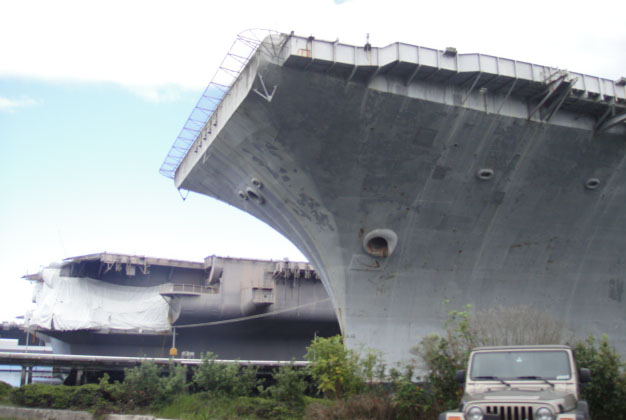
Carrier
Row, Puget Sound Naval Shipyard in Bremerton, Washington, where
the Fukushima-contaminated USS Ronald Reagan was refitted over an 18-month period.
Reconnaissance
helicopters roared back to the mother ship, which then carved an arc through
the chill waters of the Liman Current. The pride of the U.S. Navy was
fleeing the coast of Japan like a wounded whale from a shiver of hungry
sharks.
The USS Reagan’s
support role for Operation Tomodachi sustained far more injuries than
any of the 9th Carrier Group’s exercises off the Korean Peninsula.
The crews of three helicopter suffered high exposure levels, and sailors
operating the ventilation controls have since come down with severe radiation-related
symptoms.
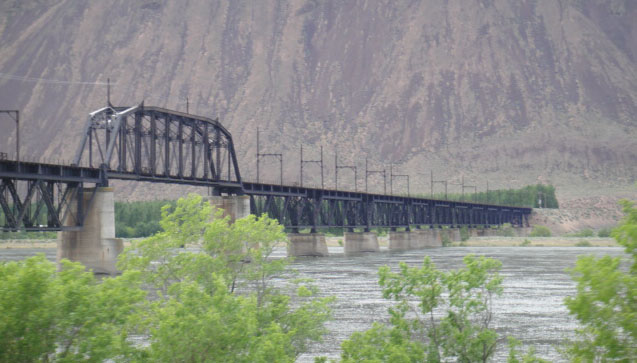
A
railroad bridge crossing the Columbia River was traversed by
the train that transported radioactive waste from the USS Ronald Reagan to the Hanford Site.
Fukushima radiation
seeped beyond soft tissue into hard steel. Below the flight deck, nuclear
isotopes in the air flowed into the air vents and below-deck ducts, while
radioactive seawater surged through its turbine pumps and tubes that suck
in seawater for the desalination system and to cool the vessel’s twin
nuclear-power reactors. The artificially produced freshwater for washing
and drinking aboard ship was soon toxic.
The detection
of war-grade plutonium residues sparked rumors of a nuclear strike on
Fukushima in undeclared war by an unidentified power. Meanwhile a blanket
of censorship was imposed over the condition and whereabouts of the USS
Ronald Reagan, which at that moment could have possibly been the first
casualty of World War III. Not until months later did confidential leaks
emerge from U.S. nonproliferation experts disclosing secret transfers
of highly enriched plutonium from Texas blended into mixed-oxide fuel
rods for Fukushima Reactors 3 and 4.
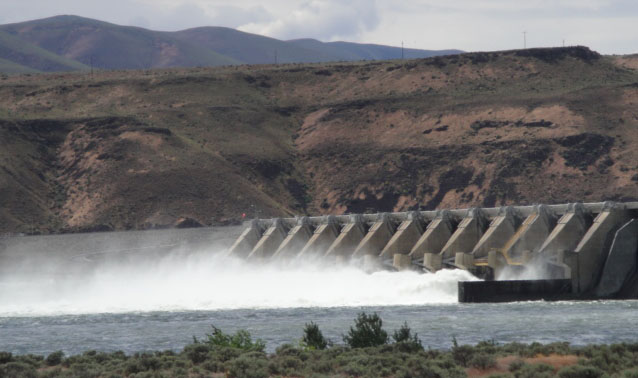
Wanapum
Hydropower Dam, 30 miles upstream from Hanford,
was mysteriously dusted with radioactive isotopes
Over the two
years since the March 2011 meltdowns, the radiation-stricken carrier vanished
from the sailing schedule, leaving other naval behemoths to take over
its missions in the South China Sea, Gulf of Aden, the Persian Gulf and
Red Sea. Then this spring, the vessel reappeared in San Diego as if nothing
had happened.
Casey
Jones, Watch Your Speed
The story behind
the USS Ronald Reagan’s long absence from active duty was revealed by
a Navy long-timer perched at a bar outside the Bremerton Naval Shipyard
in Seattle.
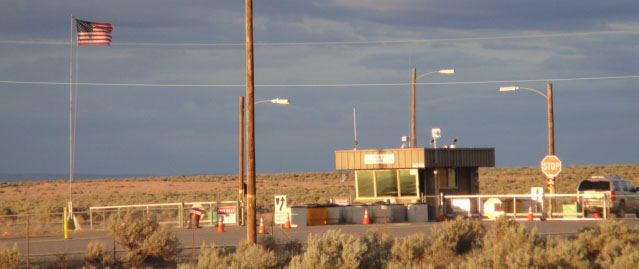
A
guard post at Hanford Site keeps out uninvited visitors.
After flushing
its pipes while transporting sailors’ cars to Alaska, the carrier was
docked for decontamination and refitting along Bremerton’s “Carrier Row”.
From early autumn 2011 until mid-March 2013, a period of 18 months, shipyard
workers replaced irradiated air ducts, pumps, pipes, gaskets, hoses and
electronic controls sensitive to radiation. The work gangs were ordered
to prevent release of any contaminated liquid into Puget Sound in compliance
with a prior Environmental Agency pollution complaint issued in 2010.
(My dosimeter
readings at Bremerton and at several points in Puget Sound confirmed the
absence of radiation leakage from the USS Reagan. Frequent sightings of
dead Dungeness crabs with floppy legs, however, suggested mortality caused
by chemical toxins, probably surfactants used for cleaning the carrier
and possibly heavy-metal compounds, possibly chrome, to deter barnacles
from the hull.)
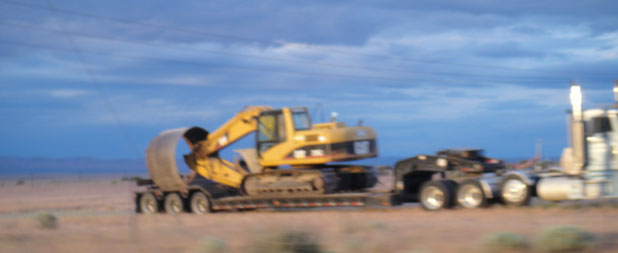
A
backhoe and steel ring are hauled to Hanford’s leaking 200 storage tank
area.
The vast pile
of radioactive scrap and barrels of liquid waste were then loaded onto
a freight train that rumbled out of the shipyard to a final resting place.
Its destination was and still is undisclosed to the news media, the public
and state officials. The terminus of that old rail track, say the shipyard
workers, is Hanford Site.
Mapping
the Terrain
Moral outrage
at the disposal of the military’s radioactive hardware in a Department
of Energy (DOE) facility supposedly under decommissioning was pushed to
the back of my mind by the astonishing natural beauty of the Cascade Range.
The four-hour drive from Seattle to Hanford offers a first-hand study
in ecology. The lacework of inlets and rocky islands of Puget Sound was
carved by glaciers during the Ice Age, when the sea was much lower. Those
rivers of ice originated in the Cascades, a sawtooth chain of basalt pillars,
remnants of ancient volcanoes. Its ridgeline divides Washington State
into two major eco-zones, the temperate rainforest of the Pacific coast
and, on the leeward side, arid lands stretching toward the Rockies.
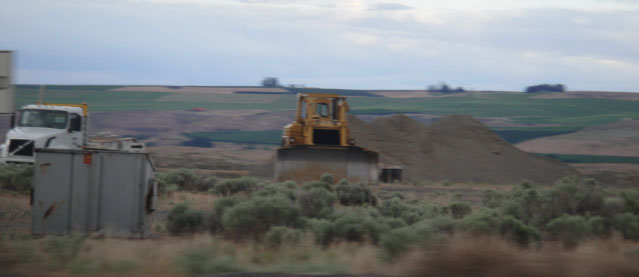
A
bulldozer starts to excavate a trench for the military’s nuclear
waste. Earlier burial sites can be seen in the background.
The eastern
slope of the watershed creates hundreds of streams that merge into the
Columbia River, which quenches apple orchards and the green pastures for
Angus cattle, dairy cows and bison. The mighty current is slowed by a
series of hydropower dams before hitting its lower reaches at Portland,
Oregon.
Under a high
bluff at Wanapum Dam, about 30 miles northwest of Hanford, my dosimeter
readings climbed to 0.16 microsieverts. Downstream, the findings were
much lower. When the air is bone-dry, how can evaporated wastewater from
leaking tanks at Hanford move so far upstream against the prevailing wind?
Why are there no traces of its passage up the gorge? I take mental note
of this baffling riddle before moving on.
Nuclear
Boneyard
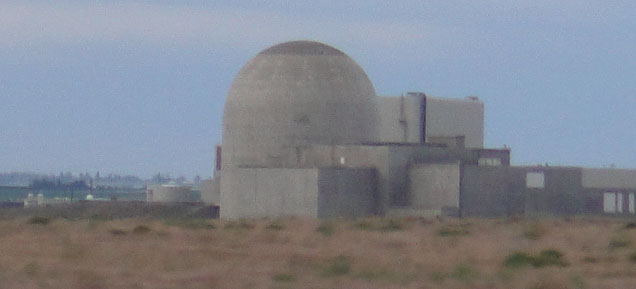
A
plutonium processing reactor
Endless flows
of water and hydropower are the necessary utilities for the production
of nuclear weapons, and the Columbia provides these in abundance to Hanford
Site, founded in 1943 under the Manhattan Project. Ringed by rosy red
hills peppered with fingers of black basalt and clumps of sage, the first
impression of Hanford basin is one of awe at Nature’s raw power rather
than fear of a grim manmade Mordor. Technology’s supreme force shrinks
against such grandeur; its fabrications scattered like the Mad Hatter’s
overturned teacups and sugar cubes alongside the Columbia.
Yet one of
those fly specks down there, inside the facility’s 586 square miles (1,517
sq. km) area, is the world’s first plutonium-production reactor. Hanford
100B provided the implosive force for the Trinity test blast and for Fat
Man, the hydrogen bomb that annihilated Nagasaki in August 1945. Nagasaki,
so much like Puget Sound, with its cathedral, shipyards, parks, saloons
and Victorian era facades . . . vanished like dream in a flash of blinding
light.
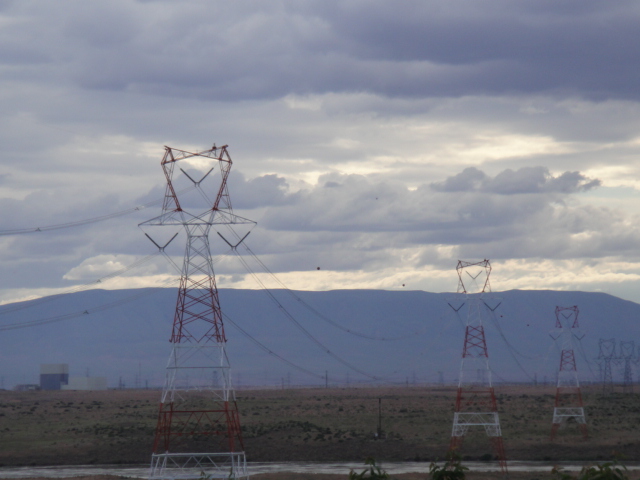
To
the right of the power line is a 100 series reactor.
After passing
under its rusty bridges in the hills, here on dry pale ground, I spot
the railroad track pointing toward the 200 West Area. On lonesome roads
outside and inside the vast facility, long-bed trucks haul yellow bulldozers
and back hoes, the grave diggers for dead machines. The earth-movers are
fitted with glass-enclosed air-filtered cabins, the thinnest of protective
shields for the drivers.
In rows of
trenches inside that dusty tract are the guts of the USS Ronald Reagan
along with the nuclear reactors from 117 decommissioned submarines. The
reactor cores are left uncovered so that Russian satellites can verify
reductions in America’s strategic arsenal. A retired nuclear-plant operator
explains how those reactor cores, too heavy and bulky for the train, are
instead transported by barge up the Columbia River. At Port Benson, adjoining
Hanford Site, the load is rolled aboard a land carrier with 16-wheel axles
and hauled at 5 miles per hour to the nuclear graveyard.
The Puget Sound
Naval Shipyard at Bremerton is the only facility that dismantles America’s
fleet of aging nuclear submarines. The fuel from the scrapped reactors
is sent by rail to a federal storage facility near Idaho Falls. Little
is known about the movements of naval cargo because several maritime lanes
in Puget Sound are protected by armed guards on speed boats, Navy SEAL
divers prowling underwater and surveillance dolphins equipped with electronic
sensors and GPS tracking devices. Fishermen, clam diggers and recreational
sailors know better than to mess with this security force.
There is no
legal mandate to inform Washington State communities of passing reactor-toting
barges because the Navy designates the cargo as “low level” waste. Local
residents who are curious about these shipments will not find the route
map posted at their docks or bridges, so here it is, courtesy of the Washington
Physicians for Social Responsibility:
“The route
begins at the (Bremerton) Shipyard and goes though Rich Passage, past
Restoration Point, and northerly though Puget Sound. The barge will then
move west through the Strait of Juan De Fuca, past Cape Flattery, before
turning south and going along the Washington Coast. As the barge makes
its way to the mouth of the Columbia River it will not enter the area
near the Olympic Coast National Marine Sanctuary known as the Area to
Be Avoided.
The barge will then go up the Columbia River following the
regular shipping channel that is used for commercial cargo. The ocean
tugs turn over the barge to river tugs on the lower Columbia. The river
route passes through the navigation locks at the Bonneville, Dalles, John
Day, and McCanry dams, until finally reaching the Port of Benton. “
Portlanders
are hereby informed that radiation is coming and going, upstream and downstream.
It’s been happening since 1986 and will continue indefinitely.
Hearts
Afire
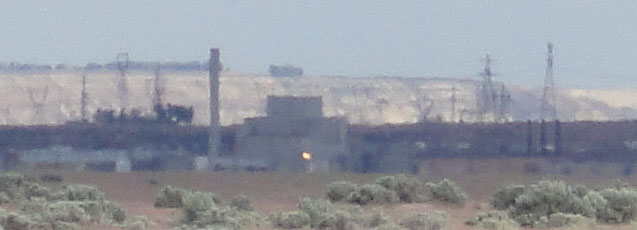
A point of
light is flickering from inside one of the older thermal power plants.
Next to a No Entry sign, my travel party passes a pair of binoculars for
a closer look. It is not sunlight reflected off a window pane. Incredibly,
there’s a massive fire blazing inside the nuclear plant. Flames are blowing
out of the open door, which is at least two stories tall and wide enough
for several trucks. No black smoke is being emitted, nor do the flames
diminish in intensity. Alarms are not blaring and there are no firefighting
sirens. Therefore, it must be a gas fire, deliberately set.
The sight of
a structure’s innards on fire is dumbfounding. Nothing about this sort
of incident has ever been reported in Hanford press releases. What could
DOE be up to? Surfacing in my mind’s eye is a flashback of the dosimeter
reading at the Wanapum hydropower dam. Hanford is being decommissioned,
and the fastest way to clean out a thermal power plant used in the past
to incinerate nuclear waste is to torch it. The invisible hot fumes lift
the radioactive particles hundreds of meters into the desert sky, and
then at nighttime an updraft carries the airborne waste up the Columbia
gorge to Wanapum and beyond. Thus, the radioactive residues disappear
as if by magic, and the monitors, inspectors and visitors remain none
the wiser.
Atmospheric
releases blowing out of Hanford are swirling up and down the Columbia
gorge, unbeknownst to ranchers, apple growers, restaurant operators, school
teachers and truckers along the riverbanks. Nobody on the outside is being
warned of the threat. This is still the Wild West, where an outlaw gang
like the DOE can kill everyone and anything that stands in their way.
Above
the Aquifer
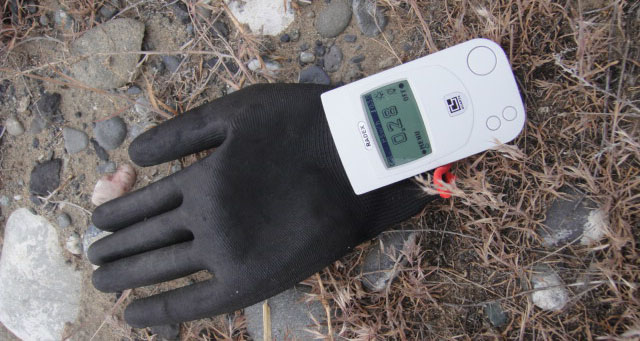
For plant workers,
the most fearsome piece of equipment inside plutonium-processing and warhead-production
facilities is the glove-box. Since the more delicate operations must be
done by hand, glove-boxes have a window and fitted with a pair of holes
for insertion from fingers to elbow. In both Fukushima and Hanford, the
best way to test exposure levels in nuclear workers is to measure castoff
gloves. At a roadside spot convenient for quick relief, a black work glove
was lying on the gravel. It registered 0.28 microsieverts, meaning whoever
urinated is a dead man walking.
By the 1960s,
waste disposal became a major problem at Hanford due to the expanding
number of 100 series reactors, along with plutonium processing centers
and a power generation plant. Initially, the DOE planned to drill long-term
storage caverns into Gable Mountain, a saddle-shaped mound of basalt on
the plant’s north side between the Columbia River reactors and the plutonium-enrichment
facilities.
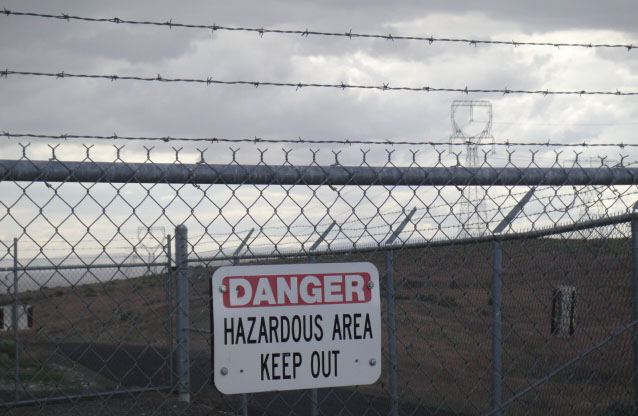
The
warning sign is posted at a waste disposal site adjoining a fast-flowing
drainage ditch.
Geologists,
working on the environmental feasibility report, found that Hanford Site
sits atop the Pasco Aquifer, the source of well water for towns, ranches
and fruit farms inside the big bulge of the Columbia. This discovery prompted
the 1978 DOE study of Yucca Mountain in Nevada as a permanent repository
of nuclear waste, but the proposed site was later abandoned due to political
opposition from nearby Las Vegas interests.
The termination
of Yucca Mountain led to an untenable situation at the 200 East Tank Farm.
There, 177 rusted-out single- and double-shelled tanks “are far gone,
past their 20-year lifetime,” said the plant operator. Tritium has been
leaking onto the ground and in the air. A greater problem is that solid
particles of plutonium and other radioactive elements are settling to
the bottom of the wastewater tanks. When atoms are in close proximity,
the release of neutrons from radioactive decay can result in a chain reaction.
DOE engineers
are anxious about the possibility of an explosive chain reaction at the
tank farm similar to the tritium blast that wrecking Fukushima’s Reactor
3. Tritium and deuterium, also known as heavy water, along with hydrogen
gas, could blow the tanks apart, sending radioactive steam into the clouds.
A much greater threat, said the plant insider, is a downward blast into
the Pasco Aquifer, sending ripples of death through hundreds of miles
of drinking water for local residents. Leakage from ruptured tanks into
the Columbia would doom downstream communities, including Portland and
its Silicon Forest industrial parks, anchored by Intel.
Grape
vines are planted across the river from Hanford’s nuclear power complex.
To prevent
this doomsday scenario, the DOE contracted the Bechtel engineering company
to design as unmanned mixing system to prevent the precipitation of plutonium
from the wastewater. The controversial design for the vitrification plant
uses jet pulses through tubes, called turkey basters, to repeatedly remix
the radioactive soup, keeping the radioactive particles in permanent suspension.
The design is fraught with weak points that could easily burst under corrosion
and high pressure. Cost overruns and construction delays have postponed
completion from 2007 to 2022, which is probably much too late to head
off a catastrophe.
DOE, the Pentagon
and nuclear industry should admit the obvious: Hanford is broken and cannot
be fixed. A radical alternative to storage at Hanford needs to be developed
rapidly and a crash program will require vast sums of money and the political
will to stop all nuclear operations from coast to coast. Permissiveness
toward the nuclear industry is suicidal. A new energy policy must begin
with zero tolerance for nuclear.
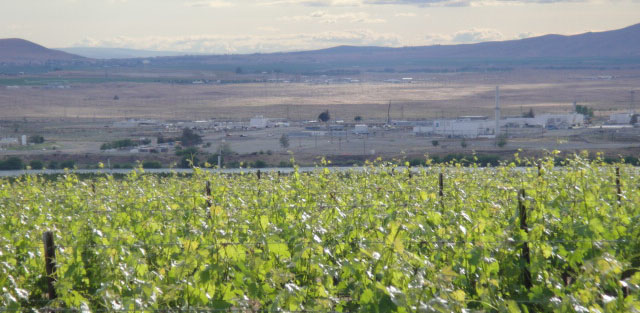
Grape vines are planted across the river from Hanford’s nuclear
power complex.
Turn
Out the Lights
The music’s
over for the nuclear industry. Three Mile Island, Chernobyl and Fukushima
have savaged the myth of cheap and safe power from atom-splitting. Hanford
takes this fiasco a step further by implicating the military in nuclear
skullduggery. Despite its bloated defense budget, the Pentagon is misappropriating
the fiscal resources of the DOE, which must dispose of nuclear-contaminated
military hardware. Funds that could otherwise be allocated to replacing
the storage tanks at Hanford are being spent on burying submarine reactors.
The Office of Management and Budget (OMB) is facing a radioactive mess
of waste, fraud and mismanagement.
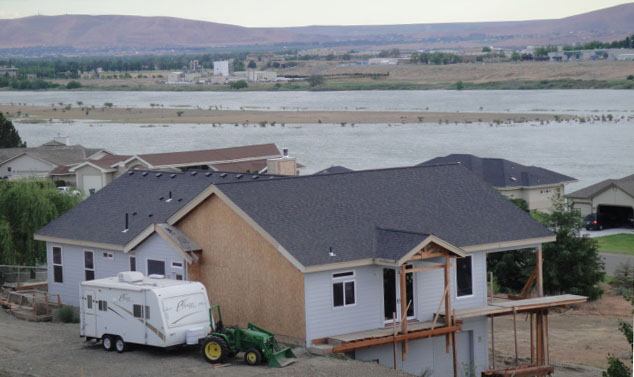
A
housing development reflects fatal problems in local zoning ordinances.
The ominous
situation at the Hanford rust belt is the result of a false sense of national
security. Nuclear weapons have been ineffective as an instrument for global
stability since their inception. Nuclear deterrence has failed to prevent
outbreaks of war and terrorism, and the Cold War would have ended sooner
without warheads. Instead of preserving the peace, the nuclear arsenals
of the major powers have only spurred on proliferation by minor regional
players.
However fast
or slow the pace of future nuclear drawdown, the problem of long-term
storage remains a formidable challenge, now that Yucca Mountain is nixed.
The search for a safe site for a nuclear-waste repository should have
started yesterday. The federal government controls millions of acres in
sites that have outlived their usefulness, for example, military zones
like Fallon test range or Area 51. The Pentagon should use its own turf
to store its waste instead of dumping on the hard-pressed DOE. The cost
of the relocating naval reactors should be deducted from the inflated
military budget and not from the shrinking pockets of taxpayers.
Ozone
Loss Led to Climate Chaos
If the threat
from Fukushima isn’t enough to bear, lethal radioactive releases from
Hanford and San Onofre, along with Indian Point and the Napoleonville
sinkhole, should motivate Americans to political action against the nuclear
lobby and its sycophants. National security and, much more, the very existence
of American society and the continent’s natural environment, are coming
apart from the effects of high-energy particles in the jet stream, which
cause ozone depletion over the Northern Hemisphere. The consequences include
the recent tornadoes in Texas and Oklahoma, and an epidemic of winter
twisters, derecho storms, flooding and drought.
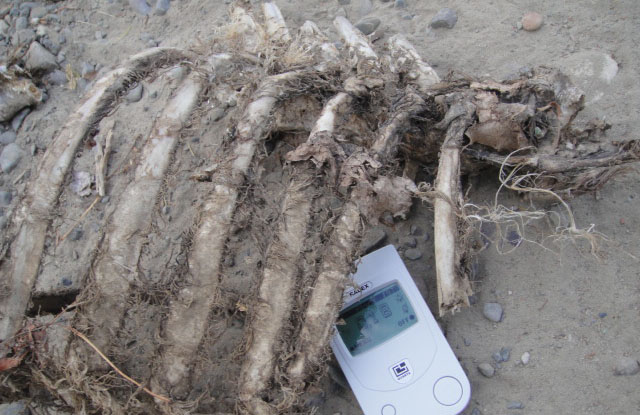
The
ribs of a wild faun indicate dangerous radiation levels in coyotes.
The harmful
influence of carbon dioxide on global weather, as exaggerated by supporters
of TEPCO and the Tennessee Valley Authority, is a convenient ruse to divert
attention and funding from the immediate task of shutting down nuclear
power.
An end to nuclear
tyranny is directly linked to the revival of genuine democracy. A sinister
and cynical force within America’s political establishment, economic elite
and scientific elect is desperately trying to prevent Americans from recovering
this nation’s foundational values of civic duty, ethical responsibility
and common sense.
Any physicist,
engineer, bureaucrat, president or monarch who persists in uttering ultra-absurd
nonsense in defense of nuclear power should be hauled away to a padded
cell for deprogramming and decommissioning. If anything is going to be
buried, it should be that deceiving pack of con artists and scoundrels.
With so many
burned-out reactors and morally warped scoundrels to deal with, let’s
hear what Nick Santoro (Joe Pesci) of Casino has to say: “A lot
of holes in the desert, and a lot of problems are buried there. You gotta
have the hole already dug before you show up with a package in the trunk.
Otherwise, you’re talking about a half-hour to 45 minutes of digging.
And who knows who’s gonna come along at that time? Pretty soon you gotta
dig a few more holes. You could be there all fricking night.”
Quick
Reads of the Technical Details
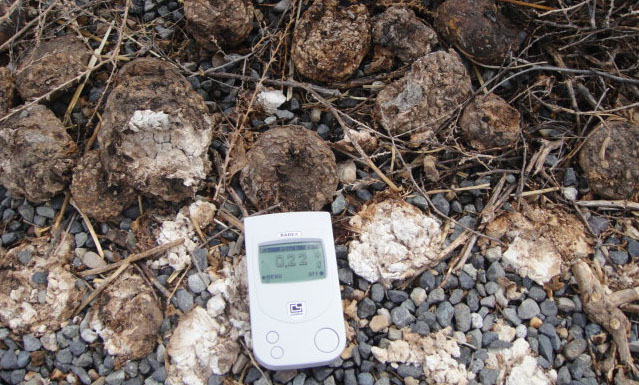
Cattle
manure along the Hanford fence show extreme levels of radiation ingestion.
The Columbia
River, once a life-giver for the Pacific Northwest, has become the bringer
of death on an unimaginable scale. Testing of radiation levels in its
waters is not being done by any government agency. My dosimeter readings
at the Hanford and on the mid-reaches of the Columbia cannot be a substitute
for a wider monitoring program, but they do point to the rising threat
of nuclear contamination.
Even with scientific
Geiger counters, the testing of water remains an elusive task.
Gamma rays
are reflected in water, throwing off readings by as much as 20 times lower
than the actual level of contamination. Thus, the only way for a layman
to make estimates in the field is by measuring biological accumulation
in plants and animals.
Dosimeter readings
on the bluffs northwest of Hanford showed low levels, due to the prevailing
wind and lack of airborne moisture.
At a riverine
chokepoint on the north bend between Reactors D and H, a wide variation
in readings, from 0.08 to 0.28 microsieverts, with the highest in sage,
indicated different rates of water absorption by various species of flora.
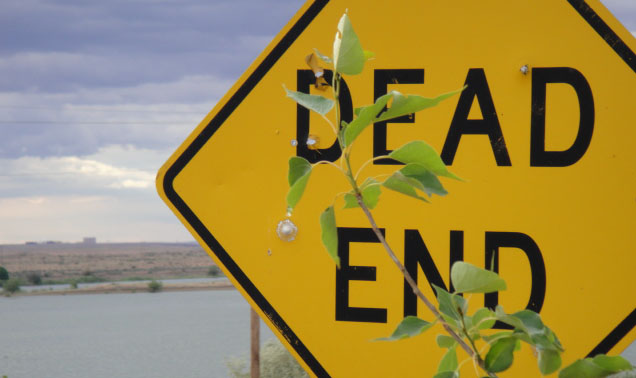
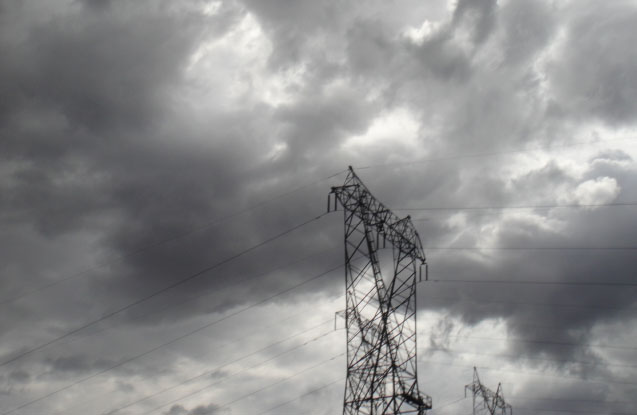
A
reactor of the 100 series is on the horizon behind the sign.
At points downriver,
near the southern tip of Hanford, the measurements on different plant
species ran consistently in the 0.28 range, equivalent to coastal areas
inside the Fukushima exclusion area (9 km from the meltdowns). A ribcage
from a faun devoured by coyotes showed remarkably high contamination,
suggesting higher levels inside predators.
The high water
from the spring snowmelt prevented access to underwater vegetation. The
readings along the outer bank of the Columbia, however, indicate levels
dangerous to downstream communities and coastal populations in northern
Oregon.
Author:
Yoichi Shimatsu is a Hong Kong-based science writer and environmental
health consultant who provides herbal therapy to Fukushima residents.
|


 Reliable
sources in Washington D.C. have informed the Organic Consumers
Association (OCA) that Monsanto has begun secretly lobbying its
Congressional allies to attach one or more “Monsanto Riders” or
amendments to the 2013 Farm Bill that would preempt or prohibit states
from requiring labels on genetically engineered (GE) foods.
Reliable
sources in Washington D.C. have informed the Organic Consumers
Association (OCA) that Monsanto has begun secretly lobbying its
Congressional allies to attach one or more “Monsanto Riders” or
amendments to the 2013 Farm Bill that would preempt or prohibit states
from requiring labels on genetically engineered (GE) foods. In response to this blatant violation of states’ rights to legislate, and consumers’ right to know, the OCA and a nationwide alliance have launched a petition to put every member of Congress on notice: If you support any Farm Bill amendment that would nullify states’ rights to label genetically modified organisms (GMOs), we’ll vote – or throw – you out of office.
On Wednesday, May 15, an amendment to the House version of the Farm Bill, inserted under the guise of protecting interstate commerce, passed out of the House Agricultural Committee. If the King Amendment makes it into the final Farm Bill, it would take away states’ rights to pass laws governing the production or manufacture of any agricultural product, including food and animals raised for food, that is involved in interstate commerce. The amendment was proposed by Rep. Steve King (R-Iowa), largely in response to a California law stating that by 2015, California will allow only eggs to be sold from hens housed in cages specified by California. But policy analysts emphasize that the amendment, broadly and ambiguously written, could be used to prohibit or preempt any state GMO labeling or food safety law.
Will the King Amendment survive the Senate? No one can be sure, say analysts. However few doubt that Monsanto will give up. We can expect that more amendments and riders will be introduced into the Farm Bill--even if the King Amendment fails—over the next month in an attempt to stop the wave of state GMO labeling laws and initiatives moving forward in states like Washington, Vermont, Maine, Connecticut and others.
Monsanto and the Grocery Manufacturers Association (GMA) have admitted privately that they’ve “lost the battle” to stop GE food labeling at the state level, now that states are aggressively moving forward on labeling laws. On May 14, Maine’s House Ag Committee passed a GMO labeling law. On May 10, the Vermont House passed a labeling bill, 99-42, despite massive lobbying by Monsanto and threats to sue the state. And though Monsanto won a razor-thin victory (51 percent to 49 percent) in a costly, hard fought California GMO labeling ballot initiative last November, biotech and Big Food now realize that Washington State voters will likely pass I-522, an upcoming ballot initiative to label GE foods, on November 5.
If Monsanto can’t stop states from passing laws, then the next step is a national preemptive measure. And all signs point to just such a power grab. Earlier this year, Monsanto slipped its extremely unpopular “Monsanto Protection Act,” an act that gives biotech immunity from federal prosecution for planting illegally approved GE crops, into the 2013 Federal Appropriations Bill. During the June 2012 Farm Bill debate, 73 U.S. Senators voted against the right of states to pass mandatory GE food labeling laws. Emboldened by these votes, and now the House Ag Committee’s vote on the King Amendment, Monsanto has every reason to believe Congress would support a potential nullification of states’ rights to label.
The million-strong OCA and its allies in the organic and natural health movement are warning incumbent Senators and House members, Democrats and Republicans alike, that thousands of health and environmental-minded constituents in their Congressional districts or states will work to recall them or drive them out of office if they fail to heed the will of the people and to respect the time-honored traditions of shared state sovereignty over food labels, food safety laws, and consumers’ right to know.
Trouble in Monsanto Nation.
Over the past 20 years Monsanto and the biotech industry, aided and abetted by indentured politicians and corporate agribusiness, have begun seizing control over the global food and farming system, including the legislative, patent, trade, judicial and regulatory bodies that are supposed to safeguard the public interest.
In the U.S., despite mounting evidence of the damage GE crops inflict on human health and the environment, approximately 170 million acres of GE crops, including corn, soybeans, cotton, canola, sugar beets, alfalfa, papaya, and squash, are currently under cultivation. These crops, untested and unlabeled, comprise 41 percent of all cultivated cropland, or 17 percent of all cropland and pastureland combined. According to the GMA, at least 70 percent of non-organic grocery store processed foods contain GMOs. And GE grains and mill byproducts now supply the overwhelming majority of animal feed on the factory farms that supply 90 percent to 95 percent of the meat, eggs and dairy products that Americans consume.
Yet despite their marketplace dominance, record profits and enormous political clout in Washington D.C., Monsanto and the biotech industry are in deep trouble. Evidence is mounting that Monsanto’s top-selling herbicide, Roundup, is a deadly poison, destroying important human gut bacteria and likely contributing to the rapid increase of food allergies and serious human diseases including cancer, autism, neurological disorders , Attention Deficit Hyperactive Disorder (ADHD), dementia, Alzheimer’s, schizophrenia and bipolar disorder. Those most susceptible to poisoning by Monsanto’s Roundup are children and the elderly.
Scientists aren’t the only ones raising new questions about Roundup. Farmers are complaining that they’re being forced to spray more and more chemicals on crops increasingly under siege from a growing army of herbicide-resistant weeds. The situation is so bad that the U.S. Environmental Protection Agency (EPA) just raised the limits of Roundup residue allowed on grains and vegetables to even more dangerous levels. But just in case the EPA someday stops raising the limits, Monsanto, Dow and the biotech industry are working on a new “solution” to the onslaught of herbicide-resistant Superweeds: They’ve applied for approval of a new and highly controversial generation of super toxic herbicide-resistant GE crops, including “Agent Orange” (2,4-D and dicamba-resistant) corn, soybeans and cotton.
As a recent widely-circulated article points out,
- “The use of 2,4-D is not new; it’s actually one of the most widely used herbicides in the world. What is new is that farmers will now ‘carpet bomb’ staple food crops like soy and corn with this chemical at a previously unprecedented scale—just the way glyphosate has been indiscriminately applied as a result of Roundup Ready crops. In fact, if 2,4-D resistant crops receive approval and eventually come to replace Monsanto's failing Roundup-resistant crops as Dow intends, it is likely that billions of pounds will be needed, on top of the already insane levels of Roundup being used (1.6 billion lbs were used in 2007 in the US alone).”
In addition to these Agent Orange crops, an expanded menu of genetically engineered organisms are awaiting approval. Next on the menu? GE apples, trees, and salmon.
State Labeling Laws: The ‘skull and crossbones’ that terrify Monsanto
Monsanto’s greatest fear isn’t a federal government charged with protecting the health and safety of its citizens. Congress and the White House seem only too happy to oblige the biotech industry’s unquenchable thirst for growth, power and dominance. No, it’s the massive, unstoppable (so far) grassroots movement of Millions Against Monsanto that strikes fear in the heart of the Biotech Bully. U.S. citizens are waking up. They’re demanding labels on genetically engineered foods, similar to those already required in the European Union. They’re calling for serious independent safety-testing of GE crops and animals, both those already approved (especially Monsanto’s Roundup-resistant crops) and those awaiting approval.
The anti-GMO movement has finally figured out, after 20 years of fruitlessly lobbying Congress, the FDA and the White House, that the federal government is not going to require labels on GE foods. Instead the movement has shifted the battleground on GMO labeling from Monsanto and Big Food’s turf in Washington D.C. to the more favorable terrain of state ballot initiatives and state legislative action—publicizing the fact that a state GMO labeling law will have the same marketplace impact as a national labeling law.
State laws spell doom for Monsanto. Companies like Kellogg’s, General Mills, Coca-Cola, Pepsi/Frito-Lay, Dean Foods, Unilever, Con-Agra, Safeway, Wal-Mart and Smuckers are not going to label in just one or two states. Monsanto knows that U.S. food companies will go GMO-free in the entire U.S., rather than admit to consumers that their products contain GMOs.
As Monsanto itself has pointed out, labels on genetically engineered foods are like putting a “skull and crossbones” on food packages. This is why Monsanto and their allies poured $46 million into defeating a California ballot initiative last year that would have required labels on GMO foods. This is why Monsanto has lobbied strenuously in 30 states this year to prevent, or at least delay, state mandatory labeling laws from being passed. This is why Monsanto has threatened to file federal lawsuits against Vermont, Connecticut, Maine and Washington if they dare grant citizens the right to know whether or not their food has been genetically engineered or not.
And this is why Monsanto’s minions are trying to insert amendments or riders into the Farm Bill that will make it nearly impossible, even illegal, for states to pass GMO labeling laws. And there’s nothing to stop them when Congress is filled with pro-biotech cheerleaders who could care less that 90 percent of U.S. consumers want mandatory labels and proper safety testing of genetically engineered crops and foods.
Countering Monsanto’s Final Offensive: Throw the Bums Out!
Only a massive grassroots resistance will deter the U.S. Senate and House from stomping on our rights. Only an unprecedented campaign of public education, petition-gathering and grassroots pressure will be able to convince the ever-more corrupt and indentured politicians in Washington D.C. to back off.
Eighteen state constitutions have century-old provisions for state registered voters to collect petitions and recall state and local officials, forcing them to either resign or stand for reelection. But what very few Americans, and even members of Congress, realize is that 11 states have constitutional provisions to recall U.S. Senators and House of Representative members, as well as state elected officials.
It’s time we exercise the full power of direct democracy, not just state and municipal ballot initiatives. We must continue to support efforts like the current state ballot initiative to label GMOs in Washington state, and county ballot initiatives to ban GMOs, factory farms and other corporate crimes, in the 24 states and hundreds of counties and municipalities where these are allowed. But we also need to use the power we have to recall and throw out of office our out-of-control Congressional Senators and Representatives as well.
If our elected officials in Congress continue to represent Monsanto and big corporations, rather than their constituents, then let’s throw the bums out! If the Washington political Establishment, both Democrats and Republicans, continue to trample on our inalienable constitutional rights and contemptuously disregard the 225-year principle of a shared balance of power between the federal government, the states and local government, then we have no choice but to recall them or throw them out of office.
Please join the nation’s organic consumers and natural health advocates in this strategic battle, the Food Fight of Our Lives. Please join this campaign to save, not only our right to choose what’s in our food, but our basic right to democratic representation and self-determination as well. Sign the petition. Tell your Congressmen and women, especially the 73 incumbents who voted last year to eliminate states rights’ to legislate on GMO labels, and those in the House this week who voted to support the King Amendment that “enough is enough,” “ basta ya.” Power to the People!

 See
the image of the paper's "No Jab No Play" campaign on the right. This
is the actual image taken from the paper's editorial page where they are
pushing this idea of socially condemning all children whose parents do
not submit to state-sponsored medical terrorism.
See
the image of the paper's "No Jab No Play" campaign on the right. This
is the actual image taken from the paper's editorial page where they are
pushing this idea of socially condemning all children whose parents do
not submit to state-sponsored medical terrorism. This
no doubt pleases the Telegraph in the same way that destroying the
planet Alderaan might please the Grand Moff Tarkin from the Star Wars
universe. What's a few billion lives lost compared to the raw power of
total control over the lives of other humans, after all?
This
no doubt pleases the Telegraph in the same way that destroying the
planet Alderaan might please the Grand Moff Tarkin from the Star Wars
universe. What's a few billion lives lost compared to the raw power of
total control over the lives of other humans, after all?

 When
it was Asher's turn to speak, she expressed "concern about
what seemed to me a wrongful search on the part of the police. The
jury foreman then reminded me that the judge had ruled out the matter
of the search, and that we were not allowed to consider it."
When
it was Asher's turn to speak, she expressed "concern about
what seemed to me a wrongful search on the part of the police. The
jury foreman then reminded me that the judge had ruled out the matter
of the search, and that we were not allowed to consider it." At
the very least, Buttars was guilty of
At
the very least, Buttars was guilty of