Showing posts with label Dams. Show all posts

Wednesday, April 10, 2013

Amazon People Theaten War Against Brazil's Dam Projects Destroying Rivers

Brazil dam row – local activists march past machinery being used in the construction of the massive Belo Monte hydroelectric dam.
 
Brazil dam row – local activists march past machinery being used in the construction of the massive Belo Monte hydroelectric dam.
 
An Amazonian community has threatened to "go to war" with the Brazilian government after a military incursion into their land by dam builders.

The Munduruku indigenous community in Para state say they have been betrayed by the authorities, who are pushing ahead with plans to build a cascade of hydropower plants on the Tapajós river without their permission.

Public prosecutors, human rights groups, environmental organisations and Christian missionaries have condemned the government's strong-arm tactics.

Helicopters, soldiers and armed police have been involved in Operation Tapajós, which aims to conduct an environmental impact assessment for the first proposed construction, the 6,133 MW São Luiz do Tapajós dam.

The facility, to be built by the Norte Energia consortium, is the biggest of three planned dams on the Tapajós, the fifth-largest river in the Amazon basin. The government's 10-year plan includes the construction of four larger hydroelectric plants on its tributary, the Jamanxim.
Under Brazilian law, major infrastructure projects require prior consultation with indigenous communities. Federal prosecutors say this has not happened and urge the courts to block the scheme which, they fear, could lead to bloodshed.

"The Munduruku have already stated on several occasions that they do not support studies for hydroelectric plants on their land unless there is full prior consultation," the prosecutors noted in a statement.

A similar survey in November led to deadly conflict. One resident, Adenilson Kirixi, was killed and several others were wounded in clashes between local people and troops accompanying the researchers in Teles Pires village.

The ministry of mines and energy noted on its website that 80 researchers, including biologists and foresters, would undertake a study of flora and fauna. The army escort was made possible by President Dilma Rousseff, who decreed this year that military personnel could be used for survey operations.

Missionaries said the recent show of force in Sawré Maybu village, Itaituba, was intimidating, degrading and an unacceptable violation of the rights of the residents.

"In this operation, the federal government has been threatening the lives of the people," the Indigenous Missionary Council said. "It is unacceptable and illegitimate for the government to impose dialogue at the tip of a bayonet."

The group said Munduruku leaders ended a phone call with representatives of the president with a declaration of war. They have also issued open letters calling for an end to the military operation, "We are not bandits. We feel betrayed, humiliated and disrespected by all this," a letter states.

One of the community's leaders, Valdenir Munduruku, has warned that locals will take action if the government does not withdraw its taskforce by 10 April. He has called for support from other indigenous groups, such as the Xingu, facing similar threats from hydroelectric dams.
Environmental groups have expressed concern.

The 1,200-mile waterway is home to more than 300 fish species and provides sustenance to some of the most biodiverse forest habitats on Earth. Ten indigenous groups inhabit the basin, along with several tribes in voluntary isolation.

With similar conflicts over other proposed dams in the Amazon, such as those at Belo Monte, Teles Pires, Santo Antônio and Jirau, some compare the use of force to the last great expansion of hydropower during the military dictatorship.

"The Brazilian government is making political decisions about the dams before the environmental impact assessment is done," said Brent Millikan of the International Rivers environmental group.

"The recent military operations illustrate that the federal government is willing to disregard existing legal instruments intended to foster dialogue between government and civil society."

Dept Of Interior Endorses Removal 4 Dams Klamath River


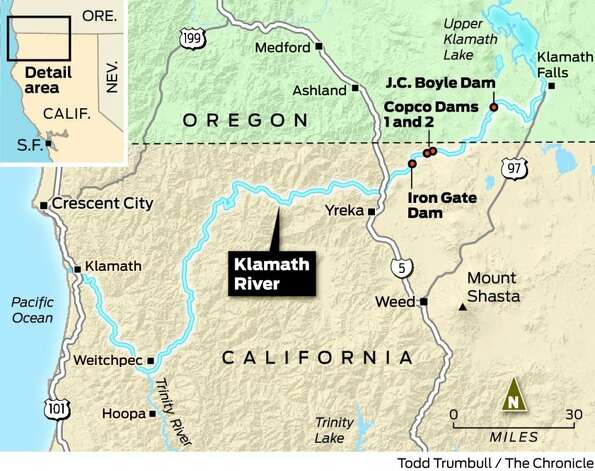
The four hydroelectric dams on the Klamath River that block salmon migration and cause toxic algae blooms in stagnant lake water should be removed, concludes the most comprehensive environmental study ever done on the river system that flows from Oregon through California to the Pacific.

If the dams go - still no sure bet - 420 miles of historic habitat would open for the first time in more than a century.

The final environmental impact statement on what would be the biggest dam-removal project in California history was released Thursday by the U.S. Department of the Interior. It supports removal of the dams: Iron Gate, Copco 1 and Copco 2 in California north of Yreka (Siskiyou County), and J.C. Boyle in Oregon.

The study predicts dam removal would employ 4,600 people during 15 years of work, and result in an 81 percent increase in chinook and similar increases in steelhead trout and coho salmon.

The project, which would cost about $1 billion, including habitat restoration and sediment removal, would nevertheless cost less over time than maintaining the reservoirs and building federally mandated fish ladders, according to Interior Department scientists.
The report "represents the most comprehensive scientific, engineering and environmental evaluation of facilities removal ever undertaken in the Klamath Basin," said Ken Salazar, secretary of the interior, in a statement.

The secretary, who will have to sign off on the plan, said removing the dams would resolve a lot of water-related problems among Indian tribes, farmers and utilities in the Klamath Basin while restoring historic fish runs.

Wild and scenic river

The mighty Klamath, a federally protected wild and scenic river, flows 255 miles from Oregon through California to the Pacific Ocean, draining 12,600 square miles of mountains, forests and marshlands that some have called the Everglades of the West.

The dams have blocked salmon migration along the California-Oregon border since the first one was built in 1909. The Klamath is the third-largest salmon run in the lower 48 states, behind the Columbia and Sacramento rivers.

Destructive parasites and blooms of toxic blue-green algae also contaminate the water behind the dams during the summer. Water diversions to cities and for agriculture exacerbate the problem, according to fishery biologists.

Serious talk of removing the dams began in 2002 after a federally ordered change in water flow led to the death of 33,000 salmon in the river.

About 40 parties, including American Indian tribes, farmers and fishermen, signed the 2010 Klamath Hydroelectric Settlement Agreement, which laid out the process of removing the dams operated by the PacifiCorp utility beginning in 2020. The groups also approved the Klamath Basin Restoration Agreement, which would appropriate $800 million over 15 years to divide up water and restore the habitat.

"The scientific and common sense conclusion is clear," said Rep. Jared Huffman, D-San Rafael. "We should tear down these dams."

Congress' approval needed

The problem is that both agreements need the approval of Congress, which appears reluctant to approve large expenditures for restoration and other costs. Supporters are now calling on the Senate Energy and Natural Resources Committee to call hearings on the matter.

"Dozens of groups came together and, despite their very different perspectives, were able to hammer out these agreements," said Curtis Knight, the conservation director for California Trout, a conservation organization. "Congress must do its part to turn this proposed local solution into reality."

There are opponents

Still, opposition remains, particularly among the 100 or so owners of lakefront property created by the dams. The value of 668 parcels is expected to go down as the reservoirs are drained.
In addition, customers of PacifiCorp in Oregon and California would pay an extra 2 percent on their monthly electric bills to cover the cost of dam removal. PacifiCorp has agreed to pay the first $200 million, and California will cover any costs above that, according to the removal agreement.

Read the report

The final Environmental Impact Statement is available at
www.klamathrestoration.gov.