NEW
YORK (AP) — For decades, people have been getting rid of cockroaches by
setting out bait mixed with poison. But in the late 1980s, in an
apartment test kitchen in Florida, something went very wrong.<br><br>
A killer product stopped working. Cockroach populations there kept
rising. Mystified researchers tested and discarded theory after theory
until they finally hit on the explanation: In a remarkably rapid display
of evolution at work, many of the cockroaches had lost their sweet
tooth, rejecting the corn syrup meant to attract them.<br><br>
In as little as five years, the sugar-rejecting trait had become so widespread that the bait had been rendered useless.
<br><br>
"Cockroaches are highly adaptive, and they're doing pretty well in
the arms race with us," said North Carolina State University
entomologist Jules Silverman, discoverer of the glucose aversion in that
Florida kitchen during a bait test.<br><br>
The findings illustrate the evolutionary prowess that has helped make
cockroaches so hard to stamp out that it is jokingly suggested they
could survive nuclear war.<br><br>
In a study published Thursday in the journal Science, Silverman and
other researchers explain the workings of the genetic mutation that gave
some roaches a competitive advantage that enabled them to survive and
multiply.<br><br>
The key is certain neurons that signal the brain about foods.<br><br>
In normal cockroaches, glucose excites neurons that tell the brain
"Sweet!" In the mutant insects, glucose activates neurons that say
"Sweet!" and ones that say "Yuck!" The "Yuck!" neurons dampen the signal
from the others, so the brain gets the message the taste is awful. This
unusual nerve activity appeared in glucose-hating cockroaches collected
from Puerto Rico as well as descendants of the Florida insects.<br><br>
The research focused on the German cockroach, a small kind that can
hitch a ride into your home in a grocery bag, not that big lunk known as
the American cockroach. Such finicky eating habits have also been seen
in these smaller roaches in Southern California, Cincinnati, Indiana,
South Korea and Russia. Scientists are now looking to see if other kinds
of cockroaches show aversion to glucose.<br><br>
The new work is nifty science. But does it explain why you can't get rid of the little buggers in your kitchen?<br><br>
Probably not, said Coby Schal, another study author at North Carolina State.
Tests show that the glucose-hating cockroaches are happy to eat most
types of bait these days, suggesting that manufacturers have removed the
glucose or masked it, he said. (Bait ingredients are a trade secret.) <br><br>
What's more, the researchers found glucose-hating cockroaches in only
seven of 19 populations they sampled from various locations.<br><br>
Frankly, if the bait you put out isn't working, it's probably because
you're using it incorrectly, suggested Schal, who said he consults to
the pesticide industry free of charge.<br><br>
Still, he said, the new work has potential to help many consumers. By
studying how cockroaches evolve to evade our poisons, scientists may
find clues to designing bait that the pests cannot resist.
<br><br>
It's not clear when the Florida cockroaches first encountered bait
with glucose or how quickly they ditched their taste for the sugar, he
said. But he said it's reasonable to estimate that it took maybe only
five years for that glucose aversion to spread to so many cockroaches
that the bait was no longer effective. That's about 25 generations of
German cockroaches, which can reproduce about one to three months after
they're born, Schal said.<br><br>
The glucose aversion may have arisen in an individual cockroach in
response to bait. Or it may have already been present in just a few
individuals when the arrival of the bait suddenly gave them an advantage
for surviving and reproducing. Their offspring would inherit the trait
and increasingly replace other cockroaches.<br><br>
Michael Scharf, an entomologist at Purdue University who studies
urban pests but wasn't involved in the new work, noted that since the
1950s, cockroaches have shown they can also evolve resistance to
insecticides. He agreed the latest results should help scientists
develop better products to control roaches.<br><br>
NOTE: Remember Aspartame has changed it's name to further deceive consumers, it is now also called Amino Sweet
Showing posts with label Aspartame. Show all posts
Showing posts with label Aspartame. Show all posts
Monday, June 3, 2013


Saturday, May 11, 2013
Wednesday, September 5, 2012
New Pepsi Sweetener Combination Of Toxins
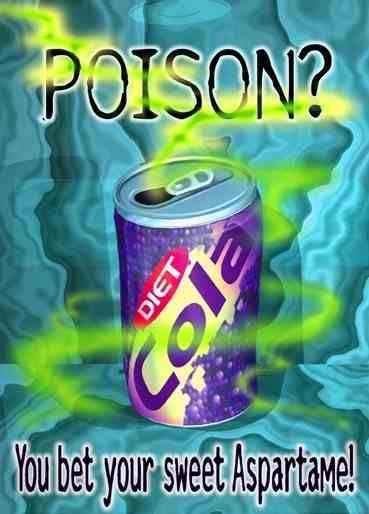
PepsiCo has decided that aspartame, a neuro-toxin used in their diet cola products as a sweetener, is not “sweet enough” and are “testing a new mix of artificial sweeteners” that will retain its potency longer than high fructose corn syrup.
The new mixture of sweeteners being tested includes acesulfame-potassium, or ace-K. The problem PepsiCo has with aspartame is that it is affected negatively in warm conditions that occur during shipping before their soda products arrive in retail stores.
In 1998, the Food and Drug Administration (FDA) approved the use of ace-K despite its known safety dangers. This chemical is most popularly used in baked goods, chewing gum and gelatin desserts according to the food safety advocacy group, the Center for Science in the Public Interest.
Ace-K, or acesulfame potassium, is a lab-created chemical that is 200 times sweeter than sucrose. Ace-K is suspected through research to have carcinogenic properties, yet this studied fact was dismissed and further studies were not conducted prior to the FDA approval.
In testing preformed on rats, ace-K was shown to stimulate dose-dependent insulin secretion. In further studies, ace-K provided more of a danger to male rats, than female rats with regard to their signal toward being cancer producing.
The chemical has a very strong after taste. To combat this phenomenon, Kraft Foods began using sodium ferulate to mask its bitterness.
Aspartame has been proven to be highly addictive because it causes actual cravings for the toxin. Many find that they cannot stop using the product because of the severe withdrawal symptoms.
Aspartic acid, also known as aspartate, acts as a neurotransmitter in your brain. It facilitates the transmission of information from neuron to neuron. Excessive amounts of aspartate in your brain kills neurons by permitting the invasion of massive amounts of calcium into the cells. This influx generates extreme levels of free radicals that kill the cells. The neural cell damage is caused by unwarranted use of aspartate. This is why they are denoted as “excitotoxins.” They “excite” or arouse the neural cells to death.
Back in March, rather than change labels to admit to poisoning their customers, PepsiCo altered their recipe by removing 4-methylimidazole (4-MI or 4-MEI), a known carcinogen, from their formula in soft drink products.
In 2011, mainstream media reported that certain brands of PepsiCo soft drinks contained a patented flame retardant used in plastics to keep carbonated drinks from becoming combustible. Over exposure to the toxin could lead to the necessity of medical attention for “skin lesions, memory loss and nerve disorders.”
A report from the Institute for Agriculture and Trade Policy stated that processed foods and beverages may contain mercury that was part of the process of deriving high fructose corn syrup. The FDA failed to make this independent study effective by acknowledging its findings.
Mercury impairs neurological development, as well as has a dramatic effect on the human nervous system. In children, mercury exposure manifests as autism and attention deficit hyperactivity disorder (ADHD).
Shockingly, PepsiCo have never denied their use of the deadly additive aspartame, nor its link to cancer. They stated publicly that the findings from scientific studies were untrue; essentially ignoring the fault and responsibility of their company to offer a product that did not endanger the health of the public. By denying the facts, their validity does not diminish.
Wednesday, March 28, 2012
Aspartame Plague Brings Horror
The aspartame horror began in 1981 due to Donald Rumsfeld, as head of the G.D. Searle pharmaceutical company, when he used his political clout to put a known carcinogen on the market to poison a nation all in the name of money.
In a Washington Post article of December 12, 2001 about Donald Rumsfeld, there was a one liner that was so incredibly relevant. That sentence was:
"He could be swilling Diet Coke with the secure knowledge that if not for his turnaround of Big Pharma giant G.D.Searle & Co. and successful touting of the sweetener aspartame, the beverage would not be possible".
If Donald Rumsfeld had never been born think of how many millions of people the world over would not suffer headaches and dizziness. Thousands blind from the free methyl alcohol in aspartame would have sight, and there would be much fewer cases of optic neuritis and macular degeneration. Millions suffering seizures would live normal lives and wouldn`t be taking anti-seizure medication that won`t work because aspartame interacts with drugs and vaccines. Think of the runner, Flo Jo, who drank Diet Coke and died of a grand mal seizure. She, no doubt, would still be alive. Brain fog and memory loss, skyrocketing symptoms of aspartame disease, would not be epidemic.
Friday, February 10, 2012
Move Over Aspartame, Neotame May Be Deadlier
Neotame, New Neurotoxic Sweetener: FDA Says No Label Needed, Not Even in Organics
A Monsanto-created chemical, Neotame is likely more toxic than Aspartame. The FDA has quietly decided that we don't have the right to know if it's adulterating our food, not even if the food is labeled USDA Organic.
Aspartame can step aside. There's a new sweetener in town and it isn't saddled with the inconvenience of having to be listed on labels, so it can be sneaked into any prepared food, even USDA so-called Organic. So sayeth the FDA. Neotame is a Monsanto-created chemical similar to Aspartame, including its neurotoxic properties.
Monsanto developed Neotame as their Aspartame patent was expiring, and had no trouble in gaining FDA approval in 2002. They added 3-dimethylbutyl, a chemical listed as hazardous by the Environmental Protection Agency (EPA), to Aspartame, making it both sweeter and more toxic.
Toxicity
Both Aspartame and Neotame contain substances that are metabolized into formaldehyde, a highly toxic poison, and an excitotoxic amino acid that agitates, thereby damaging, nerves.
At the time Neotame was originally approved by the FDA, Feingold.org, which battles the addition of many dodgy food additives, stated:
We did a search of MedLine to find studies of adverse effects or side effects of Neotame. Only four studies appeared, two of which were not studies, and the other two of which were actually a single study done by NutraSweet company researchers.
Feingold aptly described one of the nonstudies as effectively saying, "If we don't look, we won't know anything bad." The other, by the World Health Organization, is not a look at potential toxicity, but rather is about setting acceptable daily intakes of Neotame, along with other artificial sweeteners. Note: One must wonder how the FDA justifies non-listing of an ingredient for which there's an acceptable daily intake.
Mary Nash Stoddard, founder of the Aspartame Consumer Safety Network, compared the historic arc of tobacco company research with that of Aspartame. It applies equally well to Neotame:
There is a parallel issue with which to compare the Aspartame issue. That of cigarettes and the deadly effects of smoking. The massive Tobacco Industry is able to produce large volumes of scientific studies showing smoking does not cause: lung cancer, heart disease, strokes or death. Today, mainstream science accepts the fact that smoking can be deadly and addictive. So it is with Aspartame, whose approval was based, not on scientific fact, but as an issue of public policy.
Neotame Labeling
From the beginning, Neotane labeling has been limited. It's in the background noise of products produced by Agribusiness.
Up to this time, Neotame hasn't been sold to the public, but that hasn't been necessary. It's been used widely in prepared foods. So, the less awareness the public has, the less likely it is that people will try to avoid it. For the most part, the technique has worked. Now, very quietly, the FDA has decided that the public shouldn't be informed when Neotame is included in any product. Even Organic products, which are supposed to be unadultered with chemicals, are not required to state when Neotame is inside.
India will soon serve as guinea pigs for Neotame. It will soon be launched there as a tabletop sweetener, like Equal and Splendor, by NutraSweet, which owns and sells the product.
Neotame is now being marketed as Sweetos for use in cattle feed. Molasses has been utlized to get cows to eat foods made unpalatable by chemical additives. Neotame is both less costly than molasses and subject to fewer regulations. How do you like that? A natural food is more stringently regulated than a known-poisonous chemical that's put into food.
The reach of Neotame is likely to be extensive. They're planning to replace other artificial sweeteners with it. A major seller of artificial sweeteners, which goes by the misleading name of Ensigns Health Care Pvt Ltd, intends to use it in place of sucralose.
In the EU, Neotame has been approved by the European Food Safety Agency (EFSA). As is so common in the EU, the product is hidden behind an E-number. So, labels don't have to say that products contain Neotame. They only need to list "E 961". Naturally, with hundreds of E-numbers, how many people can be aware of which ones are truly dangerous?
It looks like the FDA's loosening of labeling rules for Neotame is part of a large-scale effort to make it a near-ubiquitous artificial sweetener, to be found on the tabletop, in all prepared foods—even organics—and even in the meats consumed.
The solution is fairly simple, but not necessarily easy. If you want to avoid foods adulterated with Neotame, among other dangerous additives and overprocessing, then you need to grow your own foods and prepare them yourselves, or purchase only from suppliers whose processing and sourcing is known to you, which generally means locally-produced.
A Monsanto-created chemical, Neotame is likely more toxic than Aspartame. The FDA has quietly decided that we don't have the right to know if it's adulterating our food, not even if the food is labeled USDA Organic.
Aspartame can step aside. There's a new sweetener in town and it isn't saddled with the inconvenience of having to be listed on labels, so it can be sneaked into any prepared food, even USDA so-called Organic. So sayeth the FDA. Neotame is a Monsanto-created chemical similar to Aspartame, including its neurotoxic properties.
Monsanto developed Neotame as their Aspartame patent was expiring, and had no trouble in gaining FDA approval in 2002. They added 3-dimethylbutyl, a chemical listed as hazardous by the Environmental Protection Agency (EPA), to Aspartame, making it both sweeter and more toxic.
Toxicity
Both Aspartame and Neotame contain substances that are metabolized into formaldehyde, a highly toxic poison, and an excitotoxic amino acid that agitates, thereby damaging, nerves.
At the time Neotame was originally approved by the FDA, Feingold.org, which battles the addition of many dodgy food additives, stated:
We did a search of MedLine to find studies of adverse effects or side effects of Neotame. Only four studies appeared, two of which were not studies, and the other two of which were actually a single study done by NutraSweet company researchers.
Feingold aptly described one of the nonstudies as effectively saying, "If we don't look, we won't know anything bad." The other, by the World Health Organization, is not a look at potential toxicity, but rather is about setting acceptable daily intakes of Neotame, along with other artificial sweeteners. Note: One must wonder how the FDA justifies non-listing of an ingredient for which there's an acceptable daily intake.
Mary Nash Stoddard, founder of the Aspartame Consumer Safety Network, compared the historic arc of tobacco company research with that of Aspartame. It applies equally well to Neotame:
There is a parallel issue with which to compare the Aspartame issue. That of cigarettes and the deadly effects of smoking. The massive Tobacco Industry is able to produce large volumes of scientific studies showing smoking does not cause: lung cancer, heart disease, strokes or death. Today, mainstream science accepts the fact that smoking can be deadly and addictive. So it is with Aspartame, whose approval was based, not on scientific fact, but as an issue of public policy.
Neotame Labeling
From the beginning, Neotane labeling has been limited. It's in the background noise of products produced by Agribusiness.
Up to this time, Neotame hasn't been sold to the public, but that hasn't been necessary. It's been used widely in prepared foods. So, the less awareness the public has, the less likely it is that people will try to avoid it. For the most part, the technique has worked. Now, very quietly, the FDA has decided that the public shouldn't be informed when Neotame is included in any product. Even Organic products, which are supposed to be unadultered with chemicals, are not required to state when Neotame is inside.
India will soon serve as guinea pigs for Neotame. It will soon be launched there as a tabletop sweetener, like Equal and Splendor, by NutraSweet, which owns and sells the product.
Neotame is now being marketed as Sweetos for use in cattle feed. Molasses has been utlized to get cows to eat foods made unpalatable by chemical additives. Neotame is both less costly than molasses and subject to fewer regulations. How do you like that? A natural food is more stringently regulated than a known-poisonous chemical that's put into food.
The reach of Neotame is likely to be extensive. They're planning to replace other artificial sweeteners with it. A major seller of artificial sweeteners, which goes by the misleading name of Ensigns Health Care Pvt Ltd, intends to use it in place of sucralose.
In the EU, Neotame has been approved by the European Food Safety Agency (EFSA). As is so common in the EU, the product is hidden behind an E-number. So, labels don't have to say that products contain Neotame. They only need to list "E 961". Naturally, with hundreds of E-numbers, how many people can be aware of which ones are truly dangerous?
It looks like the FDA's loosening of labeling rules for Neotame is part of a large-scale effort to make it a near-ubiquitous artificial sweetener, to be found on the tabletop, in all prepared foods—even organics—and even in the meats consumed.
The solution is fairly simple, but not necessarily easy. If you want to avoid foods adulterated with Neotame, among other dangerous additives and overprocessing, then you need to grow your own foods and prepare them yourselves, or purchase only from suppliers whose processing and sourcing is known to you, which generally means locally-produced.
Monday, December 12, 2011
Suffering From Artificial Sweetener Disease?
rtificial Sweetener Disease (ASD) is sweeping across America, affecting tens of thousands of consumers, and Western medicine calls it anything but what it really is, so that doctors can prescribe expensive pharmaceuticals and set up "check up" appointments for the following weeks.
Call it recurring headaches, unbearable migraines, depression, anxiety, muscle pain, arthritis flare ups, buzzing or ringing in the ears, chronic fatigue, fibromyalgia, irritable bowel syndrome (IBS), Crohn's disease, inflammation, even acid reflux, but don't call it ASD, or the patient may stop consuming synthetic sweeteners, and then not schedule more doctor visits.
The symptoms of ASD can change overnight, depending on how much chemical sweetener you consume, and which ones. Some combinations are especially toxic. Consumers can go from a migraine headache to vomiting or from vision problems to an upset stomach. Many people experience central nervous system disorders, cramping, nervous twitches and abnormal reflexes.
The popular saying that "there's not enough artificial sweetener in any specific product to cause health concerns" is a lie, especially now that in 2011 there are synthetic sweeteners in over 25% of all food, drink, gum and candy available. This cumulative effect has created ASD, and thanks to little or no regulation of chemical agents in food, it's not going away any time soon.
The good news is the cure for Artificial Sweetener Disease is absolutely free and involves no doctor, no health insurance co-pays, and has zero side effects. Here is the secret cure for ASD: throw away your sugar free gum and candy, and then trash all foods and drinks you have that are labeled "light" and "zero." Read the labels on everything, so you can filter out all artificial sweeteners from your products, including aspartame, sucralose, sorbitol, acesulfame-k, aspartic acid, and saccharine.
As an alternative to poisoning yourself, try Xylitol or Stevia in order to cut calories, or simply eat more organic vegetables! If problems persist, take a list of everything you ate this week to your Naturopath or Nutritionist to analyze. Remember, if you're getting sick from moldy bread, don't look for a prescription drug to cure you, just stop eating moldy bread.
Call it recurring headaches, unbearable migraines, depression, anxiety, muscle pain, arthritis flare ups, buzzing or ringing in the ears, chronic fatigue, fibromyalgia, irritable bowel syndrome (IBS), Crohn's disease, inflammation, even acid reflux, but don't call it ASD, or the patient may stop consuming synthetic sweeteners, and then not schedule more doctor visits.
The symptoms of ASD can change overnight, depending on how much chemical sweetener you consume, and which ones. Some combinations are especially toxic. Consumers can go from a migraine headache to vomiting or from vision problems to an upset stomach. Many people experience central nervous system disorders, cramping, nervous twitches and abnormal reflexes.
The popular saying that "there's not enough artificial sweetener in any specific product to cause health concerns" is a lie, especially now that in 2011 there are synthetic sweeteners in over 25% of all food, drink, gum and candy available. This cumulative effect has created ASD, and thanks to little or no regulation of chemical agents in food, it's not going away any time soon.
The good news is the cure for Artificial Sweetener Disease is absolutely free and involves no doctor, no health insurance co-pays, and has zero side effects. Here is the secret cure for ASD: throw away your sugar free gum and candy, and then trash all foods and drinks you have that are labeled "light" and "zero." Read the labels on everything, so you can filter out all artificial sweeteners from your products, including aspartame, sucralose, sorbitol, acesulfame-k, aspartic acid, and saccharine.
As an alternative to poisoning yourself, try Xylitol or Stevia in order to cut calories, or simply eat more organic vegetables! If problems persist, take a list of everything you ate this week to your Naturopath or Nutritionist to analyze. Remember, if you're getting sick from moldy bread, don't look for a prescription drug to cure you, just stop eating moldy bread.
Tuesday, October 18, 2011
Cancerous Truth About Aspartame
Aspartame, the artificial sweetener found in many diet sodas and used as an ‘alternative’ sweetener, has been found recently to have detrimental – specifically, cancerous – effects.
A study performed by researcher Victoria Innes-Brown, after mounting concerns with how much diet coke her family members seemed to consume daily, showed that of 48 rats experimented on up to 67 percent of all females developed tumors roughly the size of golf balls or larger. The male population didn’t do too well either: 21 percent of the males developed similar cancerous growths.'
A study performed by researcher Victoria Innes-Brown, after mounting concerns with how much diet coke her family members seemed to consume daily, showed that of 48 rats experimented on up to 67 percent of all females developed tumors roughly the size of golf balls or larger. The male population didn’t do too well either: 21 percent of the males developed similar cancerous growths.'
Sunday, September 4, 2011
False Aspartame Science
'A powerful multinational gang of criminals has been operating for years completely protected from prosecution by any enforcement agency. Finally the count of murders and maimings has raised a public outcry that can’t be ignored, so a special government tribunal is charged to investigate the atrocities.
The tribunal is given voluminous evidence with a multitude of victim’s testimonies that defy contradiction and confirm the guilt of the gang. 20 “experts” are to weigh the evidence, well qualified to understand the technical nature of the matter at hand. Things are looking up, soon the carnage will end and EFSA, the European Food Safety Authority, shall announce to the world that aspartame is a deadly neurotoxin, unsafe for humans in any form.
But eleven of the “experts” have connections with the aspartame industry, are enriched by it. Somehow the evidence is “lost”, so EFSA declares this chemical poison is safe as rain. Safe for babies, safe for children, safe for pregnant mothers, safe for diabetics, safe for everybody!'
The tribunal is given voluminous evidence with a multitude of victim’s testimonies that defy contradiction and confirm the guilt of the gang. 20 “experts” are to weigh the evidence, well qualified to understand the technical nature of the matter at hand. Things are looking up, soon the carnage will end and EFSA, the European Food Safety Authority, shall announce to the world that aspartame is a deadly neurotoxin, unsafe for humans in any form.
But eleven of the “experts” have connections with the aspartame industry, are enriched by it. Somehow the evidence is “lost”, so EFSA declares this chemical poison is safe as rain. Safe for babies, safe for children, safe for pregnant mothers, safe for diabetics, safe for everybody!'
Wednesday, August 31, 2011
Aspartame: Sweet Misery
Filmmakers Cori Brackett and J.T. Waldron explore the issue of aspartame toxicity in a documentary that implores viewers to take consider the potentially damaging effects of the common food additive. A sugar substitute that is found in NutraSweet and many common diet drinks, aspartame is alleged to cause toxic reactions in the human body that can result in a wide variety of physical and mental ailments.
In stating their claim that aspartame toxicity is perhaps the most insidious representation of corporate negligence since tobacco, Brackett and Waldron offer compelling evidence about a potentially deadly phenomenon
Thursday, August 18, 2011
#Rumsfeld Faces Torture Charges, IN US, From US Contractors
NOTE: Perhaps as a bit of karma, Rumsfeld will be forced to eat Aspartame during any "enhanced interrogation techniques"
Subscribe to:
Posts (Atom)