| Monday, 06 May 2013 23:49 |
 A
bill addressing prior consultation with indigenous peoples on
legislative measures remains tied up in Ecuador’s National Assembly. A
bill addressing prior consultation with indigenous peoples on
legislative measures remains tied up in Ecuador’s National Assembly.(IPS) - The Constitution of Ecuador adopted in 2008 establishes a broad range of rights for indigenous peoples and nationalities, including the right to prior consultation, which gives them the opportunity to influence decisions that affect their lives. But this right has yet to be fully translated into legislation, as the bill for a Law on Consultation with Indigenous Communities, Peoples and Nationalities is still being studied by the National Assembly. Article 57, section 7 of the constitution guarantees “free, prior and informed consultation, within a reasonable period of time, on plans and programmes for exploration, exploitation and sale of non-renewable resources located on their lands which could have environmental or cultural impacts on them.” The constitution also stipulates the right of indigenous peoples “to share in the profits earned from these projects and to receive compensation for social, cultural and environmental damages caused to them. The consultation that must be conducted by the competent authorities shall be mandatory and timely.” “If the consent of the consulted community is not obtained, steps provided for by the Constitution and the law shall be taken,” it adds. Legal grounds for consultation are also established in Convention 169 of the International Labour Organization (ILO), which Ecuador ratified in 1998, and the United Nations Declaration on the Rights of Indigenous Peoples, adopted in 2007. Nevertheless, recent mining and oil drilling projects have put the government’s commitment to respecting the right to consultation to the test, and spurred indigenous organisations to take action. On Nov. 28, 2012, hundreds of indigenous representatives converged in Quito to protest the lack of consultation prior to the 11th oil auction round, in which exploration blocks containing an estimated total of 1.6 billion barrels of crude oil would be put up for bids from private companies. At the time, Domingo Peas, a leader of the Achuar indigenous ethnic group, declared that “the government says it has carried out prior consultation, but this is not true.” “The consultations carried out among the peoples and nationalities in the areas of influence are invalid, because there was no participation by indigenous peoples and nationalities in determining the way they were conducted, they did not respect their traditional methods of decision-making, and cultural aspects, such as language, were not adequately taken into account,” he stressed. Overall, said Peas, the consultations “were neither prior, nor free, nor informed, and were conducted in bad faith.” The president of the influential Confederation of Indigenous Nationalities of Ecuador (CONAIE), Humberto Cholango, believes that the authorities have not done enough. “Prior consultation is still pending, we have still not seen the results we would like to see. We need the law to be approved; that would be a major advance,” he told Tierramérica*. The draft law, comprising 29 articles, refers to consultation on legislative measures and establishes four stages: preparation; a public call for participation and registration; the actual holding of the consultation; and analysis of the results and conclusion. In accordance with the law, the government will determine if a proposed bill affects the rights of certain communities, in which case the National Assembly will convene a prior consultation that will be conducted through the National Electoral Council. Lourdes Tibán, an indigenous National Assembly member from the leftist opposition movement Pachakutik, told Tierramérica that adoption of this law is crucial, because “it will guarantee the participation of indigenous nationalities in decisions on future laws that directly affect them, and will therefore prevent a lack of consensus.” Once this legislation is in force, other major bills can be addressed, such as the proposed law on water resources, on which debate has been postponed since 2010 precisely due to the resistance posed by indigenous peoples. One of their key concerns is that the proposals made during a prior consultation process will not be included in the final text of the law that was submitted to consultation. A number of other bills, such as those for laws on culture and land, are also on hold for the same reason. This is the heart of the conflict. One year ago, President Rafael Correa stated in one of his regular Saturday broadcasts that non-governmental organisations “want prior consultations to be popular consultations and to be binding; that means that for every step we want to take, we will need to ask the community for permission.” “This is extremely serious. This is not what the international agreements say. This would not mean acting in the interests of the majorities, but rather in the interest of unanimity. It would be impossible to govern that way,” he declared. In response to these statements, indigenous organisations sought reinforcement, calling on agencies such as the Inter-American Commission on Human Rights and the ILO to supervise the implementation of prior consultation. In fact, indigenous communities in Ecuador have already turned to some of these mechanisms in the past. In 2003, the Quechua community of Sarayaku filed a complaint with the Inter-American Commission on Human Rights against the state for authorising oil exploration in their territory, without prior consultation. The community, located in the province of Pastaza, in Ecuador’s Amazon rainforest region, denounced damages to their territory, culture and economy. In June 2012, the Inter-American Court of Human Rights ruled in favour of the community and against the state. The government is still studying how to pay the required compensation – a total of 1,398,000 dollars for material and moral damages and legal costs – and how to finish repairing the physical damage caused. |
Showing posts with label Indigenous. Show all posts
Showing posts with label Indigenous. Show all posts
Wednesday, May 15, 2013
Ecuador's Indigenous People Still Wait To Be Consulted


Saturday, April 13, 2013
Look Out Monsanto The Global Food Movement Is Rising

-
A group of Rarámuri Indians from Bocoyna Municipality, who marched into the governor’s palace in 2008 to demand that genetically modified corn not contaminate their native seeds. Photo by David Lauer.
Reading about how people transform the way they farm and eat makes you want to cook up your own plans with your neighbors.As a somewhat conscientious consumer and occasional Taco Bell boycotter, I’ve hoped that the movement was real. But it hasn't always been easy to perceive the connection between marching for improved farmworker rights, signing a petition against factory feedlots, and cooking up beets from a CSA (that is, community supported agriculture, which usually comes in the form a box of assorted veggies delivered to people who contribute to a local farm’s financial well-being).
Those connections form a tight weave in the new book, Harvesting Justice: Transforming Food, Land, and Agriculture in the Americas. Using “food sovereignty” as the secret sauce, the book sautés the individual ingredients of sister movements into a coherent, flavorful whole.

-
Young Rarámuri women select corn for next year´s seed after a farmer-to-farmer workshop on seed selection in the community of Rekusachi, Chihuahua. Photo by David Lauer.
The book’s authors, Tory Field and Beverly Bell, do a lot more with food than just write about it. Field is a farmer who co-manages the Next Barn Over Farm, a CSA program in western Massachusetts. Bell has worked for decades with small farmer organizations in Haiti, including those who set fire to agricultural aid after the 2010 earthquake. The farmers didn't see the donated seeds as aid, but as a Monsanto “trojan horse” undermining their control over their own food.
Both authors are also members of Other Worlds, an organization that educates the public about citizen movements and builds community alternatives to corporate globalization. Introducing us to farmers speaking in their own voices, they describe how fighting the dominance of agribusiness and relocalizing the food system are indeed two sides of the same coin.
The book merges five years of field research and interviews, and describes more than 100 case studies of advocacy campaigns and alternative food systems in the United States and around the world. The authors interview New Mexican farmer and teacher Miguel Santistevan, who insists that “We don’t like the way the food system treats the earth and its negative health effects on the people, [and] we are working to actualize an alternative.”
They introduce us to Rosnel Jean-Baptiste of Heads Together Small Peasant Farmers of Haiti (Tèt Kole Ti Peyizan Ayisyen), who says, “It’s not houses that are going to rebuild Haiti, it’s investing in the agriculture sector.”
And they encourage consumer action through the words of Ben Burkett, president of the National Family Farm Coaltion. “No matter what us farmers plant, the consumer’s got to change the system, ” Burkett says. “As long as they don’t complain, there’s no need even talking about it. The marketplace dictates.”

-
A group of Haitian peasants meets to discuss strategies for rebuilding agriculture after the earthquake of 2010. Photo by Roberto (Bear) Guerra.
Designed for use as an organizing tool
Accompanying the book is a curriculum of teaching exercises called "Sowing Seeds," intended for use in community and academic settings. The curriculum is dizzyingly comprehensive, a kind of “best of” in food systems education culled from sister organizations.The book connects the dots between community groups doing related work and breaks up any sense of going it alone.Have you ever wondered how many tons of tomatoes a picker needs to pick each day to earn minimum wage, or what the salary of David Novak—the CEO of the company that owns Taco Bell—would add up to in tons of tomatoes at the same rate? It’s all in here. Consumer, producer, and retailer perspectives are all explored through engaging exercises. Suggested workshop formats may come in handy if you are an educator or organizer.

Care about Your Food? Then Care about Your Farmworkers Too
It’s organic. It’s local. But did the workers who picked it have health insurance?
You may want to nudge your local bookseller to carry Harvesting Justice.
I'm guessing they won't be sorry. It’s not only highly readable but
may catalyze actions such as getting local food into school lunches.
The stunning photos serve up inspiration to get off your duff and
transform the local food system.It’s organic. It’s local. But did the workers who picked it have health insurance?
Because it provides that kind of inspiration, this is the kind of book that your local food co-op, farmer’s market, or anti-hunger organization might consider using as a study guide. It can help connect the dots between community groups doing related work and break up any sense of going it alone. The appendix fills nearly fifteen pages, introducing us to groups like the Food Chain Workers Alliance, First Nations Native Agriculture and Food Systems Initiative, and the Honduran Garifuna organization.
While these organizations are scattered around the planet, they form the foundation of a localized, alternative food system.
Reading about how people transform the way they farm and eat makes you want to reach for a big soup pot, cut up some onions, and cook up your own plans with your neighbors. Harvesting Justice gives you more than the recommended dose of civic engagement.
Daniel Moss wrote this article for YES! Magazine, a national, nonprofit media organization that fuses powerful ideas with practical actions. As a consultant, Daniel works with communities and organizations around the world to advance democratic and sustainable stewardship of our shared commons.
Interested?
- A Future for Agriculture, A Future for Haiti
Haiti's way forward is tied to food sovereignty and a renewed focus on local agriculture. - Farmers, Workers, Consumers, Unite! New Visions in Food Justice
How do we make sure that our food contributes to the health of our communities and ecosystems? - Feeding the World: It’s Not About Quantity
The resilience of our food supply is as much about the quality and diversity of our food sources as it is about how much we produce.
Wednesday, April 10, 2013
Amazon People Theaten War Against Brazil's Dam Projects Destroying Rivers

Brazil
dam row – local activists march past machinery being used in the
construction of the massive Belo Monte hydroelectric dam.
The Munduruku indigenous community in Para state say they have been betrayed by the authorities, who are pushing ahead with plans to build a cascade of hydropower plants on the Tapajós river without their permission.
Public prosecutors, human rights groups, environmental organisations and Christian missionaries have condemned the government's strong-arm tactics.
Helicopters, soldiers and armed police have been involved in Operation Tapajós, which aims to conduct an environmental impact assessment for the first proposed construction, the 6,133 MW São Luiz do Tapajós dam.
The facility, to be built by the Norte Energia consortium, is the biggest of three planned dams on the Tapajós, the fifth-largest river in the Amazon basin. The government's 10-year plan includes the construction of four larger hydroelectric plants on its tributary, the Jamanxim.
Under Brazilian law, major infrastructure projects require prior consultation with indigenous communities. Federal prosecutors say this has not happened and urge the courts to block the scheme which, they fear, could lead to bloodshed.
"The Munduruku have already stated on several occasions that they do not support studies for hydroelectric plants on their land unless there is full prior consultation," the prosecutors noted in a statement.
A similar survey in November led to deadly conflict. One resident, Adenilson Kirixi, was killed and several others were wounded in clashes between local people and troops accompanying the researchers in Teles Pires village.
The ministry of mines and energy noted on its website that 80 researchers, including biologists and foresters, would undertake a study of flora and fauna. The army escort was made possible by President Dilma Rousseff, who decreed this year that military personnel could be used for survey operations.
Missionaries said the recent show of force in Sawré Maybu village, Itaituba, was intimidating, degrading and an unacceptable violation of the rights of the residents.
"In this operation, the federal government has been threatening the lives of the people," the Indigenous Missionary Council said. "It is unacceptable and illegitimate for the government to impose dialogue at the tip of a bayonet."
The group said Munduruku leaders ended a phone call with representatives of the president with a declaration of war. They have also issued open letters calling for an end to the military operation, "We are not bandits. We feel betrayed, humiliated and disrespected by all this," a letter states.
One of the community's leaders, Valdenir Munduruku, has warned that locals will take action if the government does not withdraw its taskforce by 10 April. He has called for support from other indigenous groups, such as the Xingu, facing similar threats from hydroelectric dams.
Environmental groups have expressed concern.
The 1,200-mile waterway is home to more than 300 fish species and provides sustenance to some of the most biodiverse forest habitats on Earth. Ten indigenous groups inhabit the basin, along with several tribes in voluntary isolation.
With similar conflicts over other proposed dams in the Amazon, such as those at Belo Monte, Teles Pires, Santo Antônio and Jirau, some compare the use of force to the last great expansion of hydropower during the military dictatorship.
"The Brazilian government is making political decisions about the dams before the environmental impact assessment is done," said Brent Millikan of the International Rivers environmental group.
"The recent military operations illustrate that the federal government is willing to disregard existing legal instruments intended to foster dialogue between government and civil society."
Dept Of Interior Endorses Removal 4 Dams Klamath River
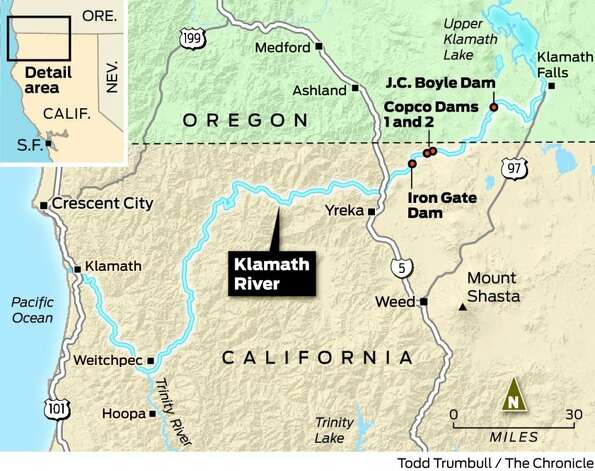
If the dams go - still no sure bet - 420 miles of historic habitat would open for the first time in more than a century.
The final environmental impact statement on what would be the biggest dam-removal project in California history was released Thursday by the U.S. Department of the Interior. It supports removal of the dams: Iron Gate, Copco 1 and Copco 2 in California north of Yreka (Siskiyou County), and J.C. Boyle in Oregon.
The study predicts dam removal would employ 4,600 people during 15 years of work, and result in an 81 percent increase in chinook and similar increases in steelhead trout and coho salmon.
The project, which would cost about $1 billion, including habitat restoration and sediment removal, would nevertheless cost less over time than maintaining the reservoirs and building federally mandated fish ladders, according to Interior Department scientists.
The report "represents the most comprehensive scientific, engineering and environmental evaluation of facilities removal ever undertaken in the Klamath Basin," said Ken Salazar, secretary of the interior, in a statement.
The secretary, who will have to sign off on the plan, said removing the dams would resolve a lot of water-related problems among Indian tribes, farmers and utilities in the Klamath Basin while restoring historic fish runs.
Wild and scenic river
The mighty Klamath, a federally protected wild and scenic river, flows 255 miles from Oregon through California to the Pacific Ocean, draining 12,600 square miles of mountains, forests and marshlands that some have called the Everglades of the West.The dams have blocked salmon migration along the California-Oregon border since the first one was built in 1909. The Klamath is the third-largest salmon run in the lower 48 states, behind the Columbia and Sacramento rivers.
Destructive parasites and blooms of toxic blue-green algae also contaminate the water behind the dams during the summer. Water diversions to cities and for agriculture exacerbate the problem, according to fishery biologists.
Serious talk of removing the dams began in 2002 after a federally ordered change in water flow led to the death of 33,000 salmon in the river.
About 40 parties, including American Indian tribes, farmers and fishermen, signed the 2010 Klamath Hydroelectric Settlement Agreement, which laid out the process of removing the dams operated by the PacifiCorp utility beginning in 2020. The groups also approved the Klamath Basin Restoration Agreement, which would appropriate $800 million over 15 years to divide up water and restore the habitat.
"The scientific and common sense conclusion is clear," said Rep. Jared Huffman, D-San Rafael. "We should tear down these dams."
Congress' approval needed
The problem is that both agreements need the approval of Congress, which appears reluctant to approve large expenditures for restoration and other costs. Supporters are now calling on the Senate Energy and Natural Resources Committee to call hearings on the matter."Dozens of groups came together and, despite their very different perspectives, were able to hammer out these agreements," said Curtis Knight, the conservation director for California Trout, a conservation organization. "Congress must do its part to turn this proposed local solution into reality."
There are opponents
Still, opposition remains, particularly among the 100 or so owners of lakefront property created by the dams. The value of 668 parcels is expected to go down as the reservoirs are drained.In addition, customers of PacifiCorp in Oregon and California would pay an extra 2 percent on their monthly electric bills to cover the cost of dam removal. PacifiCorp has agreed to pay the first $200 million, and California will cover any costs above that, according to the removal agreement.
Read the report
The final Environmental Impact Statement is available atwww.klamathrestoration.gov.
Wednesday, January 16, 2013
Bury Your Guns At Wounded Knee
December 29,
2012 marked the 122nd Anniversary of the murder of 297 Sioux Indians
at Wounded Knee Creek on the Pine Ridge Indian Reservation in South
Dakota. These 297 people, in their winter camp, were murdered by
federal agents and members of the 7th Cavalry who had come to confiscate
their firearms “for their own safety and protection.”
The slaughter began after the majority of the Sioux had peacefully
turned in their firearms.
The Calvary began shooting, and managed to wipe out the entire camp. 200 of the 297 victims were women and children. About 40 members of the 7th Cavalry were killed, but over half of them were victims of fratricide from the Hotchkiss guns of their overzealous comrades-in-arms. Twenty members of the 7th Cavalry’s death squad, were deemed “National Heroes” and were awarded the Medal of Honor for their acts of [cowardice] heroism.
We hear very little of Wounded Knee today. It is usually not mentioned in our history classes or books. What little that does exist about Wounded Knee is normally a sanitized “Official Government Explanation.” And there are several historically inaccurate depictions of the events leading up to the massacre, which appear in movie scripts and are not the least bit representative of the actual events that took place that day.
Wounded Knee was among the first federally backed gun confiscation attempts in United States history. It ended in the senseless murder of 297 people.
Before you
jump on the emotionally charged bandwagon for gun control, take
a moment to reflect on the real purpose of the Second Amendment,
the right of the people to take up arms in defense of themselves,
their families, and property in the face of invading armies or an
oppressive government.
The argument that the Second Amendment only applies to hunting and target shooting is asinine. When the United States Constitution was drafted, “hunting” was an everyday chore carried out by men and women to put meat on the table each night, and “target shooting” was an unheard of concept. Musket balls were a precious commodity and were certainly not wasted on “target shooting.”
The Second Amendment was written by people who fled oppressive and tyrannical regimes in Europe, and it refers to the right of American citizens to be armed for defensive purposes, should such tyranny arise in the United States.
As time goes forward, the average citizen in the United States continually loses little chunks of personal freedom or “liberty.” Far too many times, unjust gun control bills were passed and signed into law under the guise of “for your safety” or “for protection.” The Patriot Act signed into law by G.W. Bush, was expanded and continues under Barack Obama. It is just one of many examples of American citizens being stripped of their rights and privacy for “safety.” Now, the Right to Keep and Bear Arms is on the table, and will, most likely be attacked to facilitate the path for the removal of our firearms, all in the name of “our safety.”
Before any
American citizen blindly accepts whatever new firearms legislation
that is about to be doled out, they should stop and think about
something for just one minute. – Evil does exist in our world.
It always has and always will. Throughout history evil people have
committed evil acts. In the Bible one of the first stories is that
of Cain killing Abel. We can not legislate “evil” into
extinction. Good people will abide by the law, and the criminal
element will always find a way around it.
Evil exists all around us, but looking back at the historical record of the past 200 years, across the globe, where is “evil” and “malevolence” most often found? In the hands of those with the power, the governments. That greatest human tragedies on record and the largest loss of innocent human life can be attributed to governments.
Who do the governments always target? “Scapegoats” and “enemies” within their own borders….but only after they have been disarmed to the point where they no longer pose a threat. Ask any Native American, and they will tell you it was inferior technology and lack of arms that contributed to their demise.
Ask any Armenian why it was so easy for the Turks to exterminate millions of them, and they will answer “We were disarmed before it happened.” Ask any Jew what Hitler’s first step prior to the mass murders of the Holocaust was – confiscation of firearms from the people.
Wounded Knee is the prime example of why the Second Amendment exists, and why we should vehemently resist any attempts to infringe on our Rights to Bear Arms. Without the Second Amendment we will be totally stripped of any ability to defend ourselves and our families.
The Calvary began shooting, and managed to wipe out the entire camp. 200 of the 297 victims were women and children. About 40 members of the 7th Cavalry were killed, but over half of them were victims of fratricide from the Hotchkiss guns of their overzealous comrades-in-arms. Twenty members of the 7th Cavalry’s death squad, were deemed “National Heroes” and were awarded the Medal of Honor for their acts of [cowardice] heroism.
We hear very little of Wounded Knee today. It is usually not mentioned in our history classes or books. What little that does exist about Wounded Knee is normally a sanitized “Official Government Explanation.” And there are several historically inaccurate depictions of the events leading up to the massacre, which appear in movie scripts and are not the least bit representative of the actual events that took place that day.
Wounded Knee was among the first federally backed gun confiscation attempts in United States history. It ended in the senseless murder of 297 people.
The argument that the Second Amendment only applies to hunting and target shooting is asinine. When the United States Constitution was drafted, “hunting” was an everyday chore carried out by men and women to put meat on the table each night, and “target shooting” was an unheard of concept. Musket balls were a precious commodity and were certainly not wasted on “target shooting.”
The Second Amendment was written by people who fled oppressive and tyrannical regimes in Europe, and it refers to the right of American citizens to be armed for defensive purposes, should such tyranny arise in the United States.
As time goes forward, the average citizen in the United States continually loses little chunks of personal freedom or “liberty.” Far too many times, unjust gun control bills were passed and signed into law under the guise of “for your safety” or “for protection.” The Patriot Act signed into law by G.W. Bush, was expanded and continues under Barack Obama. It is just one of many examples of American citizens being stripped of their rights and privacy for “safety.” Now, the Right to Keep and Bear Arms is on the table, and will, most likely be attacked to facilitate the path for the removal of our firearms, all in the name of “our safety.”
|
|
Evil exists all around us, but looking back at the historical record of the past 200 years, across the globe, where is “evil” and “malevolence” most often found? In the hands of those with the power, the governments. That greatest human tragedies on record and the largest loss of innocent human life can be attributed to governments.
Who do the governments always target? “Scapegoats” and “enemies” within their own borders….but only after they have been disarmed to the point where they no longer pose a threat. Ask any Native American, and they will tell you it was inferior technology and lack of arms that contributed to their demise.
Ask any Armenian why it was so easy for the Turks to exterminate millions of them, and they will answer “We were disarmed before it happened.” Ask any Jew what Hitler’s first step prior to the mass murders of the Holocaust was – confiscation of firearms from the people.
Wounded Knee is the prime example of why the Second Amendment exists, and why we should vehemently resist any attempts to infringe on our Rights to Bear Arms. Without the Second Amendment we will be totally stripped of any ability to defend ourselves and our families.
Sunday, January 13, 2013
Idle NO MORE, 1st Nations Resistance Movement Across Canaca
“A study was done of all band audits ever done to look for evidence of corruption. Less than three percent of all of those audits ever found anything that could even be close to an individual purposely taking money for their own purposes and mismanaging it. That’s a lower corruption rate than all of the municipalities, provinces and Canada put together. So who is the corrupt ones here? It’s not First Nations!” - Miq’Maq lawyer Pam Palmater
Idle No More is an indigenous resistance movement that has taken hold in centres across Canada. It has featured a number of flash mobs and Round dances in public places like shopping malls and traffic intersections. The movement has mostly been peaceful, although there have been a few road and rail blockades.
The focus is on pieces of legislation that the founders of the movement, four Saskatchewan women named Nina Wilson, Sylvia McAdam, Jessica Gordon & Sheelah McLean, saw as further undermining First Nations sovereignty.
The movement got a boost when on December 11, Theresa Spence, Chief of the beleaguered Northern Ontario First Nation of Attawapiskat, started a hunger strike to call attention to long-standing frustrations within the First Nations Community and to force the Canadian Prime Minister and the Queen’s Representative in Canada, Governor General David Johnston, to meet with First Nations leaders.
As of January 10, 2013, the Prime Minister has agreed to meet with First Nations leaders, although the Governor General has not, except in a ‘ceremonial’ capacity.
The fact is, a nation-to-nation partnership formed between the Indigenous First Nations and European settlers which made it possible for the territory to be opened up for exploitation by settlers. Treaties between the British Crown and First Nations were at the heart of this arrangement. However, subsequent generations of settler governments took advantage of the arrangement, and have yet to live up to these agreements signed in good faith by the keepers of the land, the First Nations.
Given these realities at the core of our society in the Western Hemisphere, it is crucial that these fundamental issues be grappled with before the cause of social justice can be meaningfully addressed.
This installment of the Global Research News Hour focuses on the movement spreading throughout Canada and the world known as IDLE NO MORE.
Guests include Sociologist, writer and Indigenous activist Robert Animiiki Horton, and Professor of Globalization Studies Anthony Hall. They discuss the challenges facing the movement, advice for non-Indigenous supporters, and some of the historical and legal backdrop to this resurging resistance.
Idle No More is an indigenous resistance movement that has taken hold in centres across Canada. It has featured a number of flash mobs and Round dances in public places like shopping malls and traffic intersections. The movement has mostly been peaceful, although there have been a few road and rail blockades.
The focus is on pieces of legislation that the founders of the movement, four Saskatchewan women named Nina Wilson, Sylvia McAdam, Jessica Gordon & Sheelah McLean, saw as further undermining First Nations sovereignty.
The movement got a boost when on December 11, Theresa Spence, Chief of the beleaguered Northern Ontario First Nation of Attawapiskat, started a hunger strike to call attention to long-standing frustrations within the First Nations Community and to force the Canadian Prime Minister and the Queen’s Representative in Canada, Governor General David Johnston, to meet with First Nations leaders.
As of January 10, 2013, the Prime Minister has agreed to meet with First Nations leaders, although the Governor General has not, except in a ‘ceremonial’ capacity.
The fact is, a nation-to-nation partnership formed between the Indigenous First Nations and European settlers which made it possible for the territory to be opened up for exploitation by settlers. Treaties between the British Crown and First Nations were at the heart of this arrangement. However, subsequent generations of settler governments took advantage of the arrangement, and have yet to live up to these agreements signed in good faith by the keepers of the land, the First Nations.
Given these realities at the core of our society in the Western Hemisphere, it is crucial that these fundamental issues be grappled with before the cause of social justice can be meaningfully addressed.
This installment of the Global Research News Hour focuses on the movement spreading throughout Canada and the world known as IDLE NO MORE.
Guests include Sociologist, writer and Indigenous activist Robert Animiiki Horton, and Professor of Globalization Studies Anthony Hall. They discuss the challenges facing the movement, advice for non-Indigenous supporters, and some of the historical and legal backdrop to this resurging resistance.
Friday, December 28, 2012
People Who Don't Desise Prosecutors Simply Aren't Paying Attention
|
|
|
"Mr. Wasden, my name is Will Grigg," I replied, shaking his hand. "Several years ago you tried to put a 66-year-old retired nun named Carol Asher in prison for fourteen years because she acted as a conscientious juror. Have you ever apologized to her for that abuse of discretion?"
My ice-breaker caused Wasden's smile to evaporate, and it was quickly replaced with an expression of perplexed surprise.
"What – what abuse of discretion? What case are you talking about?" he stammered.
"Carol Asher is a retired nun from northern Idaho who was called to serve on a jury in a narcotics case," I explained. "She was one of several jurors who voted to acquit, and during the deliberations – made in the confidentiality of the jury room – she apparently made some comments about the fully-informed jury principle. This was seen as a violation of assurances that she would be bound by the judge's instructions. After the case was dismissed, one of the jurors reported her to the prosecutor – and your office filed felony perjury charges against her."
"Well, I don't remember any of the details of this matter," Wasden replied as he started to sidle away from me.
"Perhaps you should re-acquaint yourself with them," I suggested.
"I don't really see any reason to," he said, walking away while displaying a dismissive smirk.
The occasion that brought about this brief but telling conversation was a December 12 meeting held at the Portia Club in Payette, Idaho to discuss the state's open records and open meetings law. Wasden and several of his associates – people whose livelihood depends on official opacity, not public transparency – were present to teach us how to ask just the right questions in order to get the self-serving answers they were willing to provide.
Wasden was obviously caught off-guard by a polite but pointed question, and more than likely offended by it. After all, a meeting to discuss the open records law was hardly the proper forum at which to demand accountability from a public servant such as himself.
My only purpose in attending the meeting was to ask Wasden about the Asher case. I knew he would be in attendance, and intended to confront him about his misconduct – but since he was the one who approached me, I can't honestly be accused of ambushing him. Our conversation took place about five minutes before the meeting began, which meant that I was able to devote most of my evening to more productive pursuits.
Wasden was utterly mystified by the mention of the Carol Asher case, which was the source of considerable controversy in Idaho back in 2006. He honestly didn't remember who Carol Asher is, which is understandable. But he absolutely didn't care about what his office did to her, which is unforgivable.
"It's interesting that Mr. Wasden doesn't remember me or anything about my case, because he was certainly aware of it at the time," Asher told Pro Libertate. "And after the charge against me was dismissed I wrote him a long, polite letter letting him know that I held no rancor toward him, and explaining why I took the stand that I did. He never responded to my letter."
If I had inflicted needless misery on an innocent, law-abiding, 66-year-old woman, sleep would be a stranger to me until I had done everything possible to make amends. Beyond what I've learned from the public record and a very brief conversation I know nothing of Larry Wasden. The fact that he has forgotten everything about his attempt to imprison Asher for life suggests to me that his is the untroubled sleep known only to the most innocent of children, and the most incurable of sociopaths.
In late 2005, Asher was called to jury duty for the narcotics trial of William Edward Clark, a young man of Indian ancestry who lived in a northern Idaho village called White Bird. Clark was employed at a local restaurant. He also had a police record replete with petty charges of the kind that suggested he was the focus of frequent and largely unwarranted police attention.
One afternoon the previous March, Clark was given the keys to the company vehicle – an old pickup truck – and sent to Grangeville with a large load of aluminum cans to be recycled. He stopped at the Tolo Lake Mammoth Replica, locked the truck, and went to see the exhibit. A Grangeville City Police Officer drove by and spotted the truck.
At the time, Clark was the subject of a "fugitive warrant," but the available record in the Idaho Repository doesn't clearly state why. He was sentenced to probation on a misdemeanor battery charge, and then slapped with a statewide "failure to appear" bench warrant that appears to have been revoked in January. In any case, the officer recognized either Clark or the vehicle he was driving, executed a U-turn, and pulled in behind the truck.
When the officer approached Clark, he demanded the keys in order to search the truck. Clark quite properly refused to turn over the keys, pointing out that the pickup was, in effect, a company vehicle that didn't belong to him. The officer called for backup, and an Idaho County Sheriff's Deputy soon arrived. The two of them ganged up on Clark, seized the keys, and searched the truck.
On the dashboard of the truck the officers found a CD case containing a tiny ziplock bag in which was hidden .15 of a gram of meth, which had an estimated street value of about five dollars.
"No physical evidence or eyewitness testimony connected Clark to the drugs," Asher recalls of Clark's two-day trial. "The prosecution wasn't able to demonstrate that Clark was aware that it was in the vehicle. Since it was used by many other people, and the drugs were very carefully hidden, there was plenty of room for reasonable doubt. And since the search was clearly illegal, there wasn't really any reason for the arrest in the first place. But the court-appointed defense attorney just sat there like a stump and didn't raise the issue, and the trial judge wouldn't allow jurors to raise it, either."
In his smug assurance that the case was a slam-dunk, the Idaho County Prosecutor Kirk MacGregor didn't bother to prove it. After all, Clark was a socially marginal Indian kid with a bad reputation and a growing rap sheet; his accusers were two valiant defenders of the public weal; and besides, this was a drug case, which means that the defendant simply must be guilty of something.
What MacGregor didn't realize is that there was at least one member of the jury who intended to force the state to prove its case against the defendant.
Prior to the trial, Judge John Bradbury had informed the jurors that they would be able to submit questions directly to him.
"Each of us was given a notepad on which to write our questions, and several of them were given to Judge Bradbury," Asher relates. "All of them were read by the judge verbatim – except for the two I submitted, which he paraphrased and then dismissed."
During the testimony of the two police officers involved in the arrest, Asher asked the same question: "In your understanding of the law, Officer, was it lawful and proper to force a search of the defendant's pickup without first obtaining a warrant?"
"The first time I posed that question, rather than reading it aloud Bradbury simply said that a juror had asked about the legality of the search and he said that at some point prior to the trial it had been 'agreed' that the search was legal," Asher recalls. "The second time he said something to the effect of, 'There's a juror here who is still having trouble regarding the legality of the search. That matter is decided and must be left aside.'"
When the jury began its deliberations, Asher was amazed – and somewhat disgusted – by the eagerness displayed by the other jurors to offer an uncritical ratification of the prosecution's case.
"I listened to various initial comments from at least half of the jurors," she summarized in an affidavit filed prior to her own trial in 2006. "Rather than focusing on real evidence presented against him (or the lack of it), the young man was being criticized for everything from his casual dress to 'looking cocky' to his (supposed) cocky eye contact and confident smiles he frequently directed to members of the jury."
 When
it was Asher's turn to speak, she expressed "concern about
what seemed to me a wrongful search on the part of the police. The
jury foreman then reminded me that the judge had ruled out the matter
of the search, and that we were not allowed to consider it."
When
it was Asher's turn to speak, she expressed "concern about
what seemed to me a wrongful search on the part of the police. The
jury foreman then reminded me that the judge had ruled out the matter
of the search, and that we were not allowed to consider it."Displaying the dutiful docility so commonplace among collectivist drones, the foreman insisted that the proper role of the jury was to act as an instrument of state power, rather than an impediment to it. Asher tried to remind her fellow jurors that their duty was to follow the law, rather than ratify the prosecution's case.
"I can't take my orders merely from a judge, but am bound by a higher authority to render fair and just judgment according to the dictates of my own conscience in trying to protect the rights of the accused," Asher explained.
"Well, then, it looks like you could be facing big trouble here," sneered the foreman. "You just could be charged with perjury."
After taking comments from the other jurors, the foreman called for a vote. Eight members of the panel voted guilty; Asher and three others voted to acquit. The hung jury resulted in a mistrial.
As soon as court was adjourned, the foreman – in violation of the confidentiality of jury deliberations – did his duty to the State by reporting Asher's comments to MacGregor. The vindictive functionary immediately contacted Wasden and demanded that the State of Idaho file a felony perjury charge against Asher.
This was clearly an act of petty retaliation. It was also an actionable instance of malicious prosecution for which neither MacGregor nor Wasden has ever been held accountable.
There is no legal basis in the State of Idaho for the prosecution of a juror who ignores a judge's instructions regarding the law. Although the Idaho Code dictates that the court will "decide all questions of law which may arise in the course of the trial," it also states that the judge "can give no charge to the jury" – in other words, he cannot bind them to his interpretation of the law.
Idaho's official Guide for Jury Deliberations repeatedly and explicitly state that once the jury begins its deliberations, it has plenary authority to decide the case as it sees fit. The purpose of a judge's instructions, according to the guide, is to "tell you if there are special rules or a set process you should follow. Otherwise, you are free to conduct your deliberations in whatever way is helpful."
Some measure of the poverty of the state's case against Asher can be seen in the haste with which it was dismissed by Magistrate Judge Michael Griffin following a March 7, 2006 evidentiary hearing.
"I'm pretty sure that the charge was dismissed so quickly because they wanted the issue of fully-informed jurors to go away," Asher observes. "The courtroom was full the day of the evidentiary hearing, and I've been told that the court had received hundreds of phone calls from people who were really upset over what was being done to me. It seems clear that the people behind the prosecution simply wanted the matter to disappear and be forgotten."
Carol Asher was neither the first nor the only woman face a "perjury" charge for thwarting the punitive impulses of an ambitious prosecutor. Sitting next to her in the Grangeville courtroom on March 7, 2006 was Colorado attorney Paul Grant, who had represented Laura Kriho, another woman who had been maliciously prosecuted for exercising her authority as a fully informed juror in the 1996 narcotics trial of a 19-year-old girl charged with possession of methamphetamine.
|
|
." She didn't disclose that as a teenager she had received a deferred sentence on a minor drug charge, which was subsequently dismissed (but not removed from the record – nothing ever is). She also supported both drug de-criminalization and jury nullification.
During jury deliberations, Kriho annoyed the other panelists by casting doubt on the reliability of the chief prosecution witness – the arresting officer in the case. She also pointed out that the likely sentence seemed wildly disproportionate to the offense. One juror sent a note to District Judge Kenneth Barnhill demanding that Kriho be dismissed. This led to a mistrial – after which a juror contacted the judge to accuse Kriho of conspiring to hang the jury by not disclosing her beliefs.
Initially charged with felony perjury, Kriho was acquitted of that offense but found guilty of "contempt" and fined $1,200 by Gilpin County Judge Henry Nieto.
As Paul Grant pointed out, Kriho was the first American to be convicted of "the newly minted crime of failure to volunteer information during jury selection. No longer is it enough to honestly answer the questions you are asked; now you also have to answer the questions you were not asked, but that you 'knew' the judge wanted answered."
This was the supposed crime for which Larry Wasden wanted to imprison Carol Asher – and the struggle to beat back that spurious prosecution cost her thousands of dollars she didn't have.
"At the time, I was 66 years old, and although I've tried to take care of myself a 14-year sentence would probably have meant that I would have died in prison," Asher pointed out to me.
Given that he was armed and committed his crime with the aid of several armed colleagues, his act qualified as aggravated battery under Idaho law, for which the prescribed penalty is up to fifteen years in prison. (By itself, the chokehold he inflicted on Finley constitutes "attempted strangulation," which is also punishable by a term of fifteen years.)
 At
the very least, Buttars was guilty of "unnecessary
assault by a police officer," which for some reason is
considered a misdemeanor in Idaho. The specified punishment for
that crime is a year in jail and a $5000 fine. This is a lighter
punishment than the typical Idaho resident would receive for driving
with a suspended license.
At
the very least, Buttars was guilty of "unnecessary
assault by a police officer," which for some reason is
considered a misdemeanor in Idaho. The specified punishment for
that crime is a year in jail and a $5000 fine. This is a lighter
punishment than the typical Idaho resident would receive for driving
with a suspended license. Wasden signed off on a plea deal under which Buttars served two weeks in jail, paid a $500 fine and court costs, and spent a year on probation – time he put to productive use by filing a "wrongful termination" lawsuit against the City of Montpelier.
Lawrence Wasden was just as expansively accommodating toward a violent degenerate in a government-issued costume as he was perversely determined to imprison an elderly woman for the supposed crime of being a conscientious juror. He vindicates one of my oft-repeated maxims: People who don't despise prosecutors simply aren't paying attention.
Saturday, November 10, 2012
Friday, November 2, 2012
Soy's Cycle Of Destruction In The Amazon
By Dr. Mercola
One of the best strategies for reducing or eliminating GE foods is to force food manufacturers to list them on the label. You have a right to know if the foods you're eating contain GE ingredients. As it stands now, there is no labeling law.
This November, we have a great opportunity to change that with California Ballot Initiative Prop 37, which would require labeling of all genetically engineered foods and food ingredients, and ban the routine industry practice of labeling and marketing such foods as "natural." Voting day is fast approaching — if you're going to act, the time is now!
They need funds and volunteers. Remember, since California is the 8th largest economy in the world, a win for Prop 37 would be a huge step forward, likely affecting ingredients and labeling nationwide. As the campaign says,
"As goes California, so goes the nation."
I urge you to support this bill in any way you can. Here are a few suggestions as to how you can help pass this important initiative:
Soybeans are touted by the food industry as the answer to world hunger. But very few pieces of propaganda could be more misleading. Not only does soy consumption lead to a number of health problems, but its production is leaving a trail of ecological devastation beyond belief.
While most people know the Amazon is under threat, few know that one of the principal perpetrators is soy.
One of the regions hardest hit by soy monoculture is Brazil, home of the largest expanse of precious Amazon rainforest. For several years, Greenpeace has been involved in an intense investigation of Amazon soy production using satellite images, aerial surveillance, previously unreleased government documents and on-the-ground monitoring, to expose the links in the soy chain.
Many of their findings are presented in the documentary "Soy: In the Name of Progress," which you can watch in its entirety in the link above. For more information, you can also read their final report, Eating up the Amazon1.
Agricultural multinational bullies are rushing into Brazil to flatten forests into massive soy farms, expelling native peoples from their land by any means possible, legal or otherwise.
Peaceful community protests are met with violent beatings from large soy producers and their hired thugs, and individuals speaking out the loudest have been assassinated. The Brazilian government is sadly absent, uninvolved, and ineffective on this issue.
Not only is the soy takeover harming the Brazilian people and their native culture, but it's having a devastating ecological impact that could potentially affect the rest of the world.
Soy Monoculture Could Alter Global Climate Patterns
The Amazon is the largest expanse of tropical rainforest on the planet, but deforestation is occurring at an alarming rate. An area the size of France has been destroyed thus far. Not only does the Amazon contain some of the richest biodiversity in the world, but it's being destroyed before it can even be studied — so we don't even know what treasures have been lost.
The rainforest is tied into climatic patterns worldwide and provides a major source of the water vapor that ends up falling on your garden as rain. Some estimate that, if trends continue, the entire Amazon rainforest could be gone in 30 to 40 years. Consequences would be far reaching to the world's climate, including the U.S. and Europe — a climate that is already undergoing significant stress.
Soy's Cycle of Destruction in the Amazon
Between 2007 and 2008, almost three million acres of Brazilian rainforest were lost to illegal logging, soy plantations, and cattle ranching2. Soy traders encourage farmers to cut down forest vegetation and plant massive soy monocultures. The traders then take the soy and ship it to Europe where it's fed to animals like chickens and pigs. The animals are then turned into fast food products.
Before soy can be planted, soy farmers have to remove the most valuable timber from areas they illegally occupy. According to Greenpeace2 :
"As one of the first steps in the cycle of destruction, land grabbers build logging roads into pristine rainforest. Once accessible, these roads open the door to further devastation of the forest ecosystem through clearing for agricultural operations, fuel wood gathering, and mining."The illegal timber trade supports the cheap sale of once-valuable tree timber. Then deforested lands are set on fire to clear any remaining debris. So not only is the rainforest destroyed, but tons of greenhouse gases are released into the atmosphere by these burnings. Profits from this illegal logging are then used to seed soy plantations and line the pockets of a few select multinationals.
Three major companies account for 60 percent of the total financing of soy production in Brazil: ADM, Bunge and Cargill3. These enormous corporations build soy silos and terminals at the rainforest edge and buy soy from illegally cleared and operated farms, including those implementing slave labor.
As if this cycle of destruction is not bad enough, most of the soy crops are genetically engineered, which introduces an entire new set of dangers to you and the food chain. Genetically engineered crops come with serious risks, including resistant super weeds and super pests, uncontrollable cross contamination and serious health hazards, including allergies, infertility, birth defects, bizarre mutations and cancer, just to name a few.
Brazil Sees Fastest Climb in GE Soybean Share
The United States is the world's top soybean producer (33 percent), with Brazil running a close second (27 percent), followed by Argentina (21 percent)4. As of 2007, more than half of the world's soybean crops (58.6 percent) were genetically engineered (GE).
GE soybeans contain a gene that confers herbicide resistance, engineered by Monsanto. "Roundup ready soy" is being cultivated on a massive scale across the globe, having devastating effects in many countries, such as Argentina, where people are being sickened daily by massive herbicide spraying. According to GMO Compass5, at one time, GE soybeans were not permitted in Brazil, but that isn't the case today. GE seed was smuggled in from neighboring countries and planted illegally.
Unfortunately, the GE soybean share has risen faster in Brazil over the past decade than in any other major soy-producing country, as you can see in the following graphic illustrating GE soybean share trends over time.
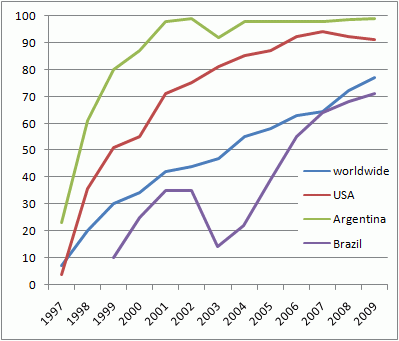
GE Soybean Share: From GMO-Compass
Strategies for Avoiding GE Foods
There are some measures you can take to make sure the foods you select are not genetically engineered. Soy is one of only nine common GE food crops, but their derivatives are in over 70 percent of supermarket foods, particularly processed foods. So, the more fresh, organic and local foods you eat, the less likely you'll be consuming GE ingredients. Also, look for the USDA Certified 100% Organic seal: This green or black seal assures the product is certified organic by the USDA, which means it contains at least 95 percent organic ingredients that are free of genetically engineered ingredients.
URGENT ACTION NEEDED: Support California's Ballot Initiative to Label GMO's!
One of the best strategies for reducing or eliminating GE foods is to force food manufacturers to list them on the label. You have a right to know if the foods you're eating contain GE ingredients. As it stands now, there is no labeling law.
This November, we have a great opportunity to change that with California Ballot Initiative Prop 37, which would require labeling of all genetically engineered foods and food ingredients, and ban the routine industry practice of labeling and marketing such foods as "natural." Voting day is fast approaching — if you're going to act, the time is now!
They need funds and volunteers. Remember, since California is the 8th largest economy in the world, a win for Prop 37 would be a huge step forward, likely affecting ingredients and labeling nationwide. As the campaign says,
"As goes California, so goes the nation."
I urge you to support this bill in any way you can. Here are a few suggestions as to how you can help pass this important initiative:
- Whether you live in California or not, please donate money to this historic effort, through the Organic Consumers Fund. If you live outside of the United States, you can still donate! For International Donations, please call (218) 353-7651!
- If you live in California and want to get involved, please contact CARightToKnow.org. They will go through all volunteer requests to put you into a position that is suitable for you, based on your stated interests and location.
- No matter where you live, please help spread the word in your personal networks, on Facebook, and Twitter. For help with the messaging, please see CARightToKnow.org.
- Talk to organic producers and stores and ask them to actively support the California Ballot. It may be the only chance we have to label genetically engineered foods.
Tuesday, October 30, 2012
Bolivia's Mother Earth Law Much Needed To Protect Nature
This month Bolivia passed the world's first ruling that grants all
nature equal rights to humans. The “Law of Mother Earth,” agreed by
politicians and grassroots social groups, redefines the South American
nation's mineral deposits as "blessings" and is supposed to lead to
radical new conservation and social measures to reduce pollution and
control industry.
One of the sectors to be largely affected is mining, which not only is Bolivia’s second biggest industry, but it injects $500 million a year into the economy. This represents nearly one third of the country's foreign currency.
The new law —passed on Oct. 15—protects the right of nature "to not be affected by mega-infrastructure and development projects that affect the balance of ecosystems and the local inhabitant communities".
So what will all these mean for mining companies operating or with projects in the Andean nation?
According to Matatea Changuy and Sophie Beier, from Pulsamérica.co.uk, the first obvious implication is that Evo Morales’ government is now legally bound to prioritize the wellbeing of its citizens and the environment. Thus, measures compromising mining activities in the country may be take in any moment alleging compliance with the new regulations outlined in the Mother Earth’s law.
While Changuy and Beir consider the law ground-breaking, as “offers some provocative, revolutionary re-conceptualization of the interdependence between Humans and Nature, and the role of the State herein,” they also warn it lacks of clear indications on how all the concepts will actually be put in place:
It draws on the Andean philosophy that views the Pachamama (meaning Mother Earth in native language) as a living being and sacred home.
Evo Morales, Latin America's first indigenous President, has become an outspoken critic in the UN of industrialized countries. He has also become notorious for raising mining taxes and nationalizing the country’s key natural gas industry as well as the telecommunications and electricity sectors, since taking power in 2006.
Earlier this year, Bolivia took over assets from Spain’s Red Eléctrica Corp. (REE) and Pan American Energy LLC.
And in July, Morales seized and nationalized the assets of Vancouver-based South American Silver Corp. (TSX:SAC), accusing the miner of causing a conflict that saw violence erupt among communities around the silver-indium-gallium project it was developing there.
Though rich in mineral and energy resources, data from the Unicef shows that Bolivia is one of the poorest countries in Latin America and the weakest economy in all of South America.
One of the sectors to be largely affected is mining, which not only is Bolivia’s second biggest industry, but it injects $500 million a year into the economy. This represents nearly one third of the country's foreign currency.
The new law —passed on Oct. 15—protects the right of nature "to not be affected by mega-infrastructure and development projects that affect the balance of ecosystems and the local inhabitant communities".
So what will all these mean for mining companies operating or with projects in the Andean nation?
According to Matatea Changuy and Sophie Beier, from Pulsamérica.co.uk, the first obvious implication is that Evo Morales’ government is now legally bound to prioritize the wellbeing of its citizens and the environment. Thus, measures compromising mining activities in the country may be take in any moment alleging compliance with the new regulations outlined in the Mother Earth’s law.
While Changuy and Beir consider the law ground-breaking, as “offers some provocative, revolutionary re-conceptualization of the interdependence between Humans and Nature, and the role of the State herein,” they also warn it lacks of clear indications on how all the concepts will actually be put in place:
In other words, such a complex and novel legal persona needs more than its inscription into the law: it needs a plan, a concept of how to reform the law from an ecological perspective. And how to do so, without creating more conflict.Bolivia, often ridiculed by the USA and Britain in the United Nations climate talks for demanding steep carbon emission cuts, has established 11 new rights for nature. They include: the right to life and to exist; the right to continue vital cycles and processes free from human alteration; the right to pure water and clean air; the right to balance; the right not to be polluted; and the right to not have cellular structure modified or genetically altered.
It draws on the Andean philosophy that views the Pachamama (meaning Mother Earth in native language) as a living being and sacred home.
Evo Morales, Latin America's first indigenous President, has become an outspoken critic in the UN of industrialized countries. He has also become notorious for raising mining taxes and nationalizing the country’s key natural gas industry as well as the telecommunications and electricity sectors, since taking power in 2006.
Earlier this year, Bolivia took over assets from Spain’s Red Eléctrica Corp. (REE) and Pan American Energy LLC.
And in July, Morales seized and nationalized the assets of Vancouver-based South American Silver Corp. (TSX:SAC), accusing the miner of causing a conflict that saw violence erupt among communities around the silver-indium-gallium project it was developing there.
Though rich in mineral and energy resources, data from the Unicef shows that Bolivia is one of the poorest countries in Latin America and the weakest economy in all of South America.
Friday, October 26, 2012
Native Americans Slaughtered, Sacrificed, Fenced In
Native Americans ‘Slaughtered, Sacrificed, Fenced in Reservations’ in US
October 26, 2012 by kristalklear
The prominent Native American activist Russell Means passed away on Monday. In 2008 he met with RT to talk about the Native Americans withdrawal from the US, their fight for recognition and his unhappiness with US citizenship.

At the end of 2007, a large group of Native Americans from South Dakota declared the independence of the Lakotah Republic from the United States, and renounced their US citizenship.
Following the incident RT’s Nadezhda Kevorkova met Russell Means, who told her about his struggle for independence.
RT: Russell, you are no longer a U.S. citizen, are you?
Russell Means: I am not. I am a Lakotah citizen, and I really regret about those who are hesitant to terminate their U.S. citizenship.
RT: In Russia many people dream of getting US citizenship, and they consider it stupid if anyone could’ve stayed in the U.S. under any pretext but failed to do so. What do you make of that?
RM: The United States is a fake country that has no culture. It’s easy to manipulate such a country, and to channel its people. The U.S. has a façade shown to the rest of the world, but few know of its reverse side as thoroughly as Indians do. The picture people see is not the reality of today’s United States.
Even the President who’s in office today wasn’t really elected, like back in the year 2000. Young people certainly strive to get here to achieve their dreams. But really anyone coming only has one reason: they want to become rich and successful, and they want to get their opportunities [to succeed]. Once you talk to them you realize they don’t even dream of anything beyond money-making. This was the reason Europeans came here. This is the principle of the American life. The world is sick and tired of American prosperity. The world is waking up.
RT: You have declared the Republic of Lakotah’s independent from the United States. What has the response been like?
RM: The world has shown a great response that’s been growing by the day. Thanks to the internet, we see how keen people are about our freedom. A large number of people support us, and welcome us. People are vividly interested in our independence. The world understands us; while the US government doesn’t.
RT: Who’s been supporting you?
RM: People don’t merely support us; thousands of people demonstrate their willingness to come to the Republic of Lakotah. Unlike the unfortunate refugees fleeing to the U.S., those willing to join us are highly qualified professionals – doctors, lawyers, professors, teachers, scientists, various profile engineers, computer specialists, farmers.
When people employ their minds they understand the meaning, and value, and the true meaning of freedom. We’re excited about anyone. If Americans want to join us we welcome them as well. The Lakota are a free people in their free country. The global situation has never been more favorable for us.

Chief Oliver, descendant of the legendary Chief Red Cloud, a supporter of Russell Means (Photo by Nadezhda Kevorkova)
RM: Casinos are legalized robbery. Only weak-minded and weak-spirited would want to spend their time playing in them. There won’t be any casinos in the Republic of Lakotah. We don’t want people to be robbed under a pretext that this kind of business is profitable for a tribe.
RT: What kind of difficulties do you expect to face, such as traveling outside the U.S. without a passport?
RM: A passport is required to be able to return to your home country. You only need an ID within the country; and the same applies to Europe. People will need their Lakotah passports to travel the world; this is something we’ve been working on now. As for me, I don’t expect any problems leaving the country; but they may want stop me from getting back in, that’s a possibility. It would be interesting if an American-born wouldn’t be allowed to return to his homeland. According to a UN convention, all groups of nationalities have the right to their own passports. So we are operating within international law.
RT: What is the meaning of freedom that Lakotah represents?
RM: Today the world lives by 17th-century values. That’s when the idea emerged that interests of an individual were protected by representative democracy. Few understand that a national government isn’t the most balanced kind of representation.
The strongest kind of representation is an association of communities where each community is a group of free citizens that guarantees their protection. The United States was intended as such a union of communities but they are no longer that way. They became an old-fashioned system of hierarchal governance.
The Republic of Lakotah will be designed on a communities principle based on consensus between them. Each community will have their own judges, law enforcement teams, and electoral councils. A community governed by its people doesn’t need police.
The patriarchal governance system is based on fear that produces various phobias. Men fear women, and women gain so much power that their identity gets modified. Refugees storm the state borders, and states protect their borders, maintain armies of prisoners, and practice torture and execution. The entire society is saturated with fear that’s been stirred up artificially. A patriarchal state believes in negative only, and expects negative only from its people. It was generated together with the market; and it made people its slaves.
A union of free communities is based on the principle of freedom rather than fear. A lot of people worldwide do realize it; this is why the Republic of Lakotah has so many supporters. If racists want to join us they are welcome to come here and live in a racist community. Freedom implies an opportunity to be an idiot and to live in a community of the likes.
RT: Native Indians aren’t represented in the U.S. Senate, or Congress, or the Supreme Court, are they?
RM: They aren’t, and they haven’t been throughout all these centuries. We intend making the U.S. government liable for the genocide of ethnic Indians. We’re now preparing paperwork to start a case at the International Court in The Hague. We are convinced that many countries will support our cause.
RT: Many journalists paint a picture of your program as a return to wigwams, fires and ritual dances, is it not true?
RM: Some would probably find this picture quite attractive, but this isn’t a possibility. We have to proceed from the reality. By returning our culture we mean using all the opportunities. I’ve traveled to Europe many times, and I’ve learned of various approaches to preserving the national culture. Back in the Soviet times, I visited Hungary, Bulgaria, Poland, and East Germany – everywhere except Russia and the Arctic region.
So I can make comparisons between places. The United States doesn’t even have opportunities for culture; it is only focused on money and on those forms of culture that yield money. Any art that sells is the kind of art that generates profit. It’s a terrible fodder turned into a machine for generating profit.
What we see now is the world being Americanized, the profitability principle, expanded. It’s caught up even with Russia which is however trying to resist it. We don’t want to see any further Americanization, but are no revisionists either – we aren’t calling people to going back to the Stone Age, to isolation, to an ethnographic museum type of life. Or to perform paid rituals, a kind of a spiritual prostitution that’s been involving Indians under the pretext that this is our way to preserve our identity by publicly performing our sacred dances.
So they say, if you don’t like Columbus, and progress, and democracy, you should give up using electricity, and computers, and phones. This is exactly what we will do immediately, as soon as those strangers and immigrants get on their boats and go back to their countries.

One of Russell Means’ achievements: A school for Native American children in Pine Ridge Reservation, South Dakota (Photo by Nadezhda Kevorkova)
RM: We have a special group that’s developing a whole new system, from creating alternative energy sources to our own banks that won’t be robbing our citizens. You have no idea just how positive people are about Indians. This is something I felt quite strongly in my travels – they were positive about me just because I was an ethnic Indian rather than an American. With this kind of trust credit, we will overcome all our difficulties, together with our allies.
The governments will have to recognize us and give us sovereignty. Their laws say it’s our land. If they refuse to do so, we will file a suit to the Supreme Court.
They will have to make that decision – you know they keep talking about the supremacy of law. Now it will backfire. So far they’ve been trying to ignore us, with the American press marginalizing us. But now, with the advent of the internet, these tricks have stopped working. The best idea for them would be to sit down and negotiate. Otherwise our next step would be going to the International Court in The Hague and demanding that genocide against American Indians be recognized. And we hope that as a founder of this court, Russia will support us.
Gandhi once said: First they ignore you, then they laugh at you, then they fight you, then condemn you, then you win.
RT:Vladimir Putin also holds Gandhi in high esteem. He says that after Gandhi died, there is no one to talk to.You have something to build upon.
RM: Putin was talking of the double-standard democracy in America. The US supports the sovereignty of all peoples, save for those who live in the US. So we are certain Russia will back us. There’s more on this. China’s resources are now worth around 40% of what the US has. Few people at all know that China has promised Bush a market collapse if the US attacks Iran. So there is a variety of tools for peoples to support one another.
RT:What if special services assassinate you?
RM: We the Indians are not afraid of death.And I haven’t been, either. Thirty-four years ago at Wounded Knee we defeated a whole army of special services. We will defeat it now, too.
You know the best thing about the Republic of Lakotah people? For centuries they slaughtered us, sacrificed us, fenced us into reservations, and stole our land, our air, our water. But we survived! We have things to offer. By contrast, they have nothing to offer. So they pretend we are non-existent.
RT:What are your arguments against the US government?
RM: According to the US data, when Europeans came here, there were around 12 million Indians across 48 states. By the early 20th century, only 250,000 Native Americans survived. About 70% of Indians are refugees in their own country; they have been displaced from their own land. The US carried out an unparalleled genocide: they killed 99.6% Indians.
The US takes pride in its commitment to law and democracy. But throughout the years, there has been no respite in wars. There are only two countries in the world that keep breaching international law non-stop: the US and Israel. The US goes as far as neglecting its own constitution, which says that we are all free and can declare independence any time.
Right now the Republic of Lakotah is a five-state area. Six more have already supported us and would like to join us, too.
RT: Do you want to stick to peaceful means? And if it doesn’t work out, will you take up arms?
RM: Never. This is inefficient. If you want to fight your way to freedom, you are no different from your enemies. You can’t protect your independence by throwing swords into the scale. Look at the Soviet experience: it was a failure.
RT: I was shown the houses of drug dealers in the reservation. What should one do about them?
RM: The communities will sort it out by themselves. There are two legal drugs in the US: alcohol and tobacco. Alcohol kills 75% of the population, while tobacco kills 24%, and the remaining 1% dies of illegal drugs. One day the six of us decided to block alcohol traffic to the reservation and formed a barrier on the border with Nebraska. But then came the police. They arrested us and let the dealers get away scot- free.
RT: But it was the Indians who introduced tobacco to the world, wasn’t it?
RM: Indians smoke a pipe with unadulterated tobacco as part of a ceremony, while the US produces cigarettes for daily consumption without any ritual meaning but with a lot of lethal chemical drugs.
RT: Do you smoke?
RM: I do smoke a pipe, but no cigarettes. Anyway, I don’t inhale the smoke – just like Bill Clinton.
RT:Americans killed all the buffalo.Now the buffalo are back and white people eat their meat in restaurants. Have they turned your basic meal into fast food?
RM: Americans crossbred the bison bull with domestic cattle. What they eat is the meat of this hybrid. They also add beef to buffalo meat. You can only taste buffalo meat at a dancing ceremony in our state and in Wyoming.
RT:Thanks to you, South Dakota no longer celebrates Columbus Day. Instead, it observes Native American Day. Now what about Thanksgiving? What is the true background? There are conflicting accounts that come from Europeans: that it is a celebration of the first harvest, or that Indians brought gifts and saved the settlers…
RM: This is all a lie. Native Americans have repeatedly saved the settlers, but there are no holidays to mark this. The true story is that the pilgrims massacred Indians, so the governor of Massachusetts issued a message to thank God for that and called on the other states to follow suit. Later on they tried to give the holiday a more peaceful meaning, but there’s no changing the past.
RT: Now what do Indians do on Thanksgiving Day?
RM: They eat turkey. Many of them don’t know a thing about it. They are a colonized people with a changed mentality and memory. Schools don’t teach them anything. Most of them don’t even know a thing about me. They believe I’m just a cinema star. Maybe the 1890 massacre rings some bell. But they are fully unaware of our 1973 victory at Wounded Knee. And that was a true triumph of Native Americans over the US government.
RT: I was shown the houses of drug dealers in the reservation. What should one do about them?
RM: The communities will sort it out by themselves. There are two legal drugs in the US: alcohol and tobacco. Alcohol kills 75% of the population, while tobacco kills 24%, and the remaining 1% dies of illegal drugs. One day the six of us decided to block alcohol traffic to the reservation and formed a barrier on the border with Nebraska. But then came the police. They arrested us and let the dealers get away scot- free.
RT: But it was the Indians who introduced tobacco to the world, wasn’t it?
RM: Indians smoke a pipe with unadulterated tobacco as part of a ceremony, while the US produces cigarettes for daily consumption without any ritual meaning but with a lot of lethal chemical drugs.
RT: Do you smoke?
RM: I do smoke a pipe, but no cigarettes. Anyway, I don’t inhale the smoke – just like Bill Clinton.
RT:Americans killed all the buffalo.Now the buffalo are back and white people eat their meat in restaurants. Have they turned your basic meal into fast food?
RM: Americans crossbred the bison bull with domestic cattle. What they eat is the meat of this hybrid. They also add beef to buffalo meat. You can only taste buffalo meat at a dancing ceremony in our state and in Wyoming.
RT:Thanks to you, South Dakota no longer celebrates Columbus Day. Instead, it observes Native American Day. Now what about Thanksgiving? What is the true background? There are conflicting accounts that come from Europeans: that it is a celebration of the first harvest, or that Indians brought gifts and saved the settlers…
RM: This is all a lie. Native Americans have repeatedly saved the settlers, but there are no holidays to mark this. The true story is that the pilgrims massacred Indians, so the governor of Massachusetts issued a message to thank God for that and called on the other states to follow suit. Later on they tried to give the holiday a more peaceful meaning, but there’s no changing the past.
RT: Now what do Indians do on Thanksgiving Day?
RM: They eat turkey. Many of them don’t know a thing about it. They are a colonized people with a changed mentality and memory. Schools don’t teach them anything. Most of them don’t even know a thing about me. They believe I’m just a cinema star. Maybe the 1890 massacre rings some bell. But they are fully unaware of our 1973 victory at Wounded Knee. And that was a true triumph of Native Americans over the US government.
RT: Could you please share some statistics on how American Indians live today?
RM: They are struggling. The life span is getting lower by the year. Men hardly live longer than 44 years, and few women are older than 47. This is worse than in the poorest African countries. The unemployment rate is about 73%. The only fluent speakers of the Lakota language are at least 65 years old, and they are few and far between. Here’s why I built a school at my ranch, where all the subjects there are taught in Lakota only.
Every fourth baby dies. Pharmaceutical companies take the healthiest kids away from their families, send them to orphanages and test drugs on them, including psychotic ones. To make matters worse, people kidnap children from reservations and sell them for organ removal or psychiatric experiments. A few cases have been started against these kidnappers. Beating and corporal punishment is rampant in schools. For kids from the reservations school embodies violence.
Scores of reservation dwellers are infected with tuberculosis, polio, and other diseases which have been defeated in the US. There are many more instances of hypertension and diabetes in reservations than in the areas populated by white Americans.
The reason for that is this particular free fodder that generations of our people have been fed. This free food contains nothing but carbs, while two thirds of our people cannot afford buying proper food. No other place in the United States has such death and disease rates as we do. Our water is intoxicated by uranium mines located in the Reservation. People living near uranium deposits suffer from cancer and all the associated diseases; women suffer miscarriages, and deliver unhealthy babies. Poor living conditions, uranium-intoxicated water and bad nutrition are the three reasons that have been killing off my people. We tried going all kinds of other ways such as rebellions, protests, marches, addresses, and strikes, but nothing got changed. The Republic of Lakotah was declared in the name of rescuing our people that the U.S. government didn’t care about. We began to die out, but we don’t want to anymore.
Most of tribal unions aren’t doing anything but cooperate with the colonial regime. They are like the Vichy Government under Hitler – merely making an impression of self-governance in the reservations. But they are even worse than the occupants.
They are now spreading rumors that we hadn’t consulted with our people and chiefs. This isn’t true. We did consult with those who are respected by people rather than the authorities. We reached an agreement with a hundred out of over 500 tribes, and with 480 families of several hundred people each. There are those in our tribes who we call miniature oligarchs, the caricature millionaires who made money on troubles of their people by selling alcohol and TVs. They also want to keep the current state of things otherwise they would lose their platform for developing their business. This mockery of life had ended on 17th December 2007. We are free. The Indian ‘Vichy’ wanted to keep their power over the Indian souls; but the Republic of Lakotah put an end to it.


Subscribe to:
Posts (Atom)