Yoichi Shimatsu
5-12-13 |
|
The azure glow
of Crater Lake was about to be smudged by a band of wispy smoke blowing
in eastward on the jet stream. As steely gray turned to black, I switched
on my dosimeter, which immediately whined in alarm. The radiation level
inside the jetliner cabin hit 2.26 microsieverts, equivalent to twice
the dosage at locations just 5 kilometers from the Fukushima No.1 nuclear
plant. Although my nerves were thoroughly rattled by the buzzing, the
dozing passengers were blissfully unaware of being bombarded by lethal
neutrons.

Sky-high
radiation reading inside a jetliner cabin while
flying over the Oregon-Washington state boundary.
The thin ghost
shadow riding through the sky had no semblance to a fat rain cloud. Here,
over the Pacific Northwest, was a vast plume of smoke from the incinerators
of Greater Tokyo that burn radioactive debris from Fukushima Prefecture.
The radiation levels gradually diminished as the jet made its descent
to SEA-TAC airport.
My journey
to Seattle from Southern California had been prompted by a questionable
claim from Washington State officials that the waves of tsunami debris
from Japan are not radioactive. This sort of optimism is based on the
assumption that any residual isotopes would be washed away in the North
Pacific Current during the passage of more than a year over a distance
of 7450 km (4630 miles).

Above
Crater Lake, Oregon, on arrival of the leading edge
of concentrated particulates from Tokyo incinerators burning low-level nuclear waste from Fukushima.
To the contrary,
my gut instinct tends to be pessimistic, especially after having conducted
several field research expeditions that discovered serious contamination
not only in northeast Japan but also on the southernmost peaks of the
Japanese archipelago. The spread of radiation, as far I have been able
to tell, is unstoppable.
New World’s
End
The Olympic
Peninsula is unexpectedly large. The three-hour drive out of Seattle wends
through a cactus desert in the rain shadow of snow-capped mountains and
then plunges into dark moss-hung stands of temperate rainforest. Beyond
the great arc of Crescent Lake, reminiscent of Scandinavia or Switzerland,
a road sign points to the town of Forks, location for the “Twilight” romantic
vampire series.

Shishi
Beach, Olympic Peninsula, has been cleared of
all debris from the 3.11 tsunami that hit northeast Japan.
At the Last
Chance gas station, the breakfast fare caters to the sport fishermen rolling
their boats down a ramp onto the Salish Sea, which separates Washington
State from British Columbia. My choice is a frozen barbecue burrito reheated
in a microwave. Farther along, totem poles in front of a low-hung casino
were carved by the Makah tribe known for their seagoing war canoes, which
are still used to hunt whales. Unlike the Japanese fleet’s mechanical
contraptions and ballistic projectiles, these muscular paddlers hurl old-fashioned
harpoons in a fair contest between man and leviathan.
Turning south
from Neah Bay, the road peters out at gravel parking lot marked by a wooden
sign that reads: “Shishi Beach 1.6 miles”. The early stretch is a pleasant
stroll atop wooden planks through a forest as spooky as those in Lord
of the Rings. Then the path descends into an endless slog through perma-mud
and poison oak well beyond the promised distance. My thought while stumbling
along was : “So this is how the natives get their revenge.”
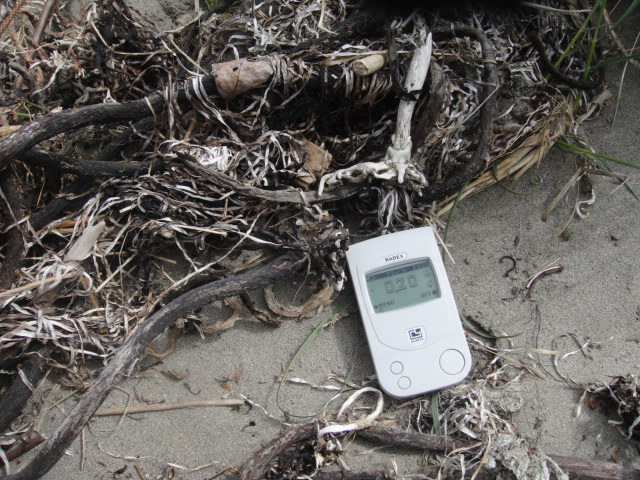
Higher
radiation levels from previous year’s seaweed are
found along the shore of the Makah tribal lands.
At last, the
waves crashing on pristine beaches devoid of foreign flotsam, come into
sight. After traveling 10,000 kilometers from the other side of the ocean,
I find not a matchstick much less a floating house or boat from Japan.
There were more bits of chewing gum wrappers on the trail than on these
lonely stretches of sand and bonsai-studded rocks.
Seaweed Tales
Disappointed,
to say the least, I switched to a stratagem of measuring radiation in
the seaweed that had washed ashore. Within a few minutes, a pattern emerged.
Dry bunches of kelp above the dunes imply a serious radioactive event
happening about a year earlier with readings of up to 0.28 microsieverts.
More recently displaced wet seaweed show half that figure. At the water’s
edge, the readings are very low, only about 0.08 microsieverts, near the
background radiation across the peninsula.
The Pacific
Northwest has abundant rainfall yet lacks the high humidity of Japan.
Thus, instead of recycling radiation inland, the isotopes are washed out
to sea, rapidly lowering contaminations on land and in the bays.
It is a pity
that my science kit does not include any instruments to detect toxic chemicals
or microbiological contamination. The steep slopes of Japan’s northeast
coast meant that most of the region’s tanks for oil, fertilizer and pesticides,
along with refrigerant fluids, were stored along the shore and were swept
away by the tsunami.
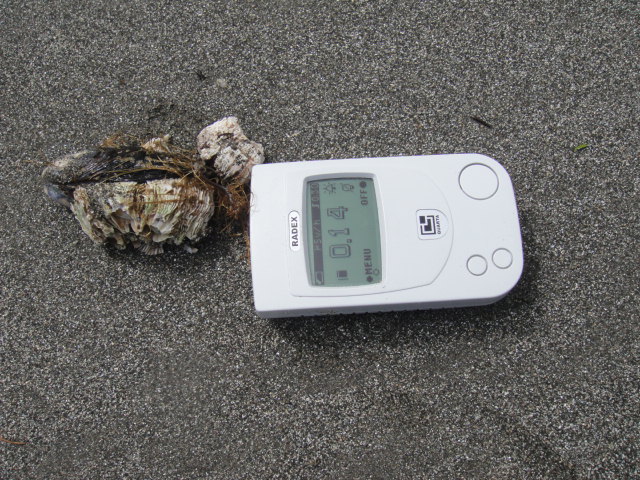
Barnacles
attached to a mussel have bio-accumulated radiation from algae and plankton.
A Strand of
Buoys
Calling it
a day, filled with hard-earned futility, I headed back toward civilization.
On the edge of Neah Bay village, the front yard of a shack identified
by the sign “FISH” is festooned with a string of colorful buoys. On closer
inspection, the plastic balls are covered with raised Chinese characters,
a bit of Japanese phonetic script and the Roman alphabet.
My experience
along the Fukushima coast showed that rubber plastic and fishing nets
absorb radiation more readily than wood or metal. The dosimeter recorded
an identical 0.16 microsieverts on every Japanese float, a level not immediately
harmful to the rare passerby. Nonetheless, the figure is a good indicator
of contamination on the journey from Fukushima. The Chinese balls are
between 0.05 and 0.08 microSv.
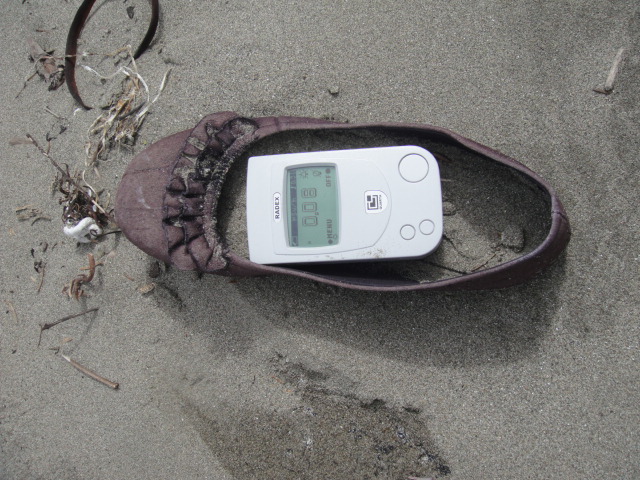
Lower
radiation levels are present in recently
dowsed items like wet kelp or this cast-off woman’s shoe.
Again, small
differences disclose a larger story. The made-in-Japan floats, aboard
trawlers or hanging to dry with nets in fishing villages, were pulled
out to sea by the tsunami and soon became irradiated by contaminated water
from the Fukushima nuclear meltdown. In contrast, the Chinese buoys were
attached to long fishing nets laid outside Japan’s 200-mile maritime exclusive
economic zone. Larger pieces of jetsam, for example, wooden beams, boats
and buildings, ripped those long nets to shreds, releasing the Chinese
buoys adrift. At that distance from the coast, radiation levels had become
greatly diluted.
So here, in
these findings, was undeniable proof that the federal and state governments
have again failed to inform American citizens of the radiation risk from
Fukushima. For all the funding spent on climate research, oceanic studies,
fisheries protection and marine biology, not a single official bulletin
mentions anything about what a visitor can learn from a string of buoys
in front of a salmon smokehouse.
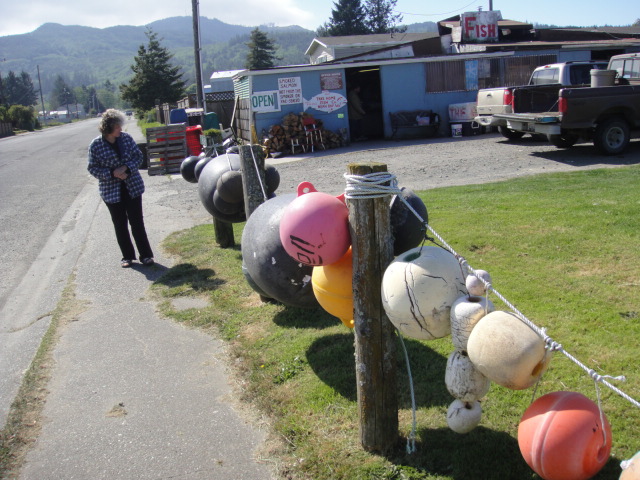
Beachcomber’s
collection of fishing-net buoys at a
salmon smokehouse run by a Makah resident
The proprietor,
a big strapping cheerful Makah fellow, stepped outside to provide answers
to the missing debris riddle. “The state has started to put two big containers
by the beaches on weekends, and volunteers come to clean up the beaches.”
The state Bureau
of Corrections responded to my query by answering that convicts from the
two nearby prisons had never been assigned to the beach detail. Therefore,
ordinary residents out of the goodness of their hearts did the hard work
of removing flotsam, which included radioactive materials. The volunteers
had no knowledge of the health risk and were given no advice on wearing
protective gloves and eyewear or about decontamination methods.
A state resident
who is an avid halibut fisherman told me: “It must be some sort of diversion
that the only thing that the biologists have been focusing on is invasive
species from Japan. They never say anything about radiation in the food
chain.”
Gazing at the
ocean from the closest point in the Lower 48 to Japan, the truth is as
cold and bitter as the north wind. I shudder to think of what is still
to come.
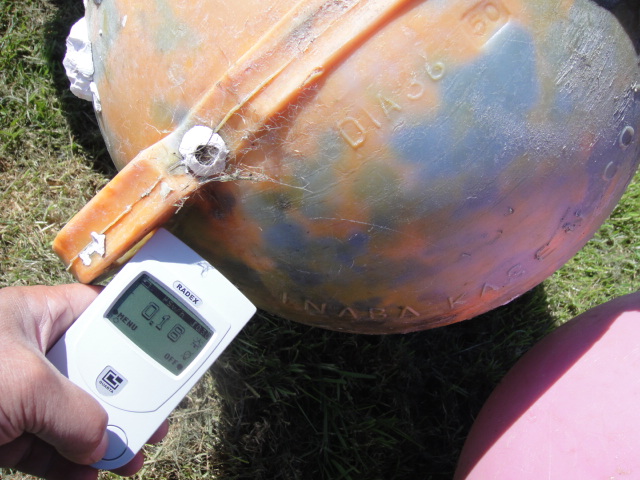
A
consistent reading of 0.16 microsieverts is found on the buoys from Japan
Update on the
Marine Mammal Kill-off in Southern California:
Before heading
to the Pacific Northwest, I met a number of Southern California residents
whose lives are deeply connected to the ocean.
A California
Fish and Wildlife ranger did not flinch when told of my radiation findings
in the heart of a dead sea lion beached at San Onofre. He told me the
following:
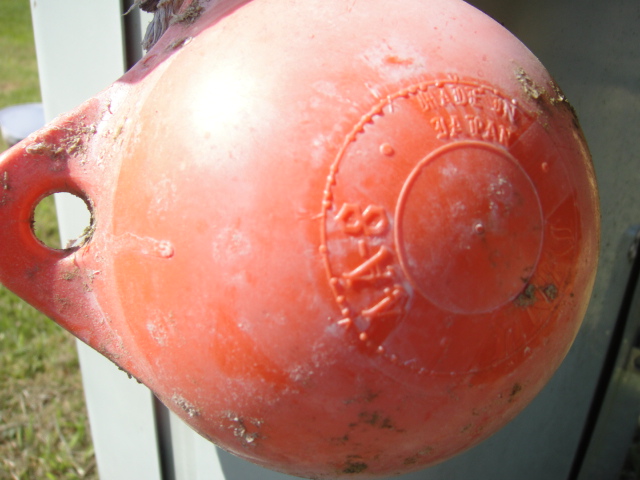
“Made
in Japan” is impressed on a small buoy.
The coming
feed shortage: “At this time of year (late winter and spring), there’s
a northward current from San Diego-Coronado Island up the Catalina Channel.
The colder California Current (moving southward) flows around the outside
of the Channel islands (Santa Catalina and San Clemente). Over the past
year, the water in the Channel has been colder than usual. Soon, a warm
current will strongly push north below the surface and there will be a
series of powerful upwellings of warm water up the Channel. The sudden
temperature change is likely to kill off the sardines, leading to a major
feed crisis for marine mammals.”
Marine environment
imbalances: “Rising population along the coast and one-sided zoning decisions
have upset the delicate balance in the marine environment. Lobbyists from
either side, industry or animal protection, have pushed the state legislature
toward one extreme or the other, further worsening the environmental balance.
The situation does not get better, for instance, when a ban against commercial
fishing opens the door to poachers. We’re going from one ill to the next
without the overall situation getting any better ”
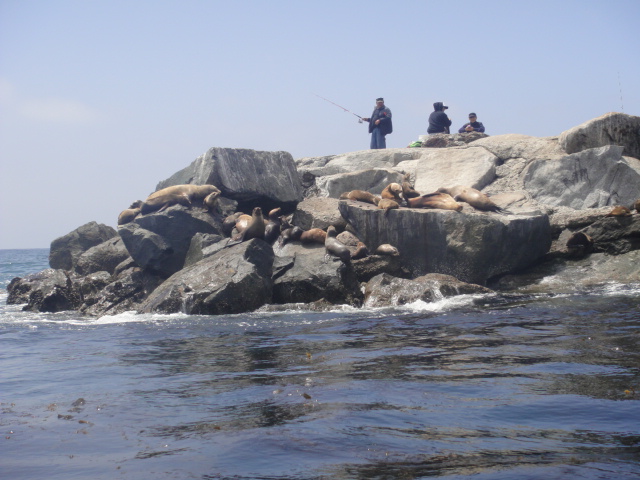
Pups
and juvenile sea lions rest on the rocks of a jetty at
Newport Harbor despite the presence of sport fisherman, a sight never seen before.
Aquaculture:
“The squid from the coast of Southern California, formerly used for bait,
are now being fished as feed for large tuna farms off the coast of Ensenada,
Mexico. The expansion of this billion-dollar industry is going to pose
a lot of pressure on fish stocks around here.”
Shark Attacks:
(reply to my question on the absence of teeth marks on the dead sea lion
at San Onofre.) “Great White sharks often do not leave any teeth marks.
There are many reports of fast-moving sharks hitting a sea lion and ripping
off a strip of skin with no other sign of a bite.”
A bait-barge
worker: “The price of sardines is no different now than in the past. There
is no shortage of smaller fish. Everything is as normal.” (His observations
runs counter to the theory of a feed shortage in the channel.)
Volunteer at
a fish-stocking raft: “We’ve never before seen sea lion pups resting on
the jetty of Newport Harbor. This is most unusual.”

A
shallow tide pool in the Laguna Beach area has higher
radiation levels due to constant evaporation.
Sport fisherman
on the jetty: “The pups arrived here about two weeks ago and stayed.”
(In mid-April, the marine mammal kill-off extended northward to Malibu
and later Santa Barbara, where beaches were littered with pups dead from
starvation. Apparently, just after that crisis, some juvenile sea lions
fled to the unfamiliar rocks at the harbor mouth. My radiation readings
of a dead pup’s intestines indicated it was not contaminated, meaning
the mother was probably dead before she could nurse the pup with radioactive
milk.}
A sport fisherman
conjectures: “The Great White sharks have been getting more aggressive
recently, attacking swimmers and sea lions. Orcas are hunting here out
of season, feeding on the white sharks. From what I can tell, the radiation
in the water is disrupting the sensors in their snouts and enraging them
to attack without cause.”
A Point about
Beach Safety:
Radiation readings
along the Laguna Beach area indicate lower readings than in San Onofre
or Santa Catalina, with one exception: Shallow tide pools affected by
solar evaporation. Flat tidal pools that are exposed at high tides tend
to act like salt ponds, concentrating radioactive isotopes in the seaweed
and in crustaceans. One large sea snail registered 0.38 microsieverts,
and seaweed clumps were up to about 0.20 microSv.
Sandy beach
areas showed much lower levels, and thus are safer for beach goers, so
act accordingly when positioning beach blankets.
Author: Yoichi
Shimatsu, a Hong Kong-based science journalist, provides health and environment
consulting to residents of Fukushima on countermeasures to radiation exposure.
|
Showing posts with label Lies. Show all posts
Showing posts with label Lies. Show all posts
Monday, May 13, 2013
Olympic Peninsula: West Coast Radiation Crisis


Former Pro-GMO Scientist Speaks Out On The Real Dangers of Genetically Engineered Food

By Thierry Vrain
I retired 10 years ago after a long career as a research scientist for Agriculture Canada. When I was on the payroll, I was the designated scientist of my institute to address public groups and reassure them that genetically engineered crops and foods were safe. There is, however, a growing body of scientific research – done mostly in Europe, Russia, and other countries – showing that diets containing engineered corn or soya cause serious health problems in laboratory mice and rats.
I don’t know if I was passionate about it but I was knowledgeable. I defended the side of technological advance, of science and progress.
In the last 10 years I have changed my position. I started paying attention to the flow of published studies coming from Europe, some from prestigious labs and published in prestigious scientific journals, that questioned the impact and safety of engineered food.
I refute the claims of the biotechnology companies that their engineered crops yield more, that they require less pesticide applications, that they have no impact on the environment and of course that they are safe to eat.
There are a number of scientific studies that have been done for Monsanto by universities in the U.S., Canada, and abroad. Most of these studies are concerned with the field performance of the engineered crops, and of course they find GMOs safe for the environment and therefore safe to eat.
Individuals should be encouraged to make their decisions on food safety based on scientific evidence and personal choice, not on emotion or the personal opinions of others.
We should all take these studies seriously and demand that government agencies replicate them rather than rely on studies paid for by the biotech companies.
The Bt corn and soya plants that are now everywhere in our environment are registered as insecticides. But are these insecticidal plants regulated and have their proteins been tested for safety? Not by the federal departments in charge of food safety, not in Canada and not in the U.S.
There are no long-term feeding studies performed in these countries to demonstrate the claims that engineered corn and soya are safe. All we have are scientific studies out of Europe and Russia, showing that rats fed engineered food die prematurely.
These studies show that proteins produced by engineered plants are different than what they should be. Inserting a gene in a genome using this technology can and does result in damaged proteins. The scientific literature is full of studies showing that engineered corn and soya contain toxic or allergenic proteins.
Genetic engineering is 40 years old. It is based on the naive understanding of the genome based on the One Gene – one protein hypothesis of 70 years ago, that each gene codes for a single protein. The Human Genome project completed in 2002 showed that this hypothesis is wrong.
The whole paradigm of the genetic engineering technology is based on a misunderstanding. Every scientist now learns that any gene can give more than one protein and that inserting a gene anywhere in a plant eventually creates rogue proteins. Some of these proteins are obviously allergenic or toxic.
I have drafted a reply to Paul Horgen’s letter to the Comox Valley Environmental Council. It is my wish that it goes viral as to educate as many people as possible rapidly. Any and all social media is fine by me. This can also be used as a briefing note for the councilors of AVICC or anywhere else. Thank you for your help. [Click here for original source with replies from Dr. Paul Horgen]
— Thierry Vrain, Innisfree Farm
I am turning you towards a recent compilation (June 2012) of over 500 government reports and scientific articles published in peer reviewed Journals, some of them with the highest recognition in the world. Like The Lancet in the medical field, or Advances in Food and Nutrition Research, or Biotechnology, or Scandinavian Journal of Immunology, European Journal of Histochemistry, Journal of Proteome Research, etc … This compilation was made by a genetic engineer in London, and an investigative journalist who summarized the gist of the publications for the lay public.
GMO Myths and Truths – an evidence based examination of the claims made for the safety and efficacy of genetically modified crops. A report of 120 pages, it can be downloaded for free from Earth Open Source. “GMO Myths and Truths” disputes the claims of the Biotech industry that GM crops yield better and more nutritious food, that they save on the use of pesticides, have no environmental impact whatsoever and are perfectly safe to eat.
Genetic pollution is so prevalent in North and South America where GM crops are grown that the fields of conventional and organic grower are regularly contaminated with engineered pollen and losing certification. The canola and flax export market from Canada to Europe (a few hundreds of millions of dollars) were recently lost because of genetic pollution. Did I mention superweeds, when RoundUp crops pass their genes on to RoundUp Resistant weeds.
Apparently over 50% of fields in the USA are now infested and the growers have to go back to use other toxic herbicides such as 2-4 D. Many areas of Ontario and Alberta are also infested. The transgenes are also transferred to soil bacteria. A chinese study published last year shows that an ampicillin resistance transgene was transferred from local engineered crops to soil bacteria, that eventually found their way into the rivers. The transgenes are also transferred to humans.
Volunteers who ate engineered soybeans had undigested DNA in their intestine and their bacterial flora was expressing the soybean transgenes in the form of antibiotic resistance. This is genetic pollution to the extreme, particularly when antibiotic resistance is fast becoming a serious global health risk. I can only assume the American Medical Association will soon recognize its poorly informed judgement.
In 2009 the American Academy of Environmental Medicine called for a moratorium of GM foods, safety testing and labeling. Their review of the available literature at the time noted that animals show serious health risks associated with GM food consumption including infertility, immune dysregulation, accelerated aging, dysregulation of genes associated with cholesterol synthesis, insulin regulation, cell signaling, and protein formation, and changes in the liver, kidney, spleen and gastrointestinal system.
Monsanto writes “There is no need to test the safety of GM foods”. So long as the engineered protein is safe, foods from GM crops are substantially equivalent and they cannot pose any health risks.” The US Food and Drug Administration waived all levels of safety testing in 1996 before approving the commercialization of these crops. Nothing more than voluntary research is necessary, and the FDA does not even want to see the results.
And there is certainly no need to publish any of it. If you remember 1996, the year that the first crops were commercialized, the research scientists of the US FDA all predicted that transgenic crops would have unpredictable hard to detect side effects, allergens, toxins, nutritional effects, new diseases. That was published in 2004 in Biotechnology if you recall seeing it.
I know well that Canada does not perform long term feeding studies as they do in Europe. The only study I am aware of from Canada is from the Sherbrooke Hospital in 2011, when doctors found that 93% of pregnant women and 82% of the fetuses tested had the protein pesticide in their blood.
This is a protein recognized in its many forms as mildly to severely allergenic. There is no information on the role played by rogue proteins created by the process of inserting transgenes in the middle of a genome. But there is a lot of long term feeding studies reporting serious health problems in mice and rats. The results of the first long term feeding studies of lab rats reported last year in Food and Chemical Toxicology show that they developed breast cancer in mid life and showed kidney and liver damage.
The current statistic I read is that North Americans are eating 193 lbs of GMO food on average annually. That includes the children I assume, not that I would use that as a scare tactic. But obviously I wrote at length because I think there is cause for alarm and it is my duty to educate the public.
One argument I hear repeatedly is that nobody has been sick or died after a meal (or a trillion meals since 1996) of GM food. Nobody gets ill from smoking a pack of cigarette either. But it sure adds up, and we did not know that in the 1950s before we started our wave of epidemics of cancer.
Except this time it is not about a bit of smoke, it’s the whole food system that is of concern. The corporate interest must be subordinated to the public interest, and the policy of substantial equivalence must be scrapped as it is clearly untrue.
Thierry Vrain is a former research scientist for Agriculture Canada. He now promotes awareness of the dangers of genetically modified foods.
Tuesday, April 30, 2013
How Did Obama Become Monsanto's Man in Washington?
And when are anti-GMO activist groups going to stop saying they’re “shocked and disappointed” by the president?
Shocked and disappointed is polite-speak and politically correct reaction. It’s baloney.
Don’t you get it? Obama has never been on your side. He never deserved your trust.
Disappointment implies he was your buddy and then unaccountably walked away.
The man is a politician. He’s a liar. Different pols have different styles of lying. Some pretend they’re your friend before they screw you over and leave you in the dust.
I’ve previously published Obama’s track record as Monsanto’s number-one political supporter in America.
Meet Monsanto’s prime lobbyist, Barack Obama:
After his victory in the 2008 election, Obama filled key posts with Monsanto people, in federal agencies that wield tremendous force in food issues, the USDA and the FDA:
At the USDA, as the director of the National Institute of Food and Agriculture, Roger Beachy, former director of the Monsanto Danforth Center.
As deputy commissioner of the FDA, the new food-safety-issues czar, the infamous Michael Taylor, former vice-president for public policy for Monsanto. Taylor had been instrumental in getting approval for Monsanto’s genetically engineered bovine growth hormone.
As commissioner of the USDA, Iowa governor, Tom Vilsack. Vilsack had set up a national group, the Governors’ Biotechnology Partnership, and had been given a Governor of the Year Award by the Biotechnology Industry Organization, whose members include Monsanto.
As the new Agriculture Trade Representative, who would push GMOs for export, Islam Siddiqui, a former Monsanto lobbyist.
As the new counsel for the USDA, Ramona Romero, who had been corporate counsel for another biotech giant, DuPont.
As the new head of the USAID, Rajiv Shah, who had previously worked in key positions for the Bill and Melinda Gates Foundation, a major funder of GMO agriculture research.
We should also remember that Obama’s secretary of state, Hillary Clinton, once worked for the Rose law firm. That firm was counsel to Monsanto.
Obama nominated Elena Kagan to the US Supreme Court. Kagan, as federal solicitor general, had previously argued for Monsanto in the Monsanto v. Geertson seed case before the Supreme Court.
The deck was stacked. Obama hadn’t simply made honest mistakes. Obama hadn’t just failed to exercise proper oversight in selecting appointees. He was staking out territory on behalf of Monsanto and other GMO corporate giants.
And now let us look at what key Obama appointees have wrought for their true bosses.
Let’s see what GMO crops have walked through the open door of the Obama presidency.
Monsanto GMO alfalfa.
Monsanto GMO sugar beets.
Monsanto GMO Bt soybean.
Coming soon: Monsanto’s GMO sweet corn.
Syngenta GMO corn for ethanol.
Syngenta GMO stacked corn.
Pioneer GMO soybean.
Syngenta GMO Bt cotton.
Bayer GMO cotton.
ATryn, an anti-clotting agent from the milk of transgenic goats.
A GMO papaya strain.
And soon, genetically engineered salmon and apples.
This is an extraordinary parade.
Obama was, all along, a stealth operative on behalf of Monsanto, biotech, GMOs, and corporate control of the future of agriculture.
He didn’t make that many key political appointments and allow that many new GMO crops to enter the food chain through a lack of oversight.
Nor is it coincidental that two of the Obama’s biggest supporters, Bill Gates and George Soros, purchased 900,000 and 500,000 shares of Monsanto, respectively, in 2010.
Records don’t show Monsanto or other biotech giants pouring a landslide of (visible) campaign cash down on Obama, relative to other large donors.
Goldman Sachs was Obama’s number-one $$ donor, and Goldman touts GM-crop commodity contracts, for both buys and sells; but Goldman has its fingers in every significant money pot from Nome to Tierra Del Fuego.
The “Obama riddle” is as plain as the nose on the face of Globalism. Monsanto’s agenda, to monopolize the world’s food supply, is essential to the Globalist blueprint. That blueprint ultimately aims for redistribution of food to the world from a point of Central Planning
As president, Obama has a sworn obligation to Globalism. His oath isn’t to protect the Constitution. Are you kidding?
Every recent president has had an overriding loyalty to Globalism.
Obama’s signing of the Monsanto Protection Act, making that corporation senior in power to the US court system, wasn’t an accident. It was taken in keen awareness of his duty to his Globalist betters.
You won’t, of course, see this disclosed on the evening news.
Here is a president who, like Bush, has no plans for a better world. Obama’s notion of “better” is tied up in the Globalist agenda:
An elite-run bureaucracy, promoting equality and justice, reduces all populations to a lowest common denominator, squashing freedom and prosperity.
Obama’s supporters will never learn the truth, because they’re blinded by the light, which they project on to the persona of the president.
Obama is aware of the con, since he triggered it, and he leverages it.
He’s all nudge-and-wink. “Yes, we’ll help you and you and you. Of course we will.”
He might help you if you make a declaration of dependence. Sacrifice yourself on an altar of despair and then you might earn the right to be fed.
Obama, while on the campaign trail in 2008, was promising transparency in government, was claiming that every person has the right to know what’s in his food (GMO labeling). But clearly, that was all cover and fluff. He was lying through his teeth and he knew it.
He’d been vetted for the presidency, and he knew the job entailed joining Monsanto and the larger Globalist agenda as a front man.
He hasn’t changed over the past four years. He’s been a covert agent since the beginning.
Imposter. Charlatan.
These words fit Obama. He’s pretended, like Clinton, to care, but he doesn’t. He doesn’t care that GMO food is taking over the country and the world. He wants it to happen. He’s always wanted it to happen.
The sitting president of the United States, Monsanto, DuPont, and Dow, among others, are prepared to do whatever is necessary to make GMO food dominate America.
They intend, through Monsanto-gene drift among millions of plants in ag fields, through increased planting of GMO crops, and through introduction of still more GMO crops, to wrap up the USA in genetically engineered food.
Obama is on board. He’s always been on board.
He is the GMO president.
If tomorrow, the Globalist Rockefellers of this world decided that all food grown in the US should be injected with Prozac, Obama would find a way to help.
Stop making excuses for the man. He’s not a victim of evil forces surrounding his presidency. He signed up for this trip with eyes wide open.
Sources:
http://redgreenandblue.org/2012/02/02/monsanto-employees-in-the-halls-of-government-part-2/
http://redgreenandblue.org/2011/02/09/monsanto-employees-in-the-halls-of-government/
http://www.motherjones.com/tom-philpott/2011/10/fda-labeling-gmo-genetically-modified-foods
http://fooddemocracynow.org/blog/2011/feb/15/update-obama-goes-rogue-gmos-tell-him-say-no-monsa/
Shocked and disappointed is polite-speak and politically correct reaction. It’s baloney.
Don’t you get it? Obama has never been on your side. He never deserved your trust.
Disappointment implies he was your buddy and then unaccountably walked away.
The man is a politician. He’s a liar. Different pols have different styles of lying. Some pretend they’re your friend before they screw you over and leave you in the dust.
I’ve previously published Obama’s track record as Monsanto’s number-one political supporter in America.
Meet Monsanto’s prime lobbyist, Barack Obama:
After his victory in the 2008 election, Obama filled key posts with Monsanto people, in federal agencies that wield tremendous force in food issues, the USDA and the FDA:
At the USDA, as the director of the National Institute of Food and Agriculture, Roger Beachy, former director of the Monsanto Danforth Center.
As deputy commissioner of the FDA, the new food-safety-issues czar, the infamous Michael Taylor, former vice-president for public policy for Monsanto. Taylor had been instrumental in getting approval for Monsanto’s genetically engineered bovine growth hormone.
As commissioner of the USDA, Iowa governor, Tom Vilsack. Vilsack had set up a national group, the Governors’ Biotechnology Partnership, and had been given a Governor of the Year Award by the Biotechnology Industry Organization, whose members include Monsanto.
As the new Agriculture Trade Representative, who would push GMOs for export, Islam Siddiqui, a former Monsanto lobbyist.
As the new counsel for the USDA, Ramona Romero, who had been corporate counsel for another biotech giant, DuPont.
As the new head of the USAID, Rajiv Shah, who had previously worked in key positions for the Bill and Melinda Gates Foundation, a major funder of GMO agriculture research.
We should also remember that Obama’s secretary of state, Hillary Clinton, once worked for the Rose law firm. That firm was counsel to Monsanto.
Obama nominated Elena Kagan to the US Supreme Court. Kagan, as federal solicitor general, had previously argued for Monsanto in the Monsanto v. Geertson seed case before the Supreme Court.
The deck was stacked. Obama hadn’t simply made honest mistakes. Obama hadn’t just failed to exercise proper oversight in selecting appointees. He was staking out territory on behalf of Monsanto and other GMO corporate giants.
And now let us look at what key Obama appointees have wrought for their true bosses.
Let’s see what GMO crops have walked through the open door of the Obama presidency.
Monsanto GMO alfalfa.
Monsanto GMO sugar beets.
Monsanto GMO Bt soybean.
Coming soon: Monsanto’s GMO sweet corn.
Syngenta GMO corn for ethanol.
Syngenta GMO stacked corn.
Pioneer GMO soybean.
Syngenta GMO Bt cotton.
Bayer GMO cotton.
ATryn, an anti-clotting agent from the milk of transgenic goats.
A GMO papaya strain.
And soon, genetically engineered salmon and apples.
This is an extraordinary parade.
Obama was, all along, a stealth operative on behalf of Monsanto, biotech, GMOs, and corporate control of the future of agriculture.
He didn’t make that many key political appointments and allow that many new GMO crops to enter the food chain through a lack of oversight.
Nor is it coincidental that two of the Obama’s biggest supporters, Bill Gates and George Soros, purchased 900,000 and 500,000 shares of Monsanto, respectively, in 2010.
Records don’t show Monsanto or other biotech giants pouring a landslide of (visible) campaign cash down on Obama, relative to other large donors.
Goldman Sachs was Obama’s number-one $$ donor, and Goldman touts GM-crop commodity contracts, for both buys and sells; but Goldman has its fingers in every significant money pot from Nome to Tierra Del Fuego.
The “Obama riddle” is as plain as the nose on the face of Globalism. Monsanto’s agenda, to monopolize the world’s food supply, is essential to the Globalist blueprint. That blueprint ultimately aims for redistribution of food to the world from a point of Central Planning
As president, Obama has a sworn obligation to Globalism. His oath isn’t to protect the Constitution. Are you kidding?
Every recent president has had an overriding loyalty to Globalism.
Obama’s signing of the Monsanto Protection Act, making that corporation senior in power to the US court system, wasn’t an accident. It was taken in keen awareness of his duty to his Globalist betters.
You won’t, of course, see this disclosed on the evening news.
Here is a president who, like Bush, has no plans for a better world. Obama’s notion of “better” is tied up in the Globalist agenda:
An elite-run bureaucracy, promoting equality and justice, reduces all populations to a lowest common denominator, squashing freedom and prosperity.
Obama’s supporters will never learn the truth, because they’re blinded by the light, which they project on to the persona of the president.
Obama is aware of the con, since he triggered it, and he leverages it.
He’s all nudge-and-wink. “Yes, we’ll help you and you and you. Of course we will.”
He might help you if you make a declaration of dependence. Sacrifice yourself on an altar of despair and then you might earn the right to be fed.
Obama, while on the campaign trail in 2008, was promising transparency in government, was claiming that every person has the right to know what’s in his food (GMO labeling). But clearly, that was all cover and fluff. He was lying through his teeth and he knew it.
He’d been vetted for the presidency, and he knew the job entailed joining Monsanto and the larger Globalist agenda as a front man.
He hasn’t changed over the past four years. He’s been a covert agent since the beginning.
Imposter. Charlatan.
These words fit Obama. He’s pretended, like Clinton, to care, but he doesn’t. He doesn’t care that GMO food is taking over the country and the world. He wants it to happen. He’s always wanted it to happen.
The sitting president of the United States, Monsanto, DuPont, and Dow, among others, are prepared to do whatever is necessary to make GMO food dominate America.
They intend, through Monsanto-gene drift among millions of plants in ag fields, through increased planting of GMO crops, and through introduction of still more GMO crops, to wrap up the USA in genetically engineered food.
Obama is on board. He’s always been on board.
He is the GMO president.
If tomorrow, the Globalist Rockefellers of this world decided that all food grown in the US should be injected with Prozac, Obama would find a way to help.
Stop making excuses for the man. He’s not a victim of evil forces surrounding his presidency. He signed up for this trip with eyes wide open.
Sources:
http://redgreenandblue.org/2012/02/02/monsanto-employees-in-the-halls-of-government-part-2/
http://redgreenandblue.org/2011/02/09/monsanto-employees-in-the-halls-of-government/
http://www.motherjones.com/tom-philpott/2011/10/fda-labeling-gmo-genetically-modified-foods
http://fooddemocracynow.org/blog/2011/feb/15/update-obama-goes-rogue-gmos-tell-him-say-no-monsa/
Tuesday, February 12, 2013
Rogue Cop on the Lam Becomes Folk Hero to Some: LAPD Appears to Want Dorner Dead, not Captured and Talking
Let’s not be too quick to dismiss the “ranting” of renegade LAPD officer Chris Dorner.
Dorner, a three-year police veteran and former Lieutenant in the US Navy who went rogue after being fired by the LAPD, has accused Los Angeles Police of systematically using excessive force, of corruption, of being racist, and of firing him for raising those issues through official channels.
By all media accounts, Dorner “snapped” after his firing, and has vowed to kill police in retaliation. He allegedly has already done so, with several people, including police officers and family members of police already shot dead or wounded.
Now there’s a record huge “manhunt” involving police departments across California, focussing on the mountains around Big Bear, featuring cops dressed in full military gear and armed with semi-automatic weapons. (Some 40-50 senior LAPD officers specifically threatened by Dorner are also being heavily guarded by LAPD cops.) Dorner has so far skilfully eluded his pursuers, despite a $1-million bounty on his head and thousands of people in the posse hunting for him. He has meanwhile developed a large and growing following of people who are actually rooting for him, with some comparing him to the Batman of “Dark Knight,” striking terror into, and wreaking vengeance on a corrupt police culture.
Few would argue that randomly killing police officers and their family members or friends is justified, but I think that there is good reason to suspect that the things that Dorner claims set him off, such as being fired for reporting police brutality, and then going through a rigged hearing, deserve serious consideration and investigation.
The LAPD has a long history of abuse of minorities (actually the majority in Los Angeles, where whites are now a minority). It has long been a kind of paramilitary force -- one which pioneered the military-style Special Weapons and Tactics (SWAT) approach to “policing.”
If you wanted a good example to prove that nothing has changed over the years, just look at the outrageous incident involving LAPD cops tasked with capturing Dorner, who instead shot up two innocent women who were delivering newspapers in a residential area of Los Angeles. The women, Margie Carranza, 47, and her mother, Emma Hernandez, 71 (now in serious condition in the hospital), were not issued any warning. Police just opened fire from behind them, destroying their truck with heavy semi-automatic fire to the point that it will have to be scrapped and replaced.
The two women are lucky to be alive (check out the pattern of bullet holes in the rear window behind the driver’s position in the accompanying photo). What they experienced was the tactics used by US troops on patrol in Iraq or Afghanistan, not the tactics that one expects of police. Their truck wasn’t even the right make or color, but LAPD’s “finest” decided it was better to be safe than sorry, so instead of acting like cops, they followed Pentagon “rules of engagement”: They attempted to waste the target.
Local residents say that after that shooting, which involved seven LAPD officers and over 70 bullets expended -- with nobody returning fire -- the street and surrounding houses were pockmarked with bullet holes. The Los Angeles Times reports that in the area, there are “bullet holes in cars, trees, garage doors and roofs.”
In roofs?
What we had here was an example of a controversial tactic that the military employed in the Iraq War, and still employs in Afghanistan, called “spray and pray” -- a tactic that led directly to the massive civilian casualties during that US war.
We shouldn’t be surprised that two brown-skinned women were almost mowed down by the LAPD--only that they somehow survived all that deadly firing directed at them with clear intent to kill.
The approach taken by those cop-hunting-cops of shooting first and asking questions later suggests that the LAPD in this “manhunt” for one of their own has no intention of capturing Dorner alive and letting him talk about what he knows about the evils rampant in the 10,000-member department. They want him dead. Locals understand this, and a cottage industry has sprung up of people wearing signs saying "Don't shoot! I'm not Dorner!"
When I lived in Los Angeles back in the 1970s, it was common for LAPD cops to bust into homes, gestapo-like, at 5 in the morning, guns out, to arrest people for minor things like outstanding court warrants for unpaid parking tickets, bald tires, or jaywalking.
Police helicopters also used to tail me -- then an editor of an alternative news weekly -- and my wife, a music graduate student, as we drove home at night. Sometimes, they would follow us from our car to front door with a brilliant spotlight, when we’d come home at night to our house in Echo Park. It was an act of deliberate intimidation.
(They also infiltrated our newspaper with an undercover cop posing as a wannabe journalist. Her job, we later learned, was to learn who our sources were inside the LAPD -- sources who had disclosed such things as that the LAPD had, and probably still has, a “shoot-to-kill” policy for police who fire their weapons.) The LAPD brass were really angry at us for being first to expose their rampant shooting and killing of unarmed residents--a story that later got picked up by the LA Times and some of the local electronic news media.
Friends in Los Angeles tell me nothing has changed about the LAPD, though of course the police weaponry has gotten heavier and their surveillance capabilities have gotten more sophisticated and invasive.
It is clear from the LAPD’s paramilitary response to the Occupy movement in Los Angeles, which included planting undercover cops among the occupiers, some of whom reportedly were agents provocateur who tried to encourage protesters to commit acts of violence, and which ended with police violence and gratuitous arrests, as in New York, that nothing has changed.
In other words, Dorner may be irrational, but he ain’t crazy. And his “army-of-one” campaign against the LAPD has already scored one success, as the department’s chief announced that he is going to re-examine the hearing that led to Dorner’s dismissal from the department to see if it had been fairly and properly handled.
A black military veteran, Dorner joined the police because he reportedly believed in service. Unable to go along with the militarist policing he saw on the job, and the racism all around him, he protested through channels and was apparently rewarded by being fired.
Now, in his own violent way, he is trying to warn us all that something is rotten in the LAPD, and by extension, in the whole police system in the US. Police departments almost everywhere in the US, have morphed, particularly since 9/11/2001, from a role of providing public safety and law enforcement into agencies of brutal fascist control, often using the LAPD's paramilitary model to work from.
As Dorner says in his lengthy manifesto (actually quite explicit and literate, but described as “ranting” in corporate media accounts), in which he explains his actions and indicts the LAPD, “The enemy combatants in LA are not the citizens and suspects, it’s the police officers.”
That could be said of many US police departments, I’m afraid.
Example: Last fall, I had the experience of trying to hitchhike in my little suburban town. A young cop drove up and informed me (incorrectly, it turns out) that it was illegal to hitchhike in Pennsylvania. When I expressed surprise at this and told him I was a journalist working on an article on hitchhiking, he then threatened me directly, saying that if I continued to try and thumb a ride, he would “take you in and lock you up.”
When I called a lawyer friend and said I was inclined to take the officer up on that threat, since I was within my rights under the law hitchhiking as long as I was standing off the road, he warned me against it, saying, “You don’t know what could happen to you if you got arrested.”
And of course he’s right. An arrest, even a wrongful arrest, in the US these days can lead to an added charge -- much more serious -- of resisting arrest, with a court basing its judgement on the word of the officer in the absence of any other witnesses. It can also lead to physical injury or worse, if the officer wants to lie and claim that the arrested person threatened him or her.
If I had been in Los Angeles, I would most likely have been locked up for an incident like that. Forget about any warning. You aren’t supposed to talk back to cops in L.A. And if you are black or Latino, the results of such an arrest could be much worse.
I remember once witnessing LAPD cops stopping a few Latino youths who had been joyriding in what might have been a stolen car. There was a helicopter overhead, and perhaps a dozen patrol cars that had converged on the scene, outside a shopping mall in Silverlake. I ran over to see what was happening and watched as the cops grabbed the kids, none of whom was armed, out of the vehicle and slammed them against the car brutally.
It was looking pretty ugly, but by then neighbors from the surrounding homes, most of them Latino, who had poured out onto their lawns because of the commotion, began yelling at the cops. One man shouted, “We see what you’re doing. These boys are all healthy. If anything happens to any of them after you arrest them we will report you!”
The cops grudgingly backed off in their attack on the boys, and took them away in a squad car. I don’t know what happened to them after that, but they were most certainly saved, by quick community response, from an on-the-spot Rodney King-style beating that could have seriously injured them, or worse.
As things stand right now, with the LAPD clearly gunning for Dorner, and wanting him dead and silenced, not captured, the public has to worry that it has more to fear from the LAPD than it has to fear from Dorner himself. At least Dorner, in his own twisted way, has specific targets in mind. The LAPD is in “spray and pray” mode.
Hopefully, Dorner will realize he can do more by figuring out a safe way to “come in from the cold” so he can try to testify about LAPD crimes, than by killing more cops. If he does manage to surrender, he’d better have a lot of support lined up to keep him safe while in custody.
Dorner, a three-year police veteran and former Lieutenant in the US Navy who went rogue after being fired by the LAPD, has accused Los Angeles Police of systematically using excessive force, of corruption, of being racist, and of firing him for raising those issues through official channels.
By all media accounts, Dorner “snapped” after his firing, and has vowed to kill police in retaliation. He allegedly has already done so, with several people, including police officers and family members of police already shot dead or wounded.
Now there’s a record huge “manhunt” involving police departments across California, focussing on the mountains around Big Bear, featuring cops dressed in full military gear and armed with semi-automatic weapons. (Some 40-50 senior LAPD officers specifically threatened by Dorner are also being heavily guarded by LAPD cops.) Dorner has so far skilfully eluded his pursuers, despite a $1-million bounty on his head and thousands of people in the posse hunting for him. He has meanwhile developed a large and growing following of people who are actually rooting for him, with some comparing him to the Batman of “Dark Knight,” striking terror into, and wreaking vengeance on a corrupt police culture.
Few would argue that randomly killing police officers and their family members or friends is justified, but I think that there is good reason to suspect that the things that Dorner claims set him off, such as being fired for reporting police brutality, and then going through a rigged hearing, deserve serious consideration and investigation.
The LAPD has a long history of abuse of minorities (actually the majority in Los Angeles, where whites are now a minority). It has long been a kind of paramilitary force -- one which pioneered the military-style Special Weapons and Tactics (SWAT) approach to “policing.”
If you wanted a good example to prove that nothing has changed over the years, just look at the outrageous incident involving LAPD cops tasked with capturing Dorner, who instead shot up two innocent women who were delivering newspapers in a residential area of Los Angeles. The women, Margie Carranza, 47, and her mother, Emma Hernandez, 71 (now in serious condition in the hospital), were not issued any warning. Police just opened fire from behind them, destroying their truck with heavy semi-automatic fire to the point that it will have to be scrapped and replaced.
The two women are lucky to be alive (check out the pattern of bullet holes in the rear window behind the driver’s position in the accompanying photo). What they experienced was the tactics used by US troops on patrol in Iraq or Afghanistan, not the tactics that one expects of police. Their truck wasn’t even the right make or color, but LAPD’s “finest” decided it was better to be safe than sorry, so instead of acting like cops, they followed Pentagon “rules of engagement”: They attempted to waste the target.
Local residents say that after that shooting, which involved seven LAPD officers and over 70 bullets expended -- with nobody returning fire -- the street and surrounding houses were pockmarked with bullet holes. The Los Angeles Times reports that in the area, there are “bullet holes in cars, trees, garage doors and roofs.”
In roofs?
What we had here was an example of a controversial tactic that the military employed in the Iraq War, and still employs in Afghanistan, called “spray and pray” -- a tactic that led directly to the massive civilian casualties during that US war.
We shouldn’t be surprised that two brown-skinned women were almost mowed down by the LAPD--only that they somehow survived all that deadly firing directed at them with clear intent to kill.
The approach taken by those cop-hunting-cops of shooting first and asking questions later suggests that the LAPD in this “manhunt” for one of their own has no intention of capturing Dorner alive and letting him talk about what he knows about the evils rampant in the 10,000-member department. They want him dead. Locals understand this, and a cottage industry has sprung up of people wearing signs saying "Don't shoot! I'm not Dorner!"
When I lived in Los Angeles back in the 1970s, it was common for LAPD cops to bust into homes, gestapo-like, at 5 in the morning, guns out, to arrest people for minor things like outstanding court warrants for unpaid parking tickets, bald tires, or jaywalking.
Police helicopters also used to tail me -- then an editor of an alternative news weekly -- and my wife, a music graduate student, as we drove home at night. Sometimes, they would follow us from our car to front door with a brilliant spotlight, when we’d come home at night to our house in Echo Park. It was an act of deliberate intimidation.
(They also infiltrated our newspaper with an undercover cop posing as a wannabe journalist. Her job, we later learned, was to learn who our sources were inside the LAPD -- sources who had disclosed such things as that the LAPD had, and probably still has, a “shoot-to-kill” policy for police who fire their weapons.) The LAPD brass were really angry at us for being first to expose their rampant shooting and killing of unarmed residents--a story that later got picked up by the LA Times and some of the local electronic news media.
Friends in Los Angeles tell me nothing has changed about the LAPD, though of course the police weaponry has gotten heavier and their surveillance capabilities have gotten more sophisticated and invasive.
It is clear from the LAPD’s paramilitary response to the Occupy movement in Los Angeles, which included planting undercover cops among the occupiers, some of whom reportedly were agents provocateur who tried to encourage protesters to commit acts of violence, and which ended with police violence and gratuitous arrests, as in New York, that nothing has changed.
In other words, Dorner may be irrational, but he ain’t crazy. And his “army-of-one” campaign against the LAPD has already scored one success, as the department’s chief announced that he is going to re-examine the hearing that led to Dorner’s dismissal from the department to see if it had been fairly and properly handled.
A black military veteran, Dorner joined the police because he reportedly believed in service. Unable to go along with the militarist policing he saw on the job, and the racism all around him, he protested through channels and was apparently rewarded by being fired.
Now, in his own violent way, he is trying to warn us all that something is rotten in the LAPD, and by extension, in the whole police system in the US. Police departments almost everywhere in the US, have morphed, particularly since 9/11/2001, from a role of providing public safety and law enforcement into agencies of brutal fascist control, often using the LAPD's paramilitary model to work from.
As Dorner says in his lengthy manifesto (actually quite explicit and literate, but described as “ranting” in corporate media accounts), in which he explains his actions and indicts the LAPD, “The enemy combatants in LA are not the citizens and suspects, it’s the police officers.”
That could be said of many US police departments, I’m afraid.
Example: Last fall, I had the experience of trying to hitchhike in my little suburban town. A young cop drove up and informed me (incorrectly, it turns out) that it was illegal to hitchhike in Pennsylvania. When I expressed surprise at this and told him I was a journalist working on an article on hitchhiking, he then threatened me directly, saying that if I continued to try and thumb a ride, he would “take you in and lock you up.”
When I called a lawyer friend and said I was inclined to take the officer up on that threat, since I was within my rights under the law hitchhiking as long as I was standing off the road, he warned me against it, saying, “You don’t know what could happen to you if you got arrested.”
And of course he’s right. An arrest, even a wrongful arrest, in the US these days can lead to an added charge -- much more serious -- of resisting arrest, with a court basing its judgement on the word of the officer in the absence of any other witnesses. It can also lead to physical injury or worse, if the officer wants to lie and claim that the arrested person threatened him or her.
If I had been in Los Angeles, I would most likely have been locked up for an incident like that. Forget about any warning. You aren’t supposed to talk back to cops in L.A. And if you are black or Latino, the results of such an arrest could be much worse.
I remember once witnessing LAPD cops stopping a few Latino youths who had been joyriding in what might have been a stolen car. There was a helicopter overhead, and perhaps a dozen patrol cars that had converged on the scene, outside a shopping mall in Silverlake. I ran over to see what was happening and watched as the cops grabbed the kids, none of whom was armed, out of the vehicle and slammed them against the car brutally.
It was looking pretty ugly, but by then neighbors from the surrounding homes, most of them Latino, who had poured out onto their lawns because of the commotion, began yelling at the cops. One man shouted, “We see what you’re doing. These boys are all healthy. If anything happens to any of them after you arrest them we will report you!”
The cops grudgingly backed off in their attack on the boys, and took them away in a squad car. I don’t know what happened to them after that, but they were most certainly saved, by quick community response, from an on-the-spot Rodney King-style beating that could have seriously injured them, or worse.
As things stand right now, with the LAPD clearly gunning for Dorner, and wanting him dead and silenced, not captured, the public has to worry that it has more to fear from the LAPD than it has to fear from Dorner himself. At least Dorner, in his own twisted way, has specific targets in mind. The LAPD is in “spray and pray” mode.
Hopefully, Dorner will realize he can do more by figuring out a safe way to “come in from the cold” so he can try to testify about LAPD crimes, than by killing more cops. If he does manage to surrender, he’d better have a lot of support lined up to keep him safe while in custody.
Friday, January 25, 2013
Who Isn't or Isn't a Well Paid "Herlo?:
America’s two
biggest groups of scammers have got to be police officers and firefighters,
whose union reps routinely tell Americans that their members put
their lives on the line every day simply by slipping into their
uniforms. They really use that terminology as they lobby for "donning
and doffing" rules that give them extra pay for the time they
spend slipping into their government-supplied garments.
But the latest data from the federal Bureau of Labor Statistics once again show that these groups of government employees work in relatively safe professions, with firefighters having a lower death rate than the average American worker and barely edging out cashiers in terms of putting their lives on the line. Most cashiers are killed on the job because of homicides, whereas a quarter of firefighter deaths are from truck accidents – and the numbers have declined, apparently, after concerted efforts to convince these heroes to buckle their seatbelts.
Fishermen, loggers, pilots and farmers/ranchers have the most dangerous jobs in America. Police officers and sheriffs fall below farmers, but above construction workers. About half of their deaths are because of car accidents, often the fault of their own driving habits.
This list looks at the data over a longer period and reinforces the same point. None of the top 10 dangerous jobs are in the government "public safety" area and only one category (trash collectors) is dominated by government employees.
I’ve known people who work in a number of the most-dangerous professions – taxi drivers, truck drivers, trash collectors, electrical line workers, loggers, fishermen, pilots, roofers, coal miners, farmers – and I cannot ever recall any of them insisting to me personally or publicly that they are "heroes" who "put their lives on the line."
Once in a while, I’ll hear a farmer insist that it’s thanks to his kind that we have food on our table, but even that’s a rarity and it's usually part of a political campaign to keep the environmental crazies from restricting his water or property use.
I can’t recall ever telling people that, by writing this article, I am a hero of the First Amendment. As annoying as my profession may be, I don’t know any journalists who would argue such an absurdity.
By contrast, police officers and paid government firefighters – as opposed to the largely noble group of volunteers, who provide this service to the public for free, despite the harassment they receive from firefighter unions who try to put them out of business – always insist that they are heroes.
They do so in their public pronouncements and especially during union negotiations. They love to have press conferences and hand out heroism awards to fellow union members. They often tell me that it's thanks to them that I am safe to enjoy my life.
During negotiations, firefighters and police routinely invoke the memory of 9/11 for their own personal gain. I remember when Laguna Beach, Calif., firefighters – who have a cushy gig on the Southern California coast – plastered photos of 9/11 all over a fire truck as they lobbied for higher pay during their dispute with the city manager.
In the California Legislature this year, Democratic leaders quietly pushed ahead legislation that would have declared that any retired cop or firefighter, no matter how old, would be presumed to have died of a work-related injury if he or she died from some common ailments such as blood disorders, heart disease or cancer. The purpose was to give huge payouts to their survivors. The bill was softened then vetoed, but it shows the lengths to which the unions will go to play the hero card for self enrichment.
A few years ago, I wrote about a bill that would have exempted firefighters from criminal negligence for on-the-job behavior. It, too, died, but there’s no special protection that these heroes won’t seek. Police unions lobby to assure that even the most abusive among them don’t have to suffer any penalties, even in instances where they shoot unarmed members of the public in the back.
Heroes are people who display great courage and selflessness to protect others. Here, we see people who are extremely well paid for services that entail only modest risk, and then rig the legal system so there is no accountability if they misbehave. They increasingly follow bureaucratic rules designed to protect "officer safety," assuring in essence that they are forced to endure virtually zero risk during their work day. Is that heroism?
In 2011, Alameda,
Calif., firefighters stood around and let a man drown to death.
They said they couldn’t go into the 60-degree San Francisco Bay
water because they didn’t have the proper cold-water training.
Many believe they were selfishly withholding "services" as a way to make a point about proposed budget cutbacks. When asked by a local TV station whether he would go into the water and save a drowning child, division chief Ricci Zombeck said:
"Well, if I was off duty I would know what I would do, but I think you’re asking me my on-duty response and I would have to stay within our policies and procedures because that’s what’s required by our department to do."
Is this the answer of a hero or a bureaucrat? My first LewRockwell article was about a similar event in Philadelphia, where police and firefighters stood around eating and joking as a suicidal man jumped into the water. Despite the assembled minions of well-paid uniformed government workers, it took some unpaid bystanders to risk their lives and try to save the jumper.
Unfortunately, the public seems to buy this nonsense. When I was on the Stossel show discussing such issues, a California union spokesman, Dave Low, argued that cops and firefighters receive big pensions because they die soon after retirement. But fortunately I had already done the research.
According to the union-controlled California Public Employees Retirement System, police are the longest-living public employee category followed closely by firefighters. They live well into their 80s, enjoying those millionaires’ pensions that their unions have secured for them.
Enough is enough. Police and firefighters work in professions that are not particularly dangerous and they live longer lives than most people. Most of this work can be replaced by the private sector. There are no categories of hero. Individuals in all professions and all walks of life engage in heroic acts. The truth will set us free – and might just lighten our tax burden also.
But the latest data from the federal Bureau of Labor Statistics once again show that these groups of government employees work in relatively safe professions, with firefighters having a lower death rate than the average American worker and barely edging out cashiers in terms of putting their lives on the line. Most cashiers are killed on the job because of homicides, whereas a quarter of firefighter deaths are from truck accidents – and the numbers have declined, apparently, after concerted efforts to convince these heroes to buckle their seatbelts.
Fishermen, loggers, pilots and farmers/ranchers have the most dangerous jobs in America. Police officers and sheriffs fall below farmers, but above construction workers. About half of their deaths are because of car accidents, often the fault of their own driving habits.
This list looks at the data over a longer period and reinforces the same point. None of the top 10 dangerous jobs are in the government "public safety" area and only one category (trash collectors) is dominated by government employees.
I’ve known people who work in a number of the most-dangerous professions – taxi drivers, truck drivers, trash collectors, electrical line workers, loggers, fishermen, pilots, roofers, coal miners, farmers – and I cannot ever recall any of them insisting to me personally or publicly that they are "heroes" who "put their lives on the line."
Once in a while, I’ll hear a farmer insist that it’s thanks to his kind that we have food on our table, but even that’s a rarity and it's usually part of a political campaign to keep the environmental crazies from restricting his water or property use.
I can’t recall ever telling people that, by writing this article, I am a hero of the First Amendment. As annoying as my profession may be, I don’t know any journalists who would argue such an absurdity.
By contrast, police officers and paid government firefighters – as opposed to the largely noble group of volunteers, who provide this service to the public for free, despite the harassment they receive from firefighter unions who try to put them out of business – always insist that they are heroes.
They do so in their public pronouncements and especially during union negotiations. They love to have press conferences and hand out heroism awards to fellow union members. They often tell me that it's thanks to them that I am safe to enjoy my life.
During negotiations, firefighters and police routinely invoke the memory of 9/11 for their own personal gain. I remember when Laguna Beach, Calif., firefighters – who have a cushy gig on the Southern California coast – plastered photos of 9/11 all over a fire truck as they lobbied for higher pay during their dispute with the city manager.
In the California Legislature this year, Democratic leaders quietly pushed ahead legislation that would have declared that any retired cop or firefighter, no matter how old, would be presumed to have died of a work-related injury if he or she died from some common ailments such as blood disorders, heart disease or cancer. The purpose was to give huge payouts to their survivors. The bill was softened then vetoed, but it shows the lengths to which the unions will go to play the hero card for self enrichment.
A few years ago, I wrote about a bill that would have exempted firefighters from criminal negligence for on-the-job behavior. It, too, died, but there’s no special protection that these heroes won’t seek. Police unions lobby to assure that even the most abusive among them don’t have to suffer any penalties, even in instances where they shoot unarmed members of the public in the back.
Heroes are people who display great courage and selflessness to protect others. Here, we see people who are extremely well paid for services that entail only modest risk, and then rig the legal system so there is no accountability if they misbehave. They increasingly follow bureaucratic rules designed to protect "officer safety," assuring in essence that they are forced to endure virtually zero risk during their work day. Is that heroism?
|
|
Many believe they were selfishly withholding "services" as a way to make a point about proposed budget cutbacks. When asked by a local TV station whether he would go into the water and save a drowning child, division chief Ricci Zombeck said:
"Well, if I was off duty I would know what I would do, but I think you’re asking me my on-duty response and I would have to stay within our policies and procedures because that’s what’s required by our department to do."
Is this the answer of a hero or a bureaucrat? My first LewRockwell article was about a similar event in Philadelphia, where police and firefighters stood around eating and joking as a suicidal man jumped into the water. Despite the assembled minions of well-paid uniformed government workers, it took some unpaid bystanders to risk their lives and try to save the jumper.
Unfortunately, the public seems to buy this nonsense. When I was on the Stossel show discussing such issues, a California union spokesman, Dave Low, argued that cops and firefighters receive big pensions because they die soon after retirement. But fortunately I had already done the research.
According to the union-controlled California Public Employees Retirement System, police are the longest-living public employee category followed closely by firefighters. They live well into their 80s, enjoying those millionaires’ pensions that their unions have secured for them.
Enough is enough. Police and firefighters work in professions that are not particularly dangerous and they live longer lives than most people. Most of this work can be replaced by the private sector. There are no categories of hero. Individuals in all professions and all walks of life engage in heroic acts. The truth will set us free – and might just lighten our tax burden also.
Sunday, January 13, 2013
The Chart Anti Gunners Don't Want You To See
What we are hearing from bloviating gun control advocates in America is nothing short of emotionally driven irrationality.
According to statistics assembled from the Federal Bureau of Investigation, the Center for Disease Control and the Federal Government, firearms related homicides are minuscule in comparison to other the other “big killers” in the United States.
If we look at homicide statistics in the United States it’s clear that more murders are committed with knives, bats, hammers and poisons than with firearms. As Kurt Nimmo recently noted, “ the number of murders committed annually with hammers and clubs far outpaces the number of murders committed with a rifle.”
The facts, not the drivel being spewed by the anti-gun propaganda machine, leave us wondering why some State and Federal lawmakers are so adamant about restricting the sale and ownership of handguns and rifles, especially since the majority of gun owners – close to 99% – have never committed a violent crime in their lives, let alone used a gun to do so.
Here is the chart they never want you to see:
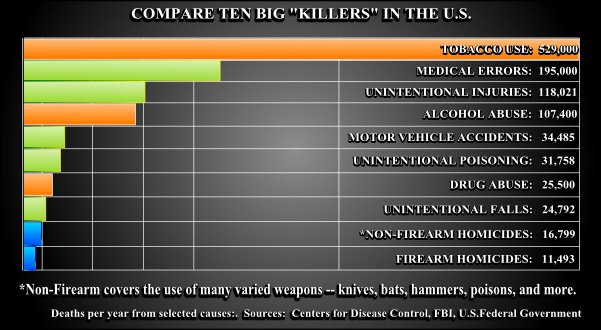
The chart above proves that politicians and those who would disarm Americans by going so far as to call for a repeal of the 2nd Amendment have ulterior motives – or they’re completely ignorant of the facts.
Perhaps their goal is to trigger a revolution in an effort to implement a total police state over the American people.
It wouldn’t be the first time that a government has tried something like this.
According to statistics assembled from the Federal Bureau of Investigation, the Center for Disease Control and the Federal Government, firearms related homicides are minuscule in comparison to other the other “big killers” in the United States.
If we look at homicide statistics in the United States it’s clear that more murders are committed with knives, bats, hammers and poisons than with firearms. As Kurt Nimmo recently noted, “ the number of murders committed annually with hammers and clubs far outpaces the number of murders committed with a rifle.”
The facts, not the drivel being spewed by the anti-gun propaganda machine, leave us wondering why some State and Federal lawmakers are so adamant about restricting the sale and ownership of handguns and rifles, especially since the majority of gun owners – close to 99% – have never committed a violent crime in their lives, let alone used a gun to do so.
Here is the chart they never want you to see:
The chart above proves that politicians and those who would disarm Americans by going so far as to call for a repeal of the 2nd Amendment have ulterior motives – or they’re completely ignorant of the facts.
Perhaps their goal is to trigger a revolution in an effort to implement a total police state over the American people.
It wouldn’t be the first time that a government has tried something like this.
Thursday, December 27, 2012
The Real Story Behind The Wonderful Wizard Of Oz

The Wonderful Wizard of Oz
The Wonderful Wizard of Oz was first published in Chicago in 1900. Its author, L. Frank Baum, was the editor of a South Dakota newspaper and a supporter of William Jennings Bryan who stood three times, unsuccessfully, as a U.S. Presidential candidate for the Democratic Party.The particular concern of both Baum and Bryan was the nature of the money supply then prevalent in the United States, and in the Mid-Western States in particular.
In America during the 1890s, as in Britain, there had been a severe depression.
Many businesses had gone bankrupt, farmers forced to sell up, factories closed and workers made unemployed. True, some farms in the Mid-West were suffering from drought, but most were still capable of growing food; the businesses and factories were still capable of providing the things that people needed; the workers still wanted to work to provide those things, and people would still want the goods and services produced if they had the money to buy them.
The money in the USA then, as now, was entirely created by the private banking system. The pretence existed then that money was based on gold. (Even now some people still think that it is!) The major banks, based on the East and West coasts, could vary the amount of money in circulation, lending more to encourage commercial activity, then fore-closing on loans to put people out of business, enabling the banks to acquire their businesses cheaply.
Baum and Bryan wanted money to be based on silver, not gold, as silver was more readily available in the Mid-West, where it was mined. Such a money supply could not be manipulated by the banks. So the story of the Wizard of Oz starts with a cyclone in the form of imagined electoral success for Bryan…
Dorothy, a sort of proverbial ‘Everywoman’, lands on the Wicked Witch of the East (the East-coast bankers), killing her, so freeing the Munchkins, the down-trodden poor, but the Wicked Witch of the West (the West-coast bankers) remains loose.
To deal with her and to get back to Kansas (normality), the Good Witch of the North, representing the electorate of the North (this is less than 40 years after the civil war), tells Dorothy to seek out the Wizard of Oz (‘oz’ being short for ounce, the means of weighing both gold and silver). She also gives her a pair of silver slippers (as they were in the book – they became ruby ones in the film). Only these silver slippers will enable her to remain safe on the yellow-brick road, representing the bankers’ gold standard, as she heads towards the Emerald City, representing Washington DC.
On her journey, Dorothy encounters a Scarecrow, representing the farmers, who do not have the wit to understand how they can end up losing their farms to the banks, even though they work hard to grow the food to feed a hungry nation. If only they could think it through!
Next, she encounters a Tin Woodsman, representing the industrial workers, rusted as solid as the factories of the 1890s depression, and who have lost the sense of compassion and co-operation to work together to help each other during hard times. Also, a spell cast upon him by the Wicked Witch of the East meant that every time he swung his axe, he chopped off a bit of himself – he downsized!
Then the growing party encounters a Cowardly Lion, representing the politicians. These have the power, through the power of Congress and the Constitution, to confront the Wicked Witches, representing the banks, but they lack the courage to do so.
Dorothy is able to motivate these three potent forces and leads them all towards the Emerald City, whence ‘greenbacks’ had once come, and an encounter with the omnipotent and wonderful Wizard of Oz.
The Wizard of Oz is initially quite majestic and apparently awesome, but he turns out to be a little man without the power that people assume he possesses. He does, of course, represent the President of the United States. With the Wizard’s illusion of power shattered, he is replaced by the Scarecrow who would ‘be another Lincoln’.
The Wicked Witch of the West, fearful for her own power, then attempts to destroy Dorothy but is herself dissolved in a bucket of water, as rain relieves the Mid-West drought, saves the farmers’ livelihoods and prevents repossession by the banks.
The Good Witch of the South, representing the Southern electorate, tells Dorothy that her silver slippers, silver-based money, are so powerful that anything she wishes for is possible, even without the help of the Wizard. Dorothy wishes to go home. There all is now well, because the land has a stable and abundant money supply.
Still a Pertinent Message
So ends this famous modern American ‘fairy-tale’. Its true message has been lost to the mists of time and the demands of Hollywood, but its message is no less pertinent now than when it was written.William Jennings Bryan was neither the first nor the last American politician to try to reform the US money supply. In fact, two money reformers achieved the office of President and attempted to put money reform into action, but just like in the Oz story, the ‘Most Powerful Man in the World’ was not as powerful as people believed.
In 1865, Abraham Lincoln introduced the original ‘greenbacks’, which were paper money issued by the US Government, largely to pay for the Federal war effort during the civil war. It was ‘fiat’ money, money made legal tender by Act of Congress. Unfortunately, Lincoln died suddenly a few weeks later and his plans died with him.
In 1963, John F. Kennedy issued Executive Order 11110 which would have removed the power of money creation from all US private banks, including the privately-owned Federal Reserve, and invested that power in the US Government. Unfortunately, Kennedy died suddenly a few weeks later and his plans died with him.
The Problems of Debt
In the USA 100% of the money supply is created by the private banks. In Britain the figure is over 97%. In the rest of the world, the figure is estimated to be over 95%. All this money is created as a debt. It is created when people borrow money, as banks do not lend existing money; they just create new money out of thin air to lend.Money created as a debt by the banks bears a charge of interest. This increases the amount of money that the economy owes by an amount greater than the amount in existence. This means that the economy is a saddled with a debt that can never be paid off, merely passed around like a game of Pass-the-Parcel in a Belfast pub. It is like a game of musical chairs, where someone has to lose out.
A Solution
Money does not have to be based on debt, nor indeed does it have to be based on precious metals. Real wealth is the goods and services that people create for each other. Money is merely a means of exchange. It could be created by HM Treasury and spent on providing public services, saving us all a modicum of taxation, and then the economy would not have to be saddled with large debts.The Money Reform Party
Like Baum and Bryan, the Money Reform Party recognises that the money supply is a political issue. The MRP has been created expressly to educate the British people about the money supply so that, through the greater awareness of the electorate (good witches, scarecrows, tin-woodsmen and Munchkins all), our cowardly lions… sorry, our politicians will no longer be able to ignore this vital issue.Codex Chooses Malnutrition
 By Scott C. Tips
The Sleuth Journal
December 26, 2012
In a stunning display of nutritional ignorance, three women ram through a Codex standard that leaves many with sub-optimal nutrition
The Codex Committee on Nutrition and Foods for Special Dietary Uses (CCNFSDU) just finished meeting all last week (December 3-7) in Bad Soden, a small German city near Frankfurt am Main. Nearly 300 delegates were in attendance, comprised of government functionaries and international non-governmental organizations (INGOs) representatives.
So, for one week, the assembled delegates – including the INGO delegation of the National Health Federation (NHF)[1] –met, discussed, and debated a wide number of food and food-supplement issues, including the controversial draft Nutrient Reference Values (NRVs) for vitamins and minerals.
Remember, the food guidelines and standards adopted by this Committee, and approved by the Codex Alimentarius Commission, are important because they are then used domestically by numerous countries worldwide and by virtually all countries in international food trade.
Nutrient Reference Values
Those who have been following the National Health Federation’s efforts at Codex since the mid-1990s will recall that at the Codex Nutrition Committee meeting in Dusseldorf, Germany in 2009, the NHF singlehandedly launched the opposition that stopped the Australian delegation and others from “dumbing down” these Nutrient Reference Values.[2]
Australia and its supporters had wrongly proposed that lower NRVs be adopted for certain important vitamins and minerals, including Vitamin C. For example, the Proposed Draft Additional or Revised NRVs for Labelling Purposes in the Codex Guidelines on Nutrition Labelling suggested reducing the Vitamin A NRV from 800 micrograms down to 550 micrograms, Vitamin C down from an already-abysmally-low 60 milligrams to 45 milligrams, Thiamin down from 1.4 milligrams to 1.2 milligrams, Niacin from 18 milligrams down to 15 milligrams, Magnesium down from 300 milligrams to 240 milligrams, and so forth.[3]
These values are already at subsistence levels, and most consumers need far more than the miserable amounts that Codex would parsimoniously dole out to them in order to enjoy optimal and robust health. Yet Australia and its supporters are so fixated on reducing the values even more that they have blinded themselves to the real science showing the absolute need for more nutrient intake, not less.
Fortunately, thanks to NHF and its key supporters India and Iraq at the 2009 meeting, the Committee wisely chose not to move forward with any of those proposed NRVs and instead held the work back for further review and study. Three years have passed since we first stopped these NRVs from being adopted, and each year of non-adoption has been a victory for NHF, and for you.
The Electronic Working Group
Last year, the Committee created an electronic Working Group (eWG) – chaired by ever-present Australia – to look at the hard numbers for each of the vitamins and minerals under consideration. NHF was a member of that group along with twenty other delegations. Working through e-mails, the Australian-led eWG gradually prepared a report; and the NHF and other delegations submitted comments throughout 2012, to be included in that report.
Unfortunately, the United States seemed to have had more of Australia’s ear than anyone else; and the eWG accordingly submitted to this year’s Committee a Final Report (over NHF’s objections) that essentially split the vitamins and minerals into two groups: One that the “eWG” (read here, Australia and the United States) considered “suitable” for adoption; and a second group that was considered “unsuitable” and would need further work.[4]
Strangely enough, this was exactly the approach pushed by the United States at the 2010 CCNFSDU meeting held in Santiago, Chile, but which NHF, the European Union, and others had opposed and defeated back then. Resurrected from its vampire grave just in time for this 2012 meeting, this plan found support with both Australia and the United States working hard to ensure that, this time, at least half of the dumbed-down nutrient values could be pushed forward towards adoption.

The 2012 Meeting
The Chairwoman was once again Dr. Pia Noble, appointed by the German Health Ministry. Co-NHF delegate, Katherine Carroll, spent time during breaks speaking with Dr. Noble to advance NHF, but it is clear that Dr. Noble has little regard for the INGOs, who are just nuisances getting in the way of pushing her agenda forward. Not surprisingly, Dr. Noble is popular with some of the delegates because, as they put it, “she moves things along.”
Well, “moving things along” – like “Fly Me To The Moon” – has become something of a theme song for this Codex Committee.
Real nutritional science is trampled into the mud as the Committee rushes pell-mell to adopt guidelines and standards without considering the consequences of what it is doing. Unfortunately only a few delegates realize what is happening, the majority are content to drift along in concert with and at the direction of the few leaders.
On the second day of the meeting, just before the lunch break, the Australian delegate, Janine Lewis, read through her eWG Final Report while we all listened. I knew what was coming because I had spoken with her before the meeting had started, asking her to, at the very least, withhold calcium from her “suitable” list of nutrients that she would advance for adoption.[5] When she asked and heard in response that I had only spoken with her and the U.S. delegate about that, her position visibly hardened and she told me simply, “Let’s see what the Committee does.”
It became obvious soon enough what the Committee would do, as I pushed the button on my microphone to speak when the meeting resumed after the lunch break. As in 2009, I was the second person to speak! This is highly unusual since the Codex procedure is to let all of the country delegations speak first, and only then allow the INGOs to speak. Being second meant that there were few who wanted to speak out on this issue.
Barbara Schneeman, the U.S. delegate, had spoken immediately before me and said the U.S. “liked these [NRV] figures” and thus liked the idea of advancing the “suitable” nutrients[6] to the Commission for adoption. With that, my microphone illuminated red and it was my turn to speak. I told the Committee that, except for calcium (whose value had been increased while magnesium’s had been decreased, the exact opposite of what should happen with these twin minerals), the Australian figures were all too low, that the NRVs were being reduced by anywhere from 15% to 25%, and questioned why Australia was always choosing the lowest values it could find, even lower than what the guidelines would call for.
The safety of vitamins and minerals, I argued, was unparalleled, so that there could be no problem with having higher levels of these nutrients. Moreover, lowering the NRVs was inconsistent with Codex’s announced goal of preventing malnutrition.

NHF delegate Kat Carroll conferring with Benin and Malaysian delegates
The Council for Responsible Nutrition (CRN), to the confusion of many, simply said “We would like to stress the scientific underpinnings of these numbers.” Did that mean they supported the values, or opposed them? It sounded more like the former, but we could not tell.
As expected, Australia responded in defense of the dumbed-down NRVs; and NHF then challenged those numbers yet again. But this time, the Malaysian, Iranian, and South African delegates spoke up one right after another in strong support of NHF and in favor of more sensible NRVs. It was heartening to hear these three women speak out for sensible nutrition based upon real science.[7]
NHF and IADSA spoke up again, respectively opposing the adoption of any of these values and, in the case of IADSA, the Biotin value. The European Union (EU) delegate, Basil Mathioudakis, quite sensibly asked the Chairwoman what logic did it make to advance some and not all of the NRVs at the same time.
Switzerland disagreed with the EU, but NHF spoke up in support of the EU’s question and suggested that the so-called “suitable” NRVs be held back, or at the very least some of the more questionable ones such as Calcium and Vitamin K. IADSA, in turn, pointed out that the Committee was going against its own guidelines by not selecting the proper value, a higher value, for Biotin.
But the Chairwoman, Pia Noble, was having none of that and insisted that these “suitable” NRVs were going forward despite the substantial opposition. In a last-ditch effort, I asked the Chairwoman to at least move the Vitamin K, Biotin, and Calcium from the “suitable” Table to the “unsuitable” category. Not only was the answer “no,” but Dr. Noble decided that since opposition might grow against these so-called “suitable” NRVs, then they should be advanced along the path of adoption as quickly as possible.
So, she unilaterally undertook to advance them along the 8-Step adoption process to Step 5/8, where they now hover on the edge of full adoption by the Commission itself next year.
As an added insult, the following day, the Committee discussed another Agenda Item, that is, revisions to the Codex General Principles for the Addition of Essential Nutrients to Foods, which in small but important part dealt with the question of whether Codex should or could state that nutrients can prevent or reduce the risk of disease.
Amazingly enough, many delegations spoke out against such language. Only the U.S. delegation and two INGOs (NHF and GAIN) defended this statement.
 Scott Tips and Benin delegate Zinsou discuss the NRVs
The Troika of Pia Noble, Janine Lewis, and Barbara Schneeman succeeded in finally pushing forward eleven of the nineteen vitamins and minerals further along the road to adoption. At the Codex Alimentarius Commission meeting next July there will be a further push to adopt these eleven vitamins and minerals and set their low (except for Calcium) values in stone. Barbara Schneeman, the U.S. delegate, will not be there as her retirement was announced at the CCNFSDU meeting.
Fortunately, there is still an opportunity to derail this effort to steam-roller consumers into ill-health and NHF intends to make the most of it.
In addition, the Chairwoman reauthorized the eWG to continue its work on the “unsuitable” nutrient values and the NHF is taking an active part in that working group’s activities. The eWG will report back to the CCNFSDU when it meets again next Fall in Germany.
Legacy
Barbara Schneeman’s legacy at Codex has been an unfortunate one of pushing big corporate interests while thumbing her nose at consumers. Whether it was her obstinate opposition to adopting a guideline for labeling GMO foods (at the Codex Committee on Food Labelling) or her questionable support for dumbing-down NRVs (at CCNFSDU), she has unfortunately been too often on the wrong side of the issues. Perhaps, in the interests of better health for consumers worldwide, her retirement from Codex could have happened a few years earlier. While this might sound uncharitable, inflicting ill-health upon billions of humans is far less charitable still.
Final Thoughts
The Troika has cleverly pushed forward some of the nutrient NRVs in the hope that the others must inevitably follow along. Whatever their agenda might truly be, the sad fact is that consumer health will suffer from their thoughtless and stercoraceous actions.
The problem facing consumers is not vitamin-and-mineral toxicity, it is widespread deficiencies of those nutrients.
Too many Codex delegates are stuck in the mindset that human populations only need bare subsistence nutrition; that is, that nutrition that merely keeps them breathing and their feet moving one step at a time. The concept that there is a greater level of nutrition – of optimal nutrition – is as foreign to them as space flight would be to Stone Age people.
They fail to comprehend that nutrients at proper levels can actually enable individuals to function at more proficient levels and without those diseases that afflict sub-optimally fed populations.
The disservice done to Humanity by those too lazy to think and then act is so profound as to be disheartening to many others
. Many among us question the motivations of those who want to only push a guideline or standard forward to final adoption simply to “get it done and out of the way.” Is their thinking really as shallow as that? Maybe we better hope it is, as that is an easier mindset to deal with than one of active malevolence.
[1] The National Health Federation delegation consisted of Scott Tips and Katherine A. Carroll. The NHF-Germany Executive Director, Petra Weiss, took ill and could not attend this year. Attorney Jeannine Stewart and others helped Scott Tips draft the NHF’s submission paper arguing for higher levels of NRVs. This NHF paper was published by the German Codex Secretariat as Conference Room Document 13 (CRD 13) and made available to all of the CCNFSDU delegates at the meeting and can be found on-line at www.thenhf.com/codex/. All photographs in this article were taken by Katherine Carroll.
[2]
Not to be confused with Maximum Upper Permitted Limits, NRVs are
nothing more than souped-up RDAs. These are numerical values assigned
to specified nutrients that will supposedly cover 98% of the
population’s nutritional needs for that nutrient. By referring to the
NRV for a vitamin or mineral, the consumer is supposed to know whether
he or she is getting an adequate intake of that nutrient, even if, as in
the case of Vitamin C, 100% of the NRV is defined as 45 milligrams!
These values are claimed to be set according to rigorous scientific
evidence; but, in reality, “science” at Codex levels is often nothing
more than a flimsy set of assumptions and erroneous conclusions cobbled
together to justify keeping consumers “safe” from “dangerous” vitamins
and minerals.
[3]
The proposed Codex NRVs are: Vitamin A (dropped from 800 mcg to 550
mcg); Vitamin D (5 mcg or 200 IUs); Vitamin E (8.8 mg); Vitamin K (60
mcg); Vitamin C (dropped from 60 mg to 45 mg); Thiamin (dropped from 1.4
to 1.2 mg); Riboflavin (dropped from 1.6 mg to 1.2 mg); Niacin (dropped
from 18 mg to 15 mg); Vitamin B6 (dropped from 2 mg to 1.3 mg); Folate (raised to 400 mcg); Vitamin B12 (2.4 mcg); Pantothenate (5 mg); Biotin (30 mcg); Calcium (raised
from 800 mg to 1000 mg); Magnesium (dropped from 300 mg to 240 mg);
Iodine (150 mcg); Iron (14.3-43.1 mg depending upon bioavailability);
Zinc (dropped from 15 mg to 3.6-11.9, depending upon bioavailability);
Selenium (30 mcg); Phosphorus (700 mg); Chloride (2.3 grams); Copper
(900 mcg); Fluoride (3.5 mg); Manganese (2.1 mg); Chromium (30 mcg); and
Molybdenum (45 mcg).
[4] See CCNFSDU document number CX/NFSDU 12/34/8.
[4] See CCNFSDU document number CX/NFSDU 12/34/8.
[5]
NHF has been opposed to Australia’s desire to raise the Calcium NRV
from 800 mg to 1000 mg for several reasons. First of all, it is
infantile nutritional science to think that health can be improved by
raising Calcium intake while simultaneously lowering Magnesium intake
(here, from 300 mg to 240 mg!). Magnesium and Calcium are twin minerals
and raising Calcium intake while lowering Magnesium intake is a certain
recipe for disaster, as it invites the calcium to settle into the soft
tissue like the skin and arteries and not go to where it properly
belongs, in the bones and teeth. Secondly, by fixing the NRV for
Calcium, the Committee has limited the range in which the Committee may
now set the NRV for Magnesium. If the Committee is to follow sound
nutritional science, then the Magnesium NRV cannot now be set any lower
than 500 mg. That is a great distance from the measly 240 mg value that
the Chairwoman and Australia would like to establish.
[6] Vitamin K, Thiamin, Riboflavin, Niacin, Vitamin B6, Folate, Vitamin B12, Pantothenate, Biotin, Calcium, and Iodine.
[7]
These three strong-willed delegates are: Fatima Sulong (Malaysia),
Atefeh Fooladi Moghaddam (Iran), and Andiswa Ngqaka (South Africa), who
resisted the strong urgings of the Chairwoman to simply look the other
way and advance the dumbed-down NRVs. The three women took an unpopular
stand and are true heroines, and to be much commended for speaking out
for health.SUPPORT H.R.3380 – THE DIETARY SUPPLEMENT HEALTH PROTECTION ACT NOW!
Subscribe to:
Posts (Atom)