| Monday, 06 May 2013 23:49 |
 A
bill addressing prior consultation with indigenous peoples on
legislative measures remains tied up in Ecuador’s National Assembly. A
bill addressing prior consultation with indigenous peoples on
legislative measures remains tied up in Ecuador’s National Assembly.(IPS) - The Constitution of Ecuador adopted in 2008 establishes a broad range of rights for indigenous peoples and nationalities, including the right to prior consultation, which gives them the opportunity to influence decisions that affect their lives. But this right has yet to be fully translated into legislation, as the bill for a Law on Consultation with Indigenous Communities, Peoples and Nationalities is still being studied by the National Assembly. Article 57, section 7 of the constitution guarantees “free, prior and informed consultation, within a reasonable period of time, on plans and programmes for exploration, exploitation and sale of non-renewable resources located on their lands which could have environmental or cultural impacts on them.” The constitution also stipulates the right of indigenous peoples “to share in the profits earned from these projects and to receive compensation for social, cultural and environmental damages caused to them. The consultation that must be conducted by the competent authorities shall be mandatory and timely.” “If the consent of the consulted community is not obtained, steps provided for by the Constitution and the law shall be taken,” it adds. Legal grounds for consultation are also established in Convention 169 of the International Labour Organization (ILO), which Ecuador ratified in 1998, and the United Nations Declaration on the Rights of Indigenous Peoples, adopted in 2007. Nevertheless, recent mining and oil drilling projects have put the government’s commitment to respecting the right to consultation to the test, and spurred indigenous organisations to take action. On Nov. 28, 2012, hundreds of indigenous representatives converged in Quito to protest the lack of consultation prior to the 11th oil auction round, in which exploration blocks containing an estimated total of 1.6 billion barrels of crude oil would be put up for bids from private companies. At the time, Domingo Peas, a leader of the Achuar indigenous ethnic group, declared that “the government says it has carried out prior consultation, but this is not true.” “The consultations carried out among the peoples and nationalities in the areas of influence are invalid, because there was no participation by indigenous peoples and nationalities in determining the way they were conducted, they did not respect their traditional methods of decision-making, and cultural aspects, such as language, were not adequately taken into account,” he stressed. Overall, said Peas, the consultations “were neither prior, nor free, nor informed, and were conducted in bad faith.” The president of the influential Confederation of Indigenous Nationalities of Ecuador (CONAIE), Humberto Cholango, believes that the authorities have not done enough. “Prior consultation is still pending, we have still not seen the results we would like to see. We need the law to be approved; that would be a major advance,” he told Tierramérica*. The draft law, comprising 29 articles, refers to consultation on legislative measures and establishes four stages: preparation; a public call for participation and registration; the actual holding of the consultation; and analysis of the results and conclusion. In accordance with the law, the government will determine if a proposed bill affects the rights of certain communities, in which case the National Assembly will convene a prior consultation that will be conducted through the National Electoral Council. Lourdes Tibán, an indigenous National Assembly member from the leftist opposition movement Pachakutik, told Tierramérica that adoption of this law is crucial, because “it will guarantee the participation of indigenous nationalities in decisions on future laws that directly affect them, and will therefore prevent a lack of consensus.” Once this legislation is in force, other major bills can be addressed, such as the proposed law on water resources, on which debate has been postponed since 2010 precisely due to the resistance posed by indigenous peoples. One of their key concerns is that the proposals made during a prior consultation process will not be included in the final text of the law that was submitted to consultation. A number of other bills, such as those for laws on culture and land, are also on hold for the same reason. This is the heart of the conflict. One year ago, President Rafael Correa stated in one of his regular Saturday broadcasts that non-governmental organisations “want prior consultations to be popular consultations and to be binding; that means that for every step we want to take, we will need to ask the community for permission.” “This is extremely serious. This is not what the international agreements say. This would not mean acting in the interests of the majorities, but rather in the interest of unanimity. It would be impossible to govern that way,” he declared. In response to these statements, indigenous organisations sought reinforcement, calling on agencies such as the Inter-American Commission on Human Rights and the ILO to supervise the implementation of prior consultation. In fact, indigenous communities in Ecuador have already turned to some of these mechanisms in the past. In 2003, the Quechua community of Sarayaku filed a complaint with the Inter-American Commission on Human Rights against the state for authorising oil exploration in their territory, without prior consultation. The community, located in the province of Pastaza, in Ecuador’s Amazon rainforest region, denounced damages to their territory, culture and economy. In June 2012, the Inter-American Court of Human Rights ruled in favour of the community and against the state. The government is still studying how to pay the required compensation – a total of 1,398,000 dollars for material and moral damages and legal costs – and how to finish repairing the physical damage caused. |
Showing posts with label South America. Show all posts
Showing posts with label South America. Show all posts
Wednesday, May 15, 2013
Ecuador's Indigenous People Still Wait To Be Consulted


Uruguay: Birth of a Movement Against Mining and Extractivism
On
March 7 one of Uruguay’s strongest myths was broken: trust in state
enterprises. That day those who turned on their faucets were met with a
foul smell and those who were drinking coffee or maté found a strange
taste. The company in charge of the water supply, the State Sanitary
Works (OSE), had to confess that there was “an episode” of algae
contamination in the Santa Lucia River Basin, which supplies six out of
ten Uruguayans.
Despite this, the state company said that the water was potable.
A statement released days later said: “In relation to the event of the taste and odor perceived several days ago by the population of the metropolitan area, OSE informs that it was entirely due to a substance released by a type of microscopic algae in the Santa Lucia River. This substance, called Geosmin, has no bearing on the health of the population “[1].
The authorities closed ranks and denied emphatically the contamination of water sources, which had always been of high quality. However, much of the population did not believe the State’s arguments, buying bottled water and depleting stocks.
This event wouldn’t have had much significance if it were not for a movement that has grown in recent years against the installation of an Indian owned, open pit, iron mine called Aratirí. The movement has also been protesting the extensive use of pesticides and fertilizers that have polluted the soy crop and recently re-forested areas. In fact, environmental consciousness has grown widely due to a debate following the installation of a massive pulp mill on the Uruguay River.
At that time (approximately 2003 – 2008), amid the euphoria of to the rise to power of the Fente Amplio (2004) and an atmosphere of nationalism exacerbated by disputes between environmentalists and the Argentine government, the majority of the population supported the Uruguayan government. Now things have changed. The rural population (only 5% of the total) began to feel the harmful effects of agricultural development and small-scale traditional farmers (including livestock herders) began to mobilize.
A Contaminated Country
It’s difficult to accept that Uruguay’s rivers are polluted. The country was always a natural paradise, with few cars and light industry, with extensive ranches and grain farming. But in the last decade, with agricultural and mineral speculation, things have changed drastically.
The main changes that have been occurring over the last ten years have been concentrated in rural production.
The price of land has increased six fold ($500 to $3,000 per hectare on average). Thirty-eight percent of agricultural land has been sold, and 41% has been leased [2]. Between 2000 and 2008 Uruguayan owners lost 1.8 million hectares that went to corporations that acquired a similar surface quantity.
There is a strong concentration of land owned by multinational corporations with one million hectares belonging to just 14 groups. Montes del Plata (Chilean-Swedish-Finnish) has 234,000 hectares followed by Forestal Oriental (Finnish) with 200,000 hectares. The U.S. company, Weyerheuser has 140,000 hectares and the Argentine owned El Tejar and Agronegocios de Plata (ADP) have 140,000 and 100,000 hectares respectively, completing the list of the largest foreign investments.
In the 2001-2002 season there were only 29,000 hectares of soybeans planted. In 2012 it exceeded 1 million hectares. Another million hectares of land was forested. This represents an exponential increase in the use of pesticides and fertilizers that have been washed by rain into rivers. This has initiated a drama that the people are beginning to feel.
A study of the Santa Lucia River (which provides 60% of the drinking water) conducted by the National Direction of the Environment (DINAMA) resulted in scandal. Internationally accepted phosphorus levels in water are 25 micrograms per liter, but the count detected in the river ranged between 70 and 12,900 micrograms per liter. [3] Scientists and environmentalists have been ringing alarm bells about the pollution, but the state has done little.
Biologist Luis Aubriot of the Sciences Department told reporters that “if there is no reduction of nitrogen and phosphorus” then the water problems will not be solved [4]. Another biologist, Mario Calcagno, recalled that in addition to the pesticides and fertilizers used for soybeans, the Santa Lucia River is polluted by refrigerator effluents, food industries and urban centers, and that native forest on its banks have been disappearing. “It’s a disaster,” he said [5].
Diego Martino, who represented Uruguay at the United Nations Program for the Environment, presented one of the strongest arguments: “In 2010, levels of atrazine were detected in the water. It is one of the components of glyphosate. There is no nationwide study that says what the consequences of very low levels of atrazine could be when consumed over ten years “[6].
In his opinion the main problem is the inability of the State to make and regulate decisions. He gave an example: How long did it take for the DINAMA to change the distance of 50 meters to 500 meters for spraying [pesticides] around a rural school? Years”. It’s not known how many children were made ill by this delay.
One of the main problems are [agricultural] reservoirs, which are used mostly for irrigation and rice cultivation. In a small country like Uruguay there are over a thousand dams that with the summer heat become incubators for algae growth because of the concentration of agrochemicals. Rain the water in the reservoirs overflows into rivers. All the rivers of Uruguay, including the extremely wide Río de la Plata, are green with pollution.
Livestock is also being affected. A rancher from the central part of the country, whose sheep drink in the large Rincón del Bonete dam, suffered the loss of 56 sheep in one year, all intoxicated [7]. The Director of Renewable Resources of the Ministry of Livestock, Agriculture and Fisheries acknowledged, “Uruguay does not have a diagnosis of the state of its water”. The same official affirms that soy is grown only four meters from lakes, rivers and streams, even though there is legislation that establishes a distance of [at least] eight meters, which is also insufficient. [8]
The director of the Institute of Ecology and Environmental Sciences at the Sciences department, Daniel Panario, received in 2012 the National Award for Citizen Excellence. He is the country’s most distinguished and combative scientist that has been denouncing pollution for over 20 years. In his opinion, the best example [of pollution] linked to water is lead.
“In the 1940s in England it was concluded that the poor performance of children in schools was due to lead and immediately all the water pipes were changed. In Uruguay this conclusion was made in the 1970s. We are now in 2013 and they have still yet to finish changing out the lead pipes in Montevideo. They say they have other priorities and that it’s expensive”[9].
In addition to the State, the university is an obstacle in allowing the population in knowing the truth. “One does not have complete freedom to investigate issues of national interest. When one goes to talk they risk having to deal with the authorities. A few days ago the [university] president said that I did not speak representing the university and that I was damaging the [image] of the department”[10].
Here appear two problems: academics prioritize research that can be published in journals, usually in English, to which ordinary people do not have access. On the other hand, universities depend on conventions and funds from various international organizations and private companies that have no interest in making public criticisms of the products they sell.
Universities themselves often boycott researchers like Panario, despite their national and international recognition. He applied twice for the national research fund and was rejected both times. He had to appeal to higher authorities for admission. He now seems happy with the growth of the movement against open-pit mining.
A Different Movement
Iron ore prices were stable for twenty years. In 1985 a dry metric ton was worth $26. In 2004 it had reached $38 and climbed to $140 in 2008. In 2009 the price dropped to $101 per ton, but now it’s rising once again. Iron ore is not just any other metal, as it represents 95 percent of all metals used in the industry.
Aratirí Mining belongs to Zamin Ferrous, an Indian company based in London. It has seven projects in South America, five in Brazil, one in Peru and one in Uruguay, and expects to produce about 50 million tons of iron ore across the continent in 2013. But the company’s potential in the region amounts to 10 billion tons.
In Uruguay they were licensed to mine about 110 thousand hectares in areas devoted to cattle ranching and forestry, where exploratory drilling had been performed to detect areas of greater density of iron ore. The mining project has three parts: the area where the mining will be conducted, about 220 kilometers of pipeline to the Rocha coast and finally a freight terminal. The total investment is estimated to be $2 billion.
In late 2010, when Parliament passed the Mining Code, small-scale rural producers of Valentines and Cerro Chato (180 and 3,000 inhabitants each), the areas where Aratirí installed [it’s project], began to mobilize. In January 2011 neighborhood commissions from the coast, where a port will be installed to export the iron, started a petition against the project.
From there [opposition] activity intensified. First they attended a session of parliament to explain the reasons for opposing the project. Small-scale livestock ranchers would see disruptions in their production because they will either face land expropriations and thus be forced to emigrate or they will be forced to migrate because of air and water pollution. The coastal villagers would suffer a loss to their fisheries and tourism will become scarce.
Later they held dozens of informational events in different places, such as small towns of 50 to 100 people. Finally in May 2011 they convened the first national march in Montevideo with the slogan “No to mining, yes to natural resources”.
The [mining] company held its own march in Cerro Chato mobilizing merchants and workers. The next day the [small-scale, opposition] producers doubled the number of people mobilized, challenging the multinational [company] that had also began conducting its own informational events that were boycotted by those opposed to mining.
In July 2011 the Confederation of Coastal villages was created with representatives from seven communities of the Rocha Department: La Paloma (pop. 3,500), Aguas Dulces (400), Punta del Diablo (800), Valizas (330), La Pedrera (200), La Esmeralda (57) and Cabo Polonio. These communities oppose the construction of a port in La Paloma designated for the export of wood to be sent to paper factories, and another port designated to export iron.
On October 12 the second national march was held with a confluence of collectives from the north, central region, south and coastal zone, made up of small-scale producers and rural workers. Several celebrities participated in a video against mega-mine projects. Since then each region now focuses on local activities and the Permanent National Assembly in Defense of the Land and Natural Assets was created with about 36 grassroots collectives [11].
In mid-2012 the government confirmed the construction of a deepwater port for the export of iron, wood and other products near La Paloma. In August the movement against mining held its first national assembly in Tacuarembó (North) attended by 300 people from 35 collectives.
In attendance were three unions, indigenous groups, community radios, small-scale producers and rural workers. Members of the coastal towns opted for direct action to prevent the construction of the port near La Paloma. On October 12 the third national march was held in Montevideo with 10 thousand people participating, dozens of gauchos on horseback, tractors, flags of indigenous peoples, environmentalists and unions.
The movement against mining in Uruguay has three unprecedented features.
The first is that it was born in the rural central region, in villages of about 50 to 3,000 people, and then it appeared in the departmental capitals and later in Montevideo, where the first groups are still being organized. This is a reversal of what has happened throughout the country’s history of social struggles, where almost all have been born in the capital.
Secondly, it’s a grassroots, assembly based, horizontal movement, linked to land and territory. It finds its inspiration from rural populist identities rather than unions and labor of the traditional left. Although these sectors are integrated and participate they do not assume a hegemonic role. The speech and language invoke the independence struggle of 200 years ago led by Jose Artigas, also emphasizing that everything relates to the land.
The third is that the movement has thus far rejected being institutionalized. NGOs have their hands bound. Political parties are kept silent. But was is most interesting is that the movement hasn’t chosen the path of a national referendum, the modality that has been adopted by all the great Uruguayan movements since the restoration of democracy, beginning with human rights.
There are local collectives that gather signatures for departmental referendums, and after extensive discussions the choice to move to a national referendum has been avoided. The experience of over 20 years indicates that this path leads to the dismantling of the movement since it infringes upon the popular will.
This is the first social movement that was born under a progressive government. It directly questions the extractive model and the pollution of water only supports the movement’s arguments especially for gaining public support. As Panario said reflecting on the aftermath of Hurricane Sandy in New York and the overall climate change debate: “You must have a catastrophe for the people to become aware.”
Despite this, the state company said that the water was potable.
A statement released days later said: “In relation to the event of the taste and odor perceived several days ago by the population of the metropolitan area, OSE informs that it was entirely due to a substance released by a type of microscopic algae in the Santa Lucia River. This substance, called Geosmin, has no bearing on the health of the population “[1].
The authorities closed ranks and denied emphatically the contamination of water sources, which had always been of high quality. However, much of the population did not believe the State’s arguments, buying bottled water and depleting stocks.
This event wouldn’t have had much significance if it were not for a movement that has grown in recent years against the installation of an Indian owned, open pit, iron mine called Aratirí. The movement has also been protesting the extensive use of pesticides and fertilizers that have polluted the soy crop and recently re-forested areas. In fact, environmental consciousness has grown widely due to a debate following the installation of a massive pulp mill on the Uruguay River.
At that time (approximately 2003 – 2008), amid the euphoria of to the rise to power of the Fente Amplio (2004) and an atmosphere of nationalism exacerbated by disputes between environmentalists and the Argentine government, the majority of the population supported the Uruguayan government. Now things have changed. The rural population (only 5% of the total) began to feel the harmful effects of agricultural development and small-scale traditional farmers (including livestock herders) began to mobilize.
A Contaminated Country
It’s difficult to accept that Uruguay’s rivers are polluted. The country was always a natural paradise, with few cars and light industry, with extensive ranches and grain farming. But in the last decade, with agricultural and mineral speculation, things have changed drastically.
The main changes that have been occurring over the last ten years have been concentrated in rural production.
The price of land has increased six fold ($500 to $3,000 per hectare on average). Thirty-eight percent of agricultural land has been sold, and 41% has been leased [2]. Between 2000 and 2008 Uruguayan owners lost 1.8 million hectares that went to corporations that acquired a similar surface quantity.
There is a strong concentration of land owned by multinational corporations with one million hectares belonging to just 14 groups. Montes del Plata (Chilean-Swedish-Finnish) has 234,000 hectares followed by Forestal Oriental (Finnish) with 200,000 hectares. The U.S. company, Weyerheuser has 140,000 hectares and the Argentine owned El Tejar and Agronegocios de Plata (ADP) have 140,000 and 100,000 hectares respectively, completing the list of the largest foreign investments.
In the 2001-2002 season there were only 29,000 hectares of soybeans planted. In 2012 it exceeded 1 million hectares. Another million hectares of land was forested. This represents an exponential increase in the use of pesticides and fertilizers that have been washed by rain into rivers. This has initiated a drama that the people are beginning to feel.
A study of the Santa Lucia River (which provides 60% of the drinking water) conducted by the National Direction of the Environment (DINAMA) resulted in scandal. Internationally accepted phosphorus levels in water are 25 micrograms per liter, but the count detected in the river ranged between 70 and 12,900 micrograms per liter. [3] Scientists and environmentalists have been ringing alarm bells about the pollution, but the state has done little.
Biologist Luis Aubriot of the Sciences Department told reporters that “if there is no reduction of nitrogen and phosphorus” then the water problems will not be solved [4]. Another biologist, Mario Calcagno, recalled that in addition to the pesticides and fertilizers used for soybeans, the Santa Lucia River is polluted by refrigerator effluents, food industries and urban centers, and that native forest on its banks have been disappearing. “It’s a disaster,” he said [5].
Diego Martino, who represented Uruguay at the United Nations Program for the Environment, presented one of the strongest arguments: “In 2010, levels of atrazine were detected in the water. It is one of the components of glyphosate. There is no nationwide study that says what the consequences of very low levels of atrazine could be when consumed over ten years “[6].
In his opinion the main problem is the inability of the State to make and regulate decisions. He gave an example: How long did it take for the DINAMA to change the distance of 50 meters to 500 meters for spraying [pesticides] around a rural school? Years”. It’s not known how many children were made ill by this delay.
One of the main problems are [agricultural] reservoirs, which are used mostly for irrigation and rice cultivation. In a small country like Uruguay there are over a thousand dams that with the summer heat become incubators for algae growth because of the concentration of agrochemicals. Rain the water in the reservoirs overflows into rivers. All the rivers of Uruguay, including the extremely wide Río de la Plata, are green with pollution.
Livestock is also being affected. A rancher from the central part of the country, whose sheep drink in the large Rincón del Bonete dam, suffered the loss of 56 sheep in one year, all intoxicated [7]. The Director of Renewable Resources of the Ministry of Livestock, Agriculture and Fisheries acknowledged, “Uruguay does not have a diagnosis of the state of its water”. The same official affirms that soy is grown only four meters from lakes, rivers and streams, even though there is legislation that establishes a distance of [at least] eight meters, which is also insufficient. [8]
The director of the Institute of Ecology and Environmental Sciences at the Sciences department, Daniel Panario, received in 2012 the National Award for Citizen Excellence. He is the country’s most distinguished and combative scientist that has been denouncing pollution for over 20 years. In his opinion, the best example [of pollution] linked to water is lead.
“In the 1940s in England it was concluded that the poor performance of children in schools was due to lead and immediately all the water pipes were changed. In Uruguay this conclusion was made in the 1970s. We are now in 2013 and they have still yet to finish changing out the lead pipes in Montevideo. They say they have other priorities and that it’s expensive”[9].
In addition to the State, the university is an obstacle in allowing the population in knowing the truth. “One does not have complete freedom to investigate issues of national interest. When one goes to talk they risk having to deal with the authorities. A few days ago the [university] president said that I did not speak representing the university and that I was damaging the [image] of the department”[10].
Here appear two problems: academics prioritize research that can be published in journals, usually in English, to which ordinary people do not have access. On the other hand, universities depend on conventions and funds from various international organizations and private companies that have no interest in making public criticisms of the products they sell.
Universities themselves often boycott researchers like Panario, despite their national and international recognition. He applied twice for the national research fund and was rejected both times. He had to appeal to higher authorities for admission. He now seems happy with the growth of the movement against open-pit mining.
A Different Movement
Iron ore prices were stable for twenty years. In 1985 a dry metric ton was worth $26. In 2004 it had reached $38 and climbed to $140 in 2008. In 2009 the price dropped to $101 per ton, but now it’s rising once again. Iron ore is not just any other metal, as it represents 95 percent of all metals used in the industry.
Aratirí Mining belongs to Zamin Ferrous, an Indian company based in London. It has seven projects in South America, five in Brazil, one in Peru and one in Uruguay, and expects to produce about 50 million tons of iron ore across the continent in 2013. But the company’s potential in the region amounts to 10 billion tons.
In Uruguay they were licensed to mine about 110 thousand hectares in areas devoted to cattle ranching and forestry, where exploratory drilling had been performed to detect areas of greater density of iron ore. The mining project has three parts: the area where the mining will be conducted, about 220 kilometers of pipeline to the Rocha coast and finally a freight terminal. The total investment is estimated to be $2 billion.
In late 2010, when Parliament passed the Mining Code, small-scale rural producers of Valentines and Cerro Chato (180 and 3,000 inhabitants each), the areas where Aratirí installed [it’s project], began to mobilize. In January 2011 neighborhood commissions from the coast, where a port will be installed to export the iron, started a petition against the project.
From there [opposition] activity intensified. First they attended a session of parliament to explain the reasons for opposing the project. Small-scale livestock ranchers would see disruptions in their production because they will either face land expropriations and thus be forced to emigrate or they will be forced to migrate because of air and water pollution. The coastal villagers would suffer a loss to their fisheries and tourism will become scarce.
Later they held dozens of informational events in different places, such as small towns of 50 to 100 people. Finally in May 2011 they convened the first national march in Montevideo with the slogan “No to mining, yes to natural resources”.
The [mining] company held its own march in Cerro Chato mobilizing merchants and workers. The next day the [small-scale, opposition] producers doubled the number of people mobilized, challenging the multinational [company] that had also began conducting its own informational events that were boycotted by those opposed to mining.
In July 2011 the Confederation of Coastal villages was created with representatives from seven communities of the Rocha Department: La Paloma (pop. 3,500), Aguas Dulces (400), Punta del Diablo (800), Valizas (330), La Pedrera (200), La Esmeralda (57) and Cabo Polonio. These communities oppose the construction of a port in La Paloma designated for the export of wood to be sent to paper factories, and another port designated to export iron.
On October 12 the second national march was held with a confluence of collectives from the north, central region, south and coastal zone, made up of small-scale producers and rural workers. Several celebrities participated in a video against mega-mine projects. Since then each region now focuses on local activities and the Permanent National Assembly in Defense of the Land and Natural Assets was created with about 36 grassroots collectives [11].
In mid-2012 the government confirmed the construction of a deepwater port for the export of iron, wood and other products near La Paloma. In August the movement against mining held its first national assembly in Tacuarembó (North) attended by 300 people from 35 collectives.
In attendance were three unions, indigenous groups, community radios, small-scale producers and rural workers. Members of the coastal towns opted for direct action to prevent the construction of the port near La Paloma. On October 12 the third national march was held in Montevideo with 10 thousand people participating, dozens of gauchos on horseback, tractors, flags of indigenous peoples, environmentalists and unions.
The movement against mining in Uruguay has three unprecedented features.
The first is that it was born in the rural central region, in villages of about 50 to 3,000 people, and then it appeared in the departmental capitals and later in Montevideo, where the first groups are still being organized. This is a reversal of what has happened throughout the country’s history of social struggles, where almost all have been born in the capital.
Secondly, it’s a grassroots, assembly based, horizontal movement, linked to land and territory. It finds its inspiration from rural populist identities rather than unions and labor of the traditional left. Although these sectors are integrated and participate they do not assume a hegemonic role. The speech and language invoke the independence struggle of 200 years ago led by Jose Artigas, also emphasizing that everything relates to the land.
The third is that the movement has thus far rejected being institutionalized. NGOs have their hands bound. Political parties are kept silent. But was is most interesting is that the movement hasn’t chosen the path of a national referendum, the modality that has been adopted by all the great Uruguayan movements since the restoration of democracy, beginning with human rights.
There are local collectives that gather signatures for departmental referendums, and after extensive discussions the choice to move to a national referendum has been avoided. The experience of over 20 years indicates that this path leads to the dismantling of the movement since it infringes upon the popular will.
This is the first social movement that was born under a progressive government. It directly questions the extractive model and the pollution of water only supports the movement’s arguments especially for gaining public support. As Panario said reflecting on the aftermath of Hurricane Sandy in New York and the overall climate change debate: “You must have a catastrophe for the people to become aware.”
Wednesday, April 10, 2013
Amazon People Theaten War Against Brazil's Dam Projects Destroying Rivers

Brazil
dam row – local activists march past machinery being used in the
construction of the massive Belo Monte hydroelectric dam.
The Munduruku indigenous community in Para state say they have been betrayed by the authorities, who are pushing ahead with plans to build a cascade of hydropower plants on the Tapajós river without their permission.
Public prosecutors, human rights groups, environmental organisations and Christian missionaries have condemned the government's strong-arm tactics.
Helicopters, soldiers and armed police have been involved in Operation Tapajós, which aims to conduct an environmental impact assessment for the first proposed construction, the 6,133 MW São Luiz do Tapajós dam.
The facility, to be built by the Norte Energia consortium, is the biggest of three planned dams on the Tapajós, the fifth-largest river in the Amazon basin. The government's 10-year plan includes the construction of four larger hydroelectric plants on its tributary, the Jamanxim.
Under Brazilian law, major infrastructure projects require prior consultation with indigenous communities. Federal prosecutors say this has not happened and urge the courts to block the scheme which, they fear, could lead to bloodshed.
"The Munduruku have already stated on several occasions that they do not support studies for hydroelectric plants on their land unless there is full prior consultation," the prosecutors noted in a statement.
A similar survey in November led to deadly conflict. One resident, Adenilson Kirixi, was killed and several others were wounded in clashes between local people and troops accompanying the researchers in Teles Pires village.
The ministry of mines and energy noted on its website that 80 researchers, including biologists and foresters, would undertake a study of flora and fauna. The army escort was made possible by President Dilma Rousseff, who decreed this year that military personnel could be used for survey operations.
Missionaries said the recent show of force in Sawré Maybu village, Itaituba, was intimidating, degrading and an unacceptable violation of the rights of the residents.
"In this operation, the federal government has been threatening the lives of the people," the Indigenous Missionary Council said. "It is unacceptable and illegitimate for the government to impose dialogue at the tip of a bayonet."
The group said Munduruku leaders ended a phone call with representatives of the president with a declaration of war. They have also issued open letters calling for an end to the military operation, "We are not bandits. We feel betrayed, humiliated and disrespected by all this," a letter states.
One of the community's leaders, Valdenir Munduruku, has warned that locals will take action if the government does not withdraw its taskforce by 10 April. He has called for support from other indigenous groups, such as the Xingu, facing similar threats from hydroelectric dams.
Environmental groups have expressed concern.
The 1,200-mile waterway is home to more than 300 fish species and provides sustenance to some of the most biodiverse forest habitats on Earth. Ten indigenous groups inhabit the basin, along with several tribes in voluntary isolation.
With similar conflicts over other proposed dams in the Amazon, such as those at Belo Monte, Teles Pires, Santo Antônio and Jirau, some compare the use of force to the last great expansion of hydropower during the military dictatorship.
"The Brazilian government is making political decisions about the dams before the environmental impact assessment is done," said Brent Millikan of the International Rivers environmental group.
"The recent military operations illustrate that the federal government is willing to disregard existing legal instruments intended to foster dialogue between government and civil society."
Friday, November 2, 2012
Soy's Cycle Of Destruction In The Amazon
By Dr. Mercola
One of the best strategies for reducing or eliminating GE foods is to force food manufacturers to list them on the label. You have a right to know if the foods you're eating contain GE ingredients. As it stands now, there is no labeling law.
This November, we have a great opportunity to change that with California Ballot Initiative Prop 37, which would require labeling of all genetically engineered foods and food ingredients, and ban the routine industry practice of labeling and marketing such foods as "natural." Voting day is fast approaching — if you're going to act, the time is now!
They need funds and volunteers. Remember, since California is the 8th largest economy in the world, a win for Prop 37 would be a huge step forward, likely affecting ingredients and labeling nationwide. As the campaign says,
"As goes California, so goes the nation."
I urge you to support this bill in any way you can. Here are a few suggestions as to how you can help pass this important initiative:
Soybeans are touted by the food industry as the answer to world hunger. But very few pieces of propaganda could be more misleading. Not only does soy consumption lead to a number of health problems, but its production is leaving a trail of ecological devastation beyond belief.
While most people know the Amazon is under threat, few know that one of the principal perpetrators is soy.
One of the regions hardest hit by soy monoculture is Brazil, home of the largest expanse of precious Amazon rainforest. For several years, Greenpeace has been involved in an intense investigation of Amazon soy production using satellite images, aerial surveillance, previously unreleased government documents and on-the-ground monitoring, to expose the links in the soy chain.
Many of their findings are presented in the documentary "Soy: In the Name of Progress," which you can watch in its entirety in the link above. For more information, you can also read their final report, Eating up the Amazon1.
Agricultural multinational bullies are rushing into Brazil to flatten forests into massive soy farms, expelling native peoples from their land by any means possible, legal or otherwise.
Peaceful community protests are met with violent beatings from large soy producers and their hired thugs, and individuals speaking out the loudest have been assassinated. The Brazilian government is sadly absent, uninvolved, and ineffective on this issue.
Not only is the soy takeover harming the Brazilian people and their native culture, but it's having a devastating ecological impact that could potentially affect the rest of the world.
Soy Monoculture Could Alter Global Climate Patterns
The Amazon is the largest expanse of tropical rainforest on the planet, but deforestation is occurring at an alarming rate. An area the size of France has been destroyed thus far. Not only does the Amazon contain some of the richest biodiversity in the world, but it's being destroyed before it can even be studied — so we don't even know what treasures have been lost.
The rainforest is tied into climatic patterns worldwide and provides a major source of the water vapor that ends up falling on your garden as rain. Some estimate that, if trends continue, the entire Amazon rainforest could be gone in 30 to 40 years. Consequences would be far reaching to the world's climate, including the U.S. and Europe — a climate that is already undergoing significant stress.
Soy's Cycle of Destruction in the Amazon
Between 2007 and 2008, almost three million acres of Brazilian rainforest were lost to illegal logging, soy plantations, and cattle ranching2. Soy traders encourage farmers to cut down forest vegetation and plant massive soy monocultures. The traders then take the soy and ship it to Europe where it's fed to animals like chickens and pigs. The animals are then turned into fast food products.
Before soy can be planted, soy farmers have to remove the most valuable timber from areas they illegally occupy. According to Greenpeace2 :
"As one of the first steps in the cycle of destruction, land grabbers build logging roads into pristine rainforest. Once accessible, these roads open the door to further devastation of the forest ecosystem through clearing for agricultural operations, fuel wood gathering, and mining."The illegal timber trade supports the cheap sale of once-valuable tree timber. Then deforested lands are set on fire to clear any remaining debris. So not only is the rainforest destroyed, but tons of greenhouse gases are released into the atmosphere by these burnings. Profits from this illegal logging are then used to seed soy plantations and line the pockets of a few select multinationals.
Three major companies account for 60 percent of the total financing of soy production in Brazil: ADM, Bunge and Cargill3. These enormous corporations build soy silos and terminals at the rainforest edge and buy soy from illegally cleared and operated farms, including those implementing slave labor.
As if this cycle of destruction is not bad enough, most of the soy crops are genetically engineered, which introduces an entire new set of dangers to you and the food chain. Genetically engineered crops come with serious risks, including resistant super weeds and super pests, uncontrollable cross contamination and serious health hazards, including allergies, infertility, birth defects, bizarre mutations and cancer, just to name a few.
Brazil Sees Fastest Climb in GE Soybean Share
The United States is the world's top soybean producer (33 percent), with Brazil running a close second (27 percent), followed by Argentina (21 percent)4. As of 2007, more than half of the world's soybean crops (58.6 percent) were genetically engineered (GE).
GE soybeans contain a gene that confers herbicide resistance, engineered by Monsanto. "Roundup ready soy" is being cultivated on a massive scale across the globe, having devastating effects in many countries, such as Argentina, where people are being sickened daily by massive herbicide spraying. According to GMO Compass5, at one time, GE soybeans were not permitted in Brazil, but that isn't the case today. GE seed was smuggled in from neighboring countries and planted illegally.
Unfortunately, the GE soybean share has risen faster in Brazil over the past decade than in any other major soy-producing country, as you can see in the following graphic illustrating GE soybean share trends over time.
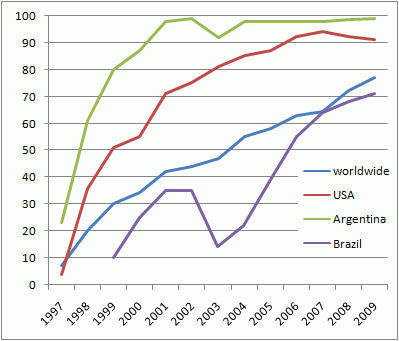
GE Soybean Share: From GMO-Compass
Strategies for Avoiding GE Foods
There are some measures you can take to make sure the foods you select are not genetically engineered. Soy is one of only nine common GE food crops, but their derivatives are in over 70 percent of supermarket foods, particularly processed foods. So, the more fresh, organic and local foods you eat, the less likely you'll be consuming GE ingredients. Also, look for the USDA Certified 100% Organic seal: This green or black seal assures the product is certified organic by the USDA, which means it contains at least 95 percent organic ingredients that are free of genetically engineered ingredients.
URGENT ACTION NEEDED: Support California's Ballot Initiative to Label GMO's!
One of the best strategies for reducing or eliminating GE foods is to force food manufacturers to list them on the label. You have a right to know if the foods you're eating contain GE ingredients. As it stands now, there is no labeling law.
This November, we have a great opportunity to change that with California Ballot Initiative Prop 37, which would require labeling of all genetically engineered foods and food ingredients, and ban the routine industry practice of labeling and marketing such foods as "natural." Voting day is fast approaching — if you're going to act, the time is now!
They need funds and volunteers. Remember, since California is the 8th largest economy in the world, a win for Prop 37 would be a huge step forward, likely affecting ingredients and labeling nationwide. As the campaign says,
"As goes California, so goes the nation."
I urge you to support this bill in any way you can. Here are a few suggestions as to how you can help pass this important initiative:
- Whether you live in California or not, please donate money to this historic effort, through the Organic Consumers Fund. If you live outside of the United States, you can still donate! For International Donations, please call (218) 353-7651!
- If you live in California and want to get involved, please contact CARightToKnow.org. They will go through all volunteer requests to put you into a position that is suitable for you, based on your stated interests and location.
- No matter where you live, please help spread the word in your personal networks, on Facebook, and Twitter. For help with the messaging, please see CARightToKnow.org.
- Talk to organic producers and stores and ask them to actively support the California Ballot. It may be the only chance we have to label genetically engineered foods.
Thursday, September 6, 2012
Deep Background On Assange, South America, US, Argentina, IMF & More
By Nicola di Cora Modigliani
From an Italian Blog
August 18, 2012
Important Note: Re-edited in English from Google translation by Sandhya Jain.
Today we talk of geo-politics and the freedom of information. But what is happening today technically (i.e. politically) began on 12 December 2008, though some say September of that year, but it took four years for the shock waves to reach Europe and America.
The issue relates to Julian Assange, Wikileaks, and the Republic of Ecuador. Mind you, it was assumed in the entire American continent, Australia, and Europe that the world was the same as ten years ago. But the world does not work that way anymore.
In Italy, no one was told of the fight growing between Brazil and the United Nations, badly managed by Christine Lagarde who heads the International Monetary Fund, whereby Italy was officially relegated from the eighth largest to the ninth largest economy in the world. It was overtaken by Brazil. So at the next G8, Italy will not be invited, but Brazil will. So we had the decision to abolish the G8 and G10 becoming the new standard.
Europe, with England and Germany at the helm, simply cannot accept the “Keynesian” triumph of South America. In essence the western guideline remains: “Let them stay home and remain grateful that we let them survive like the Africans. Otherwise one by one they will all end like Gadhafi.” This is the warning in a nutshell So, quietly, South America has in the last 40 days sent three powerful messages; the last and most important was on August 3, and it was televised live from the New York office of the International Monetary Fund. Now for some facts.
On 15 June 2012, Julian Assange understands that for him it’s over. He knows that he will be arrested in Stockholm, picked up at the airport, not by police forces of His Majesty the King of Sweden, but by two officers of the CIA and a US diplomat, using specific formal agreements between the two nations to claim that Assange “actively intervened” in the NATO conflict in Iraq while the war was in progress. He will then be taken directly to the US, to the state of Texas, and subjected to criminal prosecution for terrorist activities. There will be a demand for the death penalty based on the provisions of the Patriot Act.
So Assange consults with his group, and at 9 a.m. on 19 June, enters the Embassy of Ecuador. His team opens negotiations with British agents in London, with the Swedes in Stockholm, and American diplomats in Rio de Janeiro. They agree to let the Olympics pass, after which he can quietly go to South America, ‘just do not talk about it.’ But somehow they don’t trust the Anglo-Americans and rightly so. So they carry out two masterstrokes on 3 August and 4 August.
On 3 August 2012, 16 months ahead of schedule, Argentina President, Cristina Kirchner, arrives at the headquarters of the IMF in Manhattan, accompanied by finance minister and foreign minister of Ecuador, Patino, representing ‘Alba’ (Labour Alianza Bolivariana America), the economic union between Latin America and the Caribbean.
On that occasion, Kirchner hands a cheque of €12 billion to the IMF (whose loan was due on 31 December 2013). She announces that with this installment, Argentina has shown itself to be solvent, to be a responsible nation, trusted and reliable for anyone who wants to invest money. Argentina in 2003 went in default of $112 billion, but refused to seek cancellation of the debt; it declared bankruptcy and sought 10 years to return the money,including interest.
For 10 years, Argentina fought IMF’s attempts to impose restrictive measures of economic austerity. It opted for a different path, in line with Keynesianism, and based on financing infrastructure, research, innovation, instead of cutting expenditure. And it recovered. And it paid off the last installment of the IMF loan 16 months in advance. It thus proved once more that the ideas of the IMF and World Bank on economic ideas are noxious and wrong headed. TINA (“There is no alternative”) is a lie forced upon the majority of the world’s population by the oligarchic elites.
Fifteen minutes after making the payment, Kirchner lodges a formal complaint against the US and UK to the World Trade Organization, on the basis of files made available by Wikileaks, that is, Assange.
Argentina, having settled the debts, now wants damages; with compound interest. It’s a fight between Kirchner and Lagarde. Thanks to Assange, as his team has the transcripts of several conversations in different governments of the globe, involving the US, Britain, France, Italy, Germany,the Vatican, where money is the master: Osama Bin Laden has been sent to the attic and replaced as the arch villain by John Maynard Keynes in the minds of the financial hegemons.
Assange has become public enemy number one of the great powers since he has gained the classified records of these long conversations about how to cripple the economies of South America, how to take away their energy resources and prevent their recovery; how to prevent their governments from pushing through Keynesian economic plans instead of applying the dictates of the IMF, whose sole purpose is to pursue a neo-colonialist policyprincipally for the benefit of Spain, Italy and Germany, with British capital.
Most files have already been published on the internet. Those and others were handed over by Assange in Britain to the Ecuadorian ambassador there.
On August 3 in New York, Ecuador became the first nation in the Americas and only nation in the Western world since 1948, to apply the concept of “immoral debt” or the political and technical refusal to pay foreign debts because they were made by previous governments through corruption, in violation of constitutional laws and requirements.
On 12 December 2008, Rafael Correa the new president of Ecuador (whose GDP is around 50 billion euros, or 30 times less than Italy’s) announced on television that he had decided to cancel the national debt considering it illegal, because it violated the constitution to oppress the people. Today in Ecuador, the new constitutional principle is that what is right for the community is legitimate.
Amount of debt: € 11 billion. The IMF literally expunged Ecuador from the list of civilized nations. “The country is isolated,” declared Dominique Strauss-Kahn, then IMF Director General. The very next day, Hugo Chavez announced that Venezuela would contribute
free oil and gas to Ecuador for ten years. Four hours later, President Lula announced that Brazil would give 100 tons/day of wheat, rice, soy and fruit free to feed the population, for a long as the nation takes to recover. In the evening, Argentina announced it would give 3% of its beef production free to Ecuador to ensure adequate protein for the population. The next morning, in Bolivia, Evo Morales announced the legalization of cocaine for domestic production and collection, and free coca leaves to Ecuador with aloan of 5 billion interest-free, repayable in ten years in 120 installments.
Two days later, Ecuador denounced the United Fruit Company and Del Monte & Associates for “slavery and crimes against humanity”, nationalized the agricultural industry in bananas (Ecuador is the world’s biggest banana exporter) and launched a national organic label.
Ten days later, Bavarian Green of Schleswig Holstein, Conad in Italy, and Denmark, and Haagen Daaz were prepared to sign contracts with the new entity on the basis of “fair trade”. On 20 December 2008, taking note of the protest of the United Fruit Company, President George Bush (still in office until 17 Jan 2009), denounced the ‘criminal decision’ of Ecuador and called for its expulsion from the United Nations.
Bush said that the US was even ready for a ‘military option to safeguard US interests.’ The next morning, the powerful New York law firm of Goldberg & Goldberg submitted that there was a legal precedent for Ecuador’s action. Six hours later, the US gave up and called on the international community to challenge the legitimacy of the concept of “immoral debt”.
The United Fruit Company has a record in systematic political corruption; it was ordered to pay damages of $ 6 billion.
Interestingly, the legal precedent was dated 4 Jan 2003, and signed by George Bush. Yep. This happened in Iraq, which at that time was ‘technically’ an American possession since it was occupied by US forces and the interim government was not yet recognized by the UN. Saddam Hussein had left debts of 250 billion euros (40 billion euros against Italy, thanks to the transactions concluded Tareq Aziz, deputy to Hussein and an ally of Vatican’s Opus Dei), which the US erased by applying the concept of “immoral debt”, thus creating the recent historical precedent.
New York lawyers for the government of Ecuador offered Washington a choice: either accept and be silent, or if you challenge the decision of Ecuador then also cancel yours for Iraq and get the US Treasury to immediately pay the €250 billion, including compound interest for four years. Obama, not yet in office but already elected, asks Bush to throw in the towel. The New York lawyers are paid by the Brazilian government.
Rafael Correa, Ecuador’s president-elect, is not a farmer like Morales, or trade unionist like Lula, or a military officer like Chavez, he comes from an upper class family and is an intellectual. He is a graduate in economics and economic planning from Harvard, and self-described as a “Christian socialist”. His first official act was to freeze all bank accounts of the Church’s IOR in Quito’s banks and divert the amount into a social welfare program for the economically disadvantaged.
He put on trial the entire political class of the previous government, most of whom were sent to jail, with average sentences of 10 years, confiscated their property and nationalized it and and redistributed it in ecological agricultural cooperatives. Correa sent a letter to Pope Ratzinger in which he called himself “always the humble servant of Your Enlightened Holiness” and in which he officially bade the Vatican send to Ecuador only “clerics gifted with deep spirituality and eager to serve the needy, avoiding profiteers who would incur the rigor of human laws”.
Today, the new South America says no to colonialism and slavery of the European and US multinationals. For 400 years, ever since Europeans discovered bananas rich in potassium, Ecuadorians have lived in poverty, exploitation, destitution, while for hundreds of years a group of brutal oligarchs got rich at their expense. It is no longer the case. And it never will be again. The example of Ecuador is alive and can be replicated in any African or Asian, or European, nation in the world.
But the decisive blow to the system was a bombshell made public on 4 Aug 2012, when Julian Assange assigned the Spanish judge Garzón, the public enemy number one of organised crime, the most ferocious enemy of Silvio Berlusconi, and absolutely the most dangerous enemy of the global banking system, to defend him.
The Spanish judge has 35 years experience and has been responsible for the prosecution of the most important cases of his country for the past 25 years. He is an expert in ‘media and finance,’ and rose to international prominence in 1993 after Interpol issued a warrant on his behalf against Silvio Berlusconi and Fedele Confalonieri (Berlusconi’s right hand man) regarding transactions involving Telecinco, Pentafilm, Fininvest, Reteitalia and La Cinq.
From this it came out that the Pentafilm (Berlusconi and Cecchi Gori members, namely PD and PDL together) bought at $100 the rights of a film that it sold to Columbia Pictures for $500 to Telecinco that sold them at $1000 to an Italian network which then ultimately sold for $2000 to Rai, and so on a total of 142 times. The same film.
That is, the Rai (or us) paid the rights to a film 20 times the value of the market and bought it three times, so that all parties were taken care of.When it came to the crux of the matter, Berlusconi was prime minister, and so Garzón was stopped by the European Union. He got a half victory. He closed the Telecinco and sent its Spanish executives to jail.In 2003 the battle re-opened, with Berlusconi’s new front Mediaset. Garzón was always there.
In 2006, the Italian government at the time (Prodi & co.) helped Berlusconi to escape conviction. In 2004, Garzon opened a dossier against Pope Wojtyla and against the management of the IOR in Spain and Argentina, in relation to funding and support from the Vatican to the military juntas of Pinochet and Videla in South America.
In 2010 Garzón resigned under pressure from the Spanish Government, but before he retired, he opened a law firm dedicated exclusively to international ‘media & finance’ in The Hague, The Netherlands. And now as official legal eagle to Assange, judge Garzón has access to 145,000 files still in possession of Julian Assange that have not been made public. He has already made it known that his office is prepared to denounce several Western heads of state to the court of civil rights in The Hague. The charge will be ‘crimes against humanity, crimes against the dignity of the person.’
The battle is therefore open. It is going to be decisive for the future of freedom in the network [internet]. In the US, they make no secret of the fact that they want him dead. So do the British. But they are having trouble because Assange has taken steps to bring about a global group that deals with counter-information (real, not the Italian one). Its members are anonymous. They do not have an identified site. They simply enter the data, news, information and events. Besides, who wants to know where to look and who wants to understand? When the temperature rises, everything comes to the surface.
The British Empire has lost its composure and wants to seize Assange who has access to direct source material. And the mere fact of releasing it in public turns the tables on those who rule, and reminds the people that we are caught in an invisible war. The rulers do not know how to stop the dissemination of information about what is happening in the world.
There are people who risk their lives by the mere act of uploading information from some anonymous Internet location in Canberra, Bogota or Saint Tropez. Wikileaks should not be read as gossip. It is not. Its anonymous team deserves our respect.
We can no longer say tomorrow, “but we did not know”. Whoever wants to know today, is well served. Just try.
Translated, this means: until we send home the foul political class that poorly represents us, the chatter will have no effect. Because now we all know how things are. Otherwise, you cannot complain or be surprised that in Italy no one has ever spoken before of Ecuador, Rafael Correa, or of what happens in South America, the furious battle taking place between the Argentine President and Brazil on one hand and Christine Lagarde and Merkel other. Why wonder then, that the British want to invade a foreign embassy?
This never happened even in the hottest days of the so-called Cold War. As they say in South America when someone asks “What do they do in Europe, what’s happening there?”, you answer “In Europe they sleep. They do not know that there is life out there.”
From an Italian Blog
August 18, 2012
Important Note: Re-edited in English from Google translation by Sandhya Jain.
Today we talk of geo-politics and the freedom of information. But what is happening today technically (i.e. politically) began on 12 December 2008, though some say September of that year, but it took four years for the shock waves to reach Europe and America.
The issue relates to Julian Assange, Wikileaks, and the Republic of Ecuador. Mind you, it was assumed in the entire American continent, Australia, and Europe that the world was the same as ten years ago. But the world does not work that way anymore.
In Italy, no one was told of the fight growing between Brazil and the United Nations, badly managed by Christine Lagarde who heads the International Monetary Fund, whereby Italy was officially relegated from the eighth largest to the ninth largest economy in the world. It was overtaken by Brazil. So at the next G8, Italy will not be invited, but Brazil will. So we had the decision to abolish the G8 and G10 becoming the new standard.
Europe, with England and Germany at the helm, simply cannot accept the “Keynesian” triumph of South America. In essence the western guideline remains: “Let them stay home and remain grateful that we let them survive like the Africans. Otherwise one by one they will all end like Gadhafi.” This is the warning in a nutshell So, quietly, South America has in the last 40 days sent three powerful messages; the last and most important was on August 3, and it was televised live from the New York office of the International Monetary Fund. Now for some facts.
On 15 June 2012, Julian Assange understands that for him it’s over. He knows that he will be arrested in Stockholm, picked up at the airport, not by police forces of His Majesty the King of Sweden, but by two officers of the CIA and a US diplomat, using specific formal agreements between the two nations to claim that Assange “actively intervened” in the NATO conflict in Iraq while the war was in progress. He will then be taken directly to the US, to the state of Texas, and subjected to criminal prosecution for terrorist activities. There will be a demand for the death penalty based on the provisions of the Patriot Act.
So Assange consults with his group, and at 9 a.m. on 19 June, enters the Embassy of Ecuador. His team opens negotiations with British agents in London, with the Swedes in Stockholm, and American diplomats in Rio de Janeiro. They agree to let the Olympics pass, after which he can quietly go to South America, ‘just do not talk about it.’ But somehow they don’t trust the Anglo-Americans and rightly so. So they carry out two masterstrokes on 3 August and 4 August.
On 3 August 2012, 16 months ahead of schedule, Argentina President, Cristina Kirchner, arrives at the headquarters of the IMF in Manhattan, accompanied by finance minister and foreign minister of Ecuador, Patino, representing ‘Alba’ (Labour Alianza Bolivariana America), the economic union between Latin America and the Caribbean.
On that occasion, Kirchner hands a cheque of €12 billion to the IMF (whose loan was due on 31 December 2013). She announces that with this installment, Argentina has shown itself to be solvent, to be a responsible nation, trusted and reliable for anyone who wants to invest money. Argentina in 2003 went in default of $112 billion, but refused to seek cancellation of the debt; it declared bankruptcy and sought 10 years to return the money,including interest.
For 10 years, Argentina fought IMF’s attempts to impose restrictive measures of economic austerity. It opted for a different path, in line with Keynesianism, and based on financing infrastructure, research, innovation, instead of cutting expenditure. And it recovered. And it paid off the last installment of the IMF loan 16 months in advance. It thus proved once more that the ideas of the IMF and World Bank on economic ideas are noxious and wrong headed. TINA (“There is no alternative”) is a lie forced upon the majority of the world’s population by the oligarchic elites.
Fifteen minutes after making the payment, Kirchner lodges a formal complaint against the US and UK to the World Trade Organization, on the basis of files made available by Wikileaks, that is, Assange.
Argentina, having settled the debts, now wants damages; with compound interest. It’s a fight between Kirchner and Lagarde. Thanks to Assange, as his team has the transcripts of several conversations in different governments of the globe, involving the US, Britain, France, Italy, Germany,the Vatican, where money is the master: Osama Bin Laden has been sent to the attic and replaced as the arch villain by John Maynard Keynes in the minds of the financial hegemons.
Assange has become public enemy number one of the great powers since he has gained the classified records of these long conversations about how to cripple the economies of South America, how to take away their energy resources and prevent their recovery; how to prevent their governments from pushing through Keynesian economic plans instead of applying the dictates of the IMF, whose sole purpose is to pursue a neo-colonialist policyprincipally for the benefit of Spain, Italy and Germany, with British capital.
Most files have already been published on the internet. Those and others were handed over by Assange in Britain to the Ecuadorian ambassador there.
On August 3 in New York, Ecuador became the first nation in the Americas and only nation in the Western world since 1948, to apply the concept of “immoral debt” or the political and technical refusal to pay foreign debts because they were made by previous governments through corruption, in violation of constitutional laws and requirements.
On 12 December 2008, Rafael Correa the new president of Ecuador (whose GDP is around 50 billion euros, or 30 times less than Italy’s) announced on television that he had decided to cancel the national debt considering it illegal, because it violated the constitution to oppress the people. Today in Ecuador, the new constitutional principle is that what is right for the community is legitimate.
Amount of debt: € 11 billion. The IMF literally expunged Ecuador from the list of civilized nations. “The country is isolated,” declared Dominique Strauss-Kahn, then IMF Director General. The very next day, Hugo Chavez announced that Venezuela would contribute
free oil and gas to Ecuador for ten years. Four hours later, President Lula announced that Brazil would give 100 tons/day of wheat, rice, soy and fruit free to feed the population, for a long as the nation takes to recover. In the evening, Argentina announced it would give 3% of its beef production free to Ecuador to ensure adequate protein for the population. The next morning, in Bolivia, Evo Morales announced the legalization of cocaine for domestic production and collection, and free coca leaves to Ecuador with aloan of 5 billion interest-free, repayable in ten years in 120 installments.
Two days later, Ecuador denounced the United Fruit Company and Del Monte & Associates for “slavery and crimes against humanity”, nationalized the agricultural industry in bananas (Ecuador is the world’s biggest banana exporter) and launched a national organic label.
Ten days later, Bavarian Green of Schleswig Holstein, Conad in Italy, and Denmark, and Haagen Daaz were prepared to sign contracts with the new entity on the basis of “fair trade”. On 20 December 2008, taking note of the protest of the United Fruit Company, President George Bush (still in office until 17 Jan 2009), denounced the ‘criminal decision’ of Ecuador and called for its expulsion from the United Nations.
Bush said that the US was even ready for a ‘military option to safeguard US interests.’ The next morning, the powerful New York law firm of Goldberg & Goldberg submitted that there was a legal precedent for Ecuador’s action. Six hours later, the US gave up and called on the international community to challenge the legitimacy of the concept of “immoral debt”.
The United Fruit Company has a record in systematic political corruption; it was ordered to pay damages of $ 6 billion.
Interestingly, the legal precedent was dated 4 Jan 2003, and signed by George Bush. Yep. This happened in Iraq, which at that time was ‘technically’ an American possession since it was occupied by US forces and the interim government was not yet recognized by the UN. Saddam Hussein had left debts of 250 billion euros (40 billion euros against Italy, thanks to the transactions concluded Tareq Aziz, deputy to Hussein and an ally of Vatican’s Opus Dei), which the US erased by applying the concept of “immoral debt”, thus creating the recent historical precedent.
New York lawyers for the government of Ecuador offered Washington a choice: either accept and be silent, or if you challenge the decision of Ecuador then also cancel yours for Iraq and get the US Treasury to immediately pay the €250 billion, including compound interest for four years. Obama, not yet in office but already elected, asks Bush to throw in the towel. The New York lawyers are paid by the Brazilian government.
Rafael Correa, Ecuador’s president-elect, is not a farmer like Morales, or trade unionist like Lula, or a military officer like Chavez, he comes from an upper class family and is an intellectual. He is a graduate in economics and economic planning from Harvard, and self-described as a “Christian socialist”. His first official act was to freeze all bank accounts of the Church’s IOR in Quito’s banks and divert the amount into a social welfare program for the economically disadvantaged.
He put on trial the entire political class of the previous government, most of whom were sent to jail, with average sentences of 10 years, confiscated their property and nationalized it and and redistributed it in ecological agricultural cooperatives. Correa sent a letter to Pope Ratzinger in which he called himself “always the humble servant of Your Enlightened Holiness” and in which he officially bade the Vatican send to Ecuador only “clerics gifted with deep spirituality and eager to serve the needy, avoiding profiteers who would incur the rigor of human laws”.
Today, the new South America says no to colonialism and slavery of the European and US multinationals. For 400 years, ever since Europeans discovered bananas rich in potassium, Ecuadorians have lived in poverty, exploitation, destitution, while for hundreds of years a group of brutal oligarchs got rich at their expense. It is no longer the case. And it never will be again. The example of Ecuador is alive and can be replicated in any African or Asian, or European, nation in the world.
But the decisive blow to the system was a bombshell made public on 4 Aug 2012, when Julian Assange assigned the Spanish judge Garzón, the public enemy number one of organised crime, the most ferocious enemy of Silvio Berlusconi, and absolutely the most dangerous enemy of the global banking system, to defend him.
The Spanish judge has 35 years experience and has been responsible for the prosecution of the most important cases of his country for the past 25 years. He is an expert in ‘media and finance,’ and rose to international prominence in 1993 after Interpol issued a warrant on his behalf against Silvio Berlusconi and Fedele Confalonieri (Berlusconi’s right hand man) regarding transactions involving Telecinco, Pentafilm, Fininvest, Reteitalia and La Cinq.
From this it came out that the Pentafilm (Berlusconi and Cecchi Gori members, namely PD and PDL together) bought at $100 the rights of a film that it sold to Columbia Pictures for $500 to Telecinco that sold them at $1000 to an Italian network which then ultimately sold for $2000 to Rai, and so on a total of 142 times. The same film.
That is, the Rai (or us) paid the rights to a film 20 times the value of the market and bought it three times, so that all parties were taken care of.When it came to the crux of the matter, Berlusconi was prime minister, and so Garzón was stopped by the European Union. He got a half victory. He closed the Telecinco and sent its Spanish executives to jail.In 2003 the battle re-opened, with Berlusconi’s new front Mediaset. Garzón was always there.
In 2006, the Italian government at the time (Prodi & co.) helped Berlusconi to escape conviction. In 2004, Garzon opened a dossier against Pope Wojtyla and against the management of the IOR in Spain and Argentina, in relation to funding and support from the Vatican to the military juntas of Pinochet and Videla in South America.
In 2010 Garzón resigned under pressure from the Spanish Government, but before he retired, he opened a law firm dedicated exclusively to international ‘media & finance’ in The Hague, The Netherlands. And now as official legal eagle to Assange, judge Garzón has access to 145,000 files still in possession of Julian Assange that have not been made public. He has already made it known that his office is prepared to denounce several Western heads of state to the court of civil rights in The Hague. The charge will be ‘crimes against humanity, crimes against the dignity of the person.’
The battle is therefore open. It is going to be decisive for the future of freedom in the network [internet]. In the US, they make no secret of the fact that they want him dead. So do the British. But they are having trouble because Assange has taken steps to bring about a global group that deals with counter-information (real, not the Italian one). Its members are anonymous. They do not have an identified site. They simply enter the data, news, information and events. Besides, who wants to know where to look and who wants to understand? When the temperature rises, everything comes to the surface.
The British Empire has lost its composure and wants to seize Assange who has access to direct source material. And the mere fact of releasing it in public turns the tables on those who rule, and reminds the people that we are caught in an invisible war. The rulers do not know how to stop the dissemination of information about what is happening in the world.
There are people who risk their lives by the mere act of uploading information from some anonymous Internet location in Canberra, Bogota or Saint Tropez. Wikileaks should not be read as gossip. It is not. Its anonymous team deserves our respect.
We can no longer say tomorrow, “but we did not know”. Whoever wants to know today, is well served. Just try.
Translated, this means: until we send home the foul political class that poorly represents us, the chatter will have no effect. Because now we all know how things are. Otherwise, you cannot complain or be surprised that in Italy no one has ever spoken before of Ecuador, Rafael Correa, or of what happens in South America, the furious battle taking place between the Argentine President and Brazil on one hand and Christine Lagarde and Merkel other. Why wonder then, that the British want to invade a foreign embassy?
This never happened even in the hottest days of the so-called Cold War. As they say in South America when someone asks “What do they do in Europe, what’s happening there?”, you answer “In Europe they sleep. They do not know that there is life out there.”
Tuesday, September 4, 2012
Friday, August 24, 2012
Belo Monte Dam Construction Halted
Belo Monte Dam Construction Halted
Norte Energia could be liable for reparations and ecosystem restoration for works already completed
Altamira, Brazil:
Project
developer Norte Energia, S.A. stopped all construction on the Belo
Monte Dam yesterday after receiving written notification of last week's
decision from the Brazilian Federal Appeals Court that suspended the
project. Norte Energia issued a press statement declaring that they had
stopped construction to comply with the court order but that they would
be “taking all available measures to reverse the decision.” Earlier this
week, Norte Energia complained that the court decision suspending Belo
Monte was “inadmissible”.
Citing violations of the Brazilian Constitution and ILO Convention 169, to which Brazil is part, the court's judgement annuls a 2005 Congressional decree that authorized the Belo Monte Dam in the absence of an environmental impact study and prior consultations with indigenous peoples. According to federal Judge Antônio Souza Prudente, who authored the decision, the Brazilian Congress can only authorize Belo Monte after prior consultations with indigenous peoples that require their consent, considering the findings of a comprehensive environmental impact study.
Citing violations of the Brazilian Constitution and ILO Convention 169, to which Brazil is part, the court's judgement annuls a 2005 Congressional decree that authorized the Belo Monte Dam in the absence of an environmental impact study and prior consultations with indigenous peoples. According to federal Judge Antônio Souza Prudente, who authored the decision, the Brazilian Congress can only authorize Belo Monte after prior consultations with indigenous peoples that require their consent, considering the findings of a comprehensive environmental impact study.
“To do otherwise would transform the Constitution into a
dead letter, an act of fantasy. We can’t admit a congressional
initiative within a democratic system of government that is an act of
dictatorship, an authoritarian act that violates the rights of
indigenous peoples, " stated Souza Prudente in his decision, unanimously
upheld by fellow judges.
As a result of the court decision, Belo Monte's environmental and installation licenses, awarded to Norte Energia by federal environmental agency IBAMA, are now invalid. The court decision requires that all construction activities at Belo Monte be immediately ceased. The project consortium Norte Energia, S.A, faces a daily fine of R$500,000, or about US$250,000, if it does not comply with the suspension.
According to lawyers consulted by the Movimento Xingu Vivo, the appeals court judgement can be interpreted to require that all works already executed by Norte Energia must be dismantled, and that the environment of the region must be immediately restored. Norte Energia must also award compensation to those already affected by the project.
As a result of the court decision, Belo Monte's environmental and installation licenses, awarded to Norte Energia by federal environmental agency IBAMA, are now invalid. The court decision requires that all construction activities at Belo Monte be immediately ceased. The project consortium Norte Energia, S.A, faces a daily fine of R$500,000, or about US$250,000, if it does not comply with the suspension.
According to lawyers consulted by the Movimento Xingu Vivo, the appeals court judgement can be interpreted to require that all works already executed by Norte Energia must be dismantled, and that the environment of the region must be immediately restored. Norte Energia must also award compensation to those already affected by the project.
Friday, August 17, 2012
“We Are Not A Colony” Correa Stands Up To The Jackbooted British Gestapo
Ecuador President Rafael “We Are Not A Colony” Correa Stands Up To The Jackbooted British Gestapo
By Paul Craig Roberts
A coward dies many deaths; a brave man dies but once.
The once proud British government, now reduced to Washington’s servile whore, put on its Gestapo Jackboots and declared that if the Ecuadorean Embassy in London did not hand over WikiLeaks’ Julian Assange, British storm troopers would invade the embassy with military force and drag Assange out. Ecuador stood its ground.
“We want to be very clear, we are not a British colony,” declared Ecuador’s Foreign Minister. Far from being intimidated the President of Ecuador, Rafael Correa, replied to the threat by granting Assange political asylum. http://www.nytimes.com/2012/08/17/world/americas/ecuador-to-let-assange-stay-in-its-embassy.html?pagewanted=2&_r=1&emc=na
The once law-abiding British government had no shame in announcing that it would violate the Vienna Convention and assault the Ecuadorean Embassy, just as the Islamic students in the 1979 Khomeini Revolution in Iran took over the US Embassy and held the diplomatic staff captive. Pushed by their Washington overlords, the Brits have resorted to the tactics of a pariah state. Maybe we should be worried about British nuclear weapons.
Let’s be clear, Assange is not a fugitive from justice. He has not been charged with any crime in any country. He has not raped any women. There are no indictments pending in any court, and as no charges have been brought against him, there is no validity to the Swedish extradition request. It is not normal for people to be extradited for questioning, especially when, as in Assange’s case, he expressed his complete cooperation with being questioned a second time by Swedish officials in London.
What is this all about?
First, according to news reports, Assange was picked up by two celebrity-hunting Swedish women who took him home to their beds. Later for reasons unknown, one complained that he had not used a condom, and the other complained that she had offered one helping, but he had taken two. A Swedish prosecutor looked into the case, found that there was nothing to it, and dismissed the case.
Assange left for England. Then another Swedish prosecutor, a woman, claiming what authority I do not know, reopened the case and issued an extradition order for Assange. This is such an unusual procedure that it worked its way through the entire British court system to the Supreme Court and then back to the Supreme Court on appeal. In the end British “justice” did what the Washington overlord ordered and came down on the side of the strange extradition request.
Assange, realizing that the Swedish government was going to turn him over to Washington to be held in indefinite detention, tortured, and framed as a spy, sought protection from the Ecuadorean Embassy in London.
As corrupt as the British are, the UK government was unwilling to release Assange directly to Washington. By turning him over to Sweden, the British could feel that their hands were clean.
Sweden, formerly an honorable country like Canada once was where American war resisters could seek asylum, has been suborned and brought under Washington’s thumb. Recently, Swedish diplomats were expelled from Belarus where they seem to have been involved in helping Washington orchestrate a “color revolution” as Washington keeps attempting to extend its bases and puppet states deeper into traditional Russia.
The entire world, including Washington’s servile puppet states, understands that once Assange is in Swedish hands, Washington will deliver an extradition order, with which Sweden, unlike the British, would comply. Regardless, Ecuador understands this. The Foreign Minister Ricardo Patino announced that Ecuador granted Assange asylum because “there are indications to presume that there could be political persecution.” In the US, Patino acknowledged, Assange would not get a fair trial and could face the death penalty in a trumped up case.
The US Puppet State of Great (sic) Britain announced that Assange would not be permitted to leave Britain. So much for the British government’s defense of law and human rights. If the British do not invade the Ecuadorean Embassy and drag Assange out dead or in chains, the British position is that Assange will live out his life inside the London Embassy of Ecuador.
According to the New York Times, Assange’s asylum leaves him “with protection from arrest only on Ecuadorean territory (which includes the embassy). To leave the embassy for Ecuador, he would need cooperation that Britain has said it will not offer.” When it comes to Washington’s money or behaving honorably in accordance with international law, the British government comes down on the side of money.
The Anglo-American world, which pretends to be the moral face of humanity has now revealed for all to see that under the mask is the face of the Gestapo.
By Paul Craig Roberts
A coward dies many deaths; a brave man dies but once.
The once proud British government, now reduced to Washington’s servile whore, put on its Gestapo Jackboots and declared that if the Ecuadorean Embassy in London did not hand over WikiLeaks’ Julian Assange, British storm troopers would invade the embassy with military force and drag Assange out. Ecuador stood its ground.
“We want to be very clear, we are not a British colony,” declared Ecuador’s Foreign Minister. Far from being intimidated the President of Ecuador, Rafael Correa, replied to the threat by granting Assange political asylum. http://www.nytimes.com/2012/08/17/world/americas/ecuador-to-let-assange-stay-in-its-embassy.html?pagewanted=2&_r=1&emc=na
The once law-abiding British government had no shame in announcing that it would violate the Vienna Convention and assault the Ecuadorean Embassy, just as the Islamic students in the 1979 Khomeini Revolution in Iran took over the US Embassy and held the diplomatic staff captive. Pushed by their Washington overlords, the Brits have resorted to the tactics of a pariah state. Maybe we should be worried about British nuclear weapons.
Let’s be clear, Assange is not a fugitive from justice. He has not been charged with any crime in any country. He has not raped any women. There are no indictments pending in any court, and as no charges have been brought against him, there is no validity to the Swedish extradition request. It is not normal for people to be extradited for questioning, especially when, as in Assange’s case, he expressed his complete cooperation with being questioned a second time by Swedish officials in London.
What is this all about?
First, according to news reports, Assange was picked up by two celebrity-hunting Swedish women who took him home to their beds. Later for reasons unknown, one complained that he had not used a condom, and the other complained that she had offered one helping, but he had taken two. A Swedish prosecutor looked into the case, found that there was nothing to it, and dismissed the case.
Assange left for England. Then another Swedish prosecutor, a woman, claiming what authority I do not know, reopened the case and issued an extradition order for Assange. This is such an unusual procedure that it worked its way through the entire British court system to the Supreme Court and then back to the Supreme Court on appeal. In the end British “justice” did what the Washington overlord ordered and came down on the side of the strange extradition request.
Assange, realizing that the Swedish government was going to turn him over to Washington to be held in indefinite detention, tortured, and framed as a spy, sought protection from the Ecuadorean Embassy in London.
As corrupt as the British are, the UK government was unwilling to release Assange directly to Washington. By turning him over to Sweden, the British could feel that their hands were clean.
Sweden, formerly an honorable country like Canada once was where American war resisters could seek asylum, has been suborned and brought under Washington’s thumb. Recently, Swedish diplomats were expelled from Belarus where they seem to have been involved in helping Washington orchestrate a “color revolution” as Washington keeps attempting to extend its bases and puppet states deeper into traditional Russia.
The entire world, including Washington’s servile puppet states, understands that once Assange is in Swedish hands, Washington will deliver an extradition order, with which Sweden, unlike the British, would comply. Regardless, Ecuador understands this. The Foreign Minister Ricardo Patino announced that Ecuador granted Assange asylum because “there are indications to presume that there could be political persecution.” In the US, Patino acknowledged, Assange would not get a fair trial and could face the death penalty in a trumped up case.
The US Puppet State of Great (sic) Britain announced that Assange would not be permitted to leave Britain. So much for the British government’s defense of law and human rights. If the British do not invade the Ecuadorean Embassy and drag Assange out dead or in chains, the British position is that Assange will live out his life inside the London Embassy of Ecuador.
According to the New York Times, Assange’s asylum leaves him “with protection from arrest only on Ecuadorean territory (which includes the embassy). To leave the embassy for Ecuador, he would need cooperation that Britain has said it will not offer.” When it comes to Washington’s money or behaving honorably in accordance with international law, the British government comes down on the side of money.
The Anglo-American world, which pretends to be the moral face of humanity has now revealed for all to see that under the mask is the face of the Gestapo.
Friday, August 3, 2012
‘End of capitalism’: Bolivia to expel Coca-Cola in wake of 2012 Mayan ‘apocalypse’
In a symbolic rejection of US capitalism, Bolivia announced it will expel the Coca-Cola Company from the country at the end of the Mayan calendar. This will mark the end of capitalism and usher in a new era of equality, the Bolivian govt says.
“December 21 of 2012 will be the end of egoism and division. December 21 should be the end of Coca-Cola,”Bolivian foreign minister David Choquehuanca decreed, with bombast worthy of a viral marketing campaign.
The coming ‘end’ of the Mayan lunar calendar on December 21 of this year has sparked widespread doomsaying of an impending apocalypse. But Choquehuanca argued differently, claiming it will be the end of days for capitalism, not the planet.
“The planets will align for the first time in 26,000 years and this is the end of capitalism and the beginning of communitarianism,” said Choquehuanca as quoted by Venezuelan newspaper
The minister encouraged the people of Bolivia to drink Mocochinche, a peach-flavored soft drink, as an alternative to Coca-Cola. Venezuelan President Hugo Chavez followed suit, encouraging his country to ditch the American beverage for fruit juice produced in Venezuela.
Following this failure, the monolithic multinational released a documentary titled ‘Why McDonald’s failed in Bolivia.’Referencing surveys, sociologists, nutritionists and historians, the company came to the conclusion it was not their food that was the issue, but a culturally driven boycott.
Bolivian President Evo Morales has a reputation for controversial policies similar to the Coca-Cola ban. Morales pledged last month to legalize the consumption of coca leaves, one of the main ingredients of cocaine.
“Neither the US nor capitalist countries have a good reason to maintain the ban on coca leaf consumption,” said Morales.
The coca leaf was declared an illegal narcotic by the UN in 1961, along with cocaine, opium and morphine. The consumption of coca leaves is a centuries-old tradition in Bolivia, strongly rooted in the beliefs of various indigenous groups.
“December 21 of 2012 will be the end of egoism and division. December 21 should be the end of Coca-Cola,”Bolivian foreign minister David Choquehuanca decreed, with bombast worthy of a viral marketing campaign.
The coming ‘end’ of the Mayan lunar calendar on December 21 of this year has sparked widespread doomsaying of an impending apocalypse. But Choquehuanca argued differently, claiming it will be the end of days for capitalism, not the planet.
“The planets will align for the first time in 26,000 years and this is the end of capitalism and the beginning of communitarianism,” said Choquehuanca as quoted by Venezuelan newspaper
The minister encouraged the people of Bolivia to drink Mocochinche, a peach-flavored soft drink, as an alternative to Coca-Cola. Venezuelan President Hugo Chavez followed suit, encouraging his country to ditch the American beverage for fruit juice produced in Venezuela.
McFailure
Last year, Bolivia became the second Latin American country not to have a single McDonald’s. The fast food giant finally gave up on Bolivia after being unable to turn a profit in the country for over a decade.Following this failure, the monolithic multinational released a documentary titled ‘Why McDonald’s failed in Bolivia.’Referencing surveys, sociologists, nutritionists and historians, the company came to the conclusion it was not their food that was the issue, but a culturally driven boycott.
Bolivian President Evo Morales has a reputation for controversial policies similar to the Coca-Cola ban. Morales pledged last month to legalize the consumption of coca leaves, one of the main ingredients of cocaine.
“Neither the US nor capitalist countries have a good reason to maintain the ban on coca leaf consumption,” said Morales.
The coca leaf was declared an illegal narcotic by the UN in 1961, along with cocaine, opium and morphine. The consumption of coca leaves is a centuries-old tradition in Bolivia, strongly rooted in the beliefs of various indigenous groups.
Friday, July 27, 2012
Ecuador Takes A Stand For Wikileaks Assange
The Ecuadorean government has been working to ensure WikiLeaks founder Julian Assange is not extradited to the US and this week went so far as to call such a possibility 'evil'.
Signs placed by supporters of Assange outside the Ecuador Embassy, London.(AP/Lefteris Pitarakis) "In legal terms … the evil that Ecuador wishes to prevent is the extradition [of Assange] to the US. Now if there are ways and means of that being tied down, I think that would be a just solution," stated the senior legal adviser to the country's embassy in London, where Assange has been staying in a bid to gain political asylum in Ecuador.
Assange began his quest for asylum after Britain's Supreme Court ruled that Assange must be extradited to Sweden, where he faces accusations of sexual assault. Assange and his legal team fear that he would then be extradited to the US on what Assange maintains are politically motivated charges of espionage over his work with the whistle-blowing website WikiLeaks.
Diplomats for Ecuador said they have taken part in numerous diplomatic talks with the Swedish and UK governments, seeking to guarantee that Assange will not be extradited to the US after the completion of legal proceedings in Sweden.
Officials have estimated there have been more than 20 meetings – including video conferences – with the UK Foreign Office – and around 10 meetings between Ecuadorean and Swedish diplomats.
Under extradition law, a rule called "specialty" ensures that an individual can only be extradited to one country within a certain amount of time; however, the rule can be waived by the country granting the initial extradition – in this case the UK. If this is done, Assange could more easily be extradited to the US after his hearing in Sweden.
Ecuador is working to make sure this won't happen.
Ecuadorean government officials have now invited Swedish authorities to the embassy in London to facilitate questioning between Assange and the Swedish prosecutor surrounding the allegations in Sweden.
Assange is yet to be formally charged with a crime.
Officials in Ecuador said Assange should not expect a decision on his actual asylum request until after the Olympics.
Signs placed by supporters of Assange outside the Ecuador Embassy, London.(AP/Lefteris Pitarakis) "In legal terms … the evil that Ecuador wishes to prevent is the extradition [of Assange] to the US. Now if there are ways and means of that being tied down, I think that would be a just solution," stated the senior legal adviser to the country's embassy in London, where Assange has been staying in a bid to gain political asylum in Ecuador.
Assange began his quest for asylum after Britain's Supreme Court ruled that Assange must be extradited to Sweden, where he faces accusations of sexual assault. Assange and his legal team fear that he would then be extradited to the US on what Assange maintains are politically motivated charges of espionage over his work with the whistle-blowing website WikiLeaks.
Diplomats for Ecuador said they have taken part in numerous diplomatic talks with the Swedish and UK governments, seeking to guarantee that Assange will not be extradited to the US after the completion of legal proceedings in Sweden.
Officials have estimated there have been more than 20 meetings – including video conferences – with the UK Foreign Office – and around 10 meetings between Ecuadorean and Swedish diplomats.
Under extradition law, a rule called "specialty" ensures that an individual can only be extradited to one country within a certain amount of time; however, the rule can be waived by the country granting the initial extradition – in this case the UK. If this is done, Assange could more easily be extradited to the US after his hearing in Sweden.
Ecuador is working to make sure this won't happen.
Ecuadorean government officials have now invited Swedish authorities to the embassy in London to facilitate questioning between Assange and the Swedish prosecutor surrounding the allegations in Sweden.
Assange is yet to be formally charged with a crime.
Officials in Ecuador said Assange should not expect a decision on his actual asylum request until after the Olympics.
Saturday, June 30, 2012
Indigenous Fight Amazon Highway
A fierce row has broken out over a controversial plan to drive a road through pristine Amazon rainforest, imperiling the future of some of the world’s last uncontacted tribes.
The 125-mile (200km) road would pass through the Alto Purús national park in Peru, connecting a remote area to the outside world but opening up the most biologically and culturally important area of the upper Amazon to logging, mining and drug trafficking. Opponents of the plan fear it will threaten the existence of uncontacted tribes such as the Mashco-Piro. The first detailed photographs of members of the tribe made headlines around the world earlier this year after they were spotted on a riverbank.
The majority indigenous population of the region appears to be largely united in its opposition to the road, which would run parallel to the Brazilian border, connecting the towns of Puerto Esperanza and Iñapari. Conservationists warn it would cause irreparable harm to the environment and the area’s people.
But the road has the support of many mixed-race settlers – or mestizos – who make up roughly one fifth of the region’s population. With the Alto Purús currently accessible only by plane, they believe that the road would improve their quality of life, bringing lower prices for fuel and food and creating profitable development opportunities.
The campaign to build the road has been led by an Italian missionary, Miguel Piovesan, who claims that indigenous people are being kept isolated and denied the chances for development available to the rest of the population. He first proposed the road in 2004, around the time the Peruvian government announced that the Alto Purús was to become the country’s largest national park.
Piovesan’s plan’s met with little initial enthusiasm, but his long and determined campaign, using his own radio station and parish website, has been so successful that the country’s Congress is now due to debate a bill to allow construction to start. Piovesan has been scathing about his opponents, particularly international organizations such as Survival International and the WWF, which he accuses of profiting from keeping the tribes in isolation.
“These international organizations gain money because they present themselves as the saviors of the Indians, this is what it’s all about. So if the Indians evolve, they [the NGOs] lose their business,” he said on a recent radio show. Last week he told the Observer that the reality was that the indigenous people were being kept in a condition of “captivity and slavery incompatible with the true ecology”.
But Piovesan’s opponents suspect that he is more interested in gaining access to potential converts for his church. Reports from Peru say that he has denied the existence of the uncontacted tribes. The main indigenous organization in Puerto Esperanza, Feconapu, has demanded that the Vatican remove the priest, accusing him of insulting and humiliating the native population.
One indigenous leader, Julio Cusurichi, warned that building the road would amount to “ethnocide” of the uncontacted tribes. According to the last census, in 2007, there are only about 3,500 people living in the region, including eight known tribes and an unknown number of uncontacted Indians living in the Madre de Díos territorial reserve. The 6.7m-acre national park is also home to wildlife including jaguar, scarlet macaw and giant river otter.
The Upper Amazon Conservancy, which works with the indigenous population, has been one of the most vocal critics of the road. Its director, Chris Fagan, accused the road’s supporters of short-sighted greed and said the majority of the population were vehemently opposed.
“They depend on the forest and rivers for daily sustenance. They see the highway as just the latest example of mestizo greed and exploitation – of rubber, their religion, animal skins, mahogany, and now a highway accessing their homelands,” he said. “It will ruin one of the wildest and culturally important places on Earth. Will reason or greed prevail?”
Rebecca Spooner, Survival International’s Peru campaigner, said building the road would devastate entire peoples: “These uncontacted tribes live either side of the Peru-Brazil border. Building this road through their forest tramples over their rights, imposing so-called ‘development’ upon them. Congress has the opportunity to step in before it’s too late. This road should not be approved.”
The issue of access to areas inhabited by uncontacted tribes came to the fore in January when the Observer exposed the plight of the Jarawa tribe of the Andaman Islands, whose women and girls were being persuaded to dance semi-naked for tourists in return for gifts of food.
Last month India’s government finally took action to end the abuse, introducing a law to create a 5km buffer zone around the Jarawa’s reserve and making breaches of the law punishable with up to seven years in jail.
But in a sign that Delhi has a fight on its hands to protect the tribe, the Andaman administration responded by instructing its police force to think very carefully before taking any action against settlers living around the buffer zone.
The 125-mile (200km) road would pass through the Alto Purús national park in Peru, connecting a remote area to the outside world but opening up the most biologically and culturally important area of the upper Amazon to logging, mining and drug trafficking. Opponents of the plan fear it will threaten the existence of uncontacted tribes such as the Mashco-Piro. The first detailed photographs of members of the tribe made headlines around the world earlier this year after they were spotted on a riverbank.
The majority indigenous population of the region appears to be largely united in its opposition to the road, which would run parallel to the Brazilian border, connecting the towns of Puerto Esperanza and Iñapari. Conservationists warn it would cause irreparable harm to the environment and the area’s people.
But the road has the support of many mixed-race settlers – or mestizos – who make up roughly one fifth of the region’s population. With the Alto Purús currently accessible only by plane, they believe that the road would improve their quality of life, bringing lower prices for fuel and food and creating profitable development opportunities.
The campaign to build the road has been led by an Italian missionary, Miguel Piovesan, who claims that indigenous people are being kept isolated and denied the chances for development available to the rest of the population. He first proposed the road in 2004, around the time the Peruvian government announced that the Alto Purús was to become the country’s largest national park.
Piovesan’s plan’s met with little initial enthusiasm, but his long and determined campaign, using his own radio station and parish website, has been so successful that the country’s Congress is now due to debate a bill to allow construction to start. Piovesan has been scathing about his opponents, particularly international organizations such as Survival International and the WWF, which he accuses of profiting from keeping the tribes in isolation.
“These international organizations gain money because they present themselves as the saviors of the Indians, this is what it’s all about. So if the Indians evolve, they [the NGOs] lose their business,” he said on a recent radio show. Last week he told the Observer that the reality was that the indigenous people were being kept in a condition of “captivity and slavery incompatible with the true ecology”.
But Piovesan’s opponents suspect that he is more interested in gaining access to potential converts for his church. Reports from Peru say that he has denied the existence of the uncontacted tribes. The main indigenous organization in Puerto Esperanza, Feconapu, has demanded that the Vatican remove the priest, accusing him of insulting and humiliating the native population.
One indigenous leader, Julio Cusurichi, warned that building the road would amount to “ethnocide” of the uncontacted tribes. According to the last census, in 2007, there are only about 3,500 people living in the region, including eight known tribes and an unknown number of uncontacted Indians living in the Madre de Díos territorial reserve. The 6.7m-acre national park is also home to wildlife including jaguar, scarlet macaw and giant river otter.
The Upper Amazon Conservancy, which works with the indigenous population, has been one of the most vocal critics of the road. Its director, Chris Fagan, accused the road’s supporters of short-sighted greed and said the majority of the population were vehemently opposed.
“They depend on the forest and rivers for daily sustenance. They see the highway as just the latest example of mestizo greed and exploitation – of rubber, their religion, animal skins, mahogany, and now a highway accessing their homelands,” he said. “It will ruin one of the wildest and culturally important places on Earth. Will reason or greed prevail?”
Rebecca Spooner, Survival International’s Peru campaigner, said building the road would devastate entire peoples: “These uncontacted tribes live either side of the Peru-Brazil border. Building this road through their forest tramples over their rights, imposing so-called ‘development’ upon them. Congress has the opportunity to step in before it’s too late. This road should not be approved.”
The issue of access to areas inhabited by uncontacted tribes came to the fore in January when the Observer exposed the plight of the Jarawa tribe of the Andaman Islands, whose women and girls were being persuaded to dance semi-naked for tourists in return for gifts of food.
Last month India’s government finally took action to end the abuse, introducing a law to create a 5km buffer zone around the Jarawa’s reserve and making breaches of the law punishable with up to seven years in jail.
But in a sign that Delhi has a fight on its hands to protect the tribe, the Andaman administration responded by instructing its police force to think very carefully before taking any action against settlers living around the buffer zone.
Sunday, June 24, 2012
Thursday, June 21, 2012
60 Dams Planned For Brazil Amazon
Striking a balance between economic drive and environmental protection is the challenge nations are pondering this week in Brazil at an event marking the 20th anniversary of the U.N.-backed Earth Summit.
Follow @msnbc_world
Brazil faces that issue in its own backyard -- the Amazon. Deforestation has received plenty of attention in recent years, but lesser known is the plan to build 60 dams there -- including the $11 billion Belo Monte project.
Expected to be producing electricity by 2015, Belo Monte will be the world's third largest dam. And if the name sounds familiar, it's because Sting and other celebrities helped block the dam in 1989.
But the project is back and, for Brazil's government, Belo Monte means thousands of local jobs and enough clean energy to power 27 million homes -- not to mention goodwill among those potential voters.
For some 20,000 people living near the site, Belo Monte means an altered way of life. Damming the Xingu River, some 2,000 miles north of "Earth Summit II" in Rio de Janeiro, will create a reservoir that floods existing homes and rainforest as well as reduce a 90-mile stretch downriver to "a tiny fraction" of its normal flow, says Philip Fearnside, a researcher at Brazil's National Institute for Research in Amazonia.
Flooded residents will be relocated and given some compensation, Fearnside notes, but those living along the 90-mile "dry stretch," including members of two tribes, were left out of those talks. For them, as well as local farmers and fishermen, a river that provided food, water and a highway will be gone.
On Friday, several hundred protesters occupied part of the site, timing it just ahead of the Rio summit, and even dug a channel through an earthen dam built for the project in a symbolic bid to "free the Xingu."
Amazon Watch, a U.S.-based activist group that helped organize the protest, is planning a second march in Rio on Tuesday.
Fearnside is among those who don't buy the government argument. Most of any new electricity capacity will go to make exports, not power homes, he told msnbc.com.
Academy Award-winning director James Cameron discuss the environmental work Avatar inspired and his effort to prevent the Belo Monte dam.
"Only 27 percent of Brazil's electicity is for residential use. Most is for industries, including electro-intensive export commodities such as aluminum," he said. "Just the electricity exported in aluminum represents more than the production of Belo Monte."
"Brazil has many other alternatives," he added, starting with more of an effort to conserve energy.
Fearnside says a stretch of the Xingxu below the reservoir will be reduced to a "tiny fraction" of its current flow. He also suspects five smaller support dams will follow -- with unknown impacts on indigenous lands and the rainforest.
The reservoir itself will mean flooding a quarter of Altamira, a city of 130,000, as well as farms and rainforest, Fearnside noted.
A biologist at the government institute since 1978, Fearnside recently documented his concerns in an article for the Global Water Forum, writing that "the Brazilian government has launched an unprecedented drive to dam the Amazon’s tributaries, and Belo Monte is the spearhead for its effort
Follow @msnbc_world
Brazil faces that issue in its own backyard -- the Amazon. Deforestation has received plenty of attention in recent years, but lesser known is the plan to build 60 dams there -- including the $11 billion Belo Monte project.
Expected to be producing electricity by 2015, Belo Monte will be the world's third largest dam. And if the name sounds familiar, it's because Sting and other celebrities helped block the dam in 1989.
But the project is back and, for Brazil's government, Belo Monte means thousands of local jobs and enough clean energy to power 27 million homes -- not to mention goodwill among those potential voters.
For some 20,000 people living near the site, Belo Monte means an altered way of life. Damming the Xingu River, some 2,000 miles north of "Earth Summit II" in Rio de Janeiro, will create a reservoir that floods existing homes and rainforest as well as reduce a 90-mile stretch downriver to "a tiny fraction" of its normal flow, says Philip Fearnside, a researcher at Brazil's National Institute for Research in Amazonia.
Flooded residents will be relocated and given some compensation, Fearnside notes, but those living along the 90-mile "dry stretch," including members of two tribes, were left out of those talks. For them, as well as local farmers and fishermen, a river that provided food, water and a highway will be gone.
On Friday, several hundred protesters occupied part of the site, timing it just ahead of the Rio summit, and even dug a channel through an earthen dam built for the project in a symbolic bid to "free the Xingu."
Amazon Watch, a U.S.-based activist group that helped organize the protest, is planning a second march in Rio on Tuesday.
Fearnside is among those who don't buy the government argument. Most of any new electricity capacity will go to make exports, not power homes, he told msnbc.com.
Academy Award-winning director James Cameron discuss the environmental work Avatar inspired and his effort to prevent the Belo Monte dam.
"Only 27 percent of Brazil's electicity is for residential use. Most is for industries, including electro-intensive export commodities such as aluminum," he said. "Just the electricity exported in aluminum represents more than the production of Belo Monte."
"Brazil has many other alternatives," he added, starting with more of an effort to conserve energy.
Fearnside says a stretch of the Xingxu below the reservoir will be reduced to a "tiny fraction" of its current flow. He also suspects five smaller support dams will follow -- with unknown impacts on indigenous lands and the rainforest.
The reservoir itself will mean flooding a quarter of Altamira, a city of 130,000, as well as farms and rainforest, Fearnside noted.
A biologist at the government institute since 1978, Fearnside recently documented his concerns in an article for the Global Water Forum, writing that "the Brazilian government has launched an unprecedented drive to dam the Amazon’s tributaries, and Belo Monte is the spearhead for its effort
Tuesday, June 5, 2012
Latin America May Legalize Drugs While North America Wants To Crack Down
Leaders throughout Latin America are increasingly hinting that they may defect from the United Nations-inspired and U.S. government-led “War on Drugs.” But the Obama administration, despite adding trillions in new debt in recent years, forcefully vowed to continue pursuing the controversial war while pledging more American taxpayer funds to foreign governments for the battle.
Last month, Guatemalan President Otto Pérez Molina — a widely respected former military general with a long history of battling communism and tyranny — put the issue in the spotlight when he declared that the drug war needed to be reconsidered. The tough-on-crime leader suggested, among other measures, the legalization of the use and transportation of narcotics.
And he plans to seek support from other governments in the region ahead of an upcoming summit. "We're bringing the issue up for debate," he stated on February 13. "Today's meeting [with El Salvador President Mauricio Funes] is intended to strengthen our methods of fighting organized crime. But if drug consumption isn't reduced," he warned, "the problem will continue."
Guatemala has become one of the most dangerous nations in the world, with a soaring murder rate, overcrowded prisons, and vast swaths of territory largely controlled by criminals. Meanwhile, powerful international drug cartels continue to terrorize the populace, with well over half of all cocaine shipped to the United States transiting through Central America.
Despite more and more billions spent on the “war,” however, the problems keep getting worse. And Latin Americans are finally getting sick of it.
"Are we going to be responsible to put up a war against the cartels if we don't produce the drugs or consume the drugs? We're just a corridor of illegality," noted former Guatemalan Vice President Eduardo Stein, who led Perez Molina's transition team. "The issue of drugs in the U.S. is very marginalized, while for Guatemala and the rest of Central America it's very central."
In the United States, drug-warrior bureaucrats blasted the Guatemalan proposal to legalize drugs. But it received strong support among diverse groups — including from a prominent organization of law-enforcement officers and judges opposed to the drug war.
“President Molina’s initiative is unprecedented and marks the first time since the launching of the ‘war on drugs’ by Richard Nixon in 1971 that a foreign head of state has actively challenged the US-led policies of drug prohibition and tried to build a coalition against drug prohibition,” noted Major Neill Franklin (Ret.), Executive Director of Law Enforcement Against Prohibition (LEAP).
“We all need to show our support to President Molina and his potential Latin American allies,” Franklin said in a statement, asking supporters to sign a petition in favor of the plan. “We also need to put pressure on the Obama administration to ensure that it doesn’t stall Molina’s proposal, and that it allows a truthful debate at the April 14-15 Summit of the Americas and beyond.”
In LEAP’s petition supporting the effort, the organization noted that despite enormous resources “wasted” on the drug war, it is a failure that has unleashed “destruction and chaos all over the world” — particularly in Central America. “Prohibition is the worst possible form of control as it leaves control in the hands of powerful criminal organizations,” the statement noted.
And it is not just the Guatemalan government and U.S.-based activists re-thinking the costly war. All across Latin America and beyond, the debate is raging and opposition to prohibition is growing.
In Mexico, as the U.S.-funded “War on Drugs” accelerated and got the military involved, the nation spiraled into chaos, with murder rates soaring to unheard of levels. In response to the spectacular failure of the crackdown, the nation legalized marijuana. And despite being among the largest recipients of U.S. drug war-related tax dollars, Mexican President Felipe Calderon even suggested that “market alternatives” be considered in the United States to deal with drugs.
Colombia has been ravaged by the drug war over a period spanning several decades — much of the world’s cocaine is produced there, and profits are used to finance guerilla war. But the nation is also increasingly leaning toward the idea of legalization. President Juan Manuel Santos even said he would support legalization if other governments would agree.
"It's a theme that must be addressed," Colombia's Foreign Minister Maria Holguin told reporters last month. "The war on drugs definitely hasn't been the success it should be and it's something the countries should discuss."
Other heads of state in the region, including Costa Rican President Laura Chinchilla and President Mauricio Funes of El Salvador, have backed the calls for discussions about legalizing drugs, too. And countless former leaders from around the world — and particularly Latin America, with more than a few prominent ex-Presidents — have joined the growing chorus in support of ending the drug war.
As the debate in Latin America grew louder, however, the Obama administration promptly dispatched high-level functionaries to tone down the enthusiasm and quash any potential rebellion before it got out of hand. Vice President Joe Biden arrived in the region on March 4 to reiterate the U.S. government’s opposition, saying the benefits of legalizing drugs would be outweighed by new problems like the need for bureaucracy to regulate them and an increase in users.
“I think it warrants a discussion. It is totally legitimate,” Biden was quoted as saying. “And the reason it warrants a discussion is, on examination you realize there are more problems with legalization than with non-legalization.” He did not mention the experiences of other nations that have legalized drugs such as Portugal, which saw a dramatic decline in drug use, addiction, and crime — in fact, ten years after legalization, drug abuse dropped by half.
Before Obama upped the ante and sent Biden, U.S. “Homeland Security” boss Janet Napolitano went to Guatemala to deliver essentially the same message. "The United States does not view decriminalization as a viable way to deal with the narcotics problem," Napolitano, known among critics as “Big Sis,” reportedly told the Guatemalan President. She also promised more “assistance” and “more and more cooperation” for governments that fight drugs with sufficient vigor.
Critics of the Obama administration’s strategy lambasted the recent comments supporting the perpetuation of the U.S. government’s tax-funded bullying and perpetual war on various substances. But pressure is building at all levels across the region to end current policies.
“Latin American citizens and government leaders are openly protesting a model where their nations pay in blood and lives to fill U.S. defense contractors' pockets and spread the Pentagon's global reach — with few, if any, positive results," wrote Laura Carlsen, the director of the Mexico City-based Americas Program for the Center for International Policy. “A real discussion on effective strategies has to include the option of legalization.”
Despite the massive flow of U.S. tax dollars to Latin American governments, American influence in the region is on the decline as the federal government becomes increasingly belligerent and indebted while socialists continue to take over. And according to analysts, the Obama administration’s protests, arm-twisting and demands may soon begin to fall on deaf ears.
“The intransigence displayed by the Obama administration and Janet Napolitano might end up backfiring,” noted Jeffrey Dhywood, author of the recently released book World War D: The Case against prohibitionism, roadmap to controlled re-legalization. “The time is gone when the US could dictate its fiat to the region. Its strategy of string-attached aid, which often amounts to intimidation and bribery, eerily mirrors the ‘plomo o plata’ strategy of the drug cartels.” The cartel strategy translates to “lead/bullets or silver/money,” which essentially means take the bribe or pay dearly.
Of course, constitutional scholars have pointed out that the U.S. Constitution does not even give the federal government any authority to wage a war on drugs inside America, let alone around the world. But the federal government has nonetheless already spent over $1 trillion on its drug efforts in Latin America alone, even as the U.S. border remains wide open. Meanwhile, some 50,000 people in Mexico alone have paid for the war with their lives in recent years.
But inside the United States, the war on drugs is coming under increasing pressure, too. Over a dozen states have already nullified federal marijuana laws by legalizing the plant for medical use. And citizens in several states including Colorado and California are potentially on the verge of completely legalizing cannabis even for recreational purposes.
Last month, Guatemalan President Otto Pérez Molina — a widely respected former military general with a long history of battling communism and tyranny — put the issue in the spotlight when he declared that the drug war needed to be reconsidered. The tough-on-crime leader suggested, among other measures, the legalization of the use and transportation of narcotics.
And he plans to seek support from other governments in the region ahead of an upcoming summit. "We're bringing the issue up for debate," he stated on February 13. "Today's meeting [with El Salvador President Mauricio Funes] is intended to strengthen our methods of fighting organized crime. But if drug consumption isn't reduced," he warned, "the problem will continue."
Guatemala has become one of the most dangerous nations in the world, with a soaring murder rate, overcrowded prisons, and vast swaths of territory largely controlled by criminals. Meanwhile, powerful international drug cartels continue to terrorize the populace, with well over half of all cocaine shipped to the United States transiting through Central America.
Despite more and more billions spent on the “war,” however, the problems keep getting worse. And Latin Americans are finally getting sick of it.
"Are we going to be responsible to put up a war against the cartels if we don't produce the drugs or consume the drugs? We're just a corridor of illegality," noted former Guatemalan Vice President Eduardo Stein, who led Perez Molina's transition team. "The issue of drugs in the U.S. is very marginalized, while for Guatemala and the rest of Central America it's very central."
In the United States, drug-warrior bureaucrats blasted the Guatemalan proposal to legalize drugs. But it received strong support among diverse groups — including from a prominent organization of law-enforcement officers and judges opposed to the drug war.
“President Molina’s initiative is unprecedented and marks the first time since the launching of the ‘war on drugs’ by Richard Nixon in 1971 that a foreign head of state has actively challenged the US-led policies of drug prohibition and tried to build a coalition against drug prohibition,” noted Major Neill Franklin (Ret.), Executive Director of Law Enforcement Against Prohibition (LEAP).
“We all need to show our support to President Molina and his potential Latin American allies,” Franklin said in a statement, asking supporters to sign a petition in favor of the plan. “We also need to put pressure on the Obama administration to ensure that it doesn’t stall Molina’s proposal, and that it allows a truthful debate at the April 14-15 Summit of the Americas and beyond.”
In LEAP’s petition supporting the effort, the organization noted that despite enormous resources “wasted” on the drug war, it is a failure that has unleashed “destruction and chaos all over the world” — particularly in Central America. “Prohibition is the worst possible form of control as it leaves control in the hands of powerful criminal organizations,” the statement noted.
And it is not just the Guatemalan government and U.S.-based activists re-thinking the costly war. All across Latin America and beyond, the debate is raging and opposition to prohibition is growing.
In Mexico, as the U.S.-funded “War on Drugs” accelerated and got the military involved, the nation spiraled into chaos, with murder rates soaring to unheard of levels. In response to the spectacular failure of the crackdown, the nation legalized marijuana. And despite being among the largest recipients of U.S. drug war-related tax dollars, Mexican President Felipe Calderon even suggested that “market alternatives” be considered in the United States to deal with drugs.
Colombia has been ravaged by the drug war over a period spanning several decades — much of the world’s cocaine is produced there, and profits are used to finance guerilla war. But the nation is also increasingly leaning toward the idea of legalization. President Juan Manuel Santos even said he would support legalization if other governments would agree.
"It's a theme that must be addressed," Colombia's Foreign Minister Maria Holguin told reporters last month. "The war on drugs definitely hasn't been the success it should be and it's something the countries should discuss."
Other heads of state in the region, including Costa Rican President Laura Chinchilla and President Mauricio Funes of El Salvador, have backed the calls for discussions about legalizing drugs, too. And countless former leaders from around the world — and particularly Latin America, with more than a few prominent ex-Presidents — have joined the growing chorus in support of ending the drug war.
As the debate in Latin America grew louder, however, the Obama administration promptly dispatched high-level functionaries to tone down the enthusiasm and quash any potential rebellion before it got out of hand. Vice President Joe Biden arrived in the region on March 4 to reiterate the U.S. government’s opposition, saying the benefits of legalizing drugs would be outweighed by new problems like the need for bureaucracy to regulate them and an increase in users.
“I think it warrants a discussion. It is totally legitimate,” Biden was quoted as saying. “And the reason it warrants a discussion is, on examination you realize there are more problems with legalization than with non-legalization.” He did not mention the experiences of other nations that have legalized drugs such as Portugal, which saw a dramatic decline in drug use, addiction, and crime — in fact, ten years after legalization, drug abuse dropped by half.
Before Obama upped the ante and sent Biden, U.S. “Homeland Security” boss Janet Napolitano went to Guatemala to deliver essentially the same message. "The United States does not view decriminalization as a viable way to deal with the narcotics problem," Napolitano, known among critics as “Big Sis,” reportedly told the Guatemalan President. She also promised more “assistance” and “more and more cooperation” for governments that fight drugs with sufficient vigor.
Critics of the Obama administration’s strategy lambasted the recent comments supporting the perpetuation of the U.S. government’s tax-funded bullying and perpetual war on various substances. But pressure is building at all levels across the region to end current policies.
“Latin American citizens and government leaders are openly protesting a model where their nations pay in blood and lives to fill U.S. defense contractors' pockets and spread the Pentagon's global reach — with few, if any, positive results," wrote Laura Carlsen, the director of the Mexico City-based Americas Program for the Center for International Policy. “A real discussion on effective strategies has to include the option of legalization.”
Despite the massive flow of U.S. tax dollars to Latin American governments, American influence in the region is on the decline as the federal government becomes increasingly belligerent and indebted while socialists continue to take over. And according to analysts, the Obama administration’s protests, arm-twisting and demands may soon begin to fall on deaf ears.
“The intransigence displayed by the Obama administration and Janet Napolitano might end up backfiring,” noted Jeffrey Dhywood, author of the recently released book World War D: The Case against prohibitionism, roadmap to controlled re-legalization. “The time is gone when the US could dictate its fiat to the region. Its strategy of string-attached aid, which often amounts to intimidation and bribery, eerily mirrors the ‘plomo o plata’ strategy of the drug cartels.” The cartel strategy translates to “lead/bullets or silver/money,” which essentially means take the bribe or pay dearly.
Of course, constitutional scholars have pointed out that the U.S. Constitution does not even give the federal government any authority to wage a war on drugs inside America, let alone around the world. But the federal government has nonetheless already spent over $1 trillion on its drug efforts in Latin America alone, even as the U.S. border remains wide open. Meanwhile, some 50,000 people in Mexico alone have paid for the war with their lives in recent years.
But inside the United States, the war on drugs is coming under increasing pressure, too. Over a dozen states have already nullified federal marijuana laws by legalizing the plant for medical use. And citizens in several states including Colorado and California are potentially on the verge of completely legalizing cannabis even for recreational purposes.
Saturday, March 31, 2012
Paraguay Land Soy & Boots
Eight million hectares, half the surface area of Uruguay:
That is the combined area that the government of Fernando Lugo is hoping to investigate, to determine if the lands are "ill-gotten," whose title deeds could be forged or faked or simply seized from the times of the Stroessner dictatorship. The landowners who have inundated Paraguay with transgenic soy are resisting the review, in an alliance with a parliament where Lugo is clearly in the minority. The conflict could lead to an institutional breakdown – to the sound of [army] boots.
Magui Balbuena, of the National Council of Organizations of Rural and Indigenous Workers, offers her account to Brecha Magazine of a conflict that has as its epicenter the Paraguayan department of Alto Paraná, on the border with Brazil.
What is the situation in Alto Paraná, and what are the conflicting interests?
The struggle of the landless in this area has been going on for a long time. Recently Lugo's government has sought to legislate on the border lands that are being destroyed by multinationals, mainly Brazilian. Then the government sent the military to the border to place boundary markers and inspect title deeds. There are many doubts about how, in a very short time – about 10 years – those border lands passed into the hands of foreigners; and they are the best lands!
Those expanses are dedicated to the cultivation of transgenic soy, a monoculture for export. They have destroyed mountains, they have dried up streams and drained swamps, they have poisoned rivers with indiscriminate use of agro-chemicals. This is a very serious situation that is taking place across the country, but mainly in the border area, where a kind of patriotic spirit is rising because what the people see in those areas no longer looks like Paraguay. The campesinos feel they are the owners of the land and they react. When the soldiers went to place the boundary markers and check the title deeds of those fields, the "carperos" reacted.
What is the "carpero" movement?
It is people from different departments who are in the conflict area and are questioning a Brazilian landowner named Tranquilino Favero. He has land in three or four departments, some of the best land near the border. He has endless farms and soy fields that in all exceed one million hectares.
The National Institute of Rural Development and Land (INDERT) has started to investigate and verify the origin of the title deeds of this businessman, many of which are fake or forged. But there is also a real mafia inside INDERT that for years has sold and resold land belonging to the state.
This is what created the crisis in Ñacunday, in the department of Alto Paraná. There they are questioning a piece of land of 162,000 hectares on the border, currently controlled by Favero, that the landless campesinos claim was distributed between them by the state.
How did the different parties react?
It has been a delicate situation since the army arrived in the middle of January to place the boundary markers. The big soy farmers united around Favero to defend him. That is the case with the Agricultural Coordinator of Paraguay, the Coordinator of Soy Producers and the cooperatives. The fact that the army is there has prevented the landowners from acting against the campesinos who claim the land. There is even an order from the Interior Ministry so that the police do not suppress them. But the landowners resisted the setting of markers. Why do they refuse the examination of the documents by the state? The district attorney and the entire congress are on the side of the soy farmers, and they have covered up this problem of the "ill-gotten" lands.
The only way that the land will continue to be under the sovereignty of our country is to offer land to the thousands and thousands of campesinos who claim it.
Have there been direct confrontations by the landowners?
The pressure is very great, the press is on the side of the soy farmers, and there is real risk that they will act as they know how: with violence against the landless campesinos. The landlords have already organized armed groups and have threatened to act on their own. We are currently in a tug-of-war, and a political problem is emerging because the soy farmers have threatened that if the government continues it could put the 2013 elections at risk. They have even had meetings of military retirees. Their allies are very strong here in Paraguay. Remember that according to some estimates, the "ill-gotten" lands occupy an area of eight million hectares and are in the hands of officials, members of the military, companies, and collaborators of [former] dictator Alfredo Stroessner.
Are we talking then of a risk of institutional breakdown?
That's right. The problem in Paraguay is agriculture, of the land. There is a profound contradiction between the 400,000 landless families and Brazilian settlers ("brasiguayos") who already occupy not only border lands but also lands deep into the Chaco. It is a wooded area, natural. It is a true lung of the earth that must concern everyone. There is no control over it and it is being preyed upon, destroyed by the cultivation of transgenic soy. The right-wing of the parliament supports these invaders and it is very difficult to do something to recover sovereignty. It's an outrage, a true plundering of our land. Under this model, which has existed for decades, the women and children suffer the consequences the most: illnesses, malformations, abortions, and the extreme impoverishment of our communities and families.
We really believe that there are actors whose goal is destabilization, even resorting to bloodshed to heighten the conflict.
Brasiguayos
Over half a million Brazilians have lived in Paraguay for the past several decades. They include all kinds, but those who are central to the conflict are the landlords who have settled in the border areas in the east of the country, particularly in Alto Paraná. The majority of the landlords own enormous expanses of land that they for years have dedicated to the super-profitable cultivation of soy. And they defend their lands with arms. The dictator Alfredo Stroessner (1954-1989) found the landlords to be great allies, and let them act as they pleased on territories that were extended with no restrictions. Of the 1.5 million hectares planted with soy in the east of the country, 1.2 million of them are planted by Brazilians. The "brasiguayos" and others who arrived more recently acquired the land for a bargain price: land that in Brazil is worth $7,000 to $8,000 per hectare, in Paraguay they paid from $1,000 to at most $4,000 for the most fertile land, above all for those lands that until recent times were dedicated to ranching. In fact, in the east of the country, they do not enforce the 2005 law that prohibits the purchase or usufruct of lands situated less than 50 kilometers from the border by citizens of neighboring countries. Even less attention is paid to environmental regulations.
The hi-tech production of soy (the Brazilians "modernized" the Paraguayan agricultural sector) to a large extent drove small producers out of those areas. Claudia Ricca, of the NGO Friends of the Earth, which works in the area, told the BBC: "There is no benefit whatsoever for the area: the people are expelled from their jobs and territory, the roads are completely destroyed by the soy farmers' trucks, the businessmen don't live here, they don't pay taxes, and none of what is earned stays in the communities."
Tranquilino Favero, a septuagenarian who disembarked in Paraguay in the early 1960s, symbolizes the "brasiguayos" like few others. He crossed the border tempting fate, soon after the dictatorship was established, and today he is one of the biggest businessmen in the country. He is called the "king of soy" and is in charge of an empire that has its own army of hit men.
His connections in the army are notorious, and on multiple occasions Favero has called to "resist the advance of communism," which he sees symbolized by Fernando Lugo because of the president's historic links to campesinos and landless movements. Dozens of campesinos have been killed in the east of Paraguay by "unknowns," probably paid off by the landlords in the area.
That is the combined area that the government of Fernando Lugo is hoping to investigate, to determine if the lands are "ill-gotten," whose title deeds could be forged or faked or simply seized from the times of the Stroessner dictatorship. The landowners who have inundated Paraguay with transgenic soy are resisting the review, in an alliance with a parliament where Lugo is clearly in the minority. The conflict could lead to an institutional breakdown – to the sound of [army] boots.
Magui Balbuena, of the National Council of Organizations of Rural and Indigenous Workers, offers her account to Brecha Magazine of a conflict that has as its epicenter the Paraguayan department of Alto Paraná, on the border with Brazil.
What is the situation in Alto Paraná, and what are the conflicting interests?
The struggle of the landless in this area has been going on for a long time. Recently Lugo's government has sought to legislate on the border lands that are being destroyed by multinationals, mainly Brazilian. Then the government sent the military to the border to place boundary markers and inspect title deeds. There are many doubts about how, in a very short time – about 10 years – those border lands passed into the hands of foreigners; and they are the best lands!
Those expanses are dedicated to the cultivation of transgenic soy, a monoculture for export. They have destroyed mountains, they have dried up streams and drained swamps, they have poisoned rivers with indiscriminate use of agro-chemicals. This is a very serious situation that is taking place across the country, but mainly in the border area, where a kind of patriotic spirit is rising because what the people see in those areas no longer looks like Paraguay. The campesinos feel they are the owners of the land and they react. When the soldiers went to place the boundary markers and check the title deeds of those fields, the "carperos" reacted.
What is the "carpero" movement?
It is people from different departments who are in the conflict area and are questioning a Brazilian landowner named Tranquilino Favero. He has land in three or four departments, some of the best land near the border. He has endless farms and soy fields that in all exceed one million hectares.
The National Institute of Rural Development and Land (INDERT) has started to investigate and verify the origin of the title deeds of this businessman, many of which are fake or forged. But there is also a real mafia inside INDERT that for years has sold and resold land belonging to the state.
This is what created the crisis in Ñacunday, in the department of Alto Paraná. There they are questioning a piece of land of 162,000 hectares on the border, currently controlled by Favero, that the landless campesinos claim was distributed between them by the state.
How did the different parties react?
It has been a delicate situation since the army arrived in the middle of January to place the boundary markers. The big soy farmers united around Favero to defend him. That is the case with the Agricultural Coordinator of Paraguay, the Coordinator of Soy Producers and the cooperatives. The fact that the army is there has prevented the landowners from acting against the campesinos who claim the land. There is even an order from the Interior Ministry so that the police do not suppress them. But the landowners resisted the setting of markers. Why do they refuse the examination of the documents by the state? The district attorney and the entire congress are on the side of the soy farmers, and they have covered up this problem of the "ill-gotten" lands.
The only way that the land will continue to be under the sovereignty of our country is to offer land to the thousands and thousands of campesinos who claim it.
Have there been direct confrontations by the landowners?
The pressure is very great, the press is on the side of the soy farmers, and there is real risk that they will act as they know how: with violence against the landless campesinos. The landlords have already organized armed groups and have threatened to act on their own. We are currently in a tug-of-war, and a political problem is emerging because the soy farmers have threatened that if the government continues it could put the 2013 elections at risk. They have even had meetings of military retirees. Their allies are very strong here in Paraguay. Remember that according to some estimates, the "ill-gotten" lands occupy an area of eight million hectares and are in the hands of officials, members of the military, companies, and collaborators of [former] dictator Alfredo Stroessner.
Are we talking then of a risk of institutional breakdown?
That's right. The problem in Paraguay is agriculture, of the land. There is a profound contradiction between the 400,000 landless families and Brazilian settlers ("brasiguayos") who already occupy not only border lands but also lands deep into the Chaco. It is a wooded area, natural. It is a true lung of the earth that must concern everyone. There is no control over it and it is being preyed upon, destroyed by the cultivation of transgenic soy. The right-wing of the parliament supports these invaders and it is very difficult to do something to recover sovereignty. It's an outrage, a true plundering of our land. Under this model, which has existed for decades, the women and children suffer the consequences the most: illnesses, malformations, abortions, and the extreme impoverishment of our communities and families.
We really believe that there are actors whose goal is destabilization, even resorting to bloodshed to heighten the conflict.
Brasiguayos
Over half a million Brazilians have lived in Paraguay for the past several decades. They include all kinds, but those who are central to the conflict are the landlords who have settled in the border areas in the east of the country, particularly in Alto Paraná. The majority of the landlords own enormous expanses of land that they for years have dedicated to the super-profitable cultivation of soy. And they defend their lands with arms. The dictator Alfredo Stroessner (1954-1989) found the landlords to be great allies, and let them act as they pleased on territories that were extended with no restrictions. Of the 1.5 million hectares planted with soy in the east of the country, 1.2 million of them are planted by Brazilians. The "brasiguayos" and others who arrived more recently acquired the land for a bargain price: land that in Brazil is worth $7,000 to $8,000 per hectare, in Paraguay they paid from $1,000 to at most $4,000 for the most fertile land, above all for those lands that until recent times were dedicated to ranching. In fact, in the east of the country, they do not enforce the 2005 law that prohibits the purchase or usufruct of lands situated less than 50 kilometers from the border by citizens of neighboring countries. Even less attention is paid to environmental regulations.
The hi-tech production of soy (the Brazilians "modernized" the Paraguayan agricultural sector) to a large extent drove small producers out of those areas. Claudia Ricca, of the NGO Friends of the Earth, which works in the area, told the BBC: "There is no benefit whatsoever for the area: the people are expelled from their jobs and territory, the roads are completely destroyed by the soy farmers' trucks, the businessmen don't live here, they don't pay taxes, and none of what is earned stays in the communities."
Tranquilino Favero, a septuagenarian who disembarked in Paraguay in the early 1960s, symbolizes the "brasiguayos" like few others. He crossed the border tempting fate, soon after the dictatorship was established, and today he is one of the biggest businessmen in the country. He is called the "king of soy" and is in charge of an empire that has its own army of hit men.
His connections in the army are notorious, and on multiple occasions Favero has called to "resist the advance of communism," which he sees symbolized by Fernando Lugo because of the president's historic links to campesinos and landless movements. Dozens of campesinos have been killed in the east of Paraguay by "unknowns," probably paid off by the landlords in the area.
Subscribe to:
Posts (Atom)