Showing posts with label Fukushima. Show all posts

Thursday, August 1, 2013

Fukushima Fallout Awareness Network

“We are alarmed at the lack of testing currently in place to meet the present-and-growing threat of Cesium 134 and 137 contamination in our food supply.

The time is past-due for a comprehensive response to radiation present in our food supply from the Fukushima disaster. ”  Alexis Lynn Baden-Mayer,  Political Director, Organic Consumers Association

ACTION ALERT!! Click on the ‘Take Action’ page to sign the Bye Bye Becquerel petition to keep harmful radioactive waste out of our food, be it conventionally grown or organic!! ACTION ALERT!

 NEXT, add your comments to the FDA CITIZEN PETITION filed on March 12, 2013 by FFAN coalition members Beyond Nuclear, Citizens for Health, and Ecological Options Network to significantly lower cancer causing Cesium 134 and 137 in the U.S. food, nutritional supplement and pharmaceutical supply, including imports from Japan. (The U.S. currently has the highest allowable levels in the world, twelve times higher than Japan.) The simple action of adding your comments will encourage FDA to accept the petition and important supporting documentation into their process, otherwise it could be denied altogether. CLICK ON BLUE OR YELLOW BUTTON TO COMMENT NOW.

 “FFAN is the only group working toward safe food policy in the U.S. due to the ongoing Fukushima Daiichi nuclear catastrophe.  Please support their work and comment on the FDA Citizen Petition today!”  ~ Dr. Peter Montague, Founder and Director of Environmental Research Foundation

NOTE:  If you thought Fukushima was long over with, that's because it's very inconvenient for you to know the truth.   Truth is that Fukushima has been spewing it's deadly brew over the entire Northern Hemisphere 24/7 for more than 2 years.  If you are curious how radiation travels, how long it lasts and the cellular destruction it delivers to your body, please read my Radiation Page   http://www.natural-health-home-remedies.com/radiation.html  

You can learn about my 50 favorite herbs & remedies to help minimize the impact of continual low levels of radiation, also how to detox
 http://www.magneticclay.com/143-3-3-20.html

 Ionizing radiation   can break molecules, at a cellular level, causing unpredictable chemical reactions.

Think of vibrations breaking glass, that is what happens at a cellular level, in your body, from ionizing radiation.

Ionizing radiation is insidious, these large subatomic particles travel until they are stopped.

Your skin can easily stop them.

Once they are ingested, inhaled, or enter your body through a cut, their grotesque potent force cuts through your body like knife through butter, into the cells, blood or other organs, impacting other organs and leaving behind hideous, shocking damage.

A single alpha particle from Plutonium, Uranium, Americium or Radon can deliver a huge blast of radiation inside your body.  This radiation energy can destroy your genetic material at a cellular level.

Once radionuclides are released into the environment they circulate and are carried with the winds until they become part of the soil and food chain.  They land in our drinking water, are on the pastures that our livestock graze on, are on our vegetables and in our fruit trees.

This is particularly dangerous for humans because we are at the top of the food chain, where the higher concentrations of radionuclides are.

Most Common Diseases From Ionizing Radiation:

   *  leukemia
   *  lymphoma
   *  solid tumors or any organ
   *  bone & blood disorders
   *  heart disorders
   *  lung cancer
   *  breast cancer
   *  endocrine disruption
   *  reproductive abnormalities
   *  accelerated aging process
   *  birth defects
   *  congenital malformations
   *  kidney, liver damage

I don't believe that we can avoid radiation in our food, including organic, in the Northern Hemisphere, instead I work daily, and have since Fukushima to enhance my immune system, detox to remove heavy metal contaminants and boost antioxidants to kill free radicals... of course, nothing from the Pacific, no mushrooms as they are hyper accumulators of radiation etc.  I assume my organic food is contaminated and will continue my easy daily program for the rest of my life.  


What about you?

Sunday, July 21, 2013

Fukushima Veggies Deformed

freaky fruit 1
Fukushima vegetables, seen in these photos uploaded to Imgur, are gnarled and have strange deformities. Are these mutant vegies the result of the 2011 nuclear power plant disaster? (Photo: Imgur)
freaky fruit 2
Four peaches for the price of two. (Photo: Imgur)
freaky fruit 3

Two heads are better than one, right?
Photos of what look like malformed vegetables from Fukushima, Japan, have surfaced on Imgur. The strange produce has deformities, bumps and lumps all over it, and looks like mutant cabbage patch kids beamed to Earth after having been harvested on an alien planet.

Is the meltdown of the Fukushima Daiichi Nuclear Power Plant, a result of the disastrous 2011 earthquake and tsunami, to blame for the freaky produces' appearance?

The Fukushima Daiichi nuclear power plant melt down occurred after an 8.9 magnitude earthquake and subsequent tsunami devastated Japan's coastal region in Fukushima in March 2011. It is the largest nuclear disaster since the Chernobyl meltdown in 1986.

The catastrophe caused the deaths of some 18.500 people. However, none of these were the result of radiation exposure from the meltdown at the power plant.

Still, high levels of radiation have been detected in groundwater near the plant. CBC News reported in June of this year that officials discovered strontium-90, a byproduct of the fission of uranium and plutonium in nuclear reactors, in the groundwater at levels 30 times higher than the government's safety standard.

"High levels of tritium, a less harmful substance, had also been found, Toshihiko Fukuda, a general manager at Tokyo Electric Power Co. (TEPCO), told a news conference," CBC reports. "They suspect the radioactive material was released amid the meltdowns that rocked the plant following the March 2011 earthquake and tsunami, and has been circulating in groundwater."

In Feb. 2013, the World Health Organization, or WHO, released a report detailing the risk of radiation poisoning in the Fukushima region. They looked specifically at the increase in cancer incidence throughout the area. But, little correlation was found.

"For the general population inside and outside of Japan, the predicted risks are low and no observable increases in cancer rates above baseline rates are anticipated," WHO reported.
This isn't the first time the Fukushima nuclear power plant disaster has sparked fears that radiation was causing deformities in nature. In August 2012, researchers in Japan discovered evidence of mutant butterflies. IScience Times reported that researchers collected 144 specimens of the pale grass blue butterfly, a common species in Japan, two months after the disaster.

They found that 12 percent of the butterflies showed signs of mutation and abnormalities, including antennae disfigurement, small wings and a change in color patterns.
So are the apparent Fukushima vegetables the result of radiation? What do you think?
To see more photos of the Fukushima vegetables, click here.

Friday, May 24, 2013

Hanford Site: West Coast Radiation Crisis


By Yoichi Shimatsu
5-23-13

 
The radioactive particles billowing out of the wrecked Fukushima nuclear plant caught the officers and crew of the USS Ronald Reagan unawares. The gargantuan vessel is equipped with radiation sensors that can identify the spectrum of isotopes from civilian accidents up to all-out nuclear warfare. Although the vessel was cruising at a presumably safe 80 nautical miles from the meltdowns, the shipboard alarms started to buzz wildly.
 
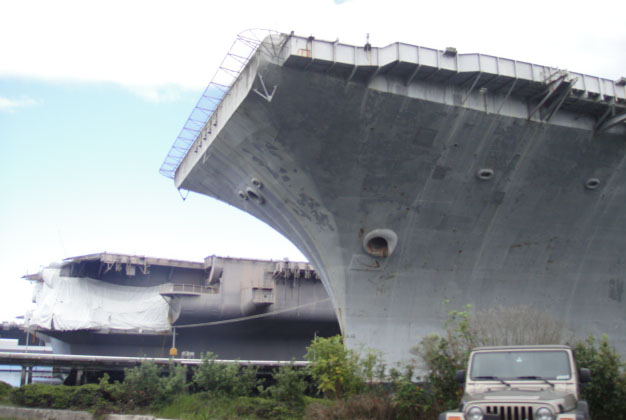
Carrier Row, Puget Sound Naval Shipyard in Bremerton, Washington, where
the Fukushima-contaminated USS Ronald Reagan
was refitted over an 18-month period.
 
Reconnaissance helicopters roared back to the mother ship, which then carved an arc through the chill waters of the Liman Current. The pride of the U.S. Navy was fleeing the coast of Japan like a wounded whale from a shiver of hungry sharks.
The USS Reagan’s support role for Operation Tomodachi sustained far more injuries than any of the 9th Carrier Group’s exercises off the Korean Peninsula. The crews of three helicopter suffered high exposure levels, and sailors operating the ventilation controls have since come down with severe radiation-related symptoms.
 
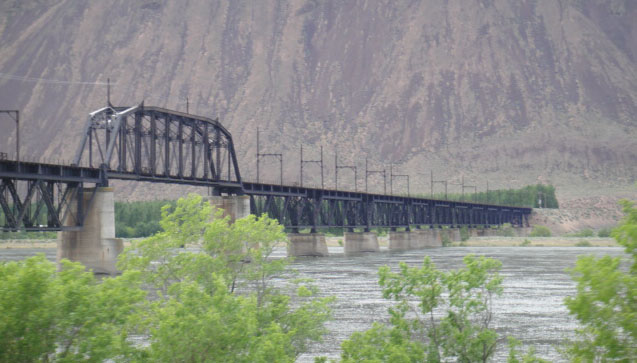
A railroad bridge crossing the Columbia River was traversed by
the train that transported radioactive waste from the
USS Ronald Reagan to the Hanford Site.
 
Fukushima radiation seeped beyond soft tissue into hard steel. Below the flight deck, nuclear isotopes in the air flowed into the air vents and below-deck ducts, while radioactive seawater surged through its turbine pumps and tubes that suck in seawater for the desalination system and to cool the vessel’s twin nuclear-power reactors. The artificially produced freshwater for washing and drinking aboard ship was soon toxic. 
 
The detection of war-grade plutonium residues sparked rumors of a nuclear strike on Fukushima in undeclared war by an unidentified power. Meanwhile a blanket of censorship was imposed over the condition and whereabouts of the USS Ronald Reagan, which at that moment could have possibly been the first casualty of World War III. Not until months later did confidential leaks emerge from U.S. nonproliferation experts disclosing secret transfers of highly enriched plutonium from Texas blended into mixed-oxide fuel rods for Fukushima Reactors 3 and 4.
 
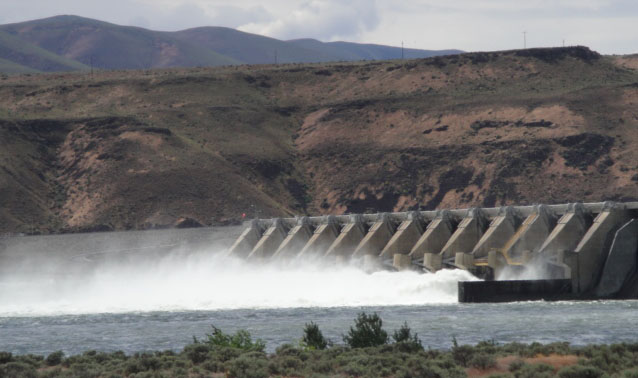
Wanapum Hydropower Dam, 30 miles upstream from Hanford,
was mysteriously dusted with radioactive isotopes
 
Over the two years since the March 2011 meltdowns, the radiation-stricken carrier vanished from the sailing schedule, leaving other naval behemoths to take over its missions in the South China Sea, Gulf of Aden, the Persian Gulf and Red Sea. Then this spring, the vessel reappeared in San Diego as if nothing had happened. 
 
Casey Jones, Watch Your Speed 
 
The story behind the USS Ronald Reagan’s long absence from active duty was revealed by a Navy long-timer perched at a bar outside the Bremerton Naval Shipyard in Seattle.
 
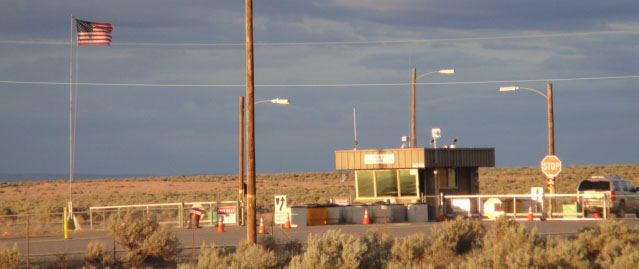
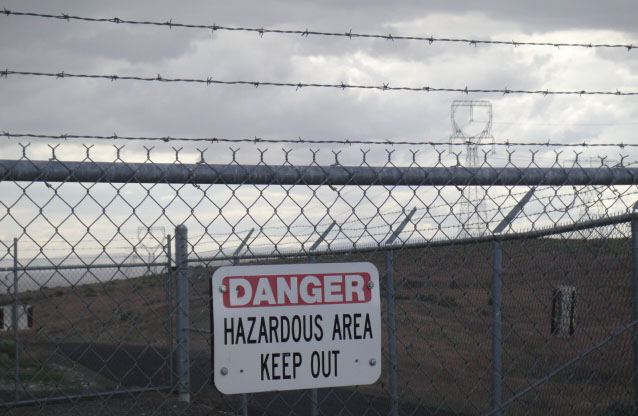
A guard post at Hanford Site keeps out uninvited visitors.
 
After flushing its pipes while transporting sailors’ cars to Alaska, the carrier was docked for decontamination and refitting along Bremerton’s “Carrier Row”. From early autumn 2011 until mid-March 2013, a period of 18 months, shipyard workers replaced irradiated air ducts, pumps, pipes, gaskets, hoses and electronic controls sensitive to radiation. The work gangs were ordered to prevent release of any contaminated liquid into Puget Sound in compliance with a prior Environmental Agency pollution complaint issued in 2010. 
 
(My dosimeter readings at Bremerton and at several points in Puget Sound confirmed the absence of radiation leakage from the USS Reagan. Frequent sightings of dead Dungeness crabs with floppy legs, however, suggested mortality caused by chemical toxins, probably surfactants used for cleaning the carrier and possibly heavy-metal compounds, possibly chrome, to deter barnacles from the hull.)
 
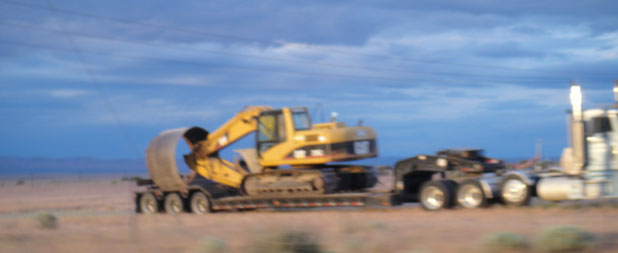
A backhoe and steel ring are hauled to Hanford’s leaking 200 storage tank area.
 
The vast pile of radioactive scrap and barrels of liquid waste were then loaded onto a freight train that rumbled out of the shipyard to a final resting place. Its destination was and still is undisclosed to the news media, the public and state officials. The terminus of that old rail track, say the shipyard workers, is Hanford Site. 
 
Mapping the Terrain 
 
Moral outrage at the disposal of the military’s radioactive hardware in a Department of Energy (DOE) facility supposedly under decommissioning was pushed to the back of my mind by the astonishing natural beauty of the Cascade Range. The four-hour drive from Seattle to Hanford offers a first-hand study in ecology. The lacework of inlets and rocky islands of Puget Sound was carved by glaciers during the Ice Age, when the sea was much lower. Those rivers of ice originated in the Cascades, a sawtooth chain of basalt pillars, remnants of ancient volcanoes. Its ridgeline divides Washington State into two major eco-zones, the temperate rainforest of the Pacific coast and, on the leeward side, arid lands stretching toward the Rockies.
 
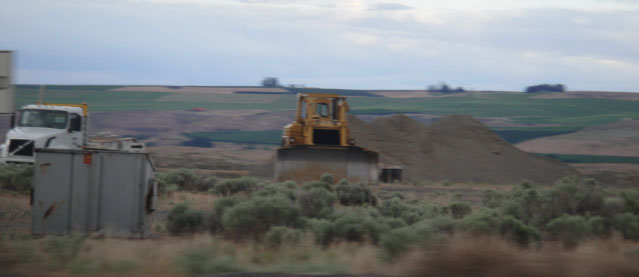
A bulldozer starts to excavate a trench for the military’s nuclear
waste. Earlier burial sites can be seen in the background.
 
The eastern slope of the watershed creates hundreds of streams that merge into the Columbia River, which quenches apple orchards and the green pastures for Angus cattle, dairy cows and bison. The mighty current is slowed by a series of hydropower dams before hitting its lower reaches at Portland, Oregon. 
 
Under a high bluff at Wanapum Dam, about 30 miles northwest of Hanford, my dosimeter readings climbed to 0.16 microsieverts. Downstream, the findings were much lower. When the air is bone-dry, how can evaporated wastewater from leaking tanks at Hanford move so far upstream against the prevailing wind? Why are there no traces of its passage up the gorge? I take mental note of this baffling riddle before moving on. 
 
Nuclear Boneyard
 
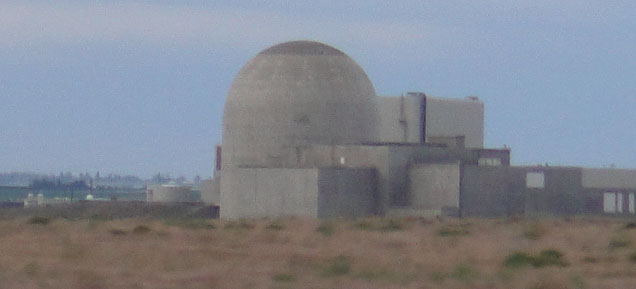
A plutonium processing reactor
 
Endless flows of water and hydropower are the necessary utilities for the production of nuclear weapons, and the Columbia provides these in abundance to Hanford Site, founded in 1943 under the Manhattan Project. Ringed by rosy red hills peppered with fingers of black basalt and clumps of sage, the first impression of Hanford basin is one of awe at Nature’s raw power rather than fear of a grim manmade Mordor. Technology’s supreme force shrinks against such grandeur; its fabrications scattered like the Mad Hatter’s overturned teacups and sugar cubes alongside the Columbia. 
 
Yet one of those fly specks down there, inside the facility’s 586 square miles (1,517 sq. km) area, is the world’s first plutonium-production reactor. Hanford 100B provided the implosive force for the Trinity test blast and for Fat Man, the hydrogen bomb that annihilated Nagasaki in August 1945. Nagasaki, so much like Puget Sound, with its cathedral, shipyards, parks, saloons and Victorian era facades . . . vanished like dream in a flash of blinding light.
 
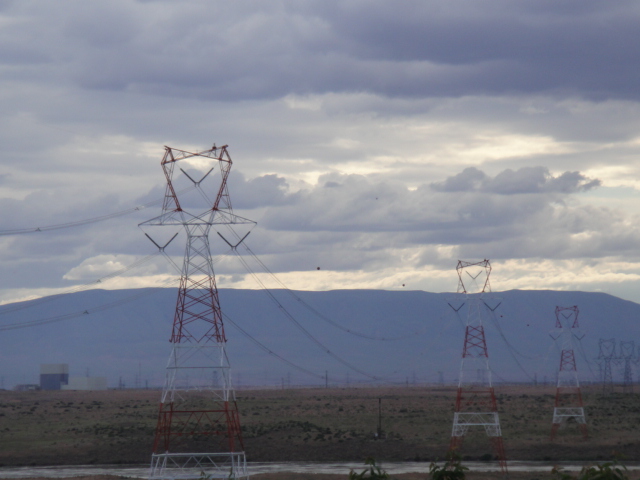
To the right of the power line is a 100 series reactor.
 
After passing under its rusty bridges in the hills, here on dry pale ground, I spot the railroad track pointing toward the 200 West Area. On lonesome roads outside and inside the vast facility, long-bed trucks haul yellow bulldozers and back hoes, the grave diggers for dead machines. The earth-movers are fitted with glass-enclosed air-filtered cabins, the thinnest of protective shields for the drivers. 
 
In rows of trenches inside that dusty tract are the guts of the USS Ronald Reagan along with the nuclear reactors from 117 decommissioned submarines. The reactor cores are left uncovered so that Russian satellites can verify reductions in America’s strategic arsenal. A retired nuclear-plant operator explains how those reactor cores, too heavy and bulky for the train, are instead transported by barge up the Columbia River. At Port Benson, adjoining Hanford Site, the load is rolled aboard a land carrier with 16-wheel axles and hauled at 5 miles per hour to the nuclear graveyard.


The Puget Sound Naval Shipyard at Bremerton is the only facility that dismantles America’s fleet of aging nuclear submarines. The fuel from the scrapped reactors is sent by rail to a federal storage facility near Idaho Falls. Little is known about the movements of naval cargo because several maritime lanes in Puget Sound are protected by armed guards on speed boats, Navy SEAL divers prowling underwater and surveillance dolphins equipped with electronic sensors and GPS tracking devices. Fishermen, clam diggers and recreational sailors know better than to mess with this security force. 
 
There is no legal mandate to inform Washington State communities of passing reactor-toting barges because the Navy designates the cargo as “low level” waste. Local residents who are curious about these shipments will not find the route map posted at their docks or bridges, so here it is, courtesy of the Washington Physicians for Social Responsibility: 
 
The route begins at the (Bremerton) Shipyard and goes though Rich Passage, past Restoration Point, and northerly though Puget Sound. The barge will then move west through the Strait of Juan De Fuca, past Cape Flattery, before turning south and going along the Washington Coast. As the barge makes its way to the mouth of the Columbia River it will not enter the area near the Olympic Coast National Marine Sanctuary known as the Area to Be Avoided. 

The barge will then go up the Columbia River following the regular shipping channel that is used for commercial cargo. The ocean tugs turn over the barge to river tugs on the lower Columbia. The river route passes through the navigation locks at the Bonneville, Dalles, John Day, and McCanry dams, until finally reaching the Port of Benton. “
Portlanders are hereby informed that radiation is coming and going, upstream and downstream. It’s been happening since 1986 and will continue indefinitely. 
 
Hearts Afire
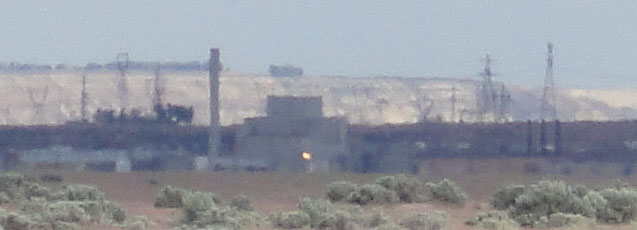
A point of light is flickering from inside one of the older thermal power plants. Next to a No Entry sign, my travel party passes a pair of binoculars for a closer look. It is not sunlight reflected off a window pane. Incredibly, there’s a massive fire blazing inside the nuclear plant. Flames are blowing out of the open door, which is at least two stories tall and wide enough for several trucks. No black smoke is being emitted, nor do the flames diminish in intensity. Alarms are not blaring and there are no firefighting sirens. Therefore, it must be a gas fire, deliberately set. 
 
The sight of a structure’s innards on fire is dumbfounding. Nothing about this sort of incident has ever been reported in Hanford press releases. What could DOE be up to? Surfacing in my mind’s eye is a flashback of the dosimeter reading at the Wanapum hydropower dam. Hanford is being decommissioned, and the fastest way to clean out a thermal power plant used in the past to incinerate nuclear waste is to torch it. The invisible hot fumes lift the radioactive particles hundreds of meters into the desert sky, and then at nighttime an updraft carries the airborne waste up the Columbia gorge to Wanapum and beyond. Thus, the radioactive residues disappear as if by magic, and the monitors, inspectors and visitors remain none the wiser. 
 
Atmospheric releases blowing out of Hanford are swirling up and down the Columbia gorge, unbeknownst to ranchers, apple growers, restaurant operators, school teachers and truckers along the riverbanks. Nobody on the outside is being warned of the threat. This is still the Wild West, where an outlaw gang like the DOE can kill everyone and anything that stands in their way. 
 
Above the Aquifer
 
 
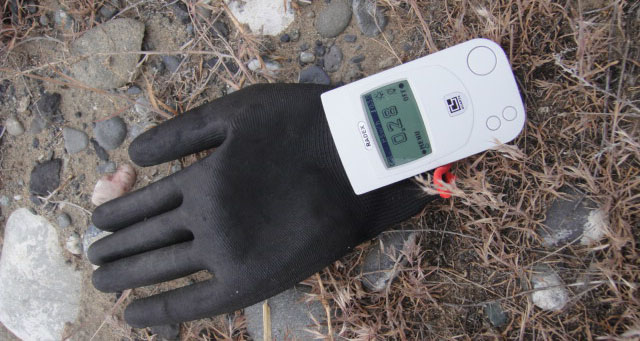
For plant workers, the most fearsome piece of equipment inside plutonium-processing and warhead-production facilities is the glove-box. Since the more delicate operations must be done by hand, glove-boxes have a window and fitted with a pair of holes for insertion from fingers to elbow. In both Fukushima and Hanford, the best way to test exposure levels in nuclear workers is to measure castoff gloves. At a roadside spot convenient for quick relief, a black work glove was lying on the gravel. It registered 0.28 microsieverts, meaning whoever urinated is a dead man walking. 
 
By the 1960s, waste disposal became a major problem at Hanford due to the expanding number of 100 series reactors, along with plutonium processing centers and a power generation plant. Initially, the DOE planned to drill long-term storage caverns into Gable Mountain, a saddle-shaped mound of basalt on the plant’s north side between the Columbia River reactors and the plutonium-enrichment facilities.
 
The warning sign is posted at a waste disposal site adjoining a fast-flowing drainage ditch.
 
Geologists, working on the environmental feasibility report, found that Hanford Site sits atop the Pasco Aquifer, the source of well water for towns, ranches and fruit farms inside the big bulge of the Columbia. This discovery prompted the 1978 DOE study of Yucca Mountain in Nevada as a permanent repository of nuclear waste, but the proposed site was later abandoned due to political opposition from nearby Las Vegas interests. 
 
The termination of Yucca Mountain led to an untenable situation at the 200 East Tank Farm. There, 177 rusted-out single- and double-shelled tanks “are far gone, past their 20-year lifetime,” said the plant operator. Tritium has been leaking onto the ground and in the air. A greater problem is that solid particles of plutonium and other radioactive elements are settling to the bottom of the wastewater tanks. When atoms are in close proximity, the release of neutrons from radioactive decay can result in a chain reaction. 
 
DOE engineers are anxious about the possibility of an explosive chain reaction at the tank farm similar to the tritium blast that wrecking Fukushima’s Reactor 3. Tritium and deuterium, also known as heavy water, along with hydrogen gas, could blow the tanks apart, sending radioactive steam into the clouds. A much greater threat, said the plant insider, is a downward blast into the Pasco Aquifer, sending ripples of death through hundreds of miles of drinking water for local residents. Leakage from ruptured tanks into the Columbia would doom downstream communities, including Portland and its Silicon Forest industrial parks, anchored by Intel.
 
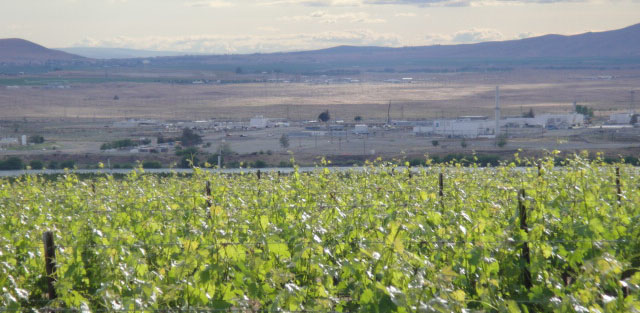
Grape vines are planted across the river from Hanford’s nuclear power complex.
 
To prevent this doomsday scenario, the DOE contracted the Bechtel engineering company to design as unmanned mixing system to prevent the precipitation of plutonium from the wastewater. The controversial design for the vitrification plant uses jet pulses through tubes, called turkey basters, to repeatedly remix the radioactive soup, keeping the radioactive particles in permanent suspension. The design is fraught with weak points that could easily burst under corrosion and high pressure. Cost overruns and construction delays have postponed completion from 2007 to 2022, which is probably much too late to head off a catastrophe. 
 
DOE, the Pentagon and nuclear industry should admit the obvious: Hanford is broken and cannot be fixed. A radical alternative to storage at Hanford needs to be developed rapidly and a crash program will require vast sums of money and the political will to stop all nuclear operations from coast to coast. Permissiveness toward the nuclear industry is suicidal. A new energy policy must begin with zero tolerance for nuclear.
 
 
Grape vines are planted across the river from Hanford’s nuclear power complex.
 
Turn Out the Lights
The music’s over for the nuclear industry. Three Mile Island, Chernobyl and Fukushima have savaged the myth of cheap and safe power from atom-splitting. Hanford takes this fiasco a step further by implicating the military in nuclear skullduggery. Despite its bloated defense budget, the Pentagon is misappropriating the fiscal resources of the DOE, which must dispose of nuclear-contaminated military hardware. Funds that could otherwise be allocated to replacing the storage tanks at Hanford are being spent on burying submarine reactors. The Office of Management and Budget (OMB) is facing a radioactive mess of waste, fraud and mismanagement.
 
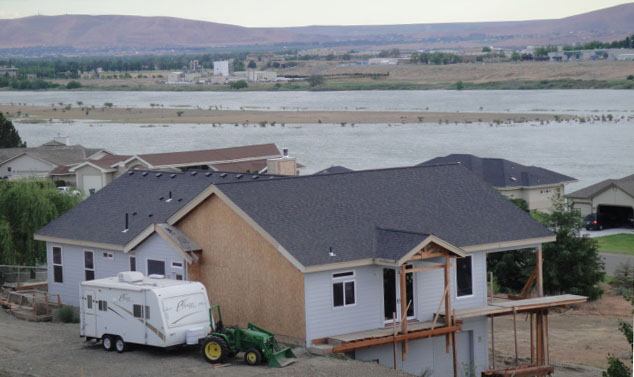
A housing development reflects fatal problems in local zoning ordinances.
 
The ominous situation at the Hanford rust belt is the result of a false sense of national security. Nuclear weapons have been ineffective as an instrument for global stability since their inception. Nuclear deterrence has failed to prevent outbreaks of war and terrorism, and the Cold War would have ended sooner without warheads. Instead of preserving the peace, the nuclear arsenals of the major powers have only spurred on proliferation by minor regional players. 
 
However fast or slow the pace of future nuclear drawdown, the problem of long-term storage remains a formidable challenge, now that Yucca Mountain is nixed. The search for a safe site for a nuclear-waste repository should have started yesterday. The federal government controls millions of acres in sites that have outlived their usefulness, for example, military zones like Fallon test range or Area 51. The Pentagon should use its own turf to store its waste instead of dumping on the hard-pressed DOE. The cost of the relocating naval reactors should be deducted from the inflated military budget and not from the shrinking pockets of taxpayers.

Ozone Loss Led to Climate Chaos 
 
If the threat from Fukushima isn’t enough to bear, lethal radioactive releases from Hanford and San Onofre, along with Indian Point and the Napoleonville sinkhole, should motivate Americans to political action against the nuclear lobby and its sycophants. National security and, much more, the very existence of American society and the continent’s natural environment, are coming apart from the effects of high-energy particles in the jet stream, which cause ozone depletion over the Northern Hemisphere. The consequences include the recent tornadoes in Texas and Oklahoma, and an epidemic of winter twisters, derecho storms, flooding and drought.
 
 
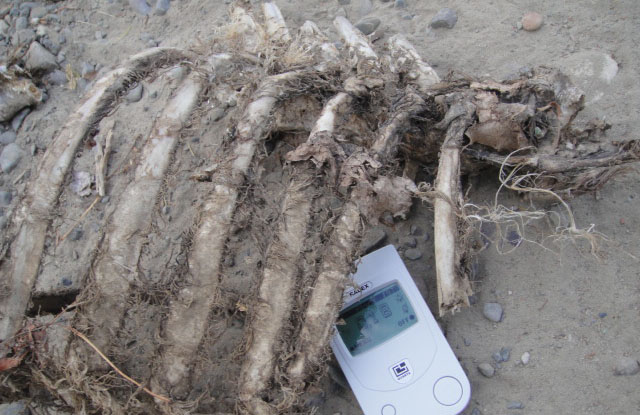
The ribs of a wild faun indicate dangerous radiation levels in coyotes.
 
The harmful influence of carbon dioxide on global weather, as exaggerated by supporters of TEPCO and the Tennessee Valley Authority, is a convenient ruse to divert attention and funding from the immediate task of shutting down nuclear power. 
 
An end to nuclear tyranny is directly linked to the revival of genuine democracy. A sinister and cynical force within America’s political establishment, economic elite and scientific elect is desperately trying to prevent Americans from recovering this nation’s foundational values of civic duty, ethical responsibility and common sense.

Any physicist, engineer, bureaucrat, president or monarch who persists in uttering ultra-absurd nonsense in defense of nuclear power should be hauled away to a padded cell for deprogramming and decommissioning. If anything is going to be buried, it should be that deceiving pack of con artists and scoundrels. 
 
With so many burned-out reactors and morally warped scoundrels to deal with, let’s hear what Nick Santoro (Joe Pesci) of Casino has to say: “A lot of holes in the desert, and a lot of problems are buried there. You gotta have the hole already dug before you show up with a package in the trunk. Otherwise, you’re talking about a half-hour to 45 minutes of digging. And who knows who’s gonna come along at that time? Pretty soon you gotta dig a few more holes. You could be there all fricking night.” 
 
Quick Reads of the Technical Details
 
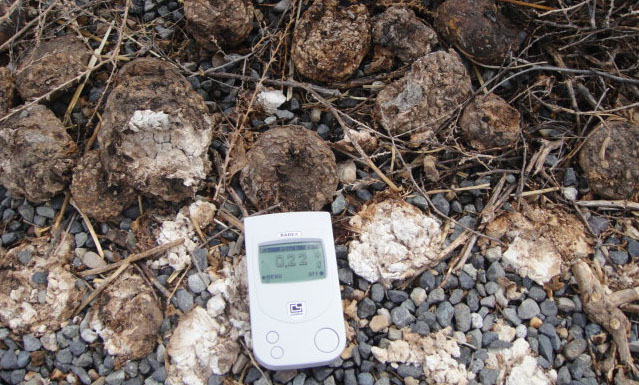
Cattle manure along the Hanford fence show extreme levels of radiation ingestion.
 
The Columbia River, once a life-giver for the Pacific Northwest, has become the bringer of death on an unimaginable scale. Testing of radiation levels in its waters is not being done by any government agency. My dosimeter readings at the Hanford and on the mid-reaches of the Columbia cannot be a substitute for a wider monitoring program, but they do point to the rising threat of nuclear contamination. 
 
Even with scientific Geiger counters, the testing of water remains an elusive task.
Gamma rays are reflected in water, throwing off readings by as much as 20 times lower than the actual level of contamination. Thus, the only way for a layman to make estimates in the field is by measuring biological accumulation in plants and animals. 
 
Dosimeter readings on the bluffs northwest of Hanford showed low levels, due to the prevailing wind and lack of airborne moisture. 
 
At a riverine chokepoint on the north bend between Reactors D and H, a wide variation in readings, from 0.08 to 0.28 microsieverts, with the highest in sage, indicated different rates of water absorption by various species of flora.
 
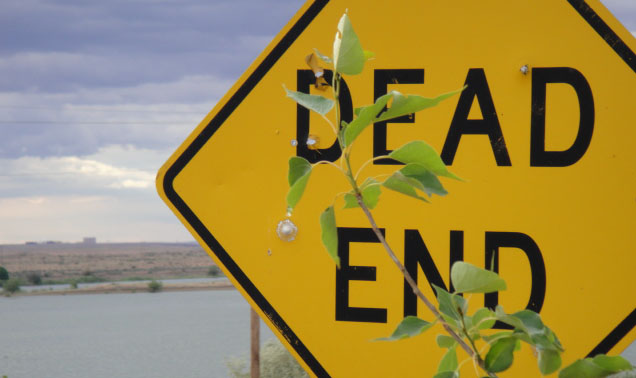
A reactor of the 100 series is on the horizon behind the sign.
 
At points downriver, near the southern tip of Hanford, the measurements on different plant species ran consistently in the 0.28 range, equivalent to coastal areas inside the Fukushima exclusion area (9 km from the meltdowns). A ribcage from a faun devoured by coyotes showed remarkably high contamination, suggesting higher levels inside predators. 
 
The high water from the spring snowmelt prevented access to underwater vegetation. The readings along the outer bank of the Columbia, however, indicate levels dangerous to downstream communities and coastal populations in northern Oregon. 
 
Author: Yoichi Shimatsu is a Hong Kong-based science writer and environmental health consultant who provides herbal therapy to Fukushima residents.

Monday, May 13, 2013

Olympic Peninsula: West Coast Radiation Crisis

Yoichi Shimatsu
5-12-13

 
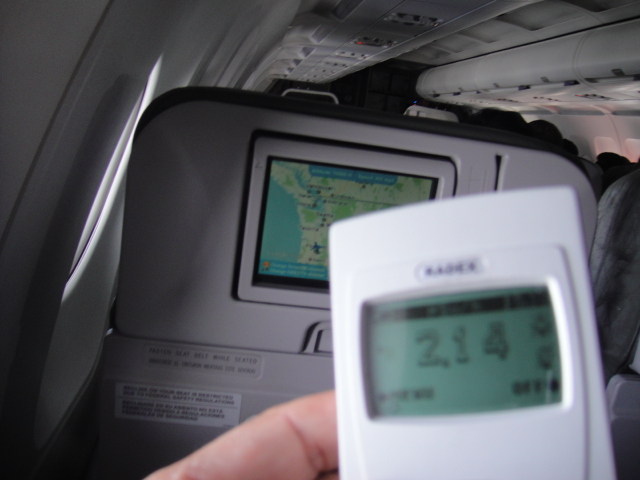
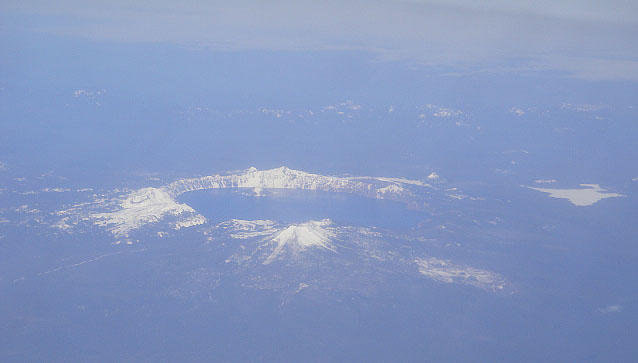
The azure glow of Crater Lake was about to be smudged by a band of wispy smoke blowing in eastward on the jet stream. As steely gray turned to black, I switched on my dosimeter, which immediately whined in alarm. The radiation level inside the jetliner cabin hit 2.26 microsieverts, equivalent to twice the dosage at locations just 5 kilometers from the Fukushima No.1 nuclear plant. Although my nerves were thoroughly rattled by the buzzing, the dozing passengers were blissfully unaware of being bombarded by lethal neutrons.
 
Sky-high radiation reading inside a jetliner cabin while
flying over the Oregon-Washington state boundary.
 
The thin ghost shadow riding through the sky had no semblance to a fat rain cloud. Here, over the Pacific Northwest, was a vast plume of smoke from the incinerators of Greater Tokyo that burn radioactive debris from Fukushima Prefecture. The radiation levels gradually diminished as the jet made its descent to SEA-TAC airport. 
 
My journey to Seattle from Southern California had been prompted by a questionable claim from Washington State officials that the waves of tsunami debris from Japan are not radioactive. This sort of optimism is based on the assumption that any residual isotopes would be washed away in the North Pacific Current during the passage of more than a year over a distance of 7450 km (4630 miles).
 
Above Crater Lake, Oregon, on arrival of the leading edge
of concentrated particulates from Tokyo incinerators
burning low-level nuclear waste from Fukushima.
 
To the contrary, my gut instinct tends to be pessimistic, especially after having conducted several field research expeditions that discovered serious contamination not only in northeast Japan but also on the southernmost peaks of the Japanese archipelago. The spread of radiation, as far I have been able to tell, is unstoppable. 
 
New World’s End 
 
The Olympic Peninsula is unexpectedly large. The three-hour drive out of Seattle wends through a cactus desert in the rain shadow of snow-capped mountains and then plunges into dark moss-hung stands of temperate rainforest. Beyond the great arc of Crescent Lake, reminiscent of Scandinavia or Switzerland, a road sign points to the town of Forks, location for the “Twilight” romantic vampire series.
 
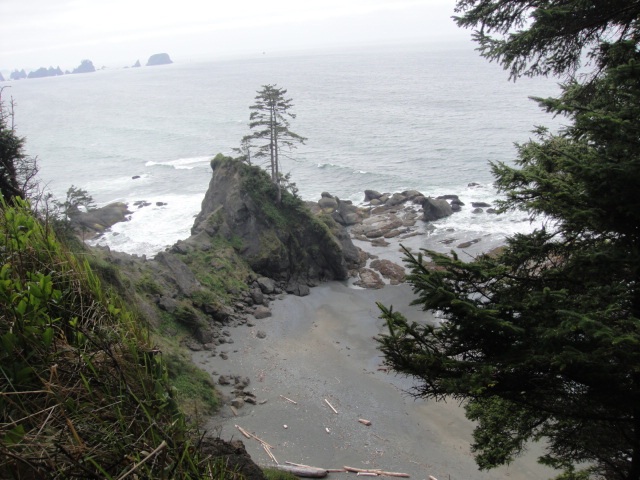
Shishi Beach, Olympic Peninsula, has been cleared of
all debris from the 3.11 tsunami that hit northeast Japan.
 
At the Last Chance gas station, the breakfast fare caters to the sport fishermen rolling their boats down a ramp onto the Salish Sea, which separates Washington State from British Columbia. My choice is a frozen barbecue burrito reheated in a microwave. Farther along, totem poles in front of a low-hung casino were carved by the Makah tribe known for their seagoing war canoes, which are still used to hunt whales. Unlike the Japanese fleet’s mechanical contraptions and ballistic projectiles, these muscular paddlers hurl old-fashioned harpoons in a fair contest between man and leviathan. 
 
Turning south from Neah Bay, the road peters out at gravel parking lot marked by a wooden sign that reads: “Shishi Beach 1.6 miles”. The early stretch is a pleasant stroll atop wooden planks through a forest as spooky as those in Lord of the Rings. Then the path descends into an endless slog through perma-mud and poison oak well beyond the promised distance. My thought while stumbling along was : “So this is how the natives get their revenge.”
 
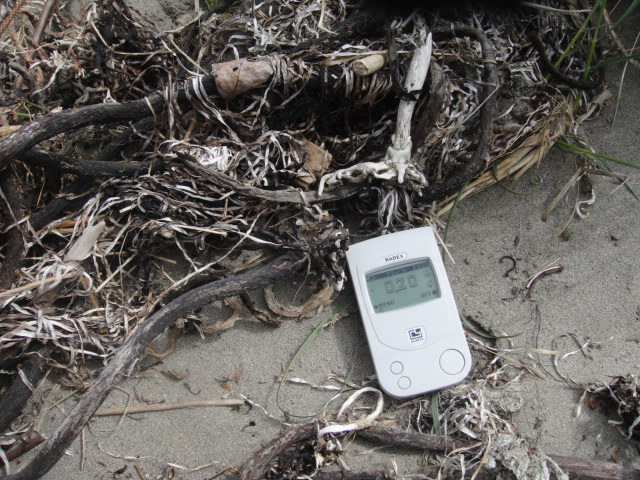
Higher radiation levels from previous year’s seaweed are
found along the shore of the Makah tribal lands.
 
 
At last, the waves crashing on pristine beaches devoid of foreign flotsam, come into sight. After traveling 10,000 kilometers from the other side of the ocean, I find not a matchstick much less a floating house or boat from Japan. There were more bits of chewing gum wrappers on the trail than on these lonely stretches of sand and bonsai-studded rocks. 
 
Seaweed Tales 
 
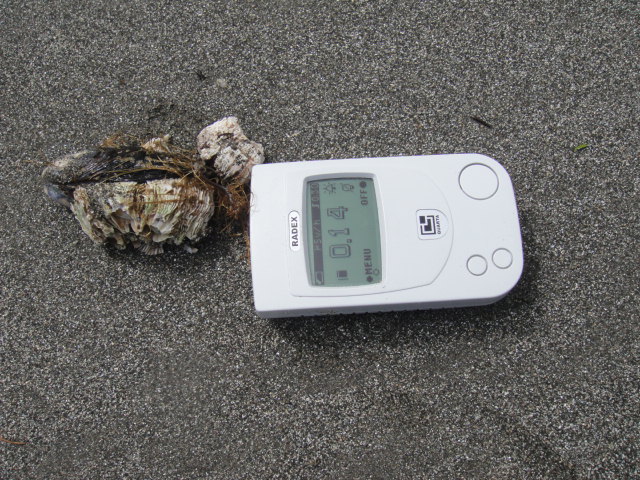
Disappointed, to say the least, I switched to a stratagem of measuring radiation in the seaweed that had washed ashore. Within a few minutes, a pattern emerged. Dry bunches of kelp above the dunes imply a serious radioactive event happening about a year earlier with readings of up to 0.28 microsieverts. More recently displaced wet seaweed show half that figure. At the water’s edge, the readings are very low, only about 0.08 microsieverts, near the background radiation across the peninsula. 
 
The Pacific Northwest has abundant rainfall yet lacks the high humidity of Japan. Thus, instead of recycling radiation inland, the isotopes are washed out to sea, rapidly lowering contaminations on land and in the bays. 
 
It is a pity that my science kit does not include any instruments to detect toxic chemicals or microbiological contamination. The steep slopes of Japan’s northeast coast meant that most of the region’s tanks for oil, fertilizer and pesticides, along with refrigerant fluids, were stored along the shore and were swept away by the tsunami.
 
Barnacles attached to a mussel have bio-accumulated radiation from algae and plankton.
 
A Strand of Buoys 
 
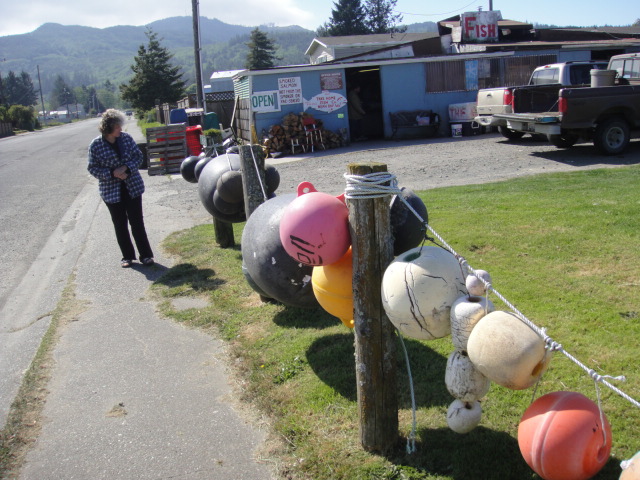
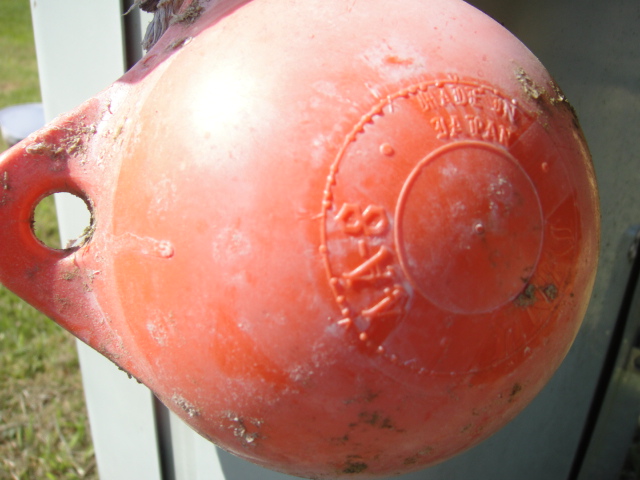
Calling it a day, filled with hard-earned futility, I headed back toward civilization. On the edge of Neah Bay village, the front yard of a shack identified by the sign “FISH” is festooned with a string of colorful buoys. On closer inspection, the plastic balls are covered with raised Chinese characters, a bit of Japanese phonetic script and the Roman alphabet. 
 
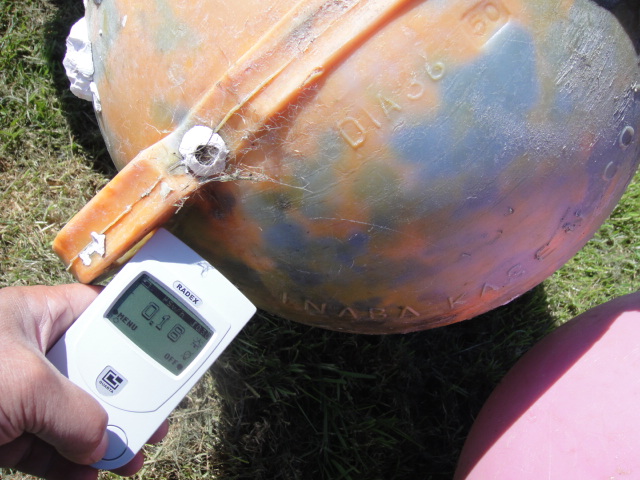
My experience along the Fukushima coast showed that rubber plastic and fishing nets absorb radiation more readily than wood or metal. The dosimeter recorded an identical 0.16 microsieverts on every Japanese float, a level not immediately harmful to the rare passerby. Nonetheless, the figure is a good indicator of contamination on the journey from Fukushima. The Chinese balls are between 0.05 and 0.08 microSv.
 
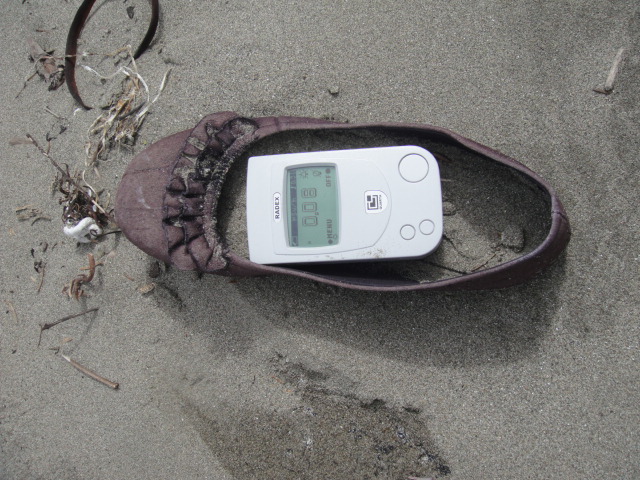
Lower radiation levels are present in recently
dowsed items like wet kelp or this cast-off woman’s shoe.
 
Again, small differences disclose a larger story. The made-in-Japan floats, aboard trawlers or hanging to dry with nets in fishing villages, were pulled out to sea by the tsunami and soon became irradiated by contaminated water from the Fukushima nuclear meltdown. In contrast, the Chinese buoys were attached to long fishing nets laid outside Japan’s 200-mile maritime exclusive economic zone. Larger pieces of jetsam, for example, wooden beams, boats and buildings, ripped those long nets to shreds, releasing the Chinese buoys adrift. At that distance from the coast, radiation levels had become greatly diluted. 
 
So here, in these findings, was undeniable proof that the federal and state governments have again failed to inform American citizens of the radiation risk from Fukushima. For all the funding spent on climate research, oceanic studies, fisheries protection and marine biology, not a single official bulletin mentions anything about what a visitor can learn from a string of buoys in front of a salmon smokehouse.
 
Beachcomber’s collection of fishing-net buoys at a
salmon smokehouse run by a Makah resident
 
The proprietor, a big strapping cheerful Makah fellow, stepped outside to provide answers to the missing debris riddle. “The state has started to put two big containers by the beaches on weekends, and volunteers come to clean up the beaches.” 
 
The state Bureau of Corrections responded to my query by answering that convicts from the two nearby prisons had never been assigned to the beach detail. Therefore, ordinary residents out of the goodness of their hearts did the hard work of removing flotsam, which included radioactive materials. The volunteers had no knowledge of the health risk and were given no advice on wearing protective gloves and eyewear or about decontamination methods. 

A state resident who is an avid halibut fisherman told me: “It must be some sort of diversion that the only thing that the biologists have been focusing on is invasive species from Japan. They never say anything about radiation in the food chain.” 
 
Gazing at the ocean from the closest point in the Lower 48 to Japan, the truth is as cold and bitter as the north wind. I shudder to think of what is still to come.
 
A consistent reading of 0.16 microsieverts is found on the buoys from Japan
 
Update on the Marine Mammal Kill-off in Southern California:
Before heading to the Pacific Northwest, I met a number of Southern California residents whose lives are deeply connected to the ocean. 
 
A California Fish and Wildlife ranger did not flinch when told of my radiation findings in the heart of a dead sea lion beached at San Onofre. He told me the following:
 
“Made in Japan” is impressed on a small buoy.
 
The coming feed shortage: “At this time of year (late winter and spring), there’s a northward current from San Diego-Coronado Island up the Catalina Channel. The colder California Current (moving southward) flows around the outside of the Channel islands (Santa Catalina and San Clemente). Over the past year, the water in the Channel has been colder than usual. Soon, a warm current will strongly push north below the surface and there will be a series of powerful upwellings of warm water up the Channel. The sudden temperature change is likely to kill off the sardines, leading to a major feed crisis for marine mammals.” 
 
Marine environment imbalances: “Rising population along the coast and one-sided zoning decisions have upset the delicate balance in the marine environment. Lobbyists from either side, industry or animal protection, have pushed the state legislature toward one extreme or the other, further worsening the environmental balance. The situation does not get better, for instance, when a ban against commercial fishing opens the door to poachers. We’re going from one ill to the next without the overall situation getting any better ”
 
 
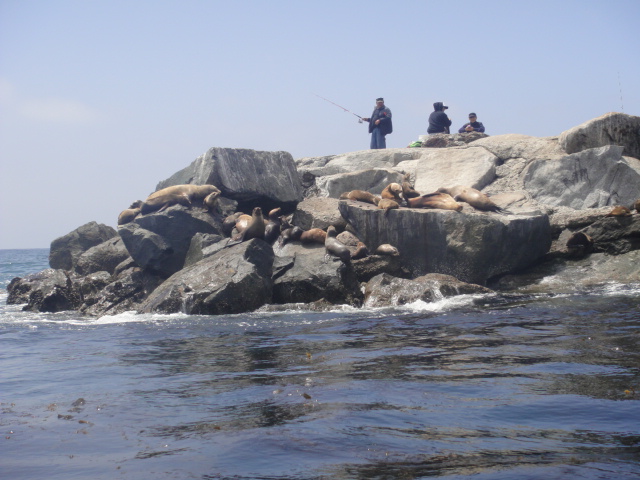
Pups and juvenile sea lions rest on the rocks of a jetty at
Newport Harbor despite the presence of sport fisherman, a sight never seen before.
 
Aquaculture: “The squid from the coast of Southern California, formerly used for bait, are now being fished as feed for large tuna farms off the coast of Ensenada, Mexico. The expansion of this billion-dollar industry is going to pose a lot of pressure on fish stocks around here.”

Shark Attacks: (reply to my question on the absence of teeth marks on the dead sea lion at San Onofre.) “Great White sharks often do not leave any teeth marks. There are many reports of fast-moving sharks hitting a sea lion and ripping off a strip of skin with no other sign of a bite.”
A bait-barge worker: “The price of sardines is no different now than in the past. There is no shortage of smaller fish. Everything is as normal.” (His observations runs counter to the theory of a feed shortage in the channel.) 
 
Volunteer at a fish-stocking raft: “We’ve never before seen sea lion pups resting on the jetty of Newport Harbor. This is most unusual.”
 
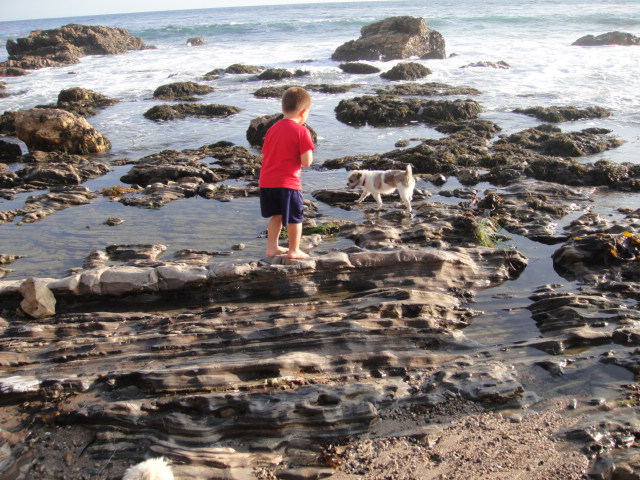
A shallow tide pool in the Laguna Beach area has higher
radiation levels due to constant evaporation.
 
Sport fisherman on the jetty: “The pups arrived here about two weeks ago and stayed.” (In mid-April, the marine mammal kill-off extended northward to Malibu and later Santa Barbara, where beaches were littered with pups dead from starvation. Apparently, just after that crisis, some juvenile sea lions fled to the unfamiliar rocks at the harbor mouth. My radiation readings of a dead pup’s intestines indicated it was not contaminated, meaning the mother was probably dead before she could nurse the pup with radioactive milk.} 
 
A sport fisherman conjectures: “The Great White sharks have been getting more aggressive recently, attacking swimmers and sea lions. Orcas are hunting here out of season, feeding on the white sharks. From what I can tell, the radiation in the water is disrupting the sensors in their snouts and enraging them to attack without cause.” 
 
A Point about Beach Safety: 
 
Radiation readings along the Laguna Beach area indicate lower readings than in San Onofre or Santa Catalina, with one exception: Shallow tide pools affected by solar evaporation. Flat tidal pools that are exposed at high tides tend to act like salt ponds, concentrating radioactive isotopes in the seaweed and in crustaceans. One large sea snail registered 0.38 microsieverts, and seaweed clumps were up to about 0.20 microSv. 
 
Sandy beach areas showed much lower levels, and thus are safer for beach goers, so act accordingly when positioning beach blankets. 
 
Author: Yoichi Shimatsu, a Hong Kong-based science journalist, provides health and environment consulting to residents of Fukushima on countermeasures to radiation exposure.

Monday, April 15, 2013

Dead sea lions washing on shore in California appear to have died from radiation poisoning

 California

An unusual surge of stranded dying and dead sea lions (seals) have littered Southern California beaches from Santa Barbara to San Diego since earlier this year. Most of the area newspapers and media outlets have been alarmingly reporting this unusual phenomenon.

It's unusual because this is the season when sea lion pups flourish. Instead they're struggling ashore in starved, emaciated conditions, if they've managed to stay alive. Scientists say almost half the sea lions born this past winter have died.

When they get too thin, they're forced to go ashore for sun because they can't stay warm in cool waters. All the concerned marine biology scientists are scratching their heads. Some have commented on how this sort of mortality rate is usually predictable according to atmospheric or oceanic conditions.

But there are none of the obvious tell-tale signs that could have predicted this high occurrence of seal pup mortality.

"They're clearly not getting enough food," said Victoria Harris, Interim Executive Director with the California Wildlife Center. Yet another scientist claims there are sufficient squid and sardine populations for them off the coast of California.

Scientists seem to be determined to get to the bottom of this marine life tragedy. "Marine mammals are sentinels of the eco system," stated Victoria Harris, of the National Oceanic and Atmospheric Agency (NOAA).

The NOAA publicly announced that they considered radiation unlikely as the cause, but it wasn't ruled out.

How radiation could be the primary causal event

Japanese marine scientists have announced extremely high radiation reading in sea water collected off Japan.

The New York Times article, "Fukushima's Contamination Produces Some Surprises at Sea" published September 28, 2011 contained information from scientists about extremely high amounts of radioactive cesium 137.

The extremely high readings recorded at different times indicated that cesium 137 was rising, and at that time in 2011, more radioactive material was continuing to leak into the ocean.

That article registered concern over the high amounts of radioactive material, but claimed at that time the ocean was diluting the radiation levels low enough to prevent humans from being harmed directly.

Of course, California sea lions are a long way off from the Japan coast, but different currents and eddies could spread a continuing accumulation of radioactive contamination farther out into the ocean from Japan.

Even tuna caught off the California coast have been found with higher than normal traces of cesium 137 from the Fukushima disaster in May of 2012.

An unpublicized cause of death for seal pups is domoic acid, produced by toxic algae bloom. It causes seizure and death in California sea lions. Domoic acid is a neurotoxin produced by a few specific types of harmful algae blooms among the phytoplankton on the ocean's surface.

Often this results in what's been termed "Red Tide" that kills off lots of marine life.

Here's where I'm going with this. Phytoplankton is easily corrupted. Although it's involved with providing well over half the earth's oxygen through the process of photosynthesis, excessive UV rays coming through ozone layer openings do damage them.

So now we have a 2011 report from researchers at the Tokyo University of Marine Science and Technology which stated that Fukushima's radioactive cessium 137 has contaminated ocean plankton. Plankton is the first food within the marine life food chain.

Professor Takashi Ishimaru, said the plankton were heavily contaminated because sea currents continuously carried contaminated water southward from the nuclear plant. There you have it. Radioactively contaminated plankton.

If it doesn't produce a form of domoic acid from that damage, it goes up the food chain to larger fish and sea mammals. Remember that quote from earlier in this article: "Marine mammals are sentinels of the eco system."

If not directly from radioactive contamination, which has not been ruled out since some Fukushima radioactive debris has washed ashore on the west coast, then the indirect consequences of radioactive plankton could be at the bottom of this seal pup tragedy.

Monday, April 8, 2013

Almost third of US West Coast newborns hit with thyroid problems after Fukushima nuclear disaster


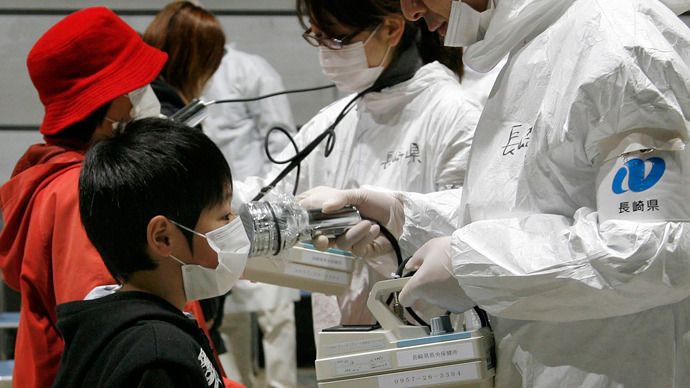
 A boy receives a radiation scan at a screening center in Koriyama in Fukushima prefecture (AFP Photo / Go Takayama)
A boy receives a radiation scan at a screening center in Koriyama in Fukushima prefecture (AFP P

Researchers have discovered that the Fukushima nuclear disaster has had far-reaching health effects more drastic than previously thought: young children born on the US West Coast are 28 percent more likely to develop congenital hyperthyroidism.

In examining post-Fukushima conditions along the West Coast, researchers found American-born children to be developing similar conditions that some Europeans acquired after the 1986 meltdown of the Chernobyl Nuclear Power Plant.

“Fukushima fallout appeared to affect all areas of the US, and was especially large in some, mostly in the western part of the nation,” researchers from the New York-based Radiation and Health Project wrote in a study published by the Open Journal of Pediatrics.

Children born after the 2011 meltdown of Japan’s Fukushima Nuclear Power Plant are at high risk of acquiring congenital hyperthyroidism if they were in the line of fire for radioactive isotopes. Researchers studied concentration levels of radioiodine isotopes (I-131) and congenital hypothyroid cases to make the association.

Just a few days after the meltdown, I-131 concentration levels in California, Hawaii, Alaska, Oregon and Washington were up to 211 times above the normal level, according to the study. At the same time, the number of congenital hypothyroid cases skyrocketed, increasing by an average of 16 percent from March 17 to Dec. 31, 2011. And between March 17 and June 30, shortly after the meltdown, newly born children experienced a 28 percent greater risk of acquiring hyperthyroidism.

In 36 other US states outside of the exposure zone, the risk of congenital hyperthyroidism decreased by 3 percent – a finding that researchers believe may serve as further proof that Fukushima had something to do with the unusually high results found on the West Coast.

The disease is usually rare, but can manifest into a serious condition if left untreated. Affected fetuses and children may suffer serious developmental delay – and a recent report found that 44.2 percent of 94,975 sampled Fukushima children have had thyroid ultrasound abnormalities as a likely result of their exposure to the radiation.

Americans often doubted that radiation from the meltdown would affect the US West Coast, but the latest research sheds light on alarming scientific data that indicates otherwise. Radioactive iodine that enters the human body typically gathers in the thyroid, which release growth hormones. Radiation exposure can therefore stunt the growth of a child’s body and brain.

Exposure can have long-lasting effects, which scientists have studied in those who were near the Chernobyl nuclear power plant during its 1986 meltdown. Decades after the accident, a 2011 study by the National Institutes of Health found that higher absorption of I-131 radiation led to an increased risk for thyroid cancer among victims of Chernobyl radiation – a risk that has not diminished over time.

The children who were unfortunate enough to be exposed to Fukushima radiation on the US West Coast, Alaska or Hawaii could face similar risks of congenital hypothyroidism or thyroid cancer throughout their lives, although the Radiation and Health Project Researchers said they are still investigating further to see what other factors might be involved in their findings before drawing any solid conclusions about the effects of Fukushima.
 
NOTE:   If you haven't reviewed this page, please inform yourself on how radiation travels and how Fukushima radiation will be circling the world for generation after generation after generation.,

<a href=http://www.natural-health-home-remedies.com/radiation.html>RADIATION</a>

You are not without options, that need to be continued for the rest of your life.

Radiation Detox

Friday, January 11, 2013

Media Silent On Fukushima Radiation Impact In US

Sometimes big news stories can only be seen by the shadows they cast.  You would think that it should be easy to find detailed updates on the Fukushima disaster's impact on our fishing industry, milk production, global radiation distribution patterns, etc.

 You would be mistaken. The massive media coverage following the initial disaster has fallen nearly silent.  Some frustrated environmental advocates have suggested that there is a media blackout.  Probably not, but media follow-up stories are few and far between these days.

In July of last year there were major stories about Fukushima and the  plum of radiation reaching across the Pacific Ocean towards North America.  On July 16, 2012, Deborah Dupre of the Examiner reported the following:

"As hair falls out of a Fukushima victim's head, a new German study reports that North America's West Coast will be the area most contaminated by Fukushima cesium of all regions in Pacific in 10 years, an "order-of-magnitude higher" than waters off Japan, according to a new German study followed by a former New York Times journalist going inside the no-entry zone and reporting radiation levels over 10 times higher than Tepco's data."
The article was accompanied by this scary graphic:

Radioactive Seawater Impact Map

Radioactive Seawater Impact Map by Radioactive Seawater Impact Map Credits: US Department of State Geographer, TerraMetrics, Google
http://www.examiner.com/article/fukushima-west-coast-cesium-slam-ahead-hair-falling-out-tepco-data-flaw?cid=PROD-redesign-right-next

The article went on to say: "After 10 years, the concentrations become nearly homogeneous over the whole Pacific, with higher values in the east, extending along the North American coast with a maximum (~1 --- 10 -'4) off Baja California," a new research report states."
Then, on August 22, 2012, Japan's NHK News reported that the Fukushima Daiichi nuclear plant detected radiation levels 380 times the government safety limit in a fish caught off Fukushima Prefecture.

http://www.forbiddenknowledgetv.com/videos/radiation-poisoning/record-radiation-detected-in-fish-off-fukushima.html

Since then not much more has been reported on the spread of radiation, although there continues to be reports about the  tons of debris from the tsunami still washing up on the Pacific coast.

 (One recent article can be found here: click here)

My internet search skill may not be the best, but the fact that I have to search for follow-up stories is a warning sign.  Journalists and the media should be paying more attention.  The only recent article I could find related to radiation fallout from Fukushima was a  scientific study published in November, 2012.  It focuses primarily on how tracing the travel of radionuclides gives insight into atmospheric air circulation in the Northern Hemisphere.  It is clear from the abstract that atmospheric traces of radiation from Fukushima have already encircled the hemisphere.

We deserve to know more about what the US, Canadian and Mexican governments are doing to monitor radiation levels, track distribution rates and study how it may be impacting our food and water.
.
Check some of these amazing detox products....
  

Wednesday, January 2, 2013

California Slammed By Fukushima Radiation Science Confirms

Fukushima Radiation Plume Hit Southern and Central California

The Journal Environmental Science and Technology reports in a new study that the Fukushima radiation plume contacted North America at California “with greatest exposure in central and southern California”, and that Southern California’s seaweed tested over 500% higher for radioactive  iodine-131 than anywhere else in the U.S. and Canada:
Projected paths of the radioactive atmospheric plume emanating from the Fukushima reactors, best described as airborne particles or aerosols for 131I, 137Cs, and 35S, and subsequent atmospheric monitoring showed it coming in contact with the North American continent at California, with greatest exposure in central and southern California. Government monitoring sites in Anaheim (southern California) recorded peak airborne concentrations of 131I at 1.9 pCi m−3
Anaheim is where Disneyland is located.
EneNews summarizes the data:
Corona Del Mar (Highest in Southern California)
  • 2.5 Bq/gdwt (gram dry weight)= 2,500 Bq/kg of dry seaweed
Santa Cruz (Highest in Central California)
  • 2.0 Bq/gdwt = 2,000 Bq/kg of dry seaweed
Simon Fraser University in Canada also tested North American seaweed after Fukushima:
  • “In samples of dehydrated seaweed taken on March 15 near the North Vancouver SeaBus terminal, the count was zero; on March 22 it was 310 Bq per kilogram; and by March 28 it was 380 Bq/kg.” -Vancouver Sun
  • Seaweed in Seattle also tested positive for iodine-131; levels were not reported -KIRO
  • No results after March 28 were reported
In addition, radioactive debris is starting to wash up on the Pacific Coast. And because the Japanese are burning radioactive materials instead of disposing of them, .
Of course, the government is doing everything it can to help citizens cover up what’s occurring. We pointed out in January:
Instead of doing much to try to protect their citizens from Fukushima, Japan, the U.S. and the EU all just raised the radiation levels they deem “safe”.
Nuclear expert Arnie Gundersen says that high-level friends in the State Department told him that Hillary Clinton signed a pact with her counterpart in Japan agreeing that the U.S. will continue buying seafood from Japan, despite that food not being tested for radioactive materials [see this].

And the Department of Energy is trying to replace the scientifically accepted model of the dangers of low dose radiation based on voodoo science. Specifically, DOE’s Lawrence Berkeley Labs used a mutant line of human cells in a petri dish which was able to repair damage from low doses of radiation, and extrapolated to the unsupported conclusion that everyone is immune to low doses of radiation….
Indeed:
American and Canadian authorities have virtually stopped monitoring airborne radiation, and are not testing fish for radiation. (Indeed, the EPA reacted to Fukushima by raising “acceptable” radiation levels.)

So – as in Japan – radiation is usually discovered by citizens and the handful of research scientists with funding to check, and not the government. See this, this, this, this, this and this.

The Japanese government’s entire strategy from day one has been to cover up the severity of the Fukushima accident. This has likely led to unnecessary, additional deaths.

Indeed, the core problem is that all of the world’s nuclear agencies are wholly captured by the nuclear industry … as are virtually all of the supposedly independent health agencies.

So the failure of the American, Canadian and other governments to test for and share results is making it difficult to hold an open scientific debate about what is happening.
And it’s not just radiation from Japan.  An effort by the Southern California Edison power company to secretly ramp up production to avoid public disclosure may have led to a leak at the San Onofre nuclear power plant.

And see these articles on California radiation exposure courtesy of EneNews: