Thursday, November 8, 2012

Psychic Protection Against Negative Energy


Have you ever entered an empty room, or office, and felt “uncomfortable”? Feeling perhaps quite happy to get out of that room, or office, as soon as possible? Maybe you have found somewhere that feels “bad” at one time yet feels “okay” at another time? This could be where we work, live, or somewhere we are visiting or passing through.

What about people? Do you know anyone who seems to have a “negative” aura? When­ever you are near them you feel more depressed, angry or fearful, than you normally do? How about the opposite? Do you know anyone who seems to make you feel better just by being around you, not even needing to say anything to you to improve things?

Apart from feeling worse around certain people and/or in certain places, do you find that you sometimes lose a lot of energy (psychic draining) in these circumstances? Do you have a problem with such things as insomnia, poor sleep, nightmares or low energy levels? Perhaps you are constantly lacking in energy? Maybe being diagnosed as having chronic fatigue? Or maybe you always seem to be getting colds, illnesses or other problems?

If the answer is “yes” then chances are you may be under intentional, or unintentional, negative psychic influence. What some people call being under psychic attack. Can anything be done about such situations? Yes, psychic protection is what one can learn to counter such things. Before talking about psychic protection however, we may wonder what it is and how it works.

To better understand this, we need to understand these negative influences. Put simply they are usually categorised into two types. Thought energies (or if they have a shape – thoughtforms) and negative spirit influence. Now, you may instantly think I am talking about dead people. I am not. We are all “spirits”. Some of us are physically alive and some of us aren’t. We do not become a spirit when we physically die. We are already one.

One may also say, “But I cannot see/hear spirits. This is proof they don’t exist.” Well, I cannot see radio or television waves in this room. Does that mean they aren’t here?

I wouldn’t think so. Much the same as hearing. I cannot hear a dog whistle. But dogs can! It would be rather foolish for me to conclude such a whistle made no noise simply on the grounds that “I didn’t hear it.”

Negative thought energies are created by someone (dead or alive) thinking negative thoughts, e.g. anger, hatred, fear etc. If the person is thinking these thoughts about us then they are automatically projected in our direction. In addition, as negative spirits are attracted to negative energy these people will often accompany the energies. Particularly if this is done “formally”, i.e., a spell.

 Fortunately, there is defense against these things. Positive energies will dissolve negative ones, and we can arrange for positive spirits to help protect us against negative ones. There is nothing particularly profound about it. To cancel out a fire, water is a good response. The principle of using the opposite response to a spell is along the same lines.

The negative thought content of a spell, or any other form of psychic attack, can be “cancelled out” by directing a positive thoughtform of the same, or greater, strength at it. When they meet, the negative thoughtform will dissolve.

 This can be achieved by such things as prayer, visualisation, etc. A common example of the latter is to imagine you are surrounded by a “protective” bubble of light. One can also imagine oneself being a hot ball of light. Like the sun. Radiating a hot, bright, light outwards.

The effect of negative entities can be “can­celled out” by positive entities of the same, or greater, strength. If the positive spirits predominate then many of the negative entities can be “cleared” (permanently) to spirit worlds.

Getting help from positive spirits is arranged by requesting it. Prayer in other words. It should be remembered we can do more than arrange “protection” this way. A good wording for such a prayer, and a list of recommended approaches is at http://home.vicnet.net.au/~johnf/aprayer.htm

Here is an example:
“I ask the Divine Light Forces (Forces of God) for…
(1) Protection against all that is not of the light (alive and dead).
(2) Healing on all levels
(3) Guidance with my life. Especially in the area of ____________________ e.g. knowing what I should be doing spiritually, help with becoming a channel for love, light, healing, guidance and inspiration. Preparing for meetings and/or seminars etc.
(4) Divine love, light and healing en­ergies to go to __________________ (people we live/work with) as well as all who are working against our spiritual progression.
Other points worth noting :
  1. There are some interesting books that can be purchased on this topic including a booklet I have written. The authors range from psychics to medical doctors, psychologists, psychiatrists, etc. There is a list of some of the books primarily related to the topic of psychic protection on my web site.
  2. Light coloured clothes tend to en­courage light coloured energies. For best health never wear dark colours.
  3. If someone is currently sending you negative effects, as in a spell, then you need to direct light, etc. to them constantly until you feel they have stopped. If you “clear” yourself today then there is no reason why they cannot dump you with new discordant energies tomorrow!
  4. Negative thinking/emotions such as anger, fear, etc. weakens our aura and reduces our “protection”. Positive thinking/emotions such as love, etc. strengthen our aura and improves our “protection”.
  5. Keep in mind that things take time. Some people think praying for one night and imagining white light around them for five minutes will solve all their problems. This is unlikely. Suppose discordant effect had built up around you and/or your house for ten years. Do you think it reasonable to expect it to go in five minutes? Think of it this way. If you had a blow torch could you melt an ice­berg? The answer is, of course, yes, but it would take more than five minutes!

Never Be A Spectator

Congratulations To Californians Who Are Happy To Keep Swallowing GMO Garbage~ Guess You Can't Fix Stupid

The quest to be inexplicably, self-abusing, loved-ones abusing stupid was superbly met this week when millions voted against Proposition 37 in California. When anyone asks me from now on how stupid I think the human race can potentially be I will always reply: see Proposition 37.
This was a public referendum in California which gave people the chance to vote for genetically-modified food (GM or GMO) to be compulsorily labelled as such and to stop the Big Food and Big Biotech cartels, including the notorious Monsanto, from promoting genetically-manipulated Frankenstein food as ‘natural’.


Now congratulations to the 4.2 million Californians who can see the obvious, but taking into account that rigging the vote to an extent is par for the course in the United States these days, the fact remains that large numbers of Californians (officially 4.8 million) actually voted against their right to know what is in the food that they and their families consume and even greater numbers - nearly 48 per cent of those eligible to vote - didn’t feel the need to even participate. That is a shocking level of utter stupidity, idiocy and brain-cell deficiency.

Do they not know what genetically-modified food is doing to their health, their children’s health and the health of virtually the entire American population - or that it is re-writing the human genetic code?

Clearly not and ignorance is often fatal as well as stupid.

How To Read Organic Labels

It's easier to read the ingredient list, that way you'll known which individual items are organic and which are conventional pesticide ridden toxins

What Is Organic Food?

A conflict of interest question has been raised regarding who makes the decisions about what contractors and consultants conduct technical or TAB reviews of materials on the National List of approved organic ingredients. Currently, the NOSB does not hold the final decision in this; instead, the USDA’s National Organic Program (NOP), the designated federal officer that participates in NOSB meetings, and the USDA Office of Ethics are said to carry an unethical influence over these decisions. NOTE: Would you believe that there are almost 300 synthetic ingredients allowed in the production or end product under the USDA Organic label? Also USDA is in bed with Monsanto, they are pushing for allowing GMO to be included under their organic label as well. Vote with your $$$$ and your fork! Reject all GMO What Is Organic, Really? According to USDA Organic Label Certifications: "100 percent organic," means that products must contain only organically produced ingredients and "approved processing aids." "Organic," products must consist of at least 95 percent organically produced ingredients. The remaining ingredients must consist of USDA approved nonagricultural (non-organic) substances. "Made with organic ingredients," processed food products must contain at least 70 percent organic ingredients. The perception that there is nothing better than USDA Organic Certification is just a perception, the reality is that in the growing and processing of USDA Organic foods, about 275 "approved non agricultural (synthetic chemicals) are allowed. That also includes anything for which there isn't an organic equivalent. So, stretching the imagination, horse manure or Mercury could be included in food and the food could still be certified as Organic, since there isn't commercially available organic horse manure or mercury. That is how Soy lecithin slithered it's way into so many organic foods, a substance considered to be a dangerous industrial toxin. There are many different organic certifications and if eating pure wholesome, natural, unadulterated foods is important to you, it will take buying from farmers & manufacturers that you know and trust or a learning curve to wade your way through the various certifications to see what's allowed that you might not want to eat. If you haven't tasted authentic grass fed meat you will be amazed?

The Fight For Real Organic Food Makes Shopping An Objectionable Experience

A

l
Greed and power in the food industry is turning a trip to the grocery store into an objectionable experience, as processed and factory foods are further pushed onto the unwitting public.
On the positive side, however, most of us now have plenty of organic  options, providing we know where to shop and how to find the good stuff.

 From fresh organic produce, to organic and compassionately farmed animal products, to a variety of delicious organic packaged foods, it is now easier than ever to eat healthy and stay away from unwanted pesticides, antibiotics, GMO ingredients, and synthetic additives in our food.

And now that Proposition 37 in California to label GMO foods has been defeated by the food industry and a sleeping populace, it is more important then ever to know how how to access and support the organic food movement.

  In a big way, your life depends on it.

Consumers must be prepared to demand and fight for high-quality organic options in our supermarkets, or we will be faced with a further degradation of production standards, questionable business practices, and conflict of interest matters.

Big Agra Conflict of Interest

A recent issue raised by various organic food industry watchdogs has been the presence of conflict of interest that has influenced decisions on what food additives are approved for use in organic packaged products. US organizations, such as the Cornucopia Institute and Center for Food Safety, have recently raised the issue of Big Agra business encroaching on the independent oversight that the US National Organic Standards Board (NOSB) has over what synthetic items can be added to the approved National List. This list includes processed synthetic items and processes that are approved for use in organic packaged products.

The decisions of the NOSB significantly affect the direction of the organic industry and what synthetic items are actually considered acceptable organic food components. Questionable items are already approved, such as the food additive Carrageenan, which was re-approved for use in organic food processing as of the Spring 2012 NOSB meeting.
“Degraded carrageenan,” which is present in all food-grade carrageenan, is classified as a “possible human carcinogen” by the International Agency for Research on Cancer of the World Health Organization (WHO) and the National Academy of Science in United States. – Cornucopia Institute

Who Owns Organic

It can be quite shocking to realize that we’re at a stage of having a “possible human carcinogen” approved as an ingredient in our organic products. Perhaps as awareness of this grows, concerned industry players, consumers and government officials will implement new checks and balances to ensure that less conflict of interest exists in the NOSB in the US, and in similar organic industry authorities worldwide.

 Industry oversight will grow in importance now that most non-organic, all-American brands, many of which are supporting Monsanto’s no GMO labeling efforts, are the same companies that have been heavily investing in the organic industry over the last 15+ years.
Some of the big food companies that have given money to the [GMO] anti-labeling cause also own organic brands, such as Kellogg Co., which owns the Kashi cereal brand, Dean Foods Co., owner of the Horizon organic dairy line and J.M. Smucker Co., which owns several organic brands. – Wall Street Journal
Here’s a PDF of the top food companies in the US and their ownership ties to well-known organic brands (as of June 2009): http://www.cornucopia.org/wp-content/themes/Cornucopia/downloads/OrganicT30J09.pdf

Click here to download a short video created by Dr. Phil Howard, Assistant Professor at Michigan State University about who owns some of the more well-known organic brands.

How to Shop Organic

Let’s agree that buying food is much more complicated than it used to be, especially for the aware, health-conscious individual. There are more choices than ever, but these choices come from fewer companies. For shoppers, it is vitally important to understand the labeling process currently employed in the organic food industry.

This is why people who want to label GMO foods are so passionate about this cause: labels are one of a few ways, if not the only way, that consumers can make informed decisions about what food they buy.

The USDA’s NOP offers some insight on its website about the labeling requirements of organic products, which can be viewed in the Labeling Organic Products PDF.


Think Local
If you already buy organic products or just want to eat healthier, don’t get discouraged by this article. It is a resource. Take this opportunity to learn from the wealth of information available here, and start making even better food choices. In our world, it is difficult to be 100% organic. But there are ways you can move closer toward this goal. Support smaller organic food producers and local farms.

 Eat fresh and raw foods. Start an organic garden or become involved in a community urban farming project. And stay informed and educated, so YOU are the one who decides on what food ends up on your dinner table.

Scientists study risks of contracting fatal brain diseases from eating farmed fish fed rendered cows

How do you know whether the farmed fish you buy has been fed soy bean pellets or rendered cows? Where do consumers go for objective, validated evidence and the latest information when research is ongoing on whether to eat farmed or wild-caught fish?

Do they go to their doctors? Farmed fish start out by having the rous sarcoma virus implanted into a specialized gene early in their embryonic development in order to amplify the fish’s growth hormone. The virus acts as a carrier. It’s called a vector (meaning a carrier virus). The farmed fish are made to grow faster and larger.

This specific rous sarcoma virus has been known since 1911 to cause cancer in chickens. See the article titled, "The Rous Sarcoma Virus (RSV)."  For more information, also see The Cholersterol Hoax, by Sherry A. Rogers, M.D., page 193. In the book, The Cholesterol Hoax, the section on page 193 specifically mentions that farmed fish are implanted with the rous sarcoma virus. On page193, the reader also is referred to the doctor's newsletter, Total Wellness, 2001.

On top of this retrovirus type of implant, farmed fish also may be getting a diet of byproducts rendered from cows. See the article, "Bovine Spongiform Encephalopathy and Aquaculture," published in the June 2009 issue of  the Journal of Alzheimer's Disease. Reference to the study also appears in the June 26, 2009 Reuters article, "Risk of Mad Cow Disease From Farmed Fish?"

A brief Journal of Alzheimer's Disease abstract of pages 277-279 reports that, "Dietary consumption of fish is widely recommended because of the beneficial effects of omega-3 polyunsaturated fatty acids on the risks of cardiovascular and Alzheimer’s diseases.

The American Heart Association currently recommends eating at least two servings of fish per week. We are concerned that consumption of farmed fish may provide a means of transmission of infectious prions from cows with bovine spongiform encephalopathy to humans, causing variant Creutzfeldt Jakob disease."

And what about the implant of  the rous sarcoma virus into a specialized gene early in the fish's embryonic development? Experts are going to refute that based on FDA laws forbidding genetic alteration of farmed fish.

Yes, everyone knows the FDA doesn't allow farmed fish to be genetically altered, but what do you say to a doctor and the doctor's book and newsletter articles that insist the rous sarcoma virus is implanted into a farmed fish embryo not to genetically change the fish's DNA, but merely to enhance the ability of the fish to produce more of a hormone that makes it grow faster?

The faster the farmed fishes grow, the sooner they'll reproduce. And maybe they'll get a bit bigger, too, but growing faster means higher turnover and more generations of fish to be sold, hence more money to be made. Follow the money. If consumers ask too many questions, experts might give details or they might try to confuse consumers by pulling out the 'misinformation' card.

Then consumers are left to validate on their own which information is correct and which is flawed or so-called 'misinformation,' a word commonly used by public relations executives for industry to silence blue-flamers, that is reporters or consumers that ask too many questions of scientists or industry spokespersons. So where do you go next? To physicians?

Do you ask your doctor where the information came from? And when the doctor cites a medical journal article that's not that recent, where do you go to validate it if the article's authors are not easy to find?

You might ask a scientist is the DNA altered or not altered during the fish's fetal stage? You could ask when the fish is implanted with the rous sarcoma virus, does the carrier virus only strengthen and nourish the fish's growth hormone without genetically altering the genes of the fish?

The outcome is that the fish grows faster. Or is the DNA of the fish altered anyway, but with some loophole that consumers haven't been told about to get around the FDA laws of not genetically altering farmed fish?

Where can consumers go for answers? What happens when consumers question authority? Do public interest research groups help? Is there a way to bridge the communication gaps between scientists and physicians sharing information?

Consumers won't know the answer unless they talk to scientists. But would scientists have the time to talk to consumers asking questions? Then there's the problem of farmed fish being fed rendered cows.

The consumer is questioning whether or not this practice is safe. These are not scare tactics. It's realistically and objectively being concerned, and wanting to know how farmed fish are treated, fed, and cared for medically.

How healthy are farmed fish? What's injected or implanted into fish? What's the difference between farmed and wild caught fish? Are fish treated with insecticide-type chemicals? Why? But consumers aren't going to learn about all the diseases of fish if there's no one to interview.

So who do you turn to?

The most approachable with a phone call would be the public relations department of a fish farm business. You could ask your doctor, but your doctor may or may not have the time to discuss fish choices with you. If doctors and scientists had a choice of what to feed their children, would they choose wild caught or farmed fish and why? 

It has been said that you are what you ate. Do you realize how much the food industry has changed since 1959? My son and my son in law both are physicians dealing with neuroradiology specializations and internal medicine. My grandchildren are in medical school. Our family sits down together for a meal and discusses genetics. Our family's goal is to discuss answers based on evidence.

So which type of fish is safest for consumers? The problem is that although the fish may not be genetically altered, the embryonic fish are implanted with a carrier virus not to change their DNA. No, that would be genetically altering them. Instead, they're implanted with a carrier virus to stimulate their own body's growth hormone. It makes fish grow faster.

There's a difference between genetically altering a fish and giving the fish a boost of strength in its growth hormone. So is there a loophole to get around the FDA's rules?

Can you inject a fish or a cow with a chemical that makes the creature grow faster by stimulating its hormone levels without changing its genes or DNA? The question keeps me up at night, but the doctors around my dinner table shrug their shoulders and joke, "there's power in numbers." And that leaves me standing alone wondering whether the consumer has the right to have a voice of confidence and resilience as a party of one.

The rous sarcoma virus (RSV) is an oncogenic virus — that is, a virus capable of causing cancer. This virus originally came from tumors of sick chickens back in 1911. The tumors were sarcomas, tumors of connective tissue. The virus was named the rous sarcoma virus (RSV) during those first 1911 experiments. Back then, healthy chickens were vaccinated with the virus from sick chickens that had cancer.

The purpose of the 1911 experiment showed that healthy chickens could be made to get cancer from a specific virus. The rous sarcoma virus is a retrovirus. Cancer can be induced in healthy chickens by injecting them with a cell-free extract of the tumor of a sick chicken. There's another problem.

Aids also is a retrovirus.

So are a lot of other tumor viruses taken from one animal and put into another. Why genetically alter fish with retroviruses just to increase the growth hormone? There's a reason why farmed fish are implanted with the rous sarcoma virus in order to increase their growth hormones.

The faster and bigger farmed fish grow, the more money they make. Each business and each hired scientist has a reason for genetically engineering farmed fish. But there's more. Omega 6 fatty acids replace much of the omega 3 fatty acids in farmed fish.

You’ll find more omega 3 fatty acids in wild caught fish than you'll find in genetically engineered farmed fish. The elevated levels of omega 6 fatty acids in farmed fish keep rising year after year, replacing the omega 3 fatty acids. Part of the reason why is because farmed fish are fed increasingly more commercial soybean pellets that contain pesticides.

The soybean pellets also have been genetically engineered (unless you’re raising fish yourself and feeding them organic fish foods). The commercial soybean pellets fed to farmed fish are full of pesticides such as Roundup that originally had been sprayed on the commercial soybean pellets along with other commercial insecticides, sometimes even with herbicides (for getting rid of weeds around the soybeans) and various pesticides.

On top of the insecticides in the soybean fish food pellets, the levels of PCBs in farmed fish are higher, in fact, ten times higher (in numerous studies) than you find in wild-caught fish from cleaner waters. So now you’re also getting PCBs in the fish. The farmed fish is exposed to more pollutants than wild fish in the open ocean. Yes, there are still some pockets of ocean not as polluted as some fish farms.


There are some cleaner spots in the ocean. Some of those oceanic areas include parts of the Arctic and Alaska. Wild-caught fish may not be irradiated, but farmed fish are irradiated so they won’t spoil while in transit to local supermarkets.

Wild-caught fish are more expensive than farmed fish.

When there's an overrun of wild fish, the overrun is canned and costs less per pound than fresh fish. The overrun is still the safe wild-caught fish in the can for three or four dollars that you'd buy in the supermarket for $17.00 per lb.

The irradiation of farmed fish not only destroys the bad bacteria. It also neutralizes some of the vitamins. So now you have fewer vitamins in farmed fish than in wild fish. When you get the cheaper farmed fish home, perhaps the fish are microwaved.

Now the fish coming out of the microwave oven has had all the antioxidants destroyed. Microwaved food destroys almost all of the nutrients, about 95% of them, according to the study, “Microwaved cooking zaps nutrients,” J. Randerson, New Scientist, Oct 25, 2003, page 14. Also, see the book titled, Optimal Nutrition for Optimal Health, by T.E. Levy. Keats Publishing, a division of McGraw-Hill, NY, 2001.

According to the article,  Microwaved cooking zaps nutrients, “Steaming left antioxidants almost untouched, while microwaving virtually eliminated them, the team found” (Journal of the Science of Food and Agriculture, vol 83, p 1511). Also see the article, "Looking at the Science on Raw vs. Cooked foods," by Jean Louis-Tu.

If you're interested in reading about what antibiotics are given to farmed fish for human consumption, see the book, Improving Farmed Fish Quality and Safety, edited by Torger Borresen. There's also a problem of how to improve disease immunity in order to reduce antibiotic use in farmed fish. How will the antibiotics given to farmed fish effect your resistance to antibiotics when you need them?

The solution to this problem is to eat wild-caught canned salmon packed in water with the “no salt added” label. It’s less costly than buying wild salmon for $16-17 per lb. Wild salmon usually is Alaskan king salmon caught from the overrun and canned.

It’s the same type of wild Alaskan salmon that you pay a lot more money for in the supermarket fish and meat department. A can of wild salmon usually costs three or four dollars. And there are two servings in the can.

One excellent brand is Crown Prince Wild Caught Natural Alaskan Pink Salmon. The low in sodium variety that comes with only 50 mgs sodium. The can notes that it contains 1.5 grams of omega 3 oils per serving. There are about 3.5 servings per can.

A serving size is ¼ cup of salmon. It also comes in a variety containing more salt. To stretch a serving further, you can mix it with chopped vegetables and a teaspoon of extra virgin olive oil. That way you get a balance of the omega 3 and omega 6 oils from the fish and olive oil.

Another possibility is to add a tablespoon of grape-seed oil mayonnaise to canned fish such as sardines or salmon. Sardines also are good if they are wild caught and canned in water without added salt. An excellent brand is Brunswick sardines canned in spring water, no salt added.
There are already 200 mg of sodium per serving in the sardines, even with no salt added. A serving size of the sardines is one can drained, which contains one gram of omega-3 fatty acids per serving and also is a good source of calcium.

Risks and benefits of eating fish are hot topics. Then again, you can always buy a bottle of contaminant-free Carlson's cod liver oil or take two Nordic Naturals (no mercury) brand of fish oil capsules. The controversy surrounding farmed versus wild-caught fish is all about what the research tells you. Consumers often follow the money.

Look for the $4 cans labeled "wild caught" when you buy Alaskan pink salmon. They contain the overrun of the same king salmon that is sold as fresh wild-caught fish in supermarkets and marked up to $17 per lb. You'll find a variety of those cans in local grocery and produce markets that offer organic foods.

Are Farmed Fish Fed Rendered Cows? 

What type of animal feed is safe from any risks of passing prions into both the human and animal food chain?

 Farmed fish are being fed too high on the food chain. Instead of fish eating fish and seaweed, farmed fish commonly are being fed rendered cows and bone meal from animals that never lived in the oceans.

See the article, "You Are What They Eat" on animal feed at the Consumer Reports.org site. Also see the June 2009 article on farmed fish and what types of food that farmed fish are fed in the Journal of Alzheimer’s Disease by Robert P. Friedland, M.D.

There are a lot more details to know regarding animal feed. Some cows may be born with a gene variation that gives them a higher risk of later developing mad cow disease or of being carriers, passing that gene to other animals, or the prions to humans, without being infected with outward symptoms.

The quick solution to this dilemma is for government regulators to ban the feeding of cow meat byproducts or bone meal to farmed fish (and to other animals) until the safety or danger of this common practice can be ascertained. The basic problem is that farmed fish are not being fed what they normally would eat.

When restaurants buy farmed fish, or when you buy farmed fish from supermarkets, are there prions in the farmed fish that could cause mad cow disease in humans? According to a Science News article, published June 17, 2009, "Farmed Fish May Pose Risk For Mad Cow Disease," University of Louisville neurologist Robert P. Friedland, M.D., questions the safety of eating farmed fish in Journal of Alzheimer’s Disease, adding a new worry to concerns about the nation’s food supply.

For those people anywhere in the world that have been diagnosed with fatal mad cow disease, did they get it from previous farmed fish meals or from beef? Are other prion-caused diseases of the brain, including Creutzfeldt Jakob disease caused by eating meat from infected animals?

Most consumers know it's not safe to eat fish that ate bonemeal. How long will it take to prove it? And is Alzheimer's also linked to what people eat? Who's studying prions in the brain related possibly to diet?

A press release on neurologist Robert P. Friedland's  research results, titled, "Farmed Fish May Pose Risk for Mad Cow Disease," appeared in the Journal of Alzheimer's Disease  on June 16, 2009. Based on his research, he and his team question the safety of eating farmed fish that are fed byproducts rendered from cows.

Recently, Dr. Friedland also has been working on the patterns of disease occurrence, including risk and protective factors, with studies of the Kikuku in Kenya, Jews and Arabs in Israel, and Caucasian and African-American subjects in Cleveland.  Friedland and his co-authors suggest farmed fish could transmit Creutzfeldt Jakob disease--commonly known as mad cow disease--if the farmed fish are fed byproducts rendered from cows.

The scientists researching the question of whether there are prions in farmed fish urge government regulators to ban feeding cow meat or bone meal to fish until the safety of this common practice can be confirmed.

“We have not proven that it’s possible for fish to transmit the disease to humans. Still, we believe that out of reasonable caution for public health, the practice of feeding rendered cows to fish should be prohibited,” Friedland said. “Fish do very well in the seas without eating cows,” he added.

Creutzfeldt Jakob disease (CJD) is an untreatable, universally-fatal disease that can be contracted by eating parts of an animal infected with bovine spongiform encephalopathy (BSE or mad cow disease). An outbreak in England attributed to infected beef prompted most countries to outlaw feeding rendered cow material to other cattle because the disease is so easily spread within the same species.

The risk of transmission of BSE to humans who eat farmed fish would appear to be low because of perceived barriers between species. But, according to the authors, it is possible for a disease to be spread by eating a carrier that is not infected itself. It’s also possible that eating diseased cow parts could cause fish to experience a pathological change that allows the infection to be passed between the two species.

“The fact that no cases of Creutzfeldt Jakob (CJD) disease have been linked to eating farmed fish does not assure that feeding rendered cow parts to fish is safe. The incubation period of these diseases may last for decades, which makes the association between feeding practices and infection difficult. Enhanced safeguards need to be put in place to protect the public,” Friedland said.

What if any prions remain in the fish's digestive tract? All you need is one molecule, and the prion will replicate itself. Fish or any animal infected with prions also might be a carrier without getting symptoms. That's one way prions might possibly get into the human food chain.
There are three major categories of CJD: sporadic CJD, hereditary CJD, and acquired CJD. There have been 163 deaths from Creutzfeldt Jakob disease (CJD) in the United Kingdom attributed to eating infected beef. Bovine spongiform encephalopathy has been identified in nine Canadian and three U.S. cattle.

There's a food safety problem with feeding animal by-products that contain mad cow disease prions in meat and bone meal. Yet rendered cow meat and bone meal is routinely fed to farmed fish. A few years ago people even fertilized vegetable gardens and fruit trees with bovine bone meal.

There is no single diagnostic test for CJD yet. The only way to confirm a diagnosis of CJD is by brain biopsy or autopsy. Whereas CJD can be transmitted to other people, the risk of this happening is extremely small. There is no treatment that can cure or control CJD.

 Patients are made comfortable and given opiates to relieve pain. Other drugs relieve the muscle jerks.

You'll still see calcium or mineral supplements containing bone meal from animals. How do you know the animals didn't carry a gene for mad cow disease or had been infected with it or some other disease fatal to humans? You've seen flu jump species from bird and pig to human, why not mad cow disease prions from cows to humans? Of course the mad cow prions jumped species from cow to human.

Can they jump from cow to fish to human?

 Prions for mad cow disease can't be killed by cooking. Research will eventually confirm or deny whether fish can pass along mad cow disease based on whether the fish ate rendered meat or bone meal from cows infected with mad cow disease. Meanwhile, the nation's food supply is at risk as evidence mounts.

How do farmed fish get the prions in their flesh that are then eaten by humans so that the fish and the human comes down with mad cow disease? It's a genetic mutation within a gene called the Prion Protein Gene that causes mad cow disease.

Prion proteins are proteins expressed abundantly in the brain and immune cells of mammals. The questions researchers are trying to answer is whether prions are found in farmed fish after the fish consume meat or bone meal containing prions from cows that are carriers but not infected themselves.

Another issue being researched is whether the meals that the fish are fed contain prions that the fish pass on to human consumers. And is it possible or not that humans can get mad cow disease from consuming farmed fish?

 If mad cow disease actually is a genetic  mutation in the cow, can a cow that doesn't become infected with mad cow disease act as a carrrier, and still pass on the prions to humans to cause mad cow disease in people or other animals--from farmed fish to chickens?

It's not only the ongoing research on whether farmed fish are transmitting diseases to humans--diseases that range from mad cow disease to possibly Alzheimer's or other brain diseases theoretically caused by prions. Think of commercial pet food also made up largely of meat by-products.

It's easy for pet food to get into the human food chain by handling pet food and touching one's mouth, nose, or eyes, or handling human food in the same room, dishes, or dishwasher, or transfering fluids or dust from canned or dry pet foods to human foods.

For now, the question is whether farmed fish contain mad cow disease prions. That's what Dr. Friedland and his co-authors want consumers to know about as the research continues. The goal is to see whether it's safe or not to feed farmed fish rendered cows. The research team so far thinks it's not safe but will continue researching to confirm or not confirm safety beyond a doubt.

Dr. Friedland wants consumers to know that scientists have not proven that it’s possible for fish to transmit the disease to humans. But researchers want consumers to be cautious. The warning is out of reasonable caution for public health. Friedland believes rendered cows should not be fed to fish. Friedland explained, "feeding rendered cows to fish should be prohibited.”

His group also is using animal models to better define the pathophysiology of Alzheimer’s disease and develop new treatments. Dr. Friedland has documented a series of important determinants of the disease, including physical and mental inactivity, smoking and diet. This work has focused on interactions of genetic and environmental lifestyle elements.

Who's studying the health of the rendered cows that are currently fed to farmed fish? Creutzfeldt Jakob disease is an untreatable, universally-fatal disease that can be contracted by eating parts of an animal infected with bovine spongiform encephalopathy (BSE or mad cow disease).

According to "Farmed Fish May Pose Risk For Mad Cow Disease," the mosts recent outbreak in England attributed to infected beef prompted most countries to outlaw feeding rendered cow material to other cattle because the disease is so easily spread within the same species.

Now people eating farmed fish have to worry not only about the hormones and antibiotics given to the farmed fish to make them grow faster, or the pollutants and insecticides in the farmed fish. Now consumers have to worry about the rendered cows, those meat byproducts fed to the fish that might be full of mad cow disease prions.

The barriers between species could be breaking down. But scientists will have to study how a disease jumps from one species to another. Rather than rely on a prion mutating, a person could get infected from a fish even if barriers between species are perceived as low.

Maybe the infection barrier between species is no longer low if the fish eats the sick mammal or infected cow as ground meal byproducts, and then the human eats the sick farmed fish? If a disease infects a fish that once infected a cow, could that disease also infect a human?

 It's easy for a disease to jump between a cow and a human. Mad cow disease spread to humans through infected cows that might even have a gene variant that makes them susceptable to mad cow disease.

The risk of transmission of mad cow disease, also known as BSE to humans who eat farmed fish could be higher than most people thought. According to the authors of the research, "it is possible for a disease to be spread by eating a carrier that is not infected itself. It’s also possible that eating diseased cow parts could cause fish to experience a pathological change that allows the infection to be passed between the two species."

According to the press release, Friedland notes, "The fact that no cases of Creutzfeldt Jakob disease have been linked to eating farmed fish does not assure that feeding rendered cow parts to fish is safe."

Scientists know it takes decades, sometimes up to 30 years, for certain brain diseases similar to mad cow disease infections to incubate in a human. Most people don't make the association between what meat they ate and what that animal or fish ate before it was cooked or sold in the market. When you go out to a restaurant for a fish sandwich, do you think that the farmed fish in the sandwich contains mad cow disease prions or similar infections?

 Dr. Friedland and the authors of the research studies would like consumers to know that "enhanced safeguards need to be put in place to protect the public.” People in Europe that came down with mad cow disease after eating infected beef never had to wait very long. Certainly not for decades.

Those people that caught mad cow disease in Europe didn't have to wait 30 years between the time they ate the beef and the time they came down with Creutzfeld Jakob, the human form of Bovine spongiform encephalopathy (mad cow disease).

 In recent years, mad cow disease, always fatal in humans and cows, also has been identified in nine Canadian and three U.S. cattle.

The moral compass of this finding is that farmed fish need to be fed safer foods, and in the meantime, eat wild-caught fish from some ocean areas that are relatively cleaner than others.
Even wild-caught fish can be bought in cans, without added salt, because they are canned from the overrun of wild-caught fish.

 Worse yet, some commercial chicken ranches feed their chickens rendered cow meat and bone meal. When you buy organic chicken, do you know what they were fed? All you know is that they weren't given hormones or anti-biotics if the label says so.

What are turkeys fed? You are told that they're not getting hormones. But what else is in the food animals eat if you're eating the animals?

 Think about whether cows were fed grass or grain. They should have been grazing on grass. Cows shouldn't be feeding on bone meal and rendered other cows. And dogs/cats shouldn't be eating meat byproducts that have been genetically altered and then injected with all types of chemicals, hormones, or antibiotics.

Be aware of what the animal ate and what hormones, antibiotics, and insecticides that animal absorbed before you ate it. If you're a vegetarian, ask what herbicides, genetic alterations, or insecticides went into the plants you eat. At least you'll know what's going into your body. And the research continues on whether farmed fish present a mad cow disease problem.

If a loved one has come down with CJD, you might wish to contact a disability attorney of your choice in order to find out related information. Also some of the associations listed below may be able to direct you to the information you'll need.

Here's a thought and helpful links to consider--posed by viewer, Terry Singeltary: "Even if fish could not contract a transmissible spongiform encephalopathy (TSE), disease, it would still be possible for the TSE agent to survive the digestinal tract. And then if that fish was added as an ingredient for feed, the agent could further spread to infect other species."

Friday, November 2, 2012

Daryl Hannah Arrested Protesting Filthy Tar Sands

Soy's Cycle Of Destruction In The Amazon

By Dr. Mercola
Soybeans are touted by the food industry as the answer to world hunger. But very few pieces of propaganda could be more misleading. Not only does soy consumption lead to a number of health problems, but its production is leaving a trail of ecological devastation beyond belief.
While most people know the Amazon is under threat, few know that one of the principal perpetrators is soy.
One of the regions hardest hit by soy monoculture is Brazil, home of the largest expanse of precious Amazon rainforest. For several years, Greenpeace has been involved in an intense investigation of Amazon soy production using satellite images, aerial surveillance, previously unreleased government documents and on-the-ground monitoring, to expose the links in the soy chain.
Many of their findings are presented in the documentary "Soy: In the Name of Progress," which you can watch in its entirety in the link above. For more information, you can also read their final report, Eating up the Amazon1.
Agricultural multinational bullies are rushing into Brazil to flatten forests into massive soy farms, expelling native peoples from their land by any means possible, legal or otherwise.
Peaceful community protests are met with violent beatings from large soy producers and their hired thugs, and individuals speaking out the loudest have been assassinated. The Brazilian government is sadly absent, uninvolved, and ineffective on this issue.
Not only is the soy takeover harming the Brazilian people and their native culture, but it's having a devastating ecological impact that could potentially affect the rest of the world.

Soy Monoculture Could Alter Global Climate Patterns

The Amazon is the largest expanse of tropical rainforest on the planet, but deforestation is occurring at an alarming rate. An area the size of France has been destroyed thus far. Not only does the Amazon contain some of the richest biodiversity in the world, but it's being destroyed before it can even be studied — so we don't even know what treasures have been lost.
The rainforest is tied into climatic patterns worldwide and provides a major source of the water vapor that ends up falling on your garden as rain. Some estimate that, if trends continue, the entire Amazon rainforest could be gone in 30 to 40 years. Consequences would be far reaching to the world's climate, including the U.S. and Europe — a climate that is already undergoing significant stress.

Soy's Cycle of Destruction in the Amazon

Between 2007 and 2008, almost three million acres of Brazilian rainforest were lost to illegal logging, soy plantations, and cattle ranching2. Soy traders encourage farmers to cut down forest vegetation and plant massive soy monocultures. The traders then take the soy and ship it to Europe where it's fed to animals like chickens and pigs. The animals are then turned into fast food products.
Before soy can be planted, soy farmers have to remove the most valuable timber from areas they illegally occupy. According to Greenpeace2 :
"As one of the first steps in the cycle of destruction, land grabbers build logging roads into pristine rainforest. Once accessible, these roads open the door to further devastation of the forest ecosystem through clearing for agricultural operations, fuel wood gathering, and mining."
The illegal timber trade supports the cheap sale of once-valuable tree timber. Then deforested lands are set on fire to clear any remaining debris. So not only is the rainforest destroyed, but tons of greenhouse gases are released into the atmosphere by these burnings. Profits from this illegal logging are then used to seed soy plantations and line the pockets of a few select multinationals.
Three major companies account for 60 percent of the total financing of soy production in Brazil: ADM, Bunge and Cargill3. These enormous corporations build soy silos and terminals at the rainforest edge and buy soy from illegally cleared and operated farms, including those implementing slave labor.
As if this cycle of destruction is not bad enough, most of the soy crops are genetically engineered, which introduces an entire new set of dangers to you and the food chain. Genetically engineered crops come with serious risks, including resistant super weeds and super pests, uncontrollable cross contamination and serious health hazards, including allergies, infertility, birth defects, bizarre mutations and cancer, just to name a few.

Brazil Sees Fastest Climb in GE Soybean Share

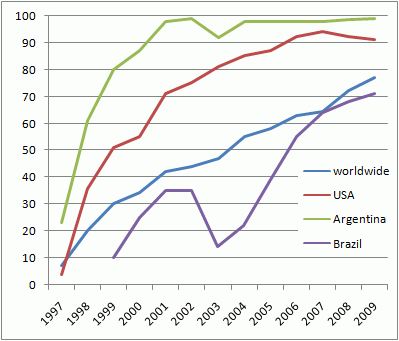
The United States is the world's top soybean producer (33 percent), with Brazil running a close second (27 percent), followed by Argentina (21 percent)4. As of 2007, more than half of the world's soybean crops (58.6 percent) were genetically engineered (GE).

GE soybeans contain a gene that confers herbicide resistance, engineered by Monsanto. "Roundup ready soy" is being cultivated on a massive scale across the globe, having devastating effects in many countries, such as Argentina, where people are being sickened daily by massive herbicide spraying. According to GMO Compass5, at one time, GE soybeans were not permitted in Brazil, but that isn't the case today. GE seed was smuggled in from neighboring countries and planted illegally.

Unfortunately, the GE soybean share has risen faster in Brazil over the past decade than in any other major soy-producing country, as you can see in the following graphic illustrating GE soybean share trends over time.

GE Soybean Share: From GMO-Compass

Strategies for Avoiding GE Foods

There are some measures you can take to make sure the foods you select are not genetically engineered. Soy is one of only nine common GE food crops, but their derivatives are in over 70 percent of supermarket foods, particularly processed foods. So, the more fresh, organic and local foods you eat, the less likely you'll be consuming GE ingredients. Also, look for the USDA Certified 100% Organic seal: This green or black seal assures the product is certified organic by the USDA, which means it contains at least 95 percent organic ingredients that are free of genetically engineered ingredients. 

URGENT ACTION NEEDED: Support California's Ballot Initiative to Label GMO's!


One of the best strategies for reducing or eliminating GE foods is to force food manufacturers to list them on the label. You have a right to know if the foods you're eating contain GE ingredients. As it stands now, there is no labeling law.

This November, we have a great opportunity to change that with California Ballot Initiative Prop 37, which would require labeling of all genetically engineered foods and food ingredients, and ban the routine industry practice of labeling and marketing such foods as "natural." Voting day is fast approaching — if you're going to act, the time is now!

They need funds and volunteers. Remember, since California is the 8th largest economy in the world, a win for Prop 37 would be a huge step forward, likely affecting ingredients and labeling nationwide. As the campaign says,

"As goes California, so goes the nation."
I urge you to support this bill in any way you can. Here are a few suggestions as to how you can help pass this important initiative:
  • Whether you live in California or not, please donate money to this historic effort, through the Organic Consumers Fund. If you live outside of the United States, you can still donate!  For International Donations, please call (218) 353-7651!
  • If you live in California and want to get involved, please contact CARightToKnow.org. They will go through all volunteer requests to put you into a position that is suitable for you, based on your stated interests and location.
  • No matter where you live, please help spread the word in your personal networks, on Facebook, and Twitter. For help with the messaging, please see CARightToKnow.org.
  • Talk to organic producers and stores and ask them to actively support the California Ballot. It may be the only chance we have to label genetically engineered foods.

Soy Is Destroying The World's Environment

Thursday, November 1, 2012

37 Lies & Dirty Tricks Brought To You By Monsanto


The Monsanto-Pepsi gang can't change the fact that 9 out of 10 people want to know if they're eating genetically modified organisms (GMOs). What they can do is try to trick California voters into believing that a simple label on their food is actually a nefarious plot to make consumers pay more for their food and make trial lawyers rich.

The corporations desperate to keep you in the dark about GMOS have tried nearly every trick in the book. Fake voter guides. Phony "scientists." Lies about newspaper endorsements. Illegal hijacking of government logos.

Here are 37 lies and dirty tricks brought to you by Monsanto and the No on 37 campaign:

#1 Fake Voter Guides - TRICK: It looks like a Democratic Party voter guide, with President Obama's photo on the front. But inside is an appeal to vote "No on 37." TRUTH: "The Ballot Guide" is a sham. The California Democratic Party has endorsed Prop 37!


#2 Illegal Use of the FDA Logo - TRICK: A No on 37 mailer contains the official seal of the U.S. Food and Drug Administration along with what appears to be a quote from the FDA opposing Prop 37. TRUTH: "The FDA has not made such statements with respect to Prop 37," FDA spokeswoman Morgan Liscinsky told KPBS. "We cannot speculate on Prop 37 and have no comments at this time."
Source:
'No On 37' Campaign Mailers 'Criminal'

#3 Use of Profits from Organic Brands to Fight your Right to Know - TRICK: Organic and natural brands appear to share your values, promoting family farms, sustainable agriculture and healthy and nutritious food. TRUTH: Many of your favorite organic and natural brands are owned by big food companies donating their profits to the No on 37 campaign, including Kraft, Kellogg, Coca-Cola, PepsiCo and General Mills.
Source: Brands Attack Consumers Right to GMO Labeling

#4 Scientists for Hire - TRICK: University of California at Davis professors oppose labeling GMOs because they understand the science of genetic engineering, they know its benefits, and they're confident that GMOs are safe. TRUTH: UC Davis professors oppose labeling because they are financial beneficiaries of the same pesticide companies that are funding the No on 37 campaign.
Source: "Experts" are Shills for Big Biotech

#5 Scientists as Sock Puppets - TRICK: An anti-Prop 37 op-ed is authored by Kent J. Bradford, a professor of plant sciences at the University of California, Davis, and the director of the Seed Biotechnology Center. TRUTH: The words Bradford uses to describe Prop 37 are taken verbatim from the No on 37 website. The Daily Democrat and The Reporter (Vacaville) published Monsanto's talking points disguised as legitimate opinion from a university professor of plant biology.
Source: Did Monsanto Write This Op-Ed?

#6 Scientists with Hidden Strings - TRICK: Martina Newell-McGloughlin, D.Sc., is the director of the International Biotechnology Program and an Adjunct Professor of Plant Pathology at the University of California, Davis. When she acts as a proponent for genetic engineering, as she did recently on the Dr. Oz Show, she presents herself as an independent academic scientist. TRUTH: Martina Newell-McGloughlin's work is funded by the same pesticide company that backs the No on 37 campaign, but the strings that attach her to Monsanto are rarely reported along with her pro-GMO views.
Source: Seeds of Doubt

#7 Lies about the Academy of Nutrition and Dietetics - TRICK: The "Argument Against Proposition 37" in California's Official Voter Information Guide states that the Academy "has concluded that biotech foods are safe." TRUTH: That statement is false. "We are concerned that California's voters are being misled to believe the nation's largest organization of food and nutrition professionals is against Proposition 37, when in fact, the Academy does not have a position on the issue," said registered dietitian Ethan A. Bergman, president of the Academy of Nutrition and Dietetics. "Voters need accurate information in order to make an informed choice."
Source: Academy of Nutrition and Dietetics

#8 Lies about Newspaper Endorsements - TRICK: In an anti-Prop-37 TV ad, the San Francisco Examiner is featured prominently as having editorialized against Prop 37. TRUTH: The San Francisco Examiner has endorsed Prop 37.
Source: No on 37 Ad Yanked

#9 Lies about Stanford University Affiliation - TRICK: A No on 37 TV ad features an academic, identified on screen as "Dr. Henry I. Miller M.D., Standford University." TRUTH: Miller is not a Stanford professor, but rather a research fellow at the Hoover Institution, a conservative think tank housed on the Stanford campus.
Source: TV Ad Is Pulled

#10 Lies about Farmer Support - TRICK: No on 37 spokesperson Kathy Fairbanks claims the "entire agricultural community of California" is opposing Prop 37. TRUTH: More than 2,000 farmers, including some GMO farmers, as well as the California Grange, the Central Coast Agricultural Network, the United Farm Workers, California Labor Federation and United Food and Commercial Workers western region all support Prop 37.
Source: No On 37 Lies Again

#11 Fake Yes on 37 Supporters Spreading No on 37 Lies - TRICK: The California Right to Know Facebook page often gets posts from people who "Like" it that begin with a statement of support for Prop 37 but end with lies straight from the No on 37 disinformation handbook. TRUTH: Employees of the pesticide and junk food companies fighting our right to know,  including Frito Lay, are trolling our pages. (No on 37 has to hang out on our page because California Right to Know has literally 100,000 more Likes than they do!)
Source: https://www.facebook.com/carighttoknow

#12 Lies about GMOs' Safety - TRICK: GMO's are "perfectly safe." TRUTH: No one's vouching for the safety of genetically engineered foods. This summer, the American Medical Association passed a new resolution calling for mandatory pre-market safety testing of GMOs. The GMO foods that are currently being consumed in the US not only aren't labeled, they have never been safety tested by independent parties.
Source: GMOs Should Be Safety Tested Says AMA

#13 Lies about the National Academy of Science - TRICK: The National Academy of Sciences says GMOs are safe and there's no reason to label them. TRUTH: The NAS study referenced by the Monsanto-Pepsi gang is the 1987 report, Introduction of Recombinant DNA-Engineered Organisms into the Environment. The 1987 NAS report doesn't address the issue of GMO labels and doesn't claim to present evidence that GMOs are safe for human consumption. GMO foods didn't exist in 1987, so they couldn't have been safety tested then. The NAS only argued that GMOs shouldn't be treated differently from normal organisms. The fact that government regulators followed the NAS approach and failed to treat GMO foods with any more precaution than normal foods is not evidence that they are safe or shouldn't be labeled.
Source: Introduction of Recombinant DNA-Engineered Organisms into...

#14 Lies about the World Health Organization - TRICK: The World Health Organization says GMOs are safe and there's no reason to label them. TRUTH: WHO recognizes "the need to examine the potential negative effects on human health of the consumption of food produced through genetic modification" and that "consumer concerns have triggered a discussion on the desirability of labeling GM foods, allowing an informed choice."
Source: The World Health Organization

#15 Lies About Pesticides - TRICK: Genetically engineered crops reduce pesticide use. TRUTH: Genetically engineered crops have actually increased pesticide use, especially the use of Monsanto's herbicide RoundUp. 527 million additional pounds of RoundUp were used on genetically engineered crops between 1996 and 2011.
Source: Modified Crops Increase Herbicide Use

#16 Lies about Disease Resistance - TRICK: Genetically engineered crops are more resistant to disease. TRUTH: Recently, scientists have identified new outbreaks of blight, rust, and other fungal infections in Monsanto's genetically engineered RoundUp Ready crops.
Source: Dangers of Genetically Engineered Food

#17 Lies about a Ban on GMOs - TRICK: Prop 37 bans genetically engineered foods unless they're specially re-labeled or remade with higher-cost ingredients. TRUTH: Prop 37 wouldn't ban anything, it would just let us know what we're eating and allow us to make an informed choice about GMOs. Prop 37 doesn't confer any regulatory authority that could be used to ban GMOs under any circumstances.
Source:
A Label, Not a Ban

#18 Lies about Zero Tolerance - TRICK: Prop 37 has a zero-tolerance for accidental GMO content in foods that aren't labeled as containing GMOs. Such a policy would force producers of essentially non-GMO products to use the label "may contain GMOs," simply out of fear of litigation. TRUTH: Prop 37 exempts foods that do not intentionally contain GMOs.
Source:
Incorrect Reports

#19 Lies about Frozen Pizza vs. Delivery Pizza - TRICK: Why would a frozen pizza from the grocery store with genetically engineered ingredients be labeled GMO, while a pizza with the same ingredients delivered from a restaurant wouldn't? TRUTH: Frozen pizza from the grocery store has an ingredients label on it. Pizza delivered from a restaurant does not. Prop 37 can add GMOs to a label, but it can't add a label to food that doesn't already have one.
Source: Opponents Have Holes in their Loopholes

#20 Lies about Fruit Juice vs. Alcohol - TRICK: Why would fruit juice with genetically engineered ingredients be labeled GMO, while alcohol with the same ingredients wouldn't? TRUTH: Fruit juice has an ingredients label, alcohol doesn't. Prop 37 is just about adding GMOs to the label, not adding labels to products that don't already have them.
Source: Opponents Have Holes in their Loopholes

#21 Lies about Soy Milk vs. Cow's Milk - TRICK: Dairy products, eggs, meat and poultry are all exempt. TRUTH: No, they're not. All dairy products, eggs, meat, poultry, and fish, for that matter, will be labeled under Prop 37, if and when genetically engineered animals are sold for human consumption.
Source: The Truth About Exemptions

#22 Lies about Dog Food vs. Steak - TRICK: Dog food with beef would be labeled, but beef wouldn't. TRUTH: Cows haven't been genetically engineered yet. If and when they are, GMO beef and dairy will be labeled under Prop 37. "Dog food with beef" contains other ingredients (vegetable oils, for instance) that might be genetically engineered and therefore might be labeled.
Source:
Vote Yes on Prop 37

#23 Lies About Animals Fed GMOs - TRICK: I'd support Prop 37's labels on GMO fruits, vegetables, animals and ingredients  -  if it covered animals raised on genetically engineered feed. TRUTH: The Monsanto-Pepsi gang isn't opposed to Prop 37 because it doesn't go far enough. The fact is, no labeling law in the world covers animals raised on genetically engineered feed. Prop 37 is designed to be compatible with the laws of our 61 trading partners who already label genetically engineered food, because most US farmers and food processors are already aware of and complying with those laws abroad.
Source:
Opponents Have Holes in their Loopholes

#24 Lies about Special Interest Exemptions - TRICK: Prop 37 is funded by the organic industry and it looks like they've exempted themselves from the law. Why would organic be exempt, while producers of conventional food have to label GMOs? TRUTH: Organic food is verified by a USDA accredited certifier to be made without the use of genetic engineering. The organic law is actually much stricter than Prop 37 because it requires third-party certification.
Source: The Truth About Exemptions

#25 Lies about Costs to Consumers - TRICK: GMO labels will result in increased food costs for needy families. An average family's annual grocery bill would increase by $400. TRUTH: 61 other countries label genetically engineered food and there isn't a single real-world example of increased food costs. Likewise, food prices didn't go up in the US when information about allergens  - or any other piece of information - was added to labels. What makes the Monsanto-Pepsi gang's grocery bill trick so dirty is that the $400 figure they cite is actually their estimate of the cost of companies switching from GMO to organic to avoid labels,  not the cost of GMO labels themselves.
Source:
Anti-Prop 37 Ad Misleads

#26 Lies about Costs to Farmers and Processors - TRICK: UC Davis Professors of agricultural economics released a report that showed Proposition 37 would increase costs for California farmers and food processors by $1.2 billion. TRUTH: The No campaign paid the authors of this study, Julian Alston and Daniel Sumner, at least $30,000. The study assumes that farmers and food producers will respond to Proposition 37 by switching from genetically engineering to organic to avoid the labeling. The authors don't devote much attention to the possibility that producers will respond to the labeling mandate by simply relabeling.
Source: Perils of the Initiative Process

#27 Lies about Costs to Taxpayers - TRICK: Prop. 37 "would cost California taxpayers millions for more bureaucracy and red tape." TRUTH: This nonpartisan Legislative Analyst's Office's estimates the annual cost of enforcement as "a few hundred thousand dollars to $1 million."
Source: The Truth About Cost

#28 Lies about "Natural" Claims - TRICK: Based on an analysis by Peggy Lemaux, part of the Monsanto-Pepsi gang, NPR's Eliza Barclay wrote an article claiming Prop 37 would stop producers of any processed food from using the term "natural." TRUTH: Only processed food containing GMOs will be blocked from carrying "natural" claims under Prop 37. The Center for Environmental Health pointed this out to Barclay and she corrected her report.
Source:
GMO Food Labeling Lies

#29 Lies about Prop 65 - TRICK: Prop 37 is just like Prop 65. TRUTH: Proposition 65 granted private attorneys a share of fines and penalties exacted from violators, making it more of a bounty system. Proposition 37 doesn't do that. Private attorneys can sue only to obtain injunctions, not penalties.
Source:
Perils of the Initiative Process

#30 Lies about Damages - TRICK: The independent, nonpartisan Legislative Analyst says that Proposition 37 would allow trial lawyers "to sue without needing to demonstrate that any specific damage occurred as a result of the alleged violation." TRUTH: Say you buy a box of cereal whose main ingredient is corn. It's not labeled GMO, but you get it tested and find that it has levels of GMO above what could result from unintentional contamination. You bring a lawsuit under Prop 37. You might be right that the processor intentionally used genetically engineered ingredients without labeling them, but what's your "damage"? If you suffered no harm, there aren't any damages that can be recognized under the law, except maybe what you paid for the cereal. If Prop 37 required a demonstration of damages before a violation of the law could be rectified, GMO labels couldn't be enforced. The advantage to this system is that the only incentive to sue will be to enforce the law, not to win money damages.
Source: The Truth About Lawsuits

#31 Lies about Trial Lawyers - TRICK: Prop 37 was written by trial lawyers for trial lawyers. TRUTH: The California Right to Know campaign began with the efforts of Pamm Larry, a former midwife, farmer and longtime Chico resident. In 2011, Pamm started organizing mothers and volunteers across the state toward a 2012 ballot drive with only one goal in mind: to let California consumers know if the food they are eating is genetically engineered. With the help of thousands of volunteers, the Right to Know campaign gathered nearly one million signatures from California voters within a 10 week period.
Source: The Truth About Lawsuits

#32 Lies about Grocers - TRICK: Prop 37 is "a nightmare scenario for grocers" and retailers because they have to obtain and keep "reams of paperwork." TRUTH: Retailers would only have to label the few raw commodities (sweet corn, papaya, squash) that are genetically engineered - if they were buying them directly from farmers, as opposed to a packer who would have responsibility for labeling. They can either stick a simple label on the bin or, if they wish, they can ask their farmer supplier for a sworn statement that the crop is not genetically engineered.
Source: The Truth About Lawsuits

#33 Lies about Lawsuits - TRICK: Prop 37 will lead to a bonanza of lawsuits. TRUTH: Lawsuits are expressly forbidden unless the potential defendant is given a chance to put the labels on. If the defendant labels the product, no lawsuit. Second, the law protects anyone for whom a claimed violation was not intentional or resulted from an error.
Source: The Truth About Lawsuits

#34 Lies about Lawsuits Against Farmers - TRICK: Farmers will get sued. TRUTH: If they're selling direct to customers, farmers need to label their genetically engineered produce. If they're selling into the supply chain, all farmers have to do is provide sworn statements as to whether or not their crops are genetically engineered (if the crops are typically GMO). Genetically engineered seeds are patented, they can only be used under contract and must be purchased each year, so farmers definitely know whether they're growing GMOs. Monsanto's the only one suing farmers.
Source:
The Truth About Lawsuits

#35 Lies about a Corporate Agenda - TRICK: In California, there is nothing on the ballot that doesn't serve some corporate agenda. TRUTH: Look at the list of donors for and against Prop 37. Will you stand with the natural health advocates and organic consumers, farmers and retailers who support your right to know, or the biggest pesticide and junk food companies in the world who want to hide the GMOs you're eating?
Source: Prop 37 Funders

#36 Lies about Foreign Corporations - TRICK: Foods imported from foreign countries are exempt if sellers simply declare that their products are "GE-free." TRUTH: There are no special provisions related to imported food.
Source: Read the Initiative

#37 Lies about Consumer Choice - TRICK: Mandatory GMO labels are unnecessary because food that is certified organic or non-GMO verified is labeled for consumers who choose to avoid GMOs. TRUTH: Only a small fraction of the public is aware of GMOs in their food. In fact 74% of the public is ignorant of the fact that they're already eating GMOs. It isn't fair to keep consumers in the dark. We deserve the right to know what we're eating! California, vote Yes on 37!

Grandma's House

A Farmer's Perspective On Prop 37

Vote YES On 37

Diet Agent Orange Fluoride Soda (Parody)

Tuesday, October 30, 2012

Why Peppers Should Be Concerned About GMO

Gaye Levy, Contributor
Activist Post

With all of the publicity given to the California ballot initiative on GMO labeling, I have seen little if nothing mentioned about an initiative in my little community that would ban GMO crops within the boundaries of our island county.

And the truth is, while there are few places in the world that could remain effectively GMO-free, the San Juan Islands in Washington State is one of them.

If passed in November, an initiative measure in our county will prohibit the cultivation of crops, livestock and other organisms that have had genes intentionally modified in a way that did not occur by mating or natural recombination. We would essentially become a safe zone for non-GMO crops, which in turn will preserve our ability to grow and control our food supply for years to come.

So why is this important and why is this being shared on a website that promotes prepping? I will get to that, but first a simplistic and easy to understand primer on GMOs.

A Brief Primer on GMOs

There are a lot of issues surrounding GMOs. Alas, many people recognize that they are “bad” but have not taken the time to learn why. Or perhaps they have taken the time but have had their eyes glaze over when faced with technical terminology or activist falderal.


Let me make things simple with a very brief explanation of what GMO’s are all about.

GMOs are organisms that have been created through through the gene-splicing techniques of biotechnology, allowing DNA from one species to be injected into another species. By taking the genetic material from one organism and inserting it into the permanent genetic code of another, numerous weird and obscene creations, such as potatoes with bacteria genes, “super” pigs with human growth genes, fish with cattle genes, and tomatoes with flounder genes have been created.

And that is just the tip of the iceberg.

These same creations are often bred with genes that not only allow them to tolerate weed killers but to also generate their own insecticides. These in turn are released into our environment, affecting our farmlands as well as our food supply.

Did I happen to mention our health and the health of animals as well?

Examples of genetically modified crops, which have been commercially planted since 1996, include soy, corn, cotton, canola, sugar beets, alfalfa, papaya, summer squash, potato, tomatoes and sweet peppers.

In addition, a genetically modified grass has recently been approved and the approval of genetically modified apples and salmon are pending.

With their ties to major corporations and the almighty dollar, the USDA, FDA and EPA are planning to fast track further approvals of GM crops, cutting the approval time down to just 18 months. GMOs, if you have not figured it out, are big business and a money scam pure and simple and for whatever reason, an alphabet soup of US agencies are in on it.

This is all happening in spite of a growing body of research indicating that GMO food products have adverse effects upon animal and human health. Scientists as well as whistleblowers within the GMO industry itself have produced evidence that GMOs are more toxic, allergenic and less nutritious than their natural counterparts. For a real eye-opening experience, take a look at the movie Genetic Roulette (available free online until October 31st and possibly longer). You will be sickened by what you see.

Why are preppers concerned about GMO crops?

Of course the problem, as it exists in most communities, including my own, is that contamination of traditional crops by genetically modified crops is generally acknowledged to be unavoidable since cross-contamination from nearby genetically modified crops can not be controlled. And so therein lies the need for entire communities to be GMO-Free, thus mitigating the effects of crop and seed cross pollination and contamination.

Do not underestimate this contamination issue because it presents a huge dilemma to those who prefer or who must grow their own food. Preppers, that group of motivated individuals seeking self-reliance and independence from big business and government controls, want to grow their food from heirloom type seeds that reproduce faithfully from one year to the next, thus ensuring a steady stream of reliable seeds that can be harvested and planted in subsequent years.

Most preppers, myself included, cook their own food, bake their own bread, concoct their own DIY cleaning supplies and know how to build and fix things themselves. Added to that list is the growing of food – fruits and vegetables – in a sustainable and productive manner.

For all of us, it is important that we control the food that is produced in our gardens. We want our seeds to be viable and to reproduce themselves as nature intended. After all, we recognize that the time may come when our gardens become out a major source of sustenance. And that, over and above everything, is our concern.

Do we want fish or antibiotic-laden tomatoes in our gardens. No. Do we want plants that create a chemical pesticide and then spread that toxin to other plants and perhaps to ourselves? No.

As far as I can tell, the only way to eliminate these issues is to grow non-GMO crops and to prevent our neighbors crops from contaminating our own gardens and fields. Which gets me to where I started at the beginning of this article; this is what we are attempting to do in my community.

The Final Word

There are those that will say that prohibiting and policing the growing of GMO crops is impossible. And yes, that may be true on a global scale. But still, as with our prepping activities, each step we take as individuals to stop GMOs becomes an important one.

Whether enforceable or not, I hope the rest of the world will keep their eyes on my little community at election time. In some small way, if we do become GMO free, we may help change the worl