Showing posts with label GMO. Show all posts

Sunday, July 21, 2013

GMO Lawsuit Settles For $750M

ST. LOUIS • Bayer CropScience agreed here late Friday to pay up to $750 million to farmers in Missouri and four other states to settle lawsuits over contamination of the U.S. rice supply by LibertyLink genetically modified rice in 2006.

"It was a devastating blow to a lot of rice farmers, and I'm tickled to death that we've finally reached a settlement where Bayer for the first time has offered to make it right to these farmers," said St. Louis lawyer Don Downing, who was co-lead counsel for the plaintiffs.
"I think it sends a signal to those who develop genetically modified seeds that they need to keep those seeds very carefully contained until they're approved for human consumption," Downing said.

But, he added, "We were very careful all along … not to say that these lawsuits are anti-GMO (genetically-modified organisms) because many of our farmers use GM crops."

Bayer, based in Germany, released a statement that read, in part, "Although Bayer CropScience believes it acted responsibly in the handling of its biotech rice, the company considers it important to resolve the litigation so that it can move forward focused on its fundamental mission of providing innovative solutions to modern agriculture."
When it was discovered in the rice supply, LibertyLink had not yet been approved for sale for human consumption. Rice futures plunged, and Japan and European countries banned the import of U.S. rice.

The first of what would eventually grow to more than 400 lawsuits representing 11,000 plaintiffs were filed within weeks. Many were eventually consolidated in federal court here.

LibertyLink rice has since been approved but has not been commercially marketed.
LibertyLink corn, soybeans and canola are on the market, Bayer spokesman Greg Coffey said.
All farmers in Missouri, Arkansas, Texas, Louisiana and Mississippi who planted long grain rice in 2006-10 — not just those who sued in state or federal court — can participate in the settlement, said Downing and co-lead counsel Adam J. Levitt. It also includes landowners who allow others to farm their land, but does not include importers, exporters, rice mills and others.

Under terms of the settlement, farmers who planted at least 85 percent of the roughly 2.2 million acres of rice during those years must sign up or Bayer can walk away from the deal.
Bayer said it has already "established appropriate provisions" for the settlement.

The settlement is broken down into three "pots" of money. The first, and the easiest to get, offers $310 an acre to compensate farmers for market losses and is available to those who had long grain rice planted in 2006-10, with lesser amounts for farmers who only planted in some of those years.

The second pot is for farmers who planted either of two rice varieties in 2006, Clearfield 131 or Cheniere, that were most affected by the contamination. Many of those farmers had to leave fields fallow, plant lower-value crops or spend money cleaning equipment of contaminated rice, plaintiffs' lawyers said. Farmers will have to show receipts documenting their planting of those varieties.

The third pot is for those who feel that they lost more, and requires more documentation, lawyers said.

Friday's settlement comes after a series of so-called "bellwether" trials set up to allow representative cases to proceed to trial and to give all sides a signal of what could come in pending cases.

Asked about compensation, Levitt said that lawyers had private fee agreements with the clients who sued. A "leadership team" of lawyers like Levitt and Downing and others who took on additional duties and expenses will receive additional money, he said.

In December 2009, a federal jury in St. Louis awarded $2 million to farmers. A different jury awarded $1.5 million in February 2010. Neither of those juries awarded punitive damages.
Last July, a federal jury in St. Louis awarded a Louisiana farmer, Denny Deshotels, $500,000 in one suit. Jurors were not given the option of punitive damages because of Louisiana law.

Two other bellwether cases settled, one a week into the trial and one the week before, Downing said.

In three state trials in Arkansas, jurors also found in favor of farmers, awarding $1 million in one trial, roughly $1 million or less in another and $6 million in actual damages and $42 million in punitive damages in the third, Downing said..

At trial, company lawyers argued that farmers who waited out the brief price hit suffered no losses and that Bayer was not negligent.

Friday's settlement had not yet been filed in federal court in St. Louis, but plaintiffs' lawyers announced the deal at 4:35 p.m. and Bayer released its own statement a short time later.
Asked to explain the timing of the settlement, Levitt declined to comment.

Coffey said, "We did release (the announcement) as soon as we could," noting it was shortly after the agreement was signed.

Downing would only say: "I can't tell you why it ended up late in the afternoon on a holiday weekend. You can perhaps speculate about that yourself."

Tuesday, May 21, 2013

The Reality Of Chemical Terrorism In our Food

Flickr - Nutrition - USDAgov
Marco Torres, Prevent Disease
Waking Times

Is it really that hard for most people to believe that we are being assaulted on a daily basis by chemical terrorism?

Genetically modified foods, artificial flavours, colors, preservatives, emulsifiers, and sweeteners all made with toxic chemicals, all of which are proven toxic to human health. We are being bombarded on a daily basis by an astronomical level of toxicity, all controlled by these chemical terrorists on behalf of the food industry. Worse is we let them.

How many more toxins will we permit in our food supply before we stand united and simply say “we’ve had enough?” How long will it take until we assertively proclaim that we will not allow any more chemicals or toxins in our foods?

Since food and health regulators cannot properly do their job to protect the public, there will come a tipping point when the people will have to do it for them. We discuss toxic chemicals almost every day, but what percentage of the population is interested enough, curious enough or most of all disciplined enough to actually make the dietary changes necessary to rid all the toxins from the foods they eat?

 How many people can avoid all processed foods every single day? I would estimate that percentage to be extremely small. Barriers are typically societal pressure, convenience and income. The reality is that we could all have a safe and healthy food industry if we truly wanted it. There are just not enough of us that want it that badly….yet.

Every year or two we have a new chemical terrorist making its way into the food supply almost like clock work. Once the public becomes savvy to the harmful nature of the new toxin, it is then renamed, rebranded and often modified into a deadlier form than its predecessor. Aspartame and aminosweet, and high fructose corn syrup and corn sugar are two excellent examples.
Let’s take a look at some of the biggest offenders that are in more than 80% of the foods we eat.


Artificial Flavors and Colors
Artificial flavors and colors means it is derived from a chemical made in a laboratory and has no nutritional value. Every single artificial flavor and color in the food industry has some kind of detrimental health effect. These include neurotoxicity, organ, developmental, reproductive toxicity and cancer.

* Examples

- Glutamates
Monosodium Glutamate (MSG)
- Maltodextrin
- Autolyzed Yeast Extract
- Disodium Guanylate
- Disodium Inosinate
- Blue 1, Blue 2
- Yellow 5, Yellow 6
- Red 3, Red 40

Genetically Modified Foods
GM Foods causes allergies, organ damage, cancer, immunotoxicty, and damaging transgenes which affect future generations. Many fruits and vegetables for sale in the U.S. are already genetically modified. The most commercialized GM fruit is papaya from HawaiiĆ¢€”about half of Hawaii’s papayas are GM.

* Examples
- Corn flour, meal, oil, starch, gluten, and syrup
- Corn Sweeteners such as fructose, dextrose, and glucose
- Modified food starch
- Soy flour, lecithin, protein, isolate, and isoflavone
- Most vegetable oils and vegetable proteins
- Canola oil (also called rapeseed oil)
- Cottonseed oil
- Anything not listed as 100% cane sugar

Toxic Preservatives 
Artificial preservatives are responsible for causing a host of health problems pertaining to respiratory tract, heart, blood and other. Some are very neurotoxic especially when combined with specific nutrients.

* Examples

- Antimicrobials
- Nitrites (i.e. Sodium Nitrite)
- Nitrates (i.e. Sodium Nitrate)
- Butylated hydroxyanisole (BHA)
- Butylated hydroxytoluene (BHT)
- Sulfites (i.e. Sodium Sulfite)
- Potassium Sorbate
- Benzoic Acid
- Propyl Gallate
- Sodium Benzoate

Toxic Emulsifiers 
An emulsifier replaces surface proteins and aids in forming the network in specific food recipes. There are no healthy non-organic emulsifiers. They are all toxic causing everything from infertility, digestive disorders and migraines.

* Examples 
- Polysorbate 80
- Mono-diglycerides
- Carrageenan
- Xanthan Gum (non-organic)
- Guar Gum
Soy Lecithin or Soya Lecithin

Toxic Sweeteners
Sweeteners such as Neotame are thousands of times sweeter than sugar. They are all very potent, neurotoxic, immunotoxic and excitotoxic.

* Examples
Aspartame
High Fructose Corn Syrup
Neotame
Sucralose
Sodium cyclamate
- Acesulfame-K

Toxic Adulterants 
Food fraud and economically motivated food adulteration is highlighted by some very toxic substances which cause cancer, glaucoma, digestive and liver disorders. These are added to foods to increase their color, volume or weight.

* Examples

- Metanil Yellow
- Potassium bromate
- Malachite Green
- Tamarind seeds
- Washing powder
- Argemone seeds

This list is by no means extensive. There are now hundreds of toxic additives in our food supply. Chemical terrorism in our food supply must end and it starts with you.

Please look at the ingredient lists before you purchase any processed foods. If you see any of these, don’t buy the product. Continue to educate yourself on the influx of new toxins introduced every year. Eventually, if we investigate enough the answers come. Rule of thumb, if the ingredient list has one chemical or more…it’s one too many.
About the Author
Marco Torres is a research specialist, writer and consumer advocate for healthy lifestyles. He holds degrees in Public Health and Environmental Science and is a professional speaker on topics such as disease prevention, environmental toxins and health policy.

Friday, May 17, 2013

New Study Shows GMO Causes Leukemia


Last September, the causal link between cancer and genetically modified food was confirmed in a French study, the first independent long-term animal feeding study not commissioned by the biotech corporations themselves. The disturbing details can be found here: New Study Finds GM Corn and Roundup Causes Cancer In Rats

Now, a new study published in the Journal of Hematology & Thromboembolic Diseases indicates that the biopesticides engineered into GM crops known as Bacillus Thuringensis (Bt) or Cry-toxins, may also contribute to blood abnormalities from anemia to hematological malignancies (blood cancers) such as leukemia.[i]

A group of scientists from the Department of Genetics and Morphology, Institute of Biological Sciences, University of Brasilia, Brasilia/DF, Brazil set out to test the purported human and environmental biosafety of GM crops, looking particularly at the role that the Bt toxin found within virtually all GM food crops plays on non-target or non-insect animal species.

The research was spurred by the Brazilian Collegiate Board of Directors of the National Sanitary Surveillance Agency (ANVISA), who advocated in 2005 for evaluations of toxicity and pathogenicity of microbiological control agents such as Bt toxins, given that little is known about their toxicological potential in non-target organisms, including humans.

While Bacillus Thurigensis spore-crystals have been used since the late 1960's in agriculture as a foliar insecticide, it was only after the advent of recombinant DNA biotechnology that these toxin-producing genes (known as delta endotoxins) were first inserted into the plants themselves and released into commercial production in the mid-90's, making their presence in the US food supply and the bodies of exposed populations ubiquitous.

What the new study revealed is that various binary combinations and doses of Bt toxins are capable of targeting mammalian cells, particularly the erythroid (red blood cell) lineage, resulting in red blood cell changes indicative of significant damage, such as anemia. In addition, the study found that Bt toxins suppressed bone marrow proliferation creating abnormal lymphocyte patterns consistent with some types of leukemia.   

EPA Approves HIGHER Levels Of Monsanto's Roundup Glyphosate

When does one plus one not equal two? When mounting evidence says glyphosate, the key ingredient in Monsanto’s Roundup pesticide, does more damage to our health and environment than we thought. And the U.S. Environmental Protection Agency (EPA) responds by approving higher, not lower, allowable limits of the pesticide residue.

Please sign the letter below. Tell the EPA you want lower, not higher, limits on Monsanto’s glyphosate and Roundup!

This month (May 2013) the EPA announced a final ruling to increase, yet again, the allowed residue limits in food and animal feed of glyphosate, the key active ingredient in Monsanto’s Roundup herbicide. Under the ruling, the allowed glyphosate level in animal feed will rise to 100 parts per million (ppm) and 40 ppm in oilseed crops.

There is precedence for final rulings to be revisited, even reversed, if enough people voice their opposition. The EPA will take comments on the ruling until July 1, 2013.

The EPA ruling defies sound science and undermines public health. Peer reviewed studies show rats fed diets as low as 2ppm of glyphosate were 70 percent to 80 percent more likely to develop tumors. Infertility, affecting both the sperm and the egg, was documented in animals subjected to glyphosate residue levels as low as .05 ppm. Birth defects in frog and chicken embryos resulted after being subjected to glyphosate residues of just 2.03 ppm.

Yet the EPA claims glyphosate is only “minimally toxic” to humans, and 40 ppm is nothing to worry about?

The EPA’s decision is all the more unjustifiable in light of two recently published, peer reviewed studies revealing glyphosate to be a far greater threat to human health than previously determined.

According to a study published in the journal Entropy in April 2013, glyphosate is related to debilitating diseases like gastrointestinal disorders, diabetes, heart disease, obesity, autism, Parkinson’s and Alzheimer’s. The study says the negative impact on the human body is “insidious and manifests slowly over time, as inflammation damages cellular systems throughout the body… it may in fact be the most biologically disruptive chemical in our environment.”

A 2012 study published in the journal Archives of Toxicology showed Roundup is toxic to human DNA even when diluted to concentrations 450-fold lower than used in agricultural applications. Industry regulators and long-term studies look at glyphosate in isolation, instead of looking at Roundup’s full formulation, which includes secret added ingredients. These “confidential” and unlabeled ingredients, when measured as a whole, affect all living cells, including human cells.

Glyphosate is the most widely used herbicide in the world. According to the EPA, at least 208 million tons of Roundup were sprayed on GE crops, lawns and roadsides in the years 2006 and 2007. In 2007, as much as 185 million pounds of glyphosate was used by U.S. farmers, double the amount used just six years ago.

A 2009 study found that Americans use about 100 million pounds of glyphosate annually on their lawns and gardens. It’s safe to assume all these number are much higher now. Why? Because GE crops are now being invaded by new strains of herbicide-resistant “superweeds” requiring higher and higher doses of poison.

Beyond Pesticides has assembled extensive documentation of past research linking glyphosate to increased cancer risk, neurotoxicity and birth defects, as well as eye, skin, respiratory irritation, lung congestion, increased breathing rate, damage to the pancreas, kidney and testes.

Glyphosate also endangers the environment, destroys soil and plants, and is linked to a host of health hazards. The EPA’s decision to increase the allowed residue limits of glyphosate is out of date, dangerous to the health of people and the environment and scientifically unsupportable.

Please sign the letter below. Tell the EPA you want lower, not higher, limits on Monsanto’s glyphosate and Roundup! I am very concerned about the increase in glyphosate residue limits proposed for food and commodity crops. Mounting evidence points to the need to lower, not raise, the allowable limits of glyphosate residue.

Peer reviewed studies show rats fed diets as low as 2ppm of glyphosate were 70 percent to 80 percent more likely to develop tumors. Infertility, affecting both the sperm and the egg, was documented in animals subjected to glyphosate residue levels as low as .05 ppm. Birth defects in frog and chicken embryos resulted after being subjected to glyphosate residues of just 2.03 ppm.

One recent study, http://www.mdpi.com/1099-4300/15/4/1416 published in the journal Entropy in April 2013, revealed glyphosate to be a far greater threat to human health than previously determined. According to the study, glyphosate is related to debilitating diseases like gastrointestinal disorders, diabetes, heart disease, obesity, autism, Parkinson’s and Alzheimer’s. The study says the negative impact on the human body is “insidious and manifests slowly over time, as inflammation damages cellular systems throughout the body… it may in fact be the most biologically disruptive chemical in our environment.”

The EPA’s science on glyphosate is outdated. I urge you to do a complete review of the toxicity of glyphosate and adjust the tolerance levels allowed in the U.S. feed and food supply downward, not upward. Thank you.

Genetically Modified Democracy: Monsanto and Congress Move to Stomp on States' Rights


Reliable sources in Washington D.C. have informed the Organic Consumers Association (OCA) that Monsanto has begun secretly lobbying its Congressional allies to attach one or more “Monsanto Riders” or amendments to the 2013 Farm Bill that would preempt or prohibit states from requiring labels on genetically engineered (GE) foods.

In response to this blatant violation of states’ rights to legislate, and consumers’ right to know, the OCA and a nationwide alliance have launched a petition to put every member of Congress on notice: If you support any Farm Bill amendment that would nullify states’ rights to label genetically modified organisms (GMOs), we’ll vote – or throw – you out of office.

On Wednesday, May 15, an amendment to the House version of the Farm Bill, inserted under the guise of protecting interstate commerce, passed out of the House Agricultural Committee. If the King Amendment makes it into the final Farm Bill, it would take away states’ rights to pass laws governing the production or manufacture of any agricultural product, including food and animals raised for food, that is involved in interstate commerce. The amendment was proposed by Rep. Steve King (R-Iowa), largely in response to a California law stating that by 2015, California will allow only eggs to be sold from hens housed in cages specified by California.  But policy analysts emphasize that the amendment, broadly and ambiguously written, could be used to prohibit or preempt any state GMO labeling or food safety law.

Will the King Amendment survive the Senate? No one can be sure, say analysts. However few doubt that Monsanto will give up. We can expect that more amendments and riders will be introduced into the Farm Bill--even if the King Amendment fails—over the next month in an attempt to stop the wave of state GMO labeling laws and initiatives moving forward in states like Washington, Vermont, Maine, Connecticut and others.

Monsanto and the Grocery Manufacturers Association (GMA) have admitted privately that they’ve “lost the battle” to stop GE food labeling at the state level, now that states are aggressively moving forward on labeling laws. On May 14, Maine’s House Ag Committee passed a GMO labeling law. On May 10, the Vermont House passed a labeling bill, 99-42, despite massive lobbying by Monsanto and threats to sue the state. And though Monsanto won a razor-thin victory (51 percent to 49 percent) in a costly, hard fought California GMO labeling ballot initiative last November, biotech and Big Food now realize that Washington State voters will likely pass I-522, an upcoming ballot initiative to label GE foods, on November 5.
  
If Monsanto can’t stop states from passing laws, then the next step is a national preemptive measure.  And all signs point to just such a power grab.  Earlier this year, Monsanto slipped its extremely unpopular “Monsanto Protection Act,” an act that gives biotech immunity from federal prosecution for planting illegally approved GE crops, into the 2013 Federal Appropriations Bill.  During the June 2012 Farm Bill debate, 73 U.S. Senators voted against the right of states to pass mandatory GE food labeling laws. Emboldened by these votes, and now the House Ag Committee’s vote on the King Amendment, Monsanto has every reason to believe Congress would support a potential nullification of states’ rights to label.

The million-strong OCA and its allies in the organic and natural health movement are warning incumbent Senators and House members, Democrats and Republicans alike, that thousands of health and environmental-minded constituents in their Congressional districts or states will work to recall them or drive them out of office if they fail to heed the will of the people and to respect the time-honored traditions of shared state sovereignty over food labels, food safety laws, and consumers’ right to know.

Trouble in Monsanto Nation.
Over the past 20 years Monsanto and the biotech industry, aided and abetted by indentured politicians and corporate agribusiness, have begun seizing control over the global food and farming system, including the legislative, patent, trade, judicial and regulatory bodies that are supposed to safeguard the public interest.

In the U.S., despite mounting evidence of the damage GE crops inflict on human health and the environment, approximately 170 million acres of GE crops, including corn, soybeans, cotton, canola, sugar beets, alfalfa, papaya, and squash, are currently under cultivation. These crops, untested and unlabeled, comprise 41 percent of all cultivated cropland, or 17 percent of all cropland and pastureland combined. According to the GMA, at least 70 percent of non-organic grocery store processed foods contain GMOs. And GE grains and mill byproducts now supply the overwhelming majority of animal feed on the factory farms that supply 90 percent to 95 percent of the meat, eggs and dairy products that Americans consume.

Yet despite their marketplace dominance, record profits and enormous political clout in Washington D.C., Monsanto and the biotech industry are in deep trouble. Evidence is mounting that Monsanto’s top-selling herbicide, Roundup, is a deadly poison, destroying important human gut bacteria and likely contributing to the rapid increase of food allergies and serious human diseases including cancer, autism, neurological disorders , Attention Deficit Hyperactive Disorder (ADHD), dementia, Alzheimer’s, schizophrenia and bipolar disorder. Those most susceptible to poisoning by Monsanto’s Roundup are children and the elderly.

Scientists aren’t the only ones raising new questions about Roundup. Farmers are complaining that they’re being forced to spray more and more chemicals on crops increasingly under siege from a growing army of herbicide-resistant weeds.  The situation is so bad that the U.S. Environmental Protection Agency (EPA) just raised the limits of Roundup residue allowed on grains and vegetables to even more dangerous levels. But just in case the EPA someday stops raising the limits, Monsanto, Dow and the biotech industry are working on a new “solution” to the onslaught of herbicide-resistant Superweeds: They’ve applied  for approval of a new and highly controversial generation of super toxic herbicide-resistant GE crops, including “Agent Orange”  (2,4-D and dicamba-resistant) corn, soybeans and cotton.

As a recent widely-circulated article points out,  

  • “The use of 2,4-D is not new; it’s actually one of the most widely used herbicides in the world. What is new is that farmers will now ‘carpet bomb’ staple food crops like soy and corn with this chemical at a previously unprecedented scale—just the way glyphosate has been indiscriminately applied as a result of Roundup Ready crops. In fact, if 2,4-D resistant crops receive approval and eventually come to replace Monsanto's failing Roundup-resistant crops as Dow intends, it is likely that billions of pounds will be needed, on top of the already insane levels of Roundup being used (1.6 billion lbs were used in 2007 in the US alone).”

In addition to these Agent Orange crops, an expanded menu of genetically engineered organisms are awaiting approval. Next on the menu?  GE apples, trees, and salmon.

State Labeling Laws: The ‘skull and crossbones’ that terrify Monsanto
Monsanto’s greatest fear isn’t a federal government charged with protecting the health and safety of its citizens.  Congress and the White House seem only too happy to oblige the biotech industry’s unquenchable thirst for growth, power and dominance. No, it’s the massive, unstoppable (so far) grassroots movement of Millions Against Monsanto that strikes fear in the heart of the Biotech Bully. U.S. citizens are waking up. They’re demanding labels on genetically engineered foods, similar to those already required in the European Union. They’re calling for serious independent safety-testing of GE crops and animals, both those already approved (especially Monsanto’s Roundup-resistant crops) and those awaiting approval.

The anti-GMO movement has finally figured out, after 20 years of fruitlessly lobbying Congress, the FDA and the White House, that the federal government is not going to require labels on GE foods. Instead the movement has shifted the battleground on GMO labeling from Monsanto and Big Food’s turf in Washington D.C. to the more favorable terrain of state ballot initiatives and state legislative action—publicizing the fact that a state GMO labeling law will have the same marketplace impact as a national labeling law.

State laws spell doom for Monsanto. Companies like Kellogg’s, General Mills, Coca-Cola, Pepsi/Frito-Lay, Dean Foods, Unilever, Con-Agra, Safeway, Wal-Mart and Smuckers are not going to label in just one or two states.  Monsanto knows that U.S. food companies will go GMO-free in the entire U.S., rather than admit to consumers that their products contain GMOs.

As Monsanto itself has pointed out, labels on genetically engineered foods are like putting a “skull and crossbones” on food packages. This is why Monsanto and their allies poured $46 million into defeating a California ballot initiative last year that would have required labels on GMO foods. This is why Monsanto has lobbied strenuously in 30 states this year to prevent, or at least delay, state mandatory labeling laws from being passed. This is why Monsanto has threatened to file federal lawsuits against Vermont, Connecticut, Maine and Washington if they dare grant citizens the right to know whether or not their food has been genetically engineered or not.

And this is why Monsanto’s minions are trying to insert amendments or riders into the Farm Bill that will make it nearly impossible, even illegal, for states to pass GMO labeling laws. And there’s nothing to stop them when Congress is filled with pro-biotech cheerleaders who could care less that 90 percent of U.S. consumers want mandatory labels and proper safety testing of genetically engineered crops and foods.

Countering Monsanto’s Final Offensive: Throw the Bums Out!
Only a massive grassroots resistance will deter the U.S. Senate and House from stomping on our rights. Only an unprecedented campaign of public education, petition-gathering and grassroots pressure will be able to convince the ever-more corrupt and indentured politicians in Washington D.C. to back off.

Eighteen state constitutions have century-old provisions for state registered voters to collect petitions and recall state and local officials, forcing them to either resign or stand for reelection. But what very few Americans, and even members of Congress, realize is that 11 states have constitutional provisions to recall U.S. Senators and House of Representative members, as well as state elected officials.

It’s time we exercise the full power of direct democracy, not just state and municipal ballot initiatives. We must continue to support efforts like the current state ballot initiative to label GMOs in Washington state, and county ballot initiatives to ban GMOs, factory farms and other corporate crimes, in the 24 states and hundreds of counties and municipalities where these are allowed.  But we also need to use the power we have to recall and throw out of office our out-of-control Congressional Senators and Representatives as well.

If our elected officials in Congress continue to represent Monsanto and big corporations, rather than their constituents, then let’s throw the bums out! If the Washington political Establishment, both Democrats and Republicans, continue to trample on our inalienable constitutional rights and contemptuously disregard the 225-year principle of a shared balance of power between the federal government, the states and local government, then we have no choice but to recall them or throw them out of office.

Please join the nation’s organic consumers and natural health advocates in this strategic battle, the Food Fight of Our Lives. Please join this campaign to save, not only our right to choose what’s in our food, but our basic right to democratic representation and self-determination as well.  Sign the petition.  Tell your Congressmen and women, especially the 73 incumbents who voted last year to eliminate states rights’ to legislate on GMO labels, and those in the House this week who voted to support the King Amendment that “enough is enough,” “ basta ya.” Power to the People!

Monday, May 13, 2013

Former Pro-GMO Scientist Speaks Out On The Real Dangers of Genetically Engineered Food

thiery_formergmo


By Thierry Vrain

I retired 10 years ago after a long career as a research scientist for Agriculture Canada. When I was on the payroll, I was the designated scientist of my institute to address public groups and reassure them that genetically engineered crops and foods were safe. There is, however, a growing body of scientific research – done mostly in Europe, Russia, and other countries – showing that diets containing engineered corn or soya cause serious health problems in laboratory mice and rats.

I don’t know if I was passionate about it but I was knowledgeable. I defended the side of technological advance, of science and progress.

In the last 10 years I have changed my position. I started paying attention to the flow of published studies coming from Europe, some from prestigious labs and published in prestigious scientific journals, that questioned the impact and safety of engineered food.
I refute the claims of the biotechnology companies that their engineered crops yield more, that they require less pesticide applications, that they have no impact on the environment and of course that they are safe to eat.

There are a number of scientific studies that have been done for Monsanto by universities in the U.S., Canada, and abroad. Most of these studies are concerned with the field performance of the engineered crops, and of course they find GMOs safe for the environment and therefore safe to eat.

Individuals should be encouraged to make their decisions on food safety based on scientific evidence and personal choice, not on emotion or the personal opinions of others.
We should all take these studies seriously and demand that government agencies replicate them rather than rely on studies paid for by the biotech companies.

The Bt corn and soya plants that are now everywhere in our environment are registered as insecticides. But are these insecticidal plants regulated and have their proteins been tested for safety? Not by the federal departments in charge of food safety, not in Canada and not in the U.S.

There are no long-term feeding studies performed in these countries to demonstrate the claims that engineered corn and soya are safe. All we have are scientific studies out of Europe and Russia, showing that rats fed engineered food die prematurely.

These studies show that proteins produced by engineered plants are different than what they should be. Inserting a gene in a genome using this technology can and does result in damaged proteins. The scientific literature is full of studies showing that engineered corn and soya contain toxic or allergenic proteins.

Genetic engineering is 40 years old. It is based on the naive understanding of the genome based on the One Gene – one protein hypothesis of 70 years ago, that each gene codes for a single protein. The Human Genome project completed in 2002 showed that this hypothesis is wrong.

The whole paradigm of the genetic engineering technology is based on a misunderstanding. Every scientist now learns that any gene can give more than one protein and that inserting a gene anywhere in a plant eventually creates rogue proteins. Some of these proteins are obviously allergenic or toxic.

I have drafted a reply to Paul Horgen’s letter to the Comox Valley Environmental Council. It is my wish that it goes viral as to educate as many people as possible rapidly. Any and all social media is fine by me. This can also be used as a briefing note for the councilors of AVICC or anywhere else. Thank you for your help. [Click here for original source with replies from Dr. Paul Horgen]
— Thierry Vrain, Innisfree Farm

I am turning you towards a recent compilation (June 2012) of over 500 government reports and scientific articles published in peer reviewed Journals, some of them with the highest recognition in the world. Like The Lancet in the medical field, or Advances in Food and Nutrition Research, or Biotechnology, or Scandinavian Journal of Immunology, European Journal of Histochemistry, Journal of Proteome Research, etc Ć¢€¦ This compilation was made by a genetic engineer in London, and an investigative journalist who summarized the gist of the publications for the lay public.

GMO Myths and Truths – an evidence based examination of the claims made for the safety and efficacy of genetically modified crops. A report of 120 pages, it can be downloaded for free from Earth Open Source. “GMO Myths and Truths” disputes the claims of the Biotech industry that GM crops yield better and more nutritious food, that they save on the use of pesticides, have no environmental impact whatsoever and are perfectly safe to eat.

 Genetic pollution is so prevalent in North and South America where GM crops are grown that the fields of conventional and organic grower are regularly contaminated with engineered pollen and losing certification. The canola and flax export market from Canada to Europe (a few hundreds of millions of dollars) were recently lost because of genetic pollution. Did I mention superweeds, when RoundUp crops pass their genes on to RoundUp Resistant weeds.

Apparently over 50% of fields in the USA are now infested and the growers have to go back to use other toxic herbicides such as 2-4 D. Many areas of Ontario and Alberta are also infested. The transgenes are also transferred to soil bacteria. A chinese study published last year shows that an ampicillin resistance transgene was transferred from local engineered crops to soil bacteria, that eventually found their way into the rivers. The transgenes are also transferred to humans.

 Volunteers who ate engineered soybeans had undigested DNA in their intestine and their bacterial flora was expressing the soybean transgenes in the form of antibiotic resistance. This is genetic pollution to the extreme, particularly when antibiotic resistance is fast becoming a serious global health risk. I can only assume the American Medical Association will soon recognize its poorly informed judgement.

In 2009 the American Academy of Environmental Medicine called for a moratorium of GM foods, safety testing and labeling. Their review of the available literature at the time noted that animals show serious health risks associated with GM food consumption including infertility, immune dysregulation, accelerated aging, dysregulation of genes associated with cholesterol synthesis, insulin regulation, cell signaling, and protein formation, and changes in the liver, kidney, spleen and gastrointestinal system.

 Monsanto writes “There is no need to test the safety of GM foods”. So long as the engineered protein is safe, foods from GM crops are substantially equivalent and they cannot pose any health risks.” The US Food and Drug Administration waived all levels of safety testing in 1996 before approving the commercialization of these crops. Nothing more than voluntary research is necessary, and the FDA does not even want to see the results.

 And there is certainly no need to publish any of it. If you remember 1996, the year that the first crops were commercialized, the research scientists of the US FDA all predicted that transgenic crops would have unpredictable hard to detect side effects, allergens, toxins, nutritional effects, new diseases. That was published in 2004 in Biotechnology if you recall seeing it.

I know well that Canada does not perform long term feeding studies as they do in Europe. The only study I am aware of from Canada is from the Sherbrooke Hospital in 2011, when doctors found that 93% of pregnant women and 82% of the fetuses tested had the protein pesticide in their blood.

This is a protein recognized in its many forms as mildly to severely allergenic. There is no information on the role played by rogue proteins created by the process of inserting transgenes in the middle of a genome. But there is a lot of long term feeding studies reporting serious health problems in mice and rats. The results of the first long term feeding studies of lab rats reported last year in Food and Chemical Toxicology show that they developed breast cancer in mid life and showed kidney and liver damage.

The current statistic I read is that North Americans are eating 193 lbs of GMO food on average annually. That includes the children I assume, not that I would use that as a scare tactic. But obviously I wrote at length because I think there is cause for alarm and it is my duty to educate the public.

One argument I hear repeatedly is that nobody has been sick or died after a meal (or a trillion meals since 1996) of GM food. Nobody gets ill from smoking a pack of cigarette either. But it sure adds up, and we did not know that in the 1950s before we started our wave of epidemics of cancer.

 Except this time it is not about a bit of smoke, it’s the whole food system that is of concern. The corporate interest must be subordinated to the public interest, and the policy of substantial equivalence must be scrapped as it is clearly untrue.

Thierry Vrain is a former research scientist for Agriculture Canada. He now promotes awareness of the dangers of genetically modified foods.

Wednesday, May 8, 2013

Welch's Fruit Juice Is 80% Non Juice

(NaturalNews) If you buy fruit juices at your local grocery store, you might notice the Welch's brand juices sold in refrigerated cartons. Welch's calls them "refrigerated cocktails" and offers exotic-sounding flavors like Strawberry Peach, Dragon Fruit Mango Cocktail and Orange Pineapple Apple.

These products are aggressively marketed with pictures of splashy fruit and loud label claims like "Fruity and Refreshing!" But what Welch's doesn't reveal anywhere except in the fine print on its ingredients label is that these juice cocktails contain more high fructose corn syrup than fruit.

In fat, they contain so much high fructose corn syrup that the front label should actually show chunks of corn rather than the fruit they currently depict.

Is this corn syrup derived from GMO corn? See below for more...

Deceptively marketed and labeled

A Natural News investigation concludes that Welch's refrigerated cocktails are deceptively labeled and marketed. The Welch's website, for starters, hides the ingredients list from consumers, showing nutrition facts but not ingredients. High fructose corn syrup only shows up under ingredients, not nutrition facts.

The front label of Welch's Strawberry Peach product uses the phrase, "Fruity & Refreshing" in a prominent position on the label. But if this claim were accurate, it would actually say, "Corny & Refreshing" because it's made more from corn than fruit.

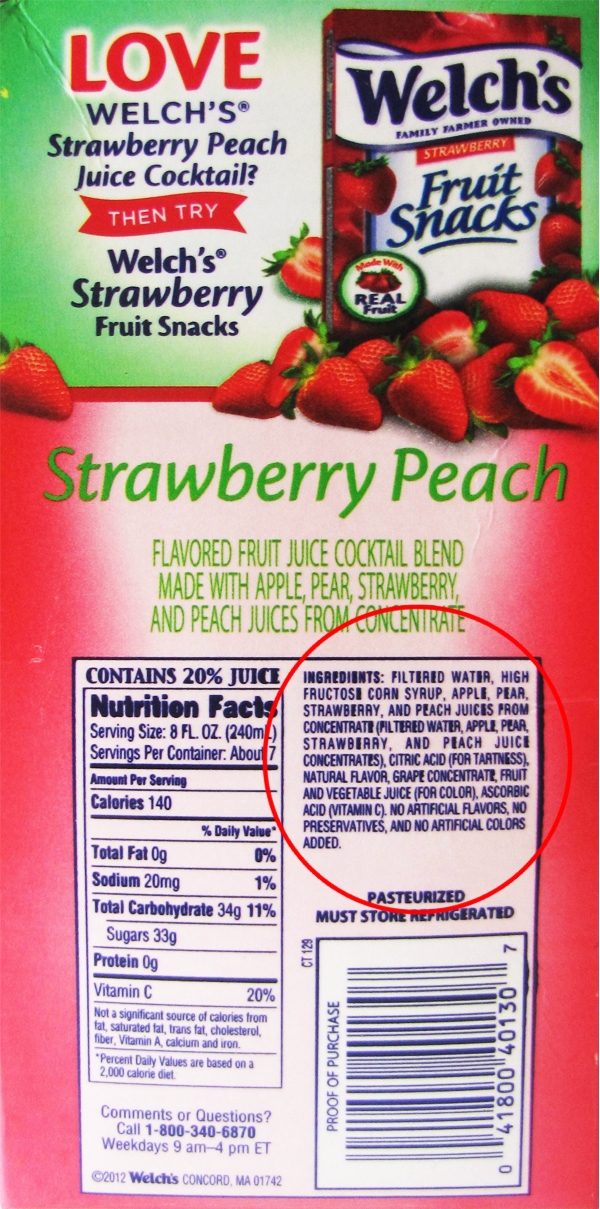
The front label (see picture below) also intentionally leaves out any mention of corn syrup even though high fructose corn syrup is the second most prominent ingredient of the product, right after water. It says:

Strawberry Peach flavored fruit juice cocktail blend made with apple, pear, strawberry and peach juices from concentrate.

No mention of corn.

The back label (see image below) begins with a giant, all-caps "LOVE" statement, jumping on the bandwagon of trying to associate LOVE with its product, even though no rational person would use the word "LOVE" to describe a highly refined liquid sugar that has been repeatedly linked to diabetes and obesity.

Welch's annual report admits it is aware that consumers seek to avoid HFCS

All this corn syrup is being pushed as fruit juice despite the fact that Welch's 2012 annual report openly admits the company is fully aware that consumers are attempting to avoid high fructose corn syrup.

It reads:

"Our mid-priced essentials line continued to grow in FY '12 with its powerful message -- no high fructose corn syrup."

The context of this statement clearly implies that "no high fructose corn syrup" is a benefit of its essentials line of products. Yet, simultaneously, Welch's continues to promote other products that contain alarming proportions of HFCS while avoiding any mention of corn on the front label.

80% water and corn syrup!

Only when you get to the back label do you learn that these Welch's fruit juice cocktails -- which are heavily adorned with photos and words that describe and imply "fruit" -- are actually 80% water and corn syrup.

The first two ingredients are Filtered Water (i.e. tap water) and High Fructose Corn Syrup. An easy-to-miss bit of text admits, "Contains 20% juice," meaning 80% of the beverage is not juice.

Nowhere does the product claim to be free of GMOs. As the vast majority of high fructose corn syrup produced in North America is derived from genetically modified corn, it is very likely that the HFCS used by Welch's is actually GMO. A genetic test would not confirm this, however, as the heavy processing of HFCS destroys genetic integrity, rendering genetic ID tests useless.

Here are the photos of the label: (story continues below)


Deceptive labeling pushes more high fructose corn syrup to children

Welch's fruit juice cocktails are depicted as if they were nothing but fruit juice. The photos, descriptive text and website text all imply they are made of nothing other than fruit juices. Nowhere on the product front label, website or promotional materials is corn depicted at all.

When consumers shop for fruit juices at their local grocery stores, they are easily misled by deceptive labeling practices such as those used by Welch's. Consumers use the pictures and prominent text on the front of the product as their primary cues to determine the composition of the product, and if that product label primarily depicts fruit and fruit juices, a typical consumer will incorrectly assume the product is primarily made of fruit and fruit juices. That same consumer will typically have no idea the product contains more corn derivatives than fruit juice.

Most consumers -- especially parents -- are actively trying to avoid high fructose corn syrup. This is often the reason why they choose fruit juice instead of sodas, as a matter of fact. Yet if they reach for Welch's juice cocktails, they are getting the exact same refined liquid sugar they were trying to avoid by choosing juice instead of soda!

Here at Natural News, we think Welch's should be ashamed of itself for pushing water and high fructose corn syrup as a fruit juice beverage. Its labeling practices deceive rather than inform consumers.

We urge you to call the Welch's comment line at 1-800-340-6870 and demand they stop selling high fructose corn syrup as fruit juice.

Corn is not a fruit. And corn syrup is not fruit juice. It is, however, often contaminated with mercury.

Demand that Welch's stop tricking consumers into thinking corn syrup is fruit juice.

Civil Disobedience Or Death By Design


Friends. How much time to we have left?

By my clock it's five minutes past midnight. We are into unchartered territory. Territory where only bravery and vision can hope to cut through the torpor and stupor which is bringing about the designed obsolescence of the human race and the transgenic re-engineering of the common gene pool of our planetary biodiversity.

As I write this, the technocrats in Brussels are lining up to enforce an Act designed put an end to our seeds. The saving and resowing of 'real' seeds. 
 
Those in high places believe we need to 'move-on' concerning the control of the food chain. It's time for total control. 
 
Only seeds registered and licensed by the State will be legal. And only those with money will be able to afford to do this exercise. The corporations will own the seeds and fulfill their ambition to have 'full spectrum dominance' of the food chain. “He who controls food controls the people”. Checkmate.

They have decided that its time to cease the perpetuation of a pattern of life on planet Earth that goes back to the birth of agriculture – and before.

That is what they are doing in Brussels 6 May 2013 and beyond. From now on, unless we cut free of obeisance to the centralised, totalitarian regimes whose takeover of our planet is almost complete, we will have only ourselves to blame. For we are complicit in allowing ourselves to become slaves of the Corporate State and its cyborg enforcement army. 
 
That is, if we continue to remain hypnotized by their antics instead of taking our destinies into our own hands and blocking or refusing to comply with their death warrants. This 'refusal' is possible. But it will only have the desired effect when, and if, it is contemporaneous with the birthing of the Divine warrior who sleeps in us all. The warrior who sleeps-on, like the besotted Rip Van Winkle in the Catskill mountains.
 We have arrived at the optimum point to draw a line in the sand. I say optimum, because the need for food faces everyone of us every day – so it's not possible to run and hide when it comes to eating. It's a bottom line necessity. It's a bottom line that is now one step from being removed from our control. I say 'one step' because we can turn around , draw our swords and say “No”.

Artists and spiritually inspired human beings are not exempt. In fact they will have a critical role to play in the great fight-back which is our one and only genuine resource at times of extreme crisis. And, in case some think otherwise, I want to state that this is such a time. No artist or spiritually inclined individual can claim to be such unless he or she is willing to enlist in the cause of protecting the sacred nature of life itself.

What the technocrats and their Illuminati masters cannot do is defy the power of the spirit – once its lit-up. And we must get it lit up – or die of starvation. Starvation of the spirit is just as prevalent as starvation from lack of food, on this tragic planet; perhaps more so. It's an artist's job to light-up the starving spirit by feeding it something that will bring it to life and steer it towards victory, not something that will encourage it to remain asleep.

I am a farmer, actor, activist and writer. I see no contradiction here. They are each mutually reinforcing elements of one life force. Of the gift of life which brought us here. And this gift of life starts as a seed. When lit-up - it presents the one power that can ultimately defeat the tunnel vision technocrats, the power besotted politicians, the blind Bilderbergers and the non-human will of the Illuminati overlords. They will all fall to our Excalibur once we remember how to use it.

Remember we must. To put an end to that darkly scheming little cabal which is, at this very moment, is dipping the ancient sacred seed into the patented petri-dish of a genetically engineered holocaust. Attempting to forever remove it from its origins in the subtle soil of a thousand lands. Fight this with a thousand shining swords, for it is we who are being engineered.

Those subverters of the sacred are convinced they will succeed in locking this seed away from the light - forever, and enlisting all humanity into their sinister power games. But, brave souls, nothing can stir us like a challenge to kill us off. Nothing can set the red corpuscles racing faster than the thought of an insentient trans-humanist cyborg future for us and our children. 
 
Pay them a fair price and offer to help them harvest it. Only connect. Connect. Never allow yourself to be just another number at the stupor-market check-out desk. Life begins when we turn and face our enemy and say NO

Wednesday, May 1, 2013

Sweet Suicide: Sugar Deadlier than Drugs and Just as Addictive

Is sugar the biggest modern-day scourge of the earth? Is it a soft kill slow suicide?

It used to be thought that our bodies could evolve and adapt with the extra poundage of sugar consumed each year. But come 150lbs yearly on average consumed by each person - I think we've proven that theory false.

It's been said that 1-2 teaspoons of sugar in various forms can change your entire physiology in just seconds. Mood swings can come from the sugar but probably mainly from the intense insulin spikes and dips. The first part of this video shows an almost cruel experiment on children's reactions to eating sugar cubes - later it talks about opioid effects, like drug withdrawals in rats including chattering teeth, high pitched crying, shakes, anxiety and brain chemistry changes.


Sugar consumption is implicated in chronic inflammation, chronic fatigue, immune suppression, feeding cancer, heart disease, and obesity - yeah, I would say that's pretty deadly! From one pre-diabetic sugar-addict to another, here are some resources:

Many people recommend Sugar Blues by William Duffy. It's a riveting true story about a man whose entire life changed after meeting actress Gloria Swanson who told him sugar was poison. He researched and found out why. He weaves the history of sugar throughout in this classic little paperback. It's one of those books that without disgusting the reader, motivates a person to really think about their next bite.

Having a hard time quitting cold turkey? Me too. Just like with tobacco, cravings are often exacerbated by malnutrition and deficiencies. Leaving a vacuum by quitting is a sure way to dive back in. ALSO - since Candida Yeast uses sugar as food, the cravings might actually be coming from the yeast. Starving Candida and the cravings becomes more difficult. Ease yourself in and add the nutrition with Dr. Joel Fuhrman's Eat for Health series of two books, one for diet and recipes, the other to gear up the mind. They are so gentle.

If you're ever at a garage sale or old book shop, look for The Carbohydrate Addict's Diet by Doctors Rachael and Richard Heller. They were both obese, tired and riddled with cravings when they discovered that if they just push carbs into dinner time only, within a 60-minute period, they could reset the whacked-out insulin cycle. The way they described the theory was that a certain set of people - carb addicts - have a leaky insulin valve that starts running the second a simple carb is eaten. They used the method to lose all the weight, cut cravings and fix mood swings - and to help people who weren't making progress in Overeaters Anonymous (OA).

Please, please ignore the parts and recipes that promote using artificial sweeteners - those are neurotoxins and there are natural alternatives available that won't spike insulin.

The video goes into marketing tactics - while compelling, I think the real trouble comes from the cravings, Candida, difficulty withdrawing, and the grotesque, vast prevalence in grocery store foods. Until cravings and diabetic tendency is corrected, it's best to avoid fruit, honey and grains, especially if these trigger reactions.

Many naturopaths can help to stave off or reverse diabetes, eradicate Candida, and curb cravings - it's best to do research, ask questions and find one in your area. A host of issues begin in the gut - be good to it. The naturopath can help with that too.

Tuesday, April 30, 2013

How Did Obama Become Monsanto's Man in Washington?

And when are anti-GMO activist groups going to stop saying they’re “shocked and disappointed” by the president? 

Shocked and disappointed is polite-speak and politically correct reaction. It’s baloney. 

Don’t you get it? Obama has never been on your side. He never deserved your trust. 

Disappointment implies he was your buddy and then unaccountably walked away.
The man is a politician. He’s a liar. Different pols have different styles of lying. Some pretend  they’re your friend before they screw you over and leave you in the dust. 

I’ve previously published Obama’s track record as Monsanto’s number-one political supporter in America. 

Meet Monsanto’s prime lobbyist, Barack Obama:

After his victory in the 2008 election, Obama filled key posts with Monsanto people, in federal agencies that wield tremendous force in food issues, the USDA and the FDA: 

At the USDA, as the director of the National Institute of Food and Agriculture, Roger Beachy, former director of the Monsanto Danforth Center.

As deputy commissioner of the FDA, the new food-safety-issues czar, the infamous Michael Taylor, former vice-president for public policy for Monsanto. Taylor had been instrumental in getting approval for Monsanto’s genetically engineered bovine growth hormone.

As commissioner of the USDA, Iowa governor, Tom Vilsack. Vilsack had set up a national group, the Governors’ Biotechnology Partnership, and had been given a Governor of the Year Award by the Biotechnology Industry Organization, whose members include Monsanto.

As the new Agriculture Trade Representative, who would push GMOs for export, Islam Siddiqui, a former Monsanto lobbyist.

As the new counsel for the USDA, Ramona Romero, who had been corporate counsel for another biotech giant, DuPont.

As the new head of the USAID, Rajiv Shah, who had previously worked in key positions for the Bill and Melinda Gates Foundation, a major funder of GMO agriculture research. 

We should also remember that Obama’s secretary of state, Hillary Clinton, once worked for the Rose law firm. That firm was counsel to Monsanto.
Obama nominated Elena Kagan to the US Supreme Court. Kagan, as federal solicitor general, had previously argued for Monsanto in the Monsanto v. Geertson seed case before the Supreme Court. 

The deck was stacked. Obama hadn’t simply made honest mistakes. Obama hadn’t just failed to exercise proper oversight in selecting appointees. He was staking out territory on behalf of Monsanto and other GMO corporate giants.
And now let us look at what key Obama appointees have wrought for their true bosses.

 Let’s see what GMO crops have walked through the open door of the Obama presidency.

Monsanto GMO alfalfa.
Monsanto GMO sugar beets.
Monsanto GMO Bt soybean.
Coming soon: Monsanto’s GMO sweet corn.
Syngenta GMO corn for ethanol.
Syngenta GMO stacked corn.
Pioneer GMO soybean.
Syngenta GMO Bt cotton.
Bayer GMO cotton.
ATryn, an anti-clotting agent from the milk of transgenic goats.
A GMO papaya strain.

And soon, genetically engineered salmon and apples.

This is an extraordinary parade. 
 
Obama was, all along, a stealth operative on behalf of Monsanto, biotech, GMOs, and corporate control of the future of agriculture. 

He didn’t make that many key political appointments and allow that many new GMO crops to enter the food chain through a lack of oversight. 

Nor is it coincidental that two of the Obama’s biggest supporters, Bill Gates and George Soros, purchased 900,000 and 500,000 shares of Monsanto, respectively, in 2010.

Records don’t show Monsanto or other biotech giants pouring a landslide of (visible) campaign cash down on Obama, relative to other large donors.

Goldman Sachs was Obama’s number-one $$ donor, and Goldman touts GM-crop commodity contracts, for both buys and sells; but Goldman has its fingers in every significant money pot from Nome to Tierra Del Fuego.

The “Obama riddle” is as plain as the nose on the face of Globalism. Monsanto’s agenda, to monopolize the world’s food supply, is essential to the Globalist blueprint. That blueprint ultimately aims for redistribution of food to the world from a point of Central Planning 

As president, Obama has a sworn obligation to Globalism. His oath isn’t to protect the Constitution. Are you kidding?


Every recent president has had an overriding loyalty to Globalism. 

Obama’s signing of the Monsanto Protection Act, making that corporation senior in power to the US court system, wasn’t an accident. It was taken in keen awareness of his duty to his Globalist betters.

You won’t, of course, see this disclosed on the evening news.
Here is a president who, like Bush, has no plans for a better world. Obama’s notion of “better” is tied up in the Globalist agenda: 

An elite-run bureaucracy, promoting equality and justice, reduces all populations to a lowest common denominator, squashing freedom and prosperity.
Obama’s supporters will never learn the truth, because they’re blinded by the light, which they project on to the persona of the president. 

Obama is aware of the con, since he triggered it, and he leverages it.
He’s all nudge-and-wink. “Yes, we’ll help you and you and you. Of course we will.”
He might help you if you make a declaration of dependence. Sacrifice yourself on an altar of despair and then you might earn the right to be fed.

Obama, while on the campaign trail in 2008, was promising transparency in government, was claiming that every person has the right to know what’s in his food (GMO labeling). But clearly, that was all cover and fluff. He was lying through his teeth and he knew it. 

He’d been vetted for the presidency, and he knew the job entailed joining Monsanto and the larger Globalist agenda as a front man.
He hasn’t changed over the past four years. He’s been a covert agent since the beginning.

Imposter. Charlatan. 

These words fit Obama. He’s pretended, like Clinton, to care, but he doesn’t. He doesn’t care that GMO food is taking over the country and the world. He wants it to happen. He’s always wanted it to happen.

The sitting president of the United States, Monsanto, DuPont, and Dow, among others, are prepared to do whatever is necessary to make GMO food dominate America.

They intend, through Monsanto-gene drift among millions of plants in ag fields, through increased planting of GMO crops, and through introduction of still more GMO crops, to wrap up the USA in genetically engineered food.

Obama is on board. He’s always been on board.

He is the GMO president.

If tomorrow, the Globalist Rockefellers of this world decided that all food grown in the US should be injected with Prozac, Obama would find a way to help.
Stop making excuses for the man. He’s not a victim of evil forces surrounding his presidency. He signed up for this trip with eyes wide open. 

Sources:
http://redgreenandblue.org/2012/02/02/monsanto-employees-in-the-halls-of-government-part-2/
http://redgreenandblue.org/2011/02/09/monsanto-employees-in-the-halls-of-government/
http://www.motherjones.com/tom-philpott/2011/10/fda-labeling-gmo-genetically-modified-foods
http://fooddemocracynow.org/blog/2011/feb/15/update-obama-goes-rogue-gmos-tell-him-say-no-monsa/


Friday, April 26, 2013

Food & Water Watch Releases Report on the Corporate Giant Monsanto

hello, monsanto.jpg

Anyone and everyone who is even slightly into food, politics, or government conspiracy theories has at least heard something about Monsanto.

Whether it's the company's development of Agent Orange or farmer lawsuits, the consensus is that the company is pretty evil.

Well, to separate fact from fiction, Food & Water Watch compiled a report, Monsanto: A Corporate Profile, documenting the company's history and influence. Read on for details.

See Also:
- Oregon Saying No to GMO Frankenfish: Florida Senate GMO Labeling Bill Waiting to Be Added to Agriculture Committee Agenda
- Obama Signs Monsanto Protection Act
- GE Mandatory Labeling Laws Introduced in Florida

Food & Water Watch's team of researchers put together the report that outlines the corporation's history and strong ties to lawmakers, regulators, and academic researchers.
According to Lynna Kaucheck, senior organizer for Food & Water Watch, "We wrote the report to show that Monsanto is responsible for the fact that the vast majority of our food supply is both genetically engineered and not labeled as such."

Currently, Monsanto holds patents on 1,676 seeds, plants, and other agricultural applications. These products are grown on more than 282 million acres across the world, including 40 percent of croplands in the United States.

Started in 1901 by John Francis Queeney, the company released its first product, the sugar substitute saccharin -- a product feared to cause cancer. Since its inception, Monsanto has gone on to produce the notorious Vietnam War chemical Agent Orange, Roundup herbicide, GE Roundup Ready seed, and the dairy industry artificial growth hormone rBGH.

Sounds healthy, huh?

The report goes on to call out the numbers. In 2011, Monsanto brought in $11.8 billion in net sales. From 2000 to 2012, the corporation donated $829,662 to U.S. political campaign contributions. In addition, during the same period, Monsanto spent $62,356,730 on U.S. lobbying efforts.

Not exactly a bunch of farmers with pitchforks.

Food & Water Watch's report concludes with recommended actions for regulators.
"From seeds to grocery stores and every place in between, our food system is tremendously consolidated with a handful of corporations dictating what we eat," said Kaucheck. "This new report shows just what a huge influence Monsanto has on the entire food system, and I hope it will motivate concerned citizens everywhere to join the fight to label GE foods, because we all deserve the right to know what we are feeding our families."

In Florida, there are two mandatory labeling bills stuck in committee. Sponsored by Rep. Michelle Rehwinkel Vasilinda,  H.B. 1233 is awaiting approval from the Agriculture Natural Resources subcommittee in the House. Sen. Maria Sach's S.B. 1728 has not been added to Monday's Committee on Agriculture in the Senate.

To view the full Food & Water Watch Report, click here.

Saturday, April 13, 2013

Look Out Monsanto The Global Food Movement Is Rising


Rarumuri GMO protest
A group of RarĆ”muri Indians from Bocoyna Municipality, who marched into the governor’s palace in 2008 to demand that genetically modified corn not contaminate their native seeds. Photo by David Lauer.
Chewing on a mouthful of locally grown lettuce, I wondered if the claims I’d heard about the global food-justice movement were true. Was there a line to follow, however crooked, between my purchase of these greens, land reform in Brazil and opposition to genetically modified seeds in California. Or was it all just empty calories?
Reading about how people transform the way they farm and eat makes you want to cook up your own plans with your neighbors.
As a somewhat conscientious consumer and occasional Taco Bell boycotter, I’ve hoped that the movement was real. But it hasn't always been easy to perceive the connection between marching for improved farmworker rights, signing a petition against factory feedlots, and cooking up beets from a CSA (that is, community supported agriculture, which usually comes in the form a box of assorted veggies delivered to people who contribute to a local farm’s financial well-being).

Those connections form a tight weave in the new book, Harvesting Justice: Transforming Food, Land, and Agriculture in the Americas. Using “food sovereignty” as the secret sauce, the book sautĆ©s the individual ingredients of sister movements into a coherent, flavorful whole.
Raramuri women work in field
Young RarĆ”muri women select corn for next year´s seed after a farmer-to-farmer workshop on seed selection in the community of Rekusachi, Chihuahua. Photo by David Lauer.
The book was created for the U.S. Food Sovereignty Alliance—a network of organizations allied with La Via Campesina, which advocates for culturally appropriate (think tortillas in Mexico instead of bread), ecologically sound (no GMOs), and small-farmer friendly food systems.

The book’s authors, Tory Field and Beverly Bell, do a lot more with food than just write about it. Field is a farmer who co-manages the Next Barn Over Farm, a CSA program in western Massachusetts. Bell has worked for decades with small farmer organizations in Haiti, including those who set fire to agricultural aid after the 2010 earthquake. The farmers didn't see the donated seeds as aid, but as a Monsanto “trojan horse” undermining their control over their own food.

Both authors are also members of Other Worlds, an organization that educates the public about citizen movements and builds community alternatives to corporate globalization. Introducing us to farmers speaking in their own voices, they describe how fighting the dominance of agribusiness and relocalizing the food system are indeed two sides of the same coin.

The book merges five years of field research and interviews, and describes more than 100 case studies of advocacy campaigns and alternative food systems in the United States and around the world. The authors interview New Mexican farmer and teacher Miguel Santistevan, who insists that “We don’t like the way the food system treats the earth and its negative health effects on the people, [and] we are working to actualize an alternative.”

They introduce us to Rosnel Jean-Baptiste of Heads Together Small Peasant Farmers of Haiti (TĆØt Kole Ti Peyizan Ayisyen), who says, “It’s not houses that are going to rebuild Haiti, it’s investing in the agriculture sector.”

And they encourage consumer action through the words of Ben Burkett, president of the National Family Farm Coaltion. “No matter what us farmers plant, the consumer’s got to change the system, ” Burkett says. “As long as they don’t complain, there’s no need even talking about it. The marketplace dictates.”
Haitian peasants
A group of Haitian peasants meets to discuss strategies for rebuilding agriculture after the earthquake of 2010. Photo by Roberto (Bear) Guerra.

Designed for use as an organizing tool

Accompanying the book is a curriculum of teaching exercises called "Sowing Seeds," intended for use in community and academic settings. The curriculum is dizzyingly comprehensive, a kind of “best of” in food systems education culled from sister organizations.
The book connects the dots between community groups doing related work and breaks up any sense of going it alone.
Have you ever wondered how many tons of tomatoes a picker needs to pick each day to earn minimum wage, or what the salary of David Novak—the CEO of the company that owns Taco Bell—would add up to in tons of tomatoes at the same rate? It’s all in here. Consumer, producer, and retailer perspectives are all explored through engaging exercises. Suggested workshop formats may come in handy if you are an educator or organizer.

Mexican farm workers in Texas. 

Care about Your Food? Then Care about Your Farmworkers Too
It’s organic. It’s local. But did the workers who picked it have health insurance?
You may want to nudge your local bookseller to carry Harvesting Justice. I'm guessing they won't be sorry. It’s not only highly readable but may catalyze actions such as getting local food into school lunches. The stunning photos serve up inspiration to get off your duff and transform the local food system.

Because it provides that kind of inspiration, this is the kind of book that your local food co-op, farmer’s market, or anti-hunger organization might consider using as a study guide. It can help connect the dots between community groups doing related work and break up any sense of going it alone. The appendix fills nearly fifteen pages, introducing us to groups like the Food Chain Workers Alliance, First Nations Native Agriculture and Food Systems Initiative, and the Honduran Garifuna organization.

 While these organizations are scattered around the planet, they form the foundation of a localized, alternative food system.

Reading about how people transform the way they farm and eat makes you want to reach for a big soup pot, cut up some onions, and cook up your own plans with your neighbors. Harvesting Justice gives you more than the recommended dose of civic engagement.

Daniel Moss wrote this article for YES! Magazine, a national, nonprofit media organization that fuses powerful ideas with practical actions. As a consultant, Daniel works with communities and organizations around the world to advance democratic and sustainable stewardship of our shared commons.

Interested?

Friday, January 25, 2013

Modern Wheat Is Nothing Like Ancient Grains


Gluten intolerance is no longer a fringe medical concept. Researchers are fully aware there is a very big problem with modern wheat cultivation. Wheat is far from being a health food. It makes you fat, causes gas and makes your intestinal tract your enemy, or rather vice-versa. High-yielding and now genetically modified varieties of wheat are making this one cereal grain you’ll probably want to axe from your food list.
233 consumer and farmer groups in 26 countries have joined the “Definitive Global Rejection of GM Wheat” statement to stop the commercialization of genetically modified (GM) wheat and remind the biotechnology corporation Monsanto that genetically modifying this major crop is not acceptable to farmers or consumers.
So how–and when–did this ancient grain become such a serious health threat?

 Author and preventive cardiologist William Davis, MD, says it’s when big agriculture stepped in decades ago to develop a higher-yielding crop. Today’s “wheat,” he says, isn’t even wheat, thanks to some of the most intense crossbreeding efforts ever seen.

 “The wheat products sold to you today are nothing like the wheat products of our grandmother’s age, very different from the wheat of the early 20th Century, and completely transformed from the wheat of the Bible and earlier,” he says.

Plant breeders changed wheat in dramatic ways. Once more than four feet tall, modern wheat–the type grown in 99 percent of wheat fields around the world–is now a stocky two-foot-tall plant with an unusually large seed head. Dr. Davis says accomplishing this involved crossing wheat with non-wheat grasses to introduce altogether new genes, using techniques like irradiation of wheat seeds and embryos with chemicals, gamma rays, and high-dose X-rays to induce mutations.

In July 2009, the most hated company in the world Monsanto, announced new research into GM wheat and industry groups kicked their promotion of GM wheat into high gear. “Widespread farmer and consumer resistance defeated GM wheat in 2004 and this global rejection remains strong, as demonstrated by today’s statement,” said Lucy Sharratt, Coordinator of the Canadian Biotechnology Action Network.

“In 2004, a coalition of Japanese consumer and food industry groups delivered a petition to the Governments of Canada and the U.S. urging them not to introduce GM wheat. Today, consumer rejection of GM wheat in Japan is just as strong as ever. 80 organizations in Japan have already signed the rejection statement,” said Keisuke Amagasa of the Tokyo-based No! GMO Campaign. “A large majority of consumers here in Japan are voicing their strong opposition to the cultivation of GM wheat. We see strong opposition from all sectors of society.”

Japan’s flour companies are also rejecting GM wheat, echoing consumer opposition. In a statement released today, the Flour Miller’s Association of Japan wrote to the No! GMO Campaign indicating its opposition.

 “Under the present circumstances, with all the doubts about safety and the environment that the consumers in Japan have, including the effect on the human body from GM foods, GM wheat is included among the items that are not acceptable for the Japanese market,” Kadota Masaaki, senior managing director of the Flour Miller’s Association wrote to the No! GMO Campaign.

Clearfield Wheat, grown on nearly 1 million acres in the Pacific Northwest and sold by BASF Corporation–the world’s largest chemical manufacturer–was created in a geneticist’s lab by exposing wheat seeds and embryos to the mutation-inducing industrial toxin sodium azide, a substance poisonous to humans and known for exploding when mishandled, says Dr. Davis. This hybridized wheat doesn’t survive in the wild, and most farmers rely on toxic chemical fertilizers and pesticides to keep the crops alive.

So what does all of this plant science have to do with what’s ailing us? Intense crossbreeding created significant changes in the amino acids in wheat’s glutenproteins, a potential cause for the 400 percent increase in celiac disease over the past 40 years.

 Wheat’s gliadin protein has also undergone changes, with what appears to be a dire consequence. “Compared to its pre-1960s predecessor, modern gliadin is a potent appetite stimulant,” explains Dr. Davis. “The new gliadin proteins may also account for the explosion in inflammatory diseases we’re seeing.”

An intolerance to gluten can cause a wide array of symptoms, some debilitating. Moreover, delays in diagnosis or common misdiagnoses can be devastating to long-term health. Gerta Farber elaborates on her research and personal experience with Celiac disease.

A powerful little chemical in wheat known as ‘wheat germ agglutinin’ (WGA) which is largely responsible for many of wheat’s pervasive, and difficult to diagnose, ill effects. Researchers are now discovering that WGA in modern wheat is very different from ancient strains.

Not only does WGA throw a monkey wrench into our assumptions about the primary causes of wheat intolerance, but due to the fact that WGA is found in highest concentrations in “whole wheat,” including its supposedly superior sprouted form, it also pulls the rug out from under one of the health food industry’s favorite poster children.

Below the radar of conventional serological testing for antibodies against the various gluten proteins and genetic testing for disease susceptibility, the WGA “lectin problem” remains almost entirely obscured. Lectins, though found in all grains, seeds, legumes, dairy and our beloved nightshades: the tomato and potato, are rarely discussed in connection with health or illness, even when their presence in our diet may greatly reduce both the quality and length of our lives.

 The appetite-stimulating properties of modern wheat most likely occurred as an accidental by-product of largely unregulated plant breeding methods, Dr. Davis explains. But he charges that it’s impact on inflammatory diseases may have something to do with the fact that, in the past 15 years, it’s been showing up in more and more processed foods. Wheat ingredients are now found in candy, Bloody Mary mixes, lunch meats, soy sauce, and even wine coolers.

As if making you hungrier wasn’t enough, early evidence suggests that modern wheat’s new biochemical code causes hormone disruption that is linked to diabetes and obesity. “It is not my contention that it is in everyone’s best interest to cut back on wheat; it is my belief thatcomplete elimination is in everyone’s best health interests,” says Dr. Davis, “In my view, that’s how bad this thing called ‘wheat’ has become.”

Replace Wheat With Spelt

Spelt is an ancient grain that has lately made a comeback in North America, even though it has been popular through the decades in many European countries. Spelt is a non-hybrid distant relative to present day wheat. Spelt’s uniqueness is derived from its genetic makeup and nutrition profile.

 Spelt has high water solubility, so nutrients are easily absorbed by the body making it easy to digest. It is high in protein (significantly higher than wheat), higher in B complex vitamins, and spelt is high in both simple and complex carbohydrates. These complex carbohydrates are an important factor in blood clotting and stimulating the body’s immune system. Spelt is a suberb fiber resource. Spelt’s nutty flavor doesn’t just taste good, it has so many other nutritional benefits that are amazingly good for you!

 Keep reading to find out more about how spelt’s nutrients contribute to lower risk of cardiovascular (heart) disease, type II diabetes, and can lessen occurrences of migraine headaches.
Spelt is more difficult to process than modern wheat varieties, making it a little more expensive to purchase. Spelt’s husk protects it from pollutants and insects which allows growers to avoid using pesticides, unlike other grains. The husk needs to be mechanically separated from the kernal before milling (this is done after it is thrashed and harvested). The spelt is stored in good, low moisture conditions in order to protect the kernal, retain nutrients, and maintain freshness.

 Over decades, modern wheat has been drastically changed to be easier to grow and harvest. This in turn increases yields, maintains a high gluten content in the wheat to produce high-volume commercial baked goods. On the other hand, spelt has preserved many of its original traits and continues to remain highly nutritious and full of flavor. And spelt can make fantastic breads and delicious pastries

A note about gluten:
 Keep in mind that spelt does contain gluten. Gluten is made up of glutenin and gliadin molecules. Gluten provides elasticity to dough, which allows bread to rise. Even though spelt’s gluten is more fragile than other wheats, the bread produces fewer air pockets, it is well formed and maintains its flavorful taste.